Dynasty

young

QBs on the Chopping Block: Planning for the 2027 Class

There was an interesting question posed by a subscriber in our DFF Discord this past weekend, following this tweet being posted:  Seeing the potential that the 2027 draft class has at the quarterback position, Josh asked this:  It’s an excellent question, and one we need to be asking ourselves for dynasty purposes. Obviously, a good number of guys from McShay’s list above either won’t pan out as first-round talents or will elect to stay in college for the 2027 season if they have remaining eligibility. But there are additional guys not on this list who could end up being first-round selections. Josh Hoover. John Mateer. Maybe DJ Lagway finally has that breakout season everyone’s been waiting for. Maybe Drew Mestemaker’s G5 dominance carries over into the P4, and he emerges as a top pick. It’s hard to project any of this so far out, but for the sake of this exercise, let’s take McShay at his word and treat the 2027 QB class as the “historic” one he’s calling it. Who will these quarterbacks be taking over for? Let’s take a look at the guys whose jobs may not be as secure as we think. These names may be good sell candidates in dynasty for you, especially on a team that’s rebuilding or retooling.  The Top “Cut” Candidates I’ll kick off my list by covering the quarterbacks I feel have the most to prove this coming season and will likely be out of a starting job by 2027 or sooner.  Geno Smith (NYJ) – Geno is the most obvious quarterback […]

To access the rest of this post, you must purchase a DFF Membership.

QBs on the Chopping Block: Planning for the 2027 Class Read More »

bijan

Running Back Fantasy Hit Rate By Rounds

Welcome back for another edition of Hit Rate by Rounds. In today’s article, we’ll be focusing on the running back position. The goal of this article is to see whether draft capital has become a stronger predictor of fantasy production for running backs over the past 14 seasons. I split the data into the first seven years and the last seven years, but I did not include 2025 because RBs typically take a couple of years to produce. Adding rookies to the equation would skew the numbers too much in favor of the older group.  The charts below show the hit rate for running backs drafted in each round (1–7), measuring what percentage went on to post at least one Top-12, Top-24, or Top-36 fantasy season. This gives us a sense of how likely a back is to deliver meaningful fantasy value based on draft capital. Looking at Round 1, the same number of running backs have been drafted in Round 1 in both groups, but the success rates have decreased. It has become harder to identify elite first-round running backs in recent years. Rd 1 RB Total Top 12 Top 24 Top 36 2011 – 2017 9 = 8/9 = 89% = 8/9 = 89% = 8/9 = 89% 2018 – 2024 9 = 6/9 = 67% = 7/9 = 78% = 8/9 = 89% 2011 – 2024 18 = 14/18 = 78% = 15/18 = 83% = 16/18 = 89% Looking at Round 2, fewer running backs have been drafted in Round 2 recently, and the hit rates

To access the rest of this post, you must purchase a DFF Membership.

Running Back Fantasy Hit Rate By Rounds Read More »

bell

2026 Rookie WR1 Analytical Model, Version 1.0: Rankings 10 to 6

The Prospect Analytical Model Rankings are one of our members’ favorite series each year at Dynasty Football Factory. Years of refining and enhancing the models to accurately predict future fantasy value have brought us to today. 

These WR1 model rankings are your ultimate guide to predicting which prospects will produce the most fantasy points in their NFL career. 

You can find the wide receivers ranked 15 to 11 in the WR1 model here.

You can find the running back RB1 model here.

For those new to the WR1 rating, it is a proprietary formula I developed in 2019 that provides a data-driven forecast of future fantasy production for incoming rookie wide receivers. There are many advanced metrics available today; we at DFF know it can be difficult to determine which ones matter and how much each matters. The WR1 model distills all that hard work into a single, easy-to-understand number. The model evaluates rookies across 13 of the most predictive metrics and combines their individual metric scores into a total WR1 rating. It was a pioneer in the fantasy analysis industry, being the first to incorporate a film-grade into the model. The goal is to provide an easy-to-use score for those who don’t want to spend hundreds of hours dissecting different metrics. Based on the prospect’s model score, I provide their probability of achieving at least one top-24 NFL Fantasy Points Per Game Season, using historical prospects with similar score ranges.

The WR1 model consistently outperforms NFL draft capital in predicting the future fantasy success of incoming prospects. For a full breakdown of the model’s past performance, click this link. You can also find the 2025 model here and the 2024 model here, where we were one of the very few publications to have Malik Nabers as the top wide receiver overall instead of Marvin Harrison Jr. Even the NFL had Harrison higher, as Nabers was drafted behind Harrison in the NFL Draft. Here is the WR1 model I published in 2023, featuring Jaxon Smith-Njigba as the WR1. The WR1 model is exceptional at identifying the true elite wide receivers. 17 of the 20 top-scoring prospects with at least three years in the NFL have had a top-24 PPR PPG NFL fantasy season.

Fourteen of the 20 have also had a top-12 PPR PPG NFL fantasy season. Nine have had multiple top 12 seasons, including perennial top-5 studs like Julio Jones, Calvin Johnson, Odell Beckham Jr., Ja’Marr Chase, and Justin Jefferson.

So let’s dive into the 2026 class overall WR1 Model Score.

10. Chris Bell, Louisville | WR1 Model Score: 24.0

Based on historical comps, Chris Bell’s WR1 Model score of 24.0 gives him an 35.8% chance of having at least one top-24 fantasy season in his career.

Historical Players With Similar WR1 Model Scores:

Adonai Mitchell
Malik Washington
Kyle Williams

The Good

Bell posted a very impressive weighted dominator (team share of receiving yards and touchdowns) of 38.2%. This ranked 3rd among wide receivers in this draft class. Louisville was not a prolific passing offense

To access the rest of this post, you must purchase a DFF Membership.

2026 Rookie WR1 Analytical Model, Version 1.0: Rankings 10 to 6 Read More »

Skyler Bell

Dynasty Wide Receiver Hit Rates By Rounds

I wanted to see if the NFL has improved at drafting based on rounds over the past 14 seasons. I split it into the first seven years and the last seven years, but I did not include 2025 because rookies typically take a couple of years to produce. More wide receivers have been drafted in Round 1 recently, and the success rates have increased, as have opportunities via bet365 bonus information. It has become easier to identify elite first round wide receivers in recent years.

Dynasty Wide Receiver Hit Rates By Rounds Read More »

stewart

Meet the 2026 Rookie RB With Elite Contact Balance

Missed Tackles Forced Per Attempt is one of the more predictive analytical statistics for running backs for future fantasy success. Over the past three years, the top 6 running backs with the highest college career missed tackles forced per attempt rate are: Bijan Robinson – 39.3% Trey Benson – 39.2% Tyrone Tracy – 38.5% Ashton Jeanty – 37.8% Bucky Irving – 36.2% For a singular metric, that is a nice hit rate. Then how is it, in an absolutely horrible running back class overall, there is a prospect with an otherworldly 46.9% missed tackles forced per attempt career rate that no one is talking about?  Fam, meet Terion Stewart.  So why haven’t you heard of Stewart? Well, for one, he was used sparingly at Virginia Tech this past season. Before that, he played four years for Bowling Green. Before you say, “Ahhh, Bowling Green,” well, remember this is the same college that just produced Harold Fannin Jr. The MAC is definitely not the SEC, but it is a competitive conference. While at Bowling Green, Stewart never eclipsed 1,000 yards rushing, staying under the radar of the best teams. He did rush for 917 and 753 his last two years there, however. The Hokies brought Stewart over for his final college season. Stewart suffered a series of injuries that forced him into a walking boot in August, which was then followed by a shoulder injury in October. He finished the year with a mediocre 82 attempts for 469 yards. Oh, and remember how you were concerned about Stewart compiling those stats

To access the rest of this post, you must purchase a DFF Membership.

Meet the 2026 Rookie RB With Elite Contact Balance Read More »

mike

Second Round Dynasty Sleeper: Mike Washington Jr.

From the University of Arkansas, Mike Washington Jr. has the potential to be one of the second-round steals in 2026 Dynasty Rookie Drafts. The 22-year-old put up some impressive numbers during his final collegiate season. At 6’1” and 223 pounds, his power and speed combination is built to handle a heavy workload. Washington Jr. can run through and past defenders in a hurry, and he’s someone who could very well outperform where he’ll get drafted. To put things simply, he’s someone who will be a problem in the NFL. Washington Jr. is a player who, depending on where he ends up, could quickly become an NFL starter immediately or at some point during the season and become a very valuable Dynasty running back. Let’s take a closer look at him. * Within this article, the statistics were pulled from Sports Reference, KeepTradeCut (KTC), and Sleeper. College Production (2021 – 2025) Washington Jr., a two-star recruit, committed to his first three collegiate seasons at Buffalo, transferred to New Mexico State before entering the transfer portal one more time for his final year of eligibility, where he ended his collegiate time at Arkansas and saw career highs in all statistical categories. This past season, Washington Jr. earned second-team All-SEC, where he rushed for 1,070 yards with eight rushing touchdowns. Additionally, he’s shown he can also be a dual-threat, adding 28 receptions on 226 receiving yards and one receiving touchdown.  In 2025, he became the 16th player in Arkansas history to eclipse 1,000 rushing yards, and he was named second-team All-SEC. The highlight

To access the rest of this post, you must purchase a DFF Membership.

Second Round Dynasty Sleeper: Mike Washington Jr. Read More »

mcgowan

Seth McGowan: The Long Road Back

Seth McGowan’s path to the 2026 NFL Draft is one of the more unusual stories in this class. Early in his career at Oklahoma, he looked like the next talented running back to come through that program. Instead, a legal incident nearly ended his career before it really started. What followed was a long road back through smaller programs and multiple stops before he finally returned to the SEC and put himself back on the NFL radar. A Promising Start That Fell Apart In 2020, McGowan showed real promise at Oklahoma. The former four-star recruit played in eight games as a freshman, rushing for 370 yards and catching 13 passes for 201 yards. His 143 total yards in the Cotton Bowl showed the kind of playmaking ability that had people believing he could become the next productive Oklahoma running back. That momentum ended in April of 2021. McGowan was arrested following an armed robbery investigation and was dismissed from the Oklahoma program. He later pleaded guilty to felony larceny, served three months in jail, and received a year of probation. Just like that, his football future was suddenly in doubt. The Long Road Back McGowan did not play football for two seasons while rebuilding his life and career. His first stop was Texas College, an NAIA program where he never appeared in a game. From there, he transferred to Butler Community College in 2023, where he played 6 games and began rebuilding his football reputation. In 2024, McGowan returned to the FBS level at New Mexico State. The talent was

To access the rest of this post, you must purchase a DFF Membership.

Seth McGowan: The Long Road Back Read More »

stowers

Eli Stowers: The Tight End Built for the Modern Game

Modern tight ends have one job above everything else: catch the football. Blocking matters. Athleticism matters. But if you can’t be trusted in traffic, none of it plays. Eli Stowers gets that. And it’s why his transition from quarterback to tight end has turned into one of the most impressive developments in college football. Stowers didn’t just convert positions. He became the focal point of Vanderbilt’s offense. In 2025, he led all FBS tight ends in receiving yards, and he did it by winning the same way every NFL tight end has to win: hands, feel, toughness, and consistency. At 6’4” and around 235-239 pounds, Stowers isn’t built like an old-school in-line blocker. He’s built like a modern weapon. And he plays like one. Production That Matters The breakout didn’t come out of nowhere. It was built year by year. In 2025, Stowers caught 62 passes for 769 yards, the most receiving yards by any tight end in the country. He averaged 12.4 yards per catch and played all 12 games as a centerpiece of the offense. The year before, he put up 49 catches for 638 yards and 5 touchdowns, earning First Team All-SEC honors and Mackey Award semifinalist recognition. Across three seasons at Vanderbilt and New Mexico State, he finished with 146 catches, 1,773 yards, and 11 touchdowns. That’s not gadget production. That’s real usage. How Stowers Wins Stowers catches the football first. That’s the foundation. He has strong, reliable hands and shows comfort working through traffic. He doesn’t panic when bodies are around him. He secures the

To access the rest of this post, you must purchase a DFF Membership.

Eli Stowers: The Tight End Built for the Modern Game Read More »

Omar Cooper Jr.

Wide Receivers to Target in Your 2026 Rookie Drafts

I wanted to do a deep dive into wide receivers. I have struggled in years past with my wide receiver model. I am happy with my other models for fantasy purposes. As I just wrote in my rookie draft hit rate article, after the top 6 wide receivers in each class, the hit rate is not good, so I wanted to find out who to target in those top 6. Some of the people that I have dug deeper into their stuff from Twitter were @NoFilm_Analysis, @DynoDayTraders, and @DynastyZoltanFF. I want to combine what I have read from the three of them and apply it to the first and second round wide receivers since 2019.

To access the rest of this post, you must purchase a DFF Membership.

Wide Receivers to Target in Your 2026 Rookie Drafts Read More »

Kaytron Allen

Kaytron Allen: The Rookie Running Back Who Wins the Boring Way

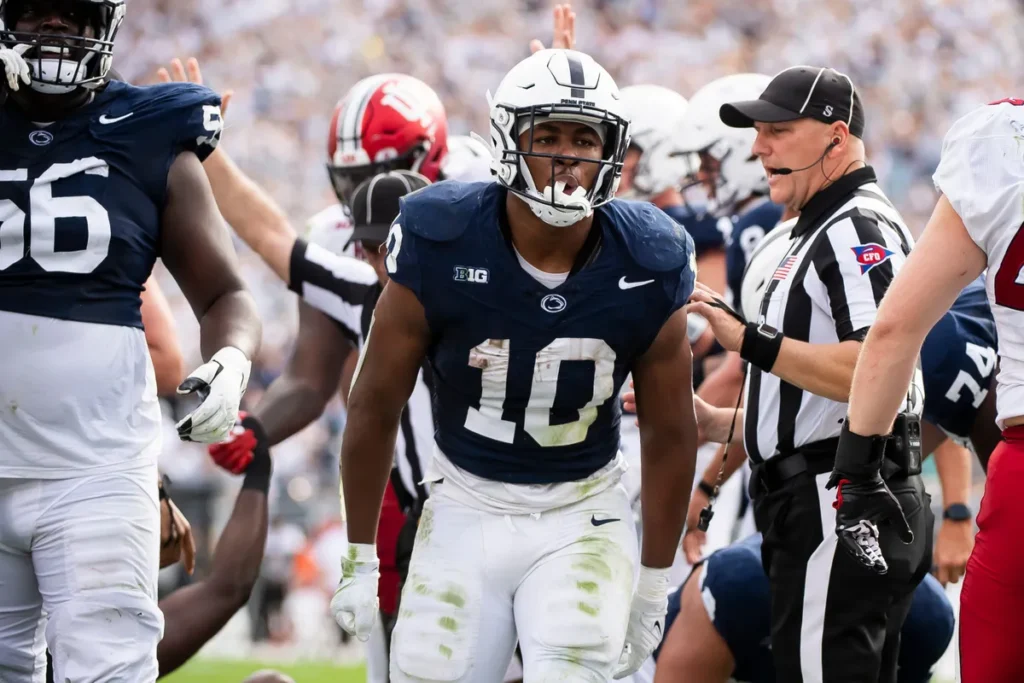
Kaytron Allen is the type of running back I fall in love with. Not because he’s going to run away from everyone. Not because he’s going to give you 60-yard highlights every week. But because he’s the kind of back that keeps drives alive. He finds the hole, stays square, and gets you what’s there. Over and over. At ~5’11” and 220-225 pounds, Allen is built like a real NFL runner. Compact. Strong. Low center of gravity. He’s hard to stop once he gets moving, and when contact shows up, he’s still finishing forward. Production That Actually Means Something Allen’s 2025 season was the best version of himself. He ran for 1,303 yards and 15 total touchdowns while averaging 6.2 yards per carry. He had five 100-yard games, and his biggest outings were loud: 226 yards at Rutgers, 160 yards and two scores against Nebraska, and 181 yards with two touchdowns at Michigan State. But the real headline is simple. He became Penn State’s all-time leading rusher with 4,180 career rushing yards, passing Evan Royster’s record. He also finished with 769 career carries, and that kind of workload tells you what Penn State thought of him. Trust. Durability. Give him the ball again. How Allen Wins Allen’s game starts with vision and patience. He’s not dancing behind the line, trying to bounce every run outside. He presses the line, lets defenders show their hand, and then makes one clean decision and goes. That one cut style is what makes him steady. It keeps him on schedule and keeps the offense

To access the rest of this post, you must purchase a DFF Membership.

Kaytron Allen: The Rookie Running Back Who Wins the Boring Way Read More »

Carnell Tate

What to Do After 1.01 and 1.02 in 2026 Superflex Rookie Drafts

In 2026 rookie drafts, Jeremiyah Love is the clear 1.01, and Fernando Mendoza sits right behind him at 1.02 in Superflex, PPR, and Tight End Premium formats. After those two, my next pick starts with Carnell Tate, then Makai Lemon, then Kenyon Sadiq, and then Jordyn Tyson. That order comes down to a mix of safety, upside, positional value, and how clean the path feels to early fantasy relevance. Tate is the safest wide receiver in the group. Lemon brings the most explosive upside. Sadiq gets a real bump in tight end premium because the athletic ceiling is different at that position. Tyson has the talent, but the risk profile is heavier than the other three.

To access the rest of this post, you must purchase a DFF Membership.

What to Do After 1.01 and 1.02 in 2026 Superflex Rookie Drafts Read More »

Ja'Kobi Lane

DFF Mock Startup: A Guide to the Unobvious

In Dynasty Fantasy Football startups, the roadmap usually starts to crystallize around Round 9. By that point, I’ve generally established the direction of my roster and identified the players I want as long-term building blocks. It’s also the stage of most drafts where managers begin wheeling and dealing to refine their strategy. For this particular mock, however, we kept things strictly business. The DFF crew came together for a pre–free agency startup draft and ran it without trades, letting the board fall naturally. Below are some of my favorite selections from this team build.

To access the rest of this post, you must purchase a DFF Membership.

DFF Mock Startup: A Guide to the Unobvious Read More »

Mike Washington Jr.

Mike Washington Jr.: The “Power-Speed” Workhorse

Running backs come in a lot of shapes, but the ones who last in the NFL usually bring a mix of size, speed, and toughness. Mike Washington Jr. checks those boxes. At 6’1” and around 223 pounds, he looks like the kind of back built to handle a heavy workload. What separates him from most runners his size is the speed. When he hits open space, he can erase angles in a hurry. Washington spent his college career climbing the ladder. He started in the MAC before finishing at Arkansas in the SEC, proving along the way that his game translated against better competition. By the time the 2025 season ended, he had established himself as one of the most productive backs in the conference.

To access the rest of this post, you must purchase a DFF Membership.

Mike Washington Jr.: The “Power-Speed” Workhorse Read More »