
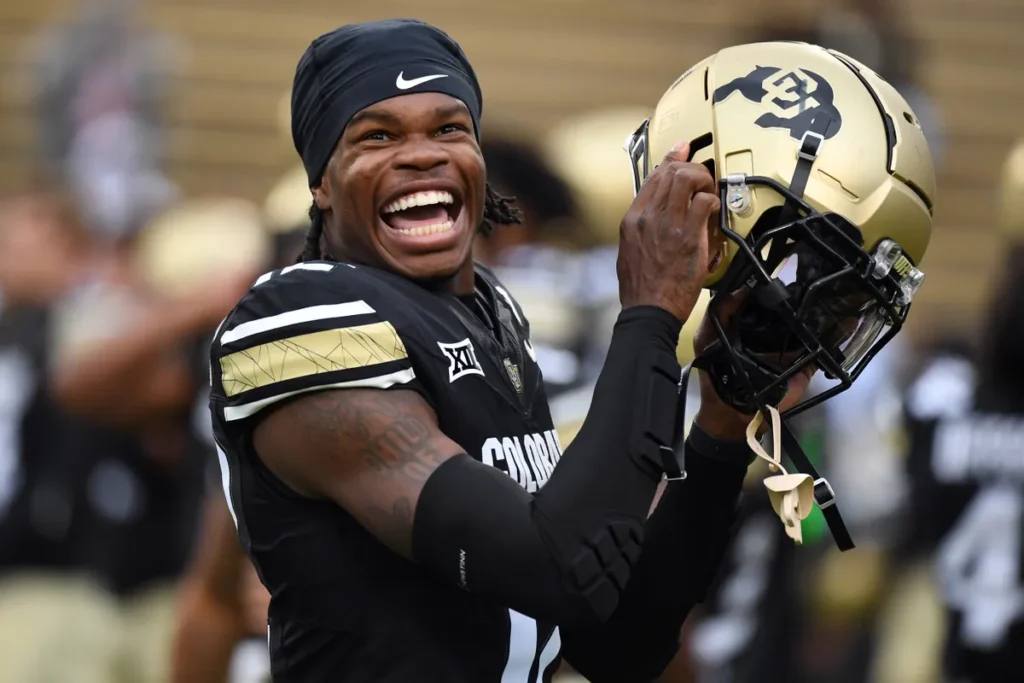
The WR1 Analytical Model Rankings are one of our member favorites each year at Dynasty Football Factory. Months of research and years of dialing in and enhancing the model to accurately predict future wide receiver fantasy value bring us to today.
These WR1 model rankings will be your ultimate guide to predicting which prospects will produce the most fantasy points in their NFL career.
For those new to the WR1 rating, this is a proprietary formula I developed to provide a data-driven forecast of future fantasy production for incoming rookie wide receivers. There are so many advanced metrics out there nowadays; we here at DFF know it can be difficult to navigate which ones matter and how much. The WR1 model takes all that hard work and boils it down to one easy-to-understand number. The model scores rookies on 13 predictive metrics and then combines those individual metric scores into a total WR1 rating score. The goal is to provide an easy-to-use score for those who don’t want to spend hundreds of hours dissecting different metrics. Based on how the prospect scores in the model, I provide their % probability of achieving at least one top 24 NFL Fantasy Points Per Game Season based on past prospects who have received a similar score range.
The WR1 model consistently outperforms NFL draft capital in predicting the future fantasy success of incoming prospects. For a full breakdown of the model’s past performance, click this link. You can also find last year’s WR1 model article here, where we were one of the very few publications to have Malik Nabers as the top wide receiver overall instead of Marvin Harrison Jr.
As you will read in this column, this is one of the weaker classes at wide receiver I have studied since first creating the WR1 analytical model in 2019. In fact, I do not see myself drafting many of these players for my Dynasty teams after the top 7. The sweet spot for value is between 2.02 and 2.06 in the second round of rookie drafts. That is when the value from the top 7 on this list falls.
15. Jaylin Noel, Iowa State, WR1 Model Score: 6.0
Drafted Round 3, Overall Pick 74 – Denver Broncos
Probability of achieving at least 1 top 24 NFL Fantasy Points Per Game Season: 28.4%
Noel is the first of two Iowa State Cyclones in our top 10. Yards per route run is a very important contributor to the WR1 model, and Noel ranks just 15th amongst wide receiver prospects in this class. His best-season weighted dominator (share of the team’s receiving yards and touchdowns) was also only 18th among the prospects. Noel did post a strong relative athletic score at 9.58, ranking eighth in the class.
Noel has far more fans in the film community than he does in analytics. Noel scored a 6.24 film grade. Zierlein states, “He’s primarily a slot receiver but has enough size and speed to kick outside in a pinch. His routes can be a little unfocused, but that’s correctable with coaching. What can’t be coached is his consistent play speed. He can accelerate and separate from turns and stems and tends to uncover on cross-country routes. The catch focus can be inconsistent, but he is willing to mix it up in the middle of the field and is a natural after the ball is in his hands.”

14. Pat Bryant, Illinois, WR1 Model Score: 11.0
Drafted Round 3, Overall Pick 74 – Denver Broncos
Probability of achieving at least 1 top 24 NFL Fantasy Points Per Game Season: 17.3%
Pat Bryant received better draft capital than expected as a Day 2 pick for the Broncos. His analytical profile is largely uninspiring. He profiles as more of a dependable low-floor receiver for fantasy. He averaged a mere 10 fantasy points per game over his college career. His strongest metric performance was his weighted college dominator (team share of yards and touchdowns), where he posted a 40.1%. But in the grand scheme, his overall production doesn’t portend future fantasy stardom.

Bryant received a low 5.97 film grade from Lance Zierlien. You never want to see this grade go under 6.00 for someone you draft for your Dynasty roster. Zierlein states, “Bryant has good size but lacks suddenness and pure vertical gas. What he lacks in explosiveness, he makes up for with intelligent releases, physicality inside the route, and elite ball skills. Bryant has average play strength but musters it all when competing for the catch. His body control and focus put him in a position to win fade routes, but his high-point talent often seals the deal. The ball skills are superior, but he needs to prove he can find ways to uncover against NFL press coverage to become more than a downfield target with backup value.”
13. Andrew Armstrong, Arkansas, WR1 Model Score: 12.0
Undrafted – Miami Dolphins
Probability of achieving at least 1 top 24 NFL Fantasy Points Per Game Season: 28.4%
It baffles me that Armstrong went undrafted. Fortunately, he did find a home, signing with the Dolphins after the draft. Draft capital is a significant input into the WR1 analytical model. It is exceedingly rare for an undrafted player to make our top 15. That is both a good thing for Armstrong, but also tells you just how weak this wide receiver class is. It is never wise to bet on an undrafted player for Dynasty.
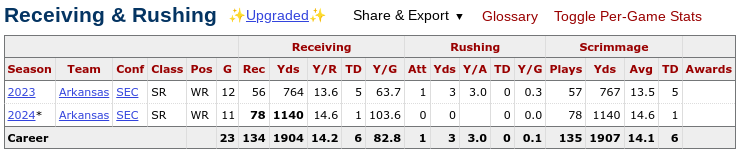
Armstrong was highly productive in the best football conference in the nation. His 3.26 receiving yards per team pass attempt mark was third overall among rookies. His 89.4 PFF Receiving Grade also ranked third among rookies.
Armstrong scored a 5.94 in Zierlein’s NFL.com film score. Zierlein states, “Long-limbed, tight-hipped wideout with average feet and a lack of separation talent. Armstrong put together solid catch production during his two seasons at Arkansas, but will need to prove it is translatable in the pros. He doesn’t get in and out of breaks quickly enough to separate and lacks the pure gas to be a field-stretching option, but he has good size and ball skills.”
12. Elic Ayomanor, Stanford, WR1 Model Score 34.0
Drafted Round 4, Overall Pick 136 – Tennessee Titans
Probability of achieving at least 1 top 24 NFL Fantasy Points Per Game Season: 28.4%
We have a big tier jump here from the eighth spot in the model to seventh. We are starting to get into the players that can be true impact players on your Dynasty roster. Ayomanor is an excellent athlete, as evidenced by his 9.56 Relative Athletic Score. This Relative Athletic Score is similar to the WR1 model but only pertains to the athletic traits of the prospect. It combines their size and results in all the NFL Combine events, such as the 40-yard dash, vertical jump, 20-yard shuttle, and bench press. Age-adjusted production is also an important contributor. Ayomanor is one of only four wide receivers in the class to have a breakout (20% of the team’s share of receiving yards/touchdowns) in their freshman year.
Ayomanor scored a 6.19 in Zierlein’s film grade. Zierlein states, “Wide receiver with pro size and traits who is still in the early stages of his development. Ayomanor lacks suddenness and burst from his break points, leading to heavier contested-catch totals, but he does a nice job with stemming coverage out of corner routes and slants. He has good build-up speed to work vertically and the strength to handle possession targets from the slot, but his ball-tracking and catch technique need a major upgrade.”

11. Jalen Royals, Utah State, WR1 Model Score: 22.0
Drafted Round 4, Overall Pick 133 – Kansas City Chiefs
Probability of achieving at least 1 top 24 NFL Fantasy Points Per Game Season: 28.4%
It is hard for a non-power four conference player to break into the top 10 of the WR1 model. The level of competition is a sizable contributing factor to their overall score. After all, these players do not have the best track record when the NFL drafts them high (I see you, Corey Davis and Skyy Moore). Royals is the first of two non-power four players in this year’s WR1 top ten. There were zero in 2024 and 2023.
This shows not only the strength of these two players’ profiles but also the weakness of the class as a whole. Royals was one of only four wide receivers in this class to garner a best-season weighted dominator above 40%. He was also one of only nine prospects to surpass the 3.00 threshold in yards per route run.
Royals ranked ninth in Lance Zierlein’s film grading with a score of 6.27. Zierlein states, “Skilled and instinctive, Royals might lack the desired explosiveness, but he makes up for it with his body control and feel for the game. He has good size and is keenly aware of defenders around him, which allows him to adjust routes and improve his chances on contested catches. He’s a decent route-runner but doesn’t have the short-area foot quickness and burst to open wide windows for his quarterback. He’s excellent as a zone-beater and uses plus body control and play strength to bring in catches in traffic.”
10. Kyle Williams, Washington State, WR1 Model Score: 15.0
Drafted Round 3, Overall Pick 69 – New England Patriots
Probability of achieving at least 1 top 24 NFL Fantasy Points Per Game Season: 28.4%
Williams has been gaining support in draft circles the closer we get to the NFL Draft. He is now considered to be squarely in the Day 2 conversation. Williams ranked sixth in the class in college career fantasy points per game with a stellar 15.8 mark. This consistent production throughout his career is particularly appealing to NFL scouts. He is one of only seven wide receivers to eclipse a 3.00 receiving yards per team pass attempt mark. Williams lacks elite athleticism. His 7.67 Relative Athletic Score ranks just 23rd in the class.
In our business of analyst prospect prognostication, there are two sides: film and analytics. The WR1 model merges those two sides to give a more holistic view of the prospect. This model was a pioneer in merging the two sides of prospect evaluation using NFL.com film legend Lance Zierlein’s film grading system.
Zierlein gave Williams a 6.20 film grade, which ranked 12th. Zierlein states, “Fifth-year senior with alignment versatility and home run potential. Williams will never be tabbed as “sure-handed”, but he can separate deep and create big plays, which could make the catch issues easier to swallow. He eliminates pursuit angles as a catch-and-run artist and gets respectful cushions, allowing for easy comeback throws. His lack of route-running fundamentals limits his tree, but that should be correctable with work. Williams’ subpar hands lower his floor, but teams looking to add a playmaker could have him queued up as a future WR3.”
9. Dont’e Thornton, Tennessee, WR1 Model Score: 16.0
Drafted Round 4, Overall Pick 108 – Las Vegas Raiders
Probability of achieving at least 1 top 24 NFL Fantasy Points Per Game Season: 28.4%
Thornton was on very few people’s radars before the NFL Draft. He was never that big of a part of the Tennessee offense. He really stood out to me when we had our DFF League of Record startup draft, where we picked rookies before they were actually drafted. One metric in particular, he popped in a big way. Thornton posted a very impressive 3.72 yards per route run. In this sense, he parallels Puka Nacua, who also didn’t post great surface stats in college but had excellent yards per route run. This showed that when he was used, he was very efficient. For whatever reason, these coaches did not give them the volume they earned.
Thornton does have a bit of Marques Valdes-Scantling to his game, so he could be frustrating to own in fantasy. He projects as a low-volume but potentially explosive week-to-week player. In bestball leagues, he would be much more palatable. There, you can withstand a dud week and a blowup the next week.

8. Jack Bech, TCU, WR1 Model Score: 22.0
Drafted Round 3, Overall Pick 69 – Las Vegas Raiders
Probability of achieving at least 1 top 24 NFL Fantasy Points Per Game Season: 28.4%
We have two Raiders back-to-back in our WR1 model standings. This time we have Jack Bech. Bech is a favorite in the film community. He is less of a darling in the analytics world. His 2.44 yards per route run mark was just 20th in the class. His 8.9 college career fantasy points per game ranked 29th.
His film grade of 6.34 by Lance Zierlein was sixth best in the class, showcasing he stood out far more on film than in the spreadsheets. Zierlein states. “Competitive inside or outside target who stands out as a box-checker in several important columns. Bech can be slowed in press and might not have much separation speed, but he’s a big, strong receiver with outstanding ball skills. He’s physical at the top of the route and has a rebounder’s feel for owning catch space once he gains top positioning. His hands are sticky and strong with elite catch focus from any spot on the field. He’s fearless and physical as a runner, but needs more nastiness as a run blocker. Bech’s lack of explosiveness could shrink his workspace, but the focus should be on his pro-ready toughness and ball skills that make him a projectable possession target with WR3 upside.:
MASSIVE TIER JUMP
7. Matthew Golden, Texas, WR1 Model Score: 42.0
Drafted Round 1, Overall Pick 23 – Green Bay Packers
Probability of achieving at least 1 top 24 NFL Fantasy Points Per Game Season: 54.2%
Ok, now it’s starting to get real. There is a massive tier jump when you get into the top seven wide receivers. This is where I started to get really interested in this group of wide receivers. That said, you likely aren’t getting Matthew Golden in your rookie drafts if you have him ranked seventh, and you should be ok with that.
Golden has been in the discussion for the number one overall receiver in this class. This again speaks to the relative weakness of this class. However, there is past precedent for Golden’s archetype going higher than their presumed NFL production. Golden posted the fastest 40-yard dash time of any receiver at the NFL Combine with a 4.29 mark. NFL teams covet speed not just for production purposes but for the ancillary impact on the rest of the offense. In analyst circles, we call this being a “sacrificial X”. Think Henry Ruggs, Jameson Williams, John Ross, Christian Watson, and Marquez Valdes-Scantling. The list of NFL Combine speed demons drafted high to not produce in the NFL is long. While the NFL values this archetype, it is not the archetype you want for your Dynasty roster. The fact he was drafted by Green Bay with Watson being likely out for 2025 further supports this role.
Golden’s 6.42 NFL.com film grade was the third-best in the class. Zierlein states, “Golden works all three levels of the field with similar consistency and productivity. His route-running needs refinement, but he does a decent job of altering tempo and separating at breakpoints. Golden has the ability to play all three receiver spots. He also has the agility and body control to turn near-misses into highlight catches. Focus drops still pepper his play, but he’s a willing participant in traffic and took command of contested catches with better physicality and catch strength in 2024.”
6. Emeka Egbuka, Ohio State, WR1 Model Score: 51.0
Drafted Round 1, Overall Pick 19 – Tampa Bay Buccaneers
Probability of achieving at least 1 top 24 NFL Fantasy Points Per Game Season 54.2%
One thing you do not need to worry about with Egbuka is his finding a starting job. The question with Egbuka will be how much he produces. He is a rare slot who brings a lot of value outside of the passing game with his elite blocking in the run game. He brings a lot of non-fantasy value to an NFL team. This was reflected in his draft capital.
But I am not here to tell you which wide receivers bring the most value to an NFL team. I am here to tell you the wide receivers who will score the most fantasy points. That is where I have some questions about Egbuka. Egbuka did not rank in the top five in any of our key predictive metrics. He was solid across the board but not elite in any of them. And that is how I would best describe him as a player. Solid. He has a decent floor but a limited ceiling. While he was not elite in any single category. He also lacks any significant red flags. It would have been nice to see him declare when first eligible, but that isn’t the non-starter it used to be. Egbuka was able to eclipse the 3.0 threshold in yards per route run.
Egbuka scored a 6.37 in Lance Zierlein’s NFL.com film grade. Zierlein states, “Fluid athlete with good size and quality ball skills who works primarily from the slot. Egbuka runs his routes with tempo and pace. He does a nice job of influencing coverage when needed. He lacks the explosiveness to race past the coverage and is a little tight in his hips getting in and out of breaks. Egbuka’s baseball background shows up with his laser-focused ball-tracking and ability to make sudden adjustments to bring throws in for a safe landing. He’s not elusive or sudden after the catch but is competitive and can squeeze out additional yardage.”
Egbuka scored a 6.37 in Lance Zierlein’s NFL.com film grade. Zierlein states, “Fluid athlete with good size and quality ball skills who works primarily from the slot. Egbuka runs his routes with tempo and pace. He does a nice job of influencing coverage when needed. He lacks the explosiveness to race past the coverage and is a little tight in his hips getting in and out of breaks. Egbuka’s baseball background shows up with his laser-focused ball-tracking and ability to make sudden adjustments to bring throws in for a safe landing. He’s not elusive or sudden after the catch but is competitive and can squeeze out additional yardage.”
5. Travis Hunter, Colorado, WR1 Model Score: 63.0
Drafted Round 1, Overall Pick 2 – Jacksonville Jaguars
Probability of achieving at least 1 top 24 NFL Fantasy Points Per Game Season: 81.4%
The WR1 model has no context. It is purely a formula constructed of predictive metrics. Travis Hunter would be higher in the rankings but he does have a huge red flag, which we are unable to predict at this time: offensive volume. Liam Coen is on record: “We’ll have a plan right now of [him playing] primarily on offense, with him learning the defensive system and practicing on the defensive side of the ball as well throughout this offseason program…” This is optimistic for sure. It gives us far more comfort selecting him for Dynasty than if we did not have that context.
Based on his predictive metrics, he received the top score in the WR1 model with an 83.0. Hunter led all prospects in college career fantasy points per game at wide receiver with 21.4 points per game.
Hunter scored the highest film grade at 6.89. Zierlein states, “Exciting two-way player whose world-class athleticism and ball skills help him shine on both sides of the ball. Hunter is an instinctive, natural football player with a feel for making the biggest plays at the biggest times. He was the best player on his team by a long stretch. On offense, Hunter gets by on talent over technique, but will need to smooth out the journey from press release to catch with better route running. He has the burst to uncover over three levels with ball skills and catch focus, reminiscent of DeVonta Smith in his Heisman Trophy-winning season.”
According to our model, if he plays wide receiver full-time, he is the best wide receiver prospect in this class. It is up to you, the manager, if you want to assume the risk of him playing limited offensive snaps. If you want a ceiling, no one has a higher one than Hunter.
4. Jayden Higgins, Iowa State, WR1 Model Score: 63.0
Drafted Round 2, Overall Pick 34 – Houston Texans
Probability of achieving at least 1 top 24 NFL Fantasy Points Per Game Season: 63.5%
Jayden Higgins’ 63.0 is comfortably ahead of Emeka Egbuka’s 51. We are officially in the range of receivers who profile as strong starters for your Dynasty team. Higgins posted an exceptional 9.63 Relative Athletic Score, which is fourth among the players highlighted in the top 15 of the WR1 model.

Higgins possesses a rare combination of size, speed, and explosiveness. His 6’4” frame and vice-grip hands with a 1.54 10-yard split are a recipe for getting open quickly. Higgins was very strong in all the advanced metric inputs we used for the WR1 model. His 17.2 college career fantasy points per game were only behind Travis Hunter and Tet McMillan. Higgins was the only receiver in this class to score a PFF receiving grade above 90 this past season. He eclipsed the all-important 3.00 yards per route run threshold, showing he was efficient with his touches.
Higgins scored a 6.33 in Lance Zierlein’s film grading system. Zierlein states, “Big inside/outside wideout with modest athletic attributes but outstanding ball skills that make him a projectable NFL prospect. Higgins needs a more limited route tree but can operate on all three levels in the right scheme. He’s smooth but physical in his routes and does a nice job of creating pockets of separation with force and strength. He has mismatch qualities from the slot with body control and a catch radius that make him a menace on jump balls downfield. He won’t outrun cornerbacks and is nothing special after the catch, but his size, ball skills, and competitiveness create a profile of production as a future contributor in three-wide sets.”

3. Luther Burden, Missouri, WR1 Model Score: 66.0
Drafted Round 2, Overall Pick 39 – Chicago Bears
Probability of achieving at least 1 top 24 NFL Fantasy Points Per Game Season: 70.8%
Burden is a bit of an enigma. After his scintillating sophomore season, he was widely thought of as a blue-chip future NFL superstar. High-end age-adjusted production is highly predictive of future NFL success.

Burden bucked the traditional ascension in production as you get older in your college career. Instead, his production fell from an astounding 93.2 yards per game as a sophomore to 56.3 yards per game as a junior. That is certainly a red flag, but it is also why we use best season vs last season for the WR1 model. Best season has proven to be more predictive since it highlights a player’s ceiling, and there can be a myriad of factors as to why production could drop, from injury to quarterback play to coaching.
However, that sophomore season was Special with a capital S. Burden was the only prospect in the class to post yards per route run above 3.25 as a sophomore. His 3.21 receiving yards per team pass attempt were fourth overall. He also posted top 10 marks in weighted college dominator (36.3%) and college career fantasy points per game (15.6). Burden is one of six early declare wide receivers symbolizing a vote of confidence from the NFL that he is getting high draft capital and is ready to play at the next level.
His landing spot is tantalizing in Detroit. Ben Johnson is one of the most creative play-callers in the NFL. He propelled Amon Ra St. Brown and Jahmyr Gibbs to fantasy superstardom. Burden has traits similar to both players and could be used in similar roles that Gibbs and St. Brown portrayed in Detroit with Johnson.
Burden had a 6.43 film grade from Lance Zierlein. Only Travis Hunter graded higher. Zierlein stated, “Former five-star recruit who offers five-star athleticism and playmaking ability. Burden is a natural on the field with above-average speed and exciting ball skills to win at a high rate. He takes snaps off and short-circuits routes if he’s not the primary option, but he can separate and succeed on all three levels when it’s his time. Missouri exploited Burden’s yards-after-catch talent with a barrage of short throws, but NFL teams are much more likely to diversify his usage, activating his complete skill set and big-play potential. The production against top teams was uneven at times, but so was Missouri’s quarterback play. Burden checks several priority boxes that typically foreshadow an impressive NFL career.”
2. Tre Harris, Mississippi, WR1 Model Score: 71.0
Drafted Round 2, Overall Pick 55 – Los Angeles Chargers
Probability of achieving at least 1 top 24 NFL Fantasy Points Per Game Season: 70.8%
The WR1 model loves Tre Harris. His ranking of three overall is quite the departure from his draft capital, which was seventh overall among wide receivers. A big factor driving this is Tre Harris’s absolutely insane yards-per-route run mark of 5.15. When I first saw this months ago, I thought it must be a misprint. But no, it is real, and it is spectacular. It is the first yards per route run recorded over 5.00 by PFF. Yards per route run is a highly predictive metric for future NFL success. This was a full yard higher than the 2nd best player, Ricky White, and 2 yards higher than the sixth overall prospect. Every time Harris touched the ball, he was a threat for an explosive play.
Harris scored the second-best PFF receiving grade in the class at 89.4. His 37.2% weighted dominator score was seventh-best. His receiving yards per team pass attempt mark was a stout 3.67, which tied for best in the class.
Harris was a high school quarterback who converted to wide receiver in college. Therefore, he was a bit raw initially. He truly blossomed when he got to Ole Miss and absolutely throttled the best defensive backs in the country in his senior year. There is no reason to think this won’t translate in the NFL.
Harris scored a 6.30 in Lance Zierlein’s film grade. Zierlein states, “Size/speed wideout who returned to school in 2024 and improved his game heading into this year’s draft. He’s primarily a first- and third-level target, mixing a barrage of hitches and slants with go routes and posts. He’s fast enough to win over the top and talented with the ball in his hands to stretch short throws into longer yardage. His route-running and contested-catch success both took an upturn, but they still need work at the pro level. Of greater concern might be a second consecutive season of time missed due to injury. Harris might be capable of expanding his route tree a bit, but he looks locked in as an “X” receiver with big-game potential and a future home as a WR2.”
1. Tetairoa McMillan, Arizona, WR1 Model Score: 77.0
Drafted Round 2, Overall Pick 55 – Carolina Panthers
Probability of achieving at least 1 top 24 NFL Fantasy Points Per Game Season: 81.4%
McMillan is a bit polarizing in draft circles. His biggest negative commentary centers around his ability to separate. He posted a 23.8% contested target rate, which is lower tier but doesn’t completely eliminate him from consideration. In fact, Marvin Harrison Jr’s biggest red flag for us last year was this same metric when he posted a 26.3%.
Now to the positives. McMillan has always produced.

A freshman-year breakout is always a great sign, and McMillan did that with his 702-yard freshman campaign. Age-adjusted production is a significant predictor of future fantasy success. He led all Power 4 wide receivers in the class with an outstanding best-season weighted dominator of 44.8%. His 17.9 college career fantasy points per game was only behind Travis Hunter’s 21.4.
McMillan scored a 6.40 in Lance Zierlein’s film grade. The only player who received a higher grade was Travis Hunter. Zierlein states, “Possession receiver with the size and ball skills to create big wins deep. He’s a linear route-runner who wears press coverage early and coasts too often on deep routes, but he has a feel for uncovering underneath and can play over the top of cornerbacks for easier jump-ball wins. McMillan is instinctive with a feel for adjusting his routes and working back on throws to make the quarterback’s job easier. He needs to show more consistent play speed and physicality to protect his workspace. His elite ball skills set him apart, though, providing a higher floor as a “Z” option with mismatch value in the slot.”
I hope you enjoyed reading my article. All of my articles have one goal in common. That goal is to provide you, our member, with actionable advice that can improve your Dynasty team. You can follow me on Twitter @force_fantasy or Blue Sky @forcefantasy.bsky.social. #DFFArmy #FantasyFootball #AlwaysBeBuilding #NFL #NFLDraft #NFLTransactions #NFLTrades #AlwaysBeScouting
Click here for a 12-month DFF Membership for just $1.67 per month. This gets you year-long access to hundreds of Dynasty articles, access to our Discord for personalized team advice from our experts, and our gigantic Dynasty Rookie draft guide covering 60+ prospects.

