
Here it is. The grand finale. The NFL Draft has concluded, and we now have the final input metric for our WR1 analytical model—draft capital. Below you will find the final post-NFL Draft rankings for the model.
The WR1 Analytical Model Rankings are one of our member favorites each year at Dynasty Football Factory. Months of research and years of dialing in and enhancing the model to accurately predict future wide receiver fantasy value bring us to today.
These WR1 model rankings will be your ultimate guide to predicting which prospects will produce the most fantasy points in their NFL career.
For those new to the WR1 rating, this is a proprietary formula I developed to provide a data-driven forecast of future fantasy production for incoming rookie wide receivers. There are so many advanced metrics out there nowadays, we here at DFF know it can be a struggle to navigate which ones matter and how much. The WR1 model takes all that hard work and boils it down to one easy-to-understand number. The model scores rookies on 13 predictive metrics and then combines those individual metric scores into a total WR1 rating score. The goal is to provide an easy-to-use score for those who don’t want to spend hundreds of hours dissecting different metrics.
It is important to note that NFL teams DO NOT CARE about your fantasy teams. Their goal is to win games, and they draft wide receivers who help them do that. While fantasy production is a big piece of that, there are other factors NFL teams covet as well.
You may find an in-depth explanation of the model’s process and a glossary of what the metrics mean here. Over the years, the WR1 process has been replicated and repackaged by other sites, so we left out a few main ingredients to keep it proprietary, but you get a good flavor of how it works.
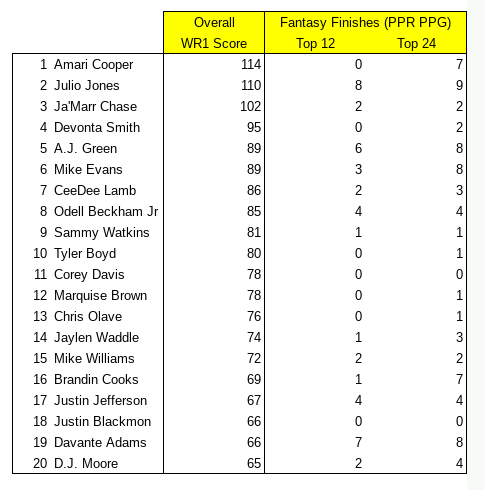
Before we get into the 2024 prospects, here are the top 20 all-time prospects in the model so you can see how effective it is at forecasting future fantasy value.
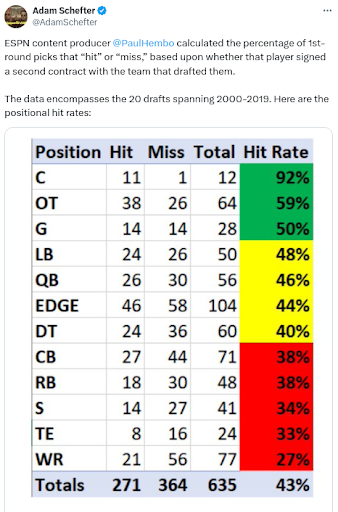
The actual NFL draft capital doesn’t have near the hit rate as the WR1 model, as evidenced by this tweet from Adam Schefter.
The WR1 model is also highly effective at steering you clear of busts.
Here are all the wide receivers with a score below 35 that were selected in the first round since 2011:

Now let’s see how the 2024 class fared:
Honorable Mentions: Just missing the top-20:
20. Roman Wilson, Michigan
WR1 Model Score: -9.0
% Chance of a Top-24 Fantasy Season: 5.0%
Landing Spot: Average
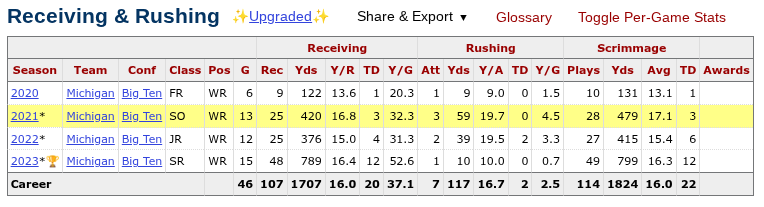
Wilson was drafted by the Pittsburgh Steelers with the twentieth pick in the third round of the 2024 NFL Draft. The top three wide receivers on the Steelers’ depth chart are George Pickens, Van Jefferson, and Calvin Austin. Wilson has a path to targets, but this is expected to be a run-heavy Arthur Smith-led offense with subpar QB play. The Steelers ranked eighth lowest last year in pass yards per game, and they doubled down on the run commitment this offseason.
Wilson earned 5 points in this category towards his overall WR1 score.
The Good
Film Grade
Wilson’s analytical profile doesn’t have a lot that pops off his resume. That is why the model also incorporates two film grades. NFL.com film legend, Lance Zierlein, had a high grade on Wilson. Wilson’s score of 6.30 ranked tenth of the 24 wide receivers evaluated in the WR1 model. Zierlein wrote this about Wilson in his draft profile. “Smooth strider with alarming speed once he touches top gear. Wilson primarily focused on attacking the intermediate and deep portions of the field, adding an explosive element to the Wolverines’ ground-and-pound approach. Wilson is an electrifying athlete, which should push his stock up, but he’ll need to learn to level up his skill getting from Point A to Point B as a route-runner to reach his potential. Wilson has good hands and can run after the catch down the field, but he’s not really a catch-and-go option underneath. He has the separation potential to make a quarterback’s life easier and figures to continue his ascension as a starting slot talent.”
Wilson earned 7 points in this category towards his overall WR1 score.
The Bad
Late Declare
Prospects that declare when they are first eligible have a significantly higher hit rate than prospects that declare after this. In essence, it’s an endorsement by the NFL that says that they are ready to compete at the highest level despite not playing four years in college. Wilson falls under this late declare category and gets dinged in the model.
Wilson lost 5 points in this category towards his overall WR1 score.
Slot Percentage
Wilson had a 68.7% slot usage in college. In general, slot receivers are seen as less valuable as they have more space to work with to create separation. The lack of talent depth in college also means slot receivers are seeing inferior coverage. Further, they also have hash marks that are 40 feet apart, while the NFL hash marks are only 18 feet apart, allowing slot fades to be heavily integrated in college with more space to work.
Wilson lost 10 points in this category toward his overall WR1 score.
The Ugly
Weighted Dominator Breakout Year
Age-adjusted production is a significant predictor of future NFL success. The more success a player sees at a younger age, the more likely they are to be successful in the NFL. Weighted dominator measures a player’s share of his team’s yardage, and touchdowns are weighted 80% yardage and 20% touchdowns. Ideally, we want our top prospects to achieve a breakout by their second year in college. Wilson not only failed to do this, but he also failed to break out by his third year. His breakout only came this last year, his fourth in college, when he achieved a 29.7% weighted dominator.
Wilson lost 2 points in this category towards his overall WR1 score.
College Career Fantasy Points Per Game
Wilson averaged only 9.2 fantasy points per game in his college career. This ranked 21st of the 24 wide receivers we ranked for this exercise that are expected to be drafted.
Wilson lost 5 points in this category towards his overall WR1 score.
19. Jalen McMillan, Washington
WR1 Model Score: -9.0
% Chance of a Top-24 Fantasy Season: 5.0%
Landing Spot: Average
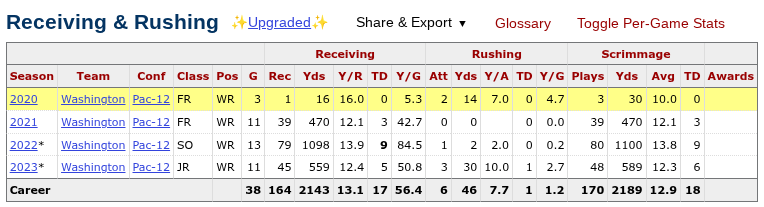
McMillan was drafted by the Tampa Bay Buccaneers with the 29th pick in the third round. McMillan played 92% of his snaps in the slot last year. Liam Coen has already indicated that Godwin will be playing a lot more slot in 2024 than he did in 2023. The Buccaneers can move on from Godwin in 2025 if McMillan progresses. The Buccaneers ranked 17th best last year in pass yards per game..
McMillan earned 5 points in this category towards his overall WR1 score.
The Good
Receiving Yards Per Team Pass Attempt Per Game
McMillan’s best year was his last season in 2022. In 2023, McMillan suffered an MCL sprain in week 2 and was not the same for the balance of the season. In 2022, McMillan was able to muster up a 1098-yard receiving season while competing for targets against two NFL top two-round picks in Rome Odunze and Ja’Lynn Polk. This catapulted McMillan to a strong 2.94 receiving yards per team pass attempt per game. This ranked 7th in this wide receiver class.
McMillan earned 3 points in this category towards his overall WR1 score.
The Bad
PFF Receiving Grade
PFF charts every targeted attempt for each wide receiver so this is a comprehensive look at their entire resume. McMillan scored only 70.8 in this metric. That was the second worst in the entire class.
McMillan earned 3 points in this category towards his overall WR1 score.
College Weighted Dominator Rating
McMillan’s best-season 23.9% best-season team share of yardage and touchdowns (weight 80% yardage, 20% touchdowns). Granted, he was on the field with two other NFL draft picks in Rome Oduze and Ja’Lynn Polk. McMillan’s mark in this metric was the 4th worst in the class.
McMillan lost 2 points in this category towards his overall WR1 score.
The Ugly
Film Grade
NFL.com film scout Lance Zierlein graded McMillan a 5.97. That was the fifth worst in this class. Zierlein states this about McMillan in his draft profile. “Slot target with good size and production over the last two seasons. McMillan is a long-striding field-stretcher who is at his best with momentum routes in a West Coast passing scheme. He lacks aggression and play strength and could labor against the press or when faced with contested catches. McMillan has adequate build-up speed to create opportunities down the field, but needs the ball on target. Teams will need to determine if McMillan was a product of the impressive Washington passing scheme, or if he’s a stand-alone talent outside of UW.”
18. Johnny Wilson, Florida St.
WR1 Model Score: 6.0
% Chance of a Top-24 Fantasy Season: 8.2%
Landing Spot: Below Average
Wilson was drafted by the Philadelphia Eagles with the ninth pick in the sixth-round of the 2024 NFL Draft. AJ Brown and Devonta Smith are locked up for years. The Eagles ranked sixteenth lowest last year in pass yards per game.
Wilson earned 5 points in this category towards his overall WR1 score.
The Good
Yards Per Route Run
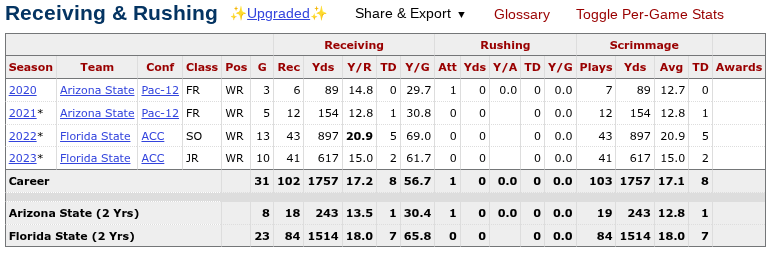
Yards per route run (YPRR) is a highly predictive metric for future fantasy success. It is interesting to see Wilson rank so highly in this metric with relatively low cumulative counting stats. Wilson topped out at 897 receiving yards as a sophomore, far from the top tier of this draft class. However, his best season YPRR of 3.36 ranked third in the class, behind only blue-chip studs Malik Nabers (3.81) and Marvin Harrison Jr. (3.44).
Coleman earned 12 points in this category toward his overall WR1 score.
Relative Athletic Score
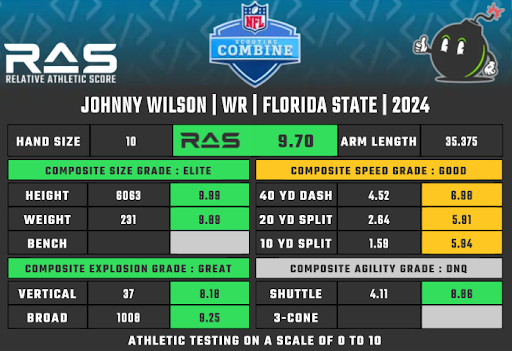
Wilson is an athletic specimen. He stands a lofty 6’6″, weighing in at 231 lbs. He moves fluidly for a man of his stature and posted a solid 4.52 40-yard dash. His 9.70 Relative Athletic Score was 6th in the class.
Wilson earned 15 points in this category toward his overall WR1 score.
The Bad
College Career Fantasy Points Per Game
Wilson’s usage was lackluster throughout his college career. Targets are earned, and he simply didn’t earn them at a high rate. His highest yardage output came as a junior with 897 yards and 5 touchdowns. For his career, he averaged a mere 10.5 fantasy points per game. This ranked 17th among the 24 wide receivers evaluated in this draft class.
Wilson lost 5 points in this category toward his overall WR1 score.
The Ugly
Film Grade
The WR1 model utilizes a film grade from NFL.com scouting legend Lance Zierlein. Wilson scored very poorly, posting a 5.95 score for film. This was the second-worst in this class from the wide receivers evaluated for this model. Zierlein’s report on Wilson reads, “An enormous target with an elite catch radius, Wilson is still in the process of learning to play to his traits. He is fairly physically against the press, but plodding feet limit his release quickness and ability to separate out of breaks. He flashes impressive catches here and there but generally fails to impose his frame and strength on defenders, leading to a disappointing contested-catch rate for such a big man. Wilson’s body control and ball skills might not be good enough to stick at wide receiver. He could end up trying to make a team as an F tight end with enough developmental traits to warrant an extended look.”
Wilson earned 0 points in this category toward his overall WR1 score.
17. Jermaine Burton, Alabama
WR1 Model Score: 5.0
% Chance of a Top-24 Fantasy Season: 8.2%
Landing Spot: Average
Burton was drafted by the Cincinnati Bengals with the sixteenth pick in the third round of the 2024 NFL Draft. Burton walks into a decent role vacated by Tyler Boyd. It still is picking up the scraps left behind by Chase and Higgins, but it was worth 98 targets. The Bengals ranked 15th in pass yards per game last year.
Wilson earned 5 points in this category towards his overall WR1 score.
The Good
Film Score
Zierlein gives Burton a 6.28, the eleventh-highest film grade in this wide receiver class. Zierlein writes, “While the catch totals and yardage weren’t necessarily prolific, Burton’s tape is very appealing. He has pretty good size and plays bigger than he measures. He can fight through the press, get physical at the break point, and carve out space on 50/50 balls. Burton wasn’t asked to run an extended route tree, but he has the traits and ball skills to work all three levels against NFL cornerbacks.”
Burton earned 3 points in this category toward his overall WR1 score.
The Bad
Late Declare
Burton gets a ding to his model score for not declaring for the NFL when he was first eligible. Historically, prospects who declare when they are first eligible have a far higher hit rate than those who do not.
Burton lost 5 points in this category towards his overall WR1 score.
Draft Capital
After you get past the first two rounds of the NFL draft, hit rates start to drop precipitously. Burton is currently projected to go in the third round of the NFL draft per NFL Mock Draft Database.
Burton lost 8 points in this category towards his overall WR1 score.
The Ugly
College Career Fantasy Points Per Game
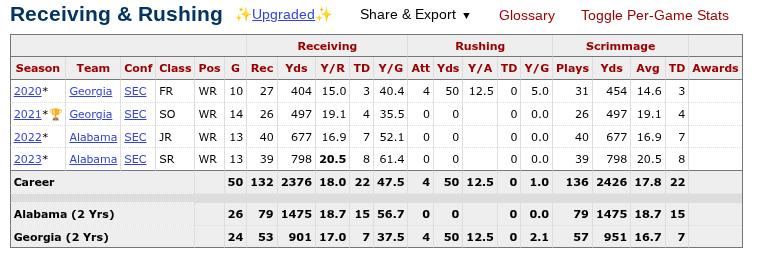
Burton only averaged 10.5 fantasy points per game in his college career. This ranked 18th of the 24 wide receiver prospects in the mix to be drafted. Bearing in mind that this is ultimately the exact metric that we are looking for when we draft for Dynasty leagues, this is a red flag. His volume simply isn’t there to be an elite fantasy option. He projects more as a vertical field stretcher in the NFL.
Burton lost 5 points in this category towards his overall WR1 score.
16. Devontez Walker, North Carolina
WR1 Model Score: 5.0
% Chance of a Top-24 Fantasy Season: 8.2%
Landing Spot: Below Average
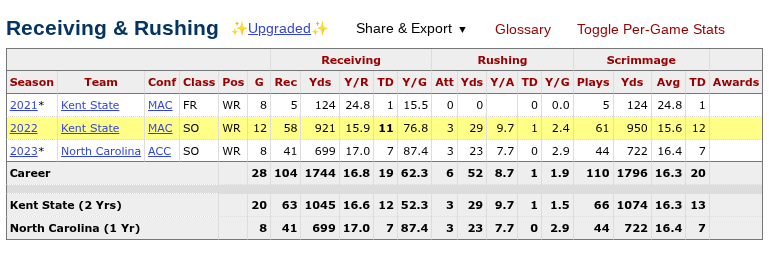
Walker was drafted by the Baltimore Ravens with the 13th pick in the fourth round of the 2024 NFL Draft. The Ravens have a fairly crowded pass-catching group with Mark Andrews, Zay Flowers, and the recently re-signed Rashod Bateman. The Ravens ranked twelfth lowest last year in pass yards per game.
Walker earned 0 points in this category towards his overall WR1 score.
The Good
Relative Athletic Score
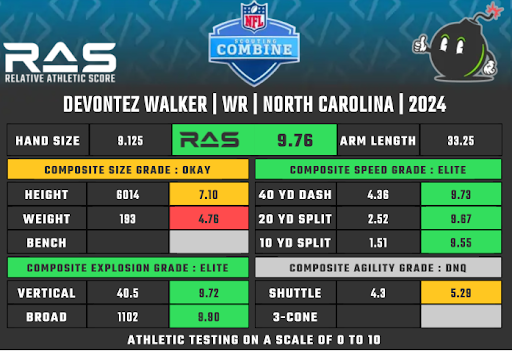
Walker posted fantastic numbers at the NFL Combine, sparking him to a 9.76 Relative Athletic Score. This was the fifth-highest mark in the class. His workout was highlighted by a blistering 4.36 forty-yard dash. His vertical and broad jumps were also in the elite range of wide receiver prospects.
Walker earned 15 points in this category toward his overall WR1 score.
The Bad
Contested Target Rate
The contested target rate is exactly what it sounds like. It is a measure of a player’s % of targets that were deemed contested by PFF. At its core, it is a measure of the player’s ability to separate. At the college level, it is easier for some receivers to use their physical prowess to outcompete defensive backs. That does not translate to the NFL. They need to separate.
Per Scott Barrett, the top-10 Power Five players with the highest contested target rate since 2017 include famous draft busts like JJ Arcega-Whiteside (37.3%), Denzel Mims (28.9%), Hakeem Butler (28.8%), Quentin Johnston (27.1%), Tylan Wallace (27.0%), Terrace Marshall (26.5%) and David Bell (26.5%).
Walker’s contested target rate was an astounding 25.8%. This was the fifth-highest mark for any wide receiver expected to be drafted this year.
Walker lost 8 points in this category toward his overall WR1 score.
The Bad
PFF Receiving Grade
Per PFF, “The PFF grading system isolates the targeted receiver’s role on every pass attempt. Credit is given for plays in which the receiver adds value to the offense, especially when it’s above and beyond what was called for schematically.”
Walker was awarded the worst receiving grade of all 24 wide receivers included in the WR1 model. His 68.3 mark was also the only grade in the 60s.
Walker lost 4 points in this category toward his overall WR1 score.
15. Javon Baker, Central Florida
WR1 Model Score: 15.0
% Chance of a Top-24 Fantasy Season: 28.4%
Landing Spot: Average
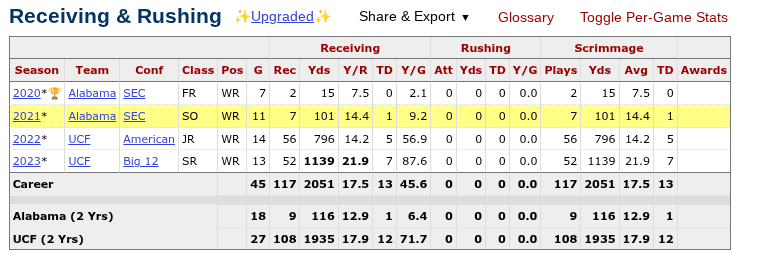
Baker was drafted by the New England Patriots with the tenth pick in the fourth round of the 2024 NFL Draft. The Patriots are bereft of talent in their wide receiver room so the opportunity to compete for targets will be there. The Patriots have a raw rookie QB and a low-ceiling veteran who will be passing the ball this season. The Patriots ranked fifth-lowest last year in pass yards per game.
Baker earned 5 points in this category towards his overall WR1 score.
The Good
College Weighted Dominator Rating
Baker was a 4-star recruit who started his career at Alabama before really breaking out at Central Florida. Facing Big 12 competition his senior year, Baker compiled 1139 yards and 7 touchdowns. His weighted dominator (team share weighted 80% receiving yards and 20% touchdowns) was an excellent 32.9%. That was the seventh-best in the class.
Baker earned 3 points in this category toward his overall WR1 score.
Receiving Yards Per Team Pass Attempt Per Game
Baker not only achieved lofty volume thresholds, but he was also efficient with his touches. His YPRR (3.21) and receiving yards per team pass attempt per game (RYPTPAPG) (3.12) both eclipsed the 3.00 elite threshold we like from our top prospects. His 3.12 RYPTPAPG was good for fourth in the class.
Baker earned 10 points in this category toward his overall WR1 score.
The Bad
Relative Athletic Score
Baker tested quite poorly, which is a red flag for a true X receiver. His height is merely average, his straight-line speed is below average among the top prospects in the class, and his 40-time was only 4.54 seconds. Overall, his Relative Athletic Score was just 7.84. To put this into context, that number ranked 22nd of the 24 wide receivers evaluated in the WR1 model.

Baker earned 0 points in this category toward his overall WR1 score.
The Ugly
College Career Fantasy Points Per Game
It’s important to note that this metric is the one we ultimately want them to produce when they get to the NFL. Therefore, it is quite worrisome that Baker only managed to put up 8.7 fantasy points per game throughout his career. He barely saw the field for Alabama in his freshman and sophomore years. The competition for targets was good but not great in Jameson Williams and John Metchie. For our top prospects, we like to see them break through lineup competition such as that.
Baker lost 5 points in this category toward his overall WR1 score.
14. Luke McCaffrey, Rice
WR1 Model Score: 15.0
% Chance of a Top-24 Fantasy Season: 28.4%
Landing Spot: Average
McCaffrey was drafted by the Washington Commanders with the 37th pick in the third round of the 2024 NFL Draft. McCaffrey should build an immediate rapport with fellow rookie Jayden Daniels. 71.5% of his snaps at Rice last year came from the slot. Jahan Dotson takes most of the snaps from the slot for the Commanders, but does move out a decent amount. Other than that, the pickings are thin in Washington. The Commanders ranked 18th in pass yards per game last year.
McCaffrey earned 5 points in this category towards his overall WR1 score.
The Good
College Career Fantasy Points Per Game
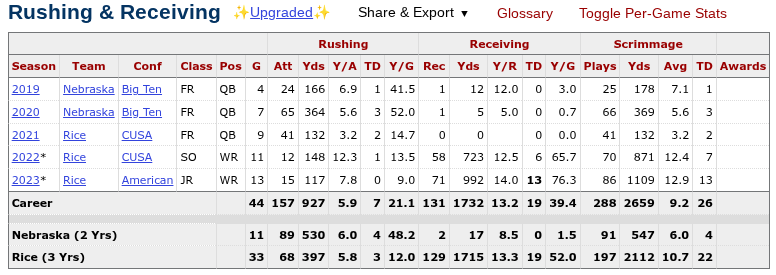
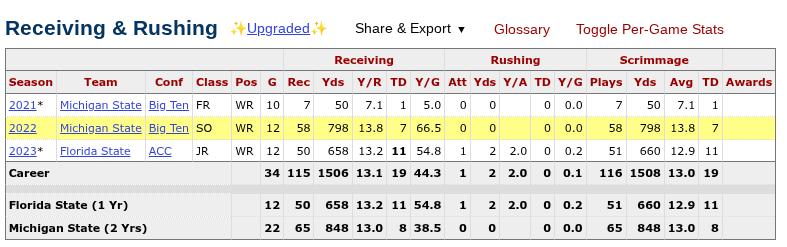
McCaffrey only converted to wide receiver in 2022 after trying his hand at quarterback in the earlier part of his college career. Once he converted, he posted an incredible 18.6 fantasy points per game in his final two years at Rice. For his college career as a wide receiver, he ranked number one overall among wide receivers in this class. This score was higher than Malik Nabers and Marvin Harrison Jr., so how can he rank 20 overall, you ask? Well, there are 13 metrics that feed the model, and we will get to the ones that are dragging him down.
McCaffrey earned 6 points in this category towards his overall WR1 score.
Weighted Dominator Rating
Weighted dominator measures a player’s share of his team’s yardage, and touchdowns are weighted 80% yardage and 20% touchdowns. McCaffrey posted an excellent 33.1% weighted dominator rating (80% yards team share, 20% touchdowns team share). This was good for sixth in the class.
McCaffrey earned 3 points in this category toward his overall WR1 score.
Relative Athletic Score
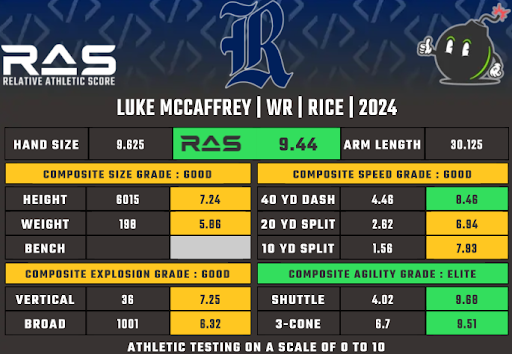
McCaffrey has an outstanding athletic profile. This is highlighted by his 4.02 shuttle and 6.7 three-cone times. Those two metrics are highly coveted in NFL circles. McCaffrey has the tools to develop into an elite slot receiver in the NFL. He just hasn’t been doing it very long, so he is more of a projection than other prospects.
McCaffrey earned 15 points in this category towards his overall WR1 score.
The Bad
Late Declare
McCaffrey was eligible to declare for the NFL last year but did not. Given that he had just converted from quarterback to wide receiver, his being a late declare is not a surprise, but still it is a ding to his WR1 model score.
McCaffrey lost 5 points in this category toward his overall WR1 score.
The Ugly
Draft Capital
McCaffrey was selected in the 3rd round with the 100th overall pick by the Washington Commanders. McCaffrey was projected to be a fifth-rounder by consensus mock drafters, so despite the late pick, it was actually better than forecasted. Jahan Dotson played 39% of his snaps in the slot last year.McCaffrey played 71.5% of his snaps in the slot. It will be interesting to see how the Commanders deploy the two.
McCaffrey lost 8 points in this category toward his overall WR1 score.
13. Ja’lynn Polk
WR1 Model Score: 15.0
% Chance of a Top-24 Fantasy Season: 28.4%

Landing Spot: Average
Polk was drafted by the New England Patriots with the fifth pick in the second round of the 2024 NFL Draft. There is no WR 1 in New England right now, and many would argue there is no WR 2. Therefore, the path to targets is wide open for Polk and their new quarterback, Drake Maye. The Patriots ranked fifth-lowest last year in pass yards per game.
Polk earned 5 points in this category towards his overall WR1 score.
The Good
Draft Capital
For a second-round selection, you would like to see a far superior analytical profile than the one Ja’lynn Polk brings to the table. This one metric is vaulting him up the WR1 analytical model ranks as draft capital is a significant input.
Polk earned 5 points in this category towards his overall WR1 score.
The Bad
PFF Receiving Grade
Per PFF, “The PFF grading system isolates the targeted receiver’s role on every pass attempt. Credit is given for plays in which the receiver adds value to the offense, especially when it’s above and beyond what was called for schematically.”
Polk was awarded a 76.1 PFF receiving grade this past season. He ranked 18th of the 24 wide receivers expected to be drafted in this mode.
Polk earned 0 points in this category towards his overall WR1 score.
Film Grade
The WR1 model was one of the pioneers in implementing the all-important film grade into an analytical model. The model uses NFL.com film legend Lance Zierlein’s film grading system. Polk scored a 6.15. This ranked just 18th in the class of the 24 wide receivers evaluated for the model.
Zierlein wrote this about Polk in his NFL.com draft profile, “Polk might not have the early acceleration to overtake and stack NFL press corners. He also lacks ideal suddenness getting in and out of his breaks as a route runner. He runs routes with a consistent pace — including through his stems and turns — which can create some freedom. However, Polk shines once the ball goes up. He can carve out space near the boundary, catch with strong hands when contested, and track and finish when he heads deep.”
Polk earned 3 points in this category toward his overall WR1 score.
The Ugly
Yards Per Route Run
Yards per route run (YPRR) is one of the most predictive metrics for future fantasy success. We want our elite prospects to post a result in this metric over 3.00.
Polk’s YPRR was 2.30, ranking 20th in the class.
Polk lost 5 points in this category toward his overall WR1 score.
12. Keon Coleman, Florida St.
WR1 Model Score: 15.0
% Chance of a Top-24 Fantasy Season: 28.4%
Landing Spot: Above Average
Coleman was drafted by the Buffalo Bills with the first pick in the second round of the 2024 NFL Draft. The Bills traded Stefon Diggs away to the Houston Texans this offseason, leaving Dalton Kincaid as the alpha among the pass catchers. As you will read about below, Coleman has some major red flags, but there is no question he has the opportunity to succeed with one of the best passers in the NFL at the helm in Josh Allen. The Bills teelers ranked eighth best last year in pass yards per game.
Coleman earned 8 points in this category towards his overall WR1 score.
The Good
Draft Capital
Coleman is currently projected to be selected in the second round of the NFL draft per the NFL Mock Draft Database. NFL Mock Draft Database has nine wide receivers being drafted in the second round. Coleman ranks eighth of nine in this model.
Coleman earned 5 points in this category towards his overall WR1 score.
Early Declare
Coleman is declaring in his first year of eligibility for the NFL draft. Prospects who replicate this historically have a higher hit rate in the NFL than those who do not. It is an endorsement by the NFL that this player is ready to enter the league early.
Coleman earned 5 points in this category towards his overall WR1 score.
The Bad
Yards Per Route Run
Coleman posted a peak yards per route run of 2.07. Of the 24 wide receivers evaluated for this exercise, this ranked just 23rd. This is one of the premier predictive metrics of future fantasy success and is a major red flag.
Coleman lost 5 points in this category toward his overall WR1 score.
The Ugly
Contested Target Rate
Contested target rate is exactly what it sounds like. It is a measure of a player’s % of targets that were deemed contested by PFF. At its core, it is a measure of the player’s ability to separate. At the college level, it is easier for some receivers to use their physical prowess to outcompete defensive backs. That does not translate to the NFL. They need to separate.
Per Scott Barrett, the top-10 power 5 players with the highest contested target rate since 2017 include famous draft busts like JJ Arcega-Whiteside (37.3%), Denzel Mims (28.9%), Hakeem Butler (28.8%), Quentin Johnston (27.1%), Tylan Wallace (27.0%), Terrace Marshall (26.5%) and David Bell (26.5%). Coleman’s contested target rate was an astounding 34.5%. This is the second-highest mark for a Power 5 receiver since 2017. Further, his contested catch % wasn’t very good last year (33.3%).
Coleman lost 15 points in this category toward his overall WR1 score.
PFF Receiving Grade
Per PFF, “The PFF grading system isolates the targeted receiver’s role on every pass attempt. Credit is given for plays in which the receiver adds value to the offense, especially when it’s above and beyond what was called for schematically.”
Coleman posted a paltry 70.6 PFF receiving grade this past season. Of the 24 wide receivers expected to be drafted in this mode, this ranked 23rd.
Coleman lost 2 points in this category towards his overall WR1 score.
11. Malik Washington, Virginia
WR1 Model Score: 21.0
% Chance of a Top-24 Fantasy Season: 28.4%

Landing Spot: Average
Washington was drafted by the Miami Dolphins with the eighth pick in the sixth round of the 2024 NFL Draft. Jaylen Waddle and Tyreek Hill are the best tandem in the NFL, but there are still targets to go around in Miami. Miami targeted Smythe, Wilson, Berrios + Cracraft 126 times. The Dolphins ranked first last year in pass yards per game.
Wilson earned 5 points in this category towards his overall WR1 score.
The Good
Weighted Dominator Rating
Washington had quite the career arc in college. He barely saw the field during his first two years at Northwestern. Once he did get playing time, he had two years as a junior and senior with 578 yards and 694 yards, respectively. Then he transferred to Virginia and went ballistic as a supersenior. He led the nation with 110 receptions. To go along with this, he had 1426 yards, behind just Malik Nabers and Rome Odunze. His weighted dominator rating was an astronomically high 47.4%. For context, blue-chip studs Malik Nabers and Marvin Harrison didn’t clear 40%.
Washington earned 5 points in this category towards his overall WR1 score.
PFF Receiving Grade
The PFF Receiving grade is, in essence, a film grade as it charts each play of that receiver. Washington had the second-highest PFF receiving grade in the class. He trailed the only superstar in the making, Malik Nabers.
Washington earned 5 points in this category towards his overall WR1 score.
The Bad
Slot Percentage
Washington projects almost exclusively as a slot receiver in the NFL. He won’t be on the field when teams run out their 12 personnel packages. His usage in the slot in college was 87.9%. This was the second-highest in the class. Slot receivers tend to have a tougher time translating in the NFL vs. an elite X.
Washington lost 10 points in this category toward his overall WR1 score.
The Ugly
Late Declare
We want our top prospects to declare after their third year out of high school. Washington just started to see the field after his third year. It was not until his fifth year that he finally had a monstrous season.
Washington earned 5 points in this category towards his overall WR1 score.
10. Adonai Mitchell
WR1 Model Score: 23.0
% Chance of a Top-24 Fantasy Season: 28.4%
Landing Spot: Average
Mitchell was drafted by the Indianapolis Colts Steelers with the 20th pick in the second round of the 2024 NFL Draft. The Colts have two incumbent top-tier target earners in Michael Pittman and Josh Downs. Mitchell figures to slot in third in targets, taking Alec Pierce’s role over. The Colts ranked just 20th best in pass yards per game last year.
Mitchell earned 5 points in this category towards his overall WR1 score.
The Good
Relative Athletic Score
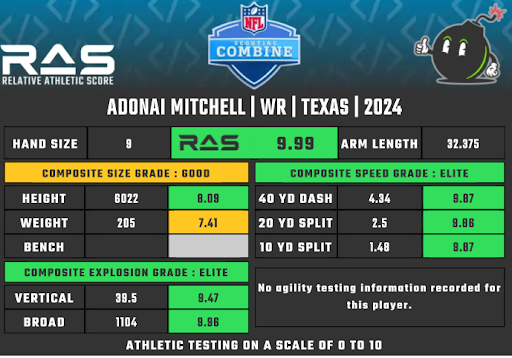
As mentioned in the draft capital section, NFL scouts are wowed by Mitchell’s traits. He has solid WR size at 6’2” and 205 lbs. His straight-line speed, as measured by his 4.34 40-yard dash, grades out as elite for a man of his size. He also possesses elite jumping ability, as shown by his 39.5-inch vertical and 11’04” broad jump. The traits are there for a high-ceiling NFL career.
Mitchell earned 15 points in this category towards his overall WR1 score.
Early Declare
Mitchell is declaring after his third year of playing college football. He is forfeiting his remaining college eligibility to enter the NFL.
Mitchell earned 5 points in this category towards his overall WR1 score.
The Hideous
Everything Else
The WR1 model uses 13 inputs. Anything that has to do with actual production, Adonai Mitchell looks terrible in. That is what makes him such a fascinating prospect. He jumps off the film and has all the traits to be a top-tier elite talent. So why has he been so mediocre so far?
Many blame his quarterback play, but Xavier Worthy managed to produce just fine. PFF also had Ewers graded as the 10th-best QB in their PFF grading system for Power 5 QBs. It’s not elite, but not terrible.
So how bad was his production?
Mitchell ranked:
- 24th of 24 wide receivers in receiving yards per team pass attempt
- 21st of 24 wide receivers in PFF receiving grade
- 20th of 24 wide receivers in college career fantasy points per game
- 20th of 24 wide receivers in weighted dominator
And here is a stat that will blow your mind:
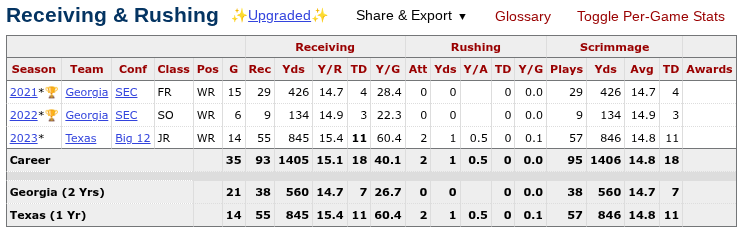
YPRR is one of the most predictive metrics for future fantasy success in the NFL. Mitchell’s best season YPRR ranked 24th of the 24 wide receivers in the model for this draft class. That is terrible. But what makes it even worse is that Mitchell’s best season YPRR was worse than 22 of the prospect’s second-best seasons in YPRR. That is monumentally bad.
Ultimately, this isn’t a fashion show. We play fantasy to get the most points based on player production. Mitchell can look as great as he wants on tape and has better athletic traits than 95% of the wide receivers in the NFL. But if that doesn’t translate to production, I can’t in good faith recommend you draft him in your Dynasty leagues. It also says a lot that his PFF grade was so bad. This is, in essence, a very comprehensive film grade that rates every targeted pass attempt, not just the highlights.
9. Ricky Pearsall, Florida
WR1 Model Score: 26.0
% Chance of a Top-24 Fantasy Season: 28.4%
Landing Spot: Average
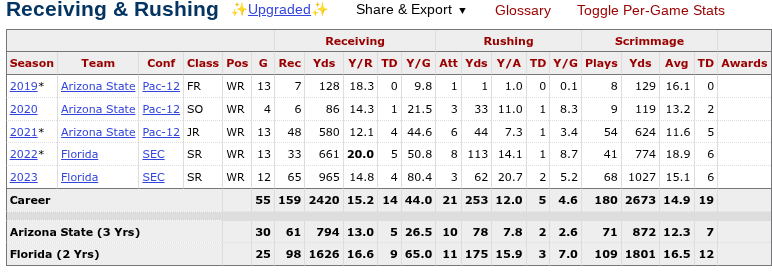
Pearsall was drafted by the San Francisco 49ers with the 31st pick in the third round of the 2024 NFL Draft. He enters a crowded room of receiving weapons with Brandon Aiyuk, Deebo Samuel, Christian McCaffrey, and George Kittle. One of those is expected to be traded, and the 49ers ranked fifth last year in pass yards per game. For this reason, he stays at average vs. below average.
Pearsall earned 5 points in this category towards his overall WR1 score.
The Good
Film Grade
Film legend Lance Zierlein is very high on Pearsall. Pearsall’s film grade, awarded by Zierlien, was a stout 6.32. This was good for seventh overall in the class. Zierlien states the following about Pearsall. “Dependable slot target with good size and soft hands who will need to prove that he can free himself against NFL-man coverage. Pearsall might get the stereotypical “crafty route runner” label, but it suits him. He appears to play with an idea of how to manipulate certain coverage looks and leverage. He also plays with attention to detail and a consistent route tempo to create windows, but lacks ideal foot quickness to beat the press and maintain separation. While the hands are reliable, he’s not physical enough to tilt contested catches in his favor and might have a ceiling of quality backup with punt-return value.”
Pearsall earned 7 points in this category toward his overall WR1 score.
Relative Athletic Score
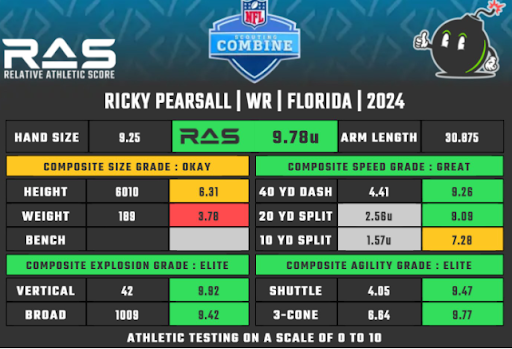
Pearsall is one of the most athletically gifted wide receivers in this class. His 9.91 Relative Athletic Score ranked tied for fourth overall in the class. NFL scouts drool over prospects who excel in the shuttle and three-cone drills. Pearsall ran a 4.05 shuttle and 6.64 three-cone, both of which graded out in the elite tier of prospects.
Pearsall earned 15 points in this category towards his overall WR1 score.
The Bad
Slot Percentage
Pearsall had a 56.5% slot usage in college. In general, slot receivers are seen as less valuable as they have more space to work with. The lack of talent depth in college also means slot receivers are seeing inferior coverage. Further, they also have hash marks that are 40 feet apart, while the NFL hash marks are only 18 feet apart, allowing slot fades to be heavily integrated in college with more space to work.
Pearsall lost 10 points in this category toward his overall WR1 score.
Late Declare
Pearsall not only failed to declare when first eligible after his third year of college, but he also did not declare for the NFL Draft after his fourth year. It was only after his fifth year that NFL scouts finally endorsed his play to say he would get significant enough draft capital to enter the draft.
Pearsall lost 5 points in this category toward his overall WR1 score.
The Ugly
College Career Fantasy Points Per Game
In his fourth year in college, which would be the final year for most prospects, Pearsall achieved a career-high yardage total. However, this total was only 661 receiving yards. Age-adjusted production is a high predictor of future fantasy success. Pearsall did proceed to put up a solid 965-yard year this past season, but he was also in his fifth year of eligibility playing against 18 and 19-year-old cornerbacks. For a player with five years of college, you would certainly like to see a higher average career fantasy points per game as most top prospects achieve their breakout in their second or third year and then continue to grow volume from their making the lower freshman production less of a factor.
However, Pearsall still only managed 10.0 fantasy points per game over his career. This ranked 19th of the 24 prospects in the model in this draft class.
Pearsall earned 15 points in this category toward his overall WR1 score.
8. Xavier Legette
WR1 Model Score: 42.0
% Chance of a Top-24 Fantasy Season: 54.2%

Landing Spot: Below Average
Legette was drafted by the Carolina Panthers with the 32nd pick in the first round of the 2024 NFL Draft. Diontae Johnson will be the alpha target earner in the revamped Panther offense. Legette looks to step into the WR2 role ahead of an ancient Adam Thielen and mediocre Jonathan Mingo. The Panthers ranked last last year in pass yards per game.
Legette earned 0 points in this category towards his overall WR1 score.
The Good
College Weighted Dominator Rating
Legette has one of the most unique analytical profiles you will ever see from a college prospect. He did absolutely nothing to receive production in his first four years and then had an insanely good fifth year. Usually, a player will show a little something before a monster breakout season. And if they haven’t, then it is highly unlikely they ever will.
College weighted dominator rating is a best-season metric measurement in the WR1 model. It measures the player’s share of the team’s receiving yards and touchdowns, weighted 80% yardage and 20% touchdowns.
Legette had the second-highest rating in this class at 41.5%, trailing only Malik Washington (Marvin Harrison Jr. and Malik Nabers were 3rd and 4th, respectively).
Relative Athletic Score
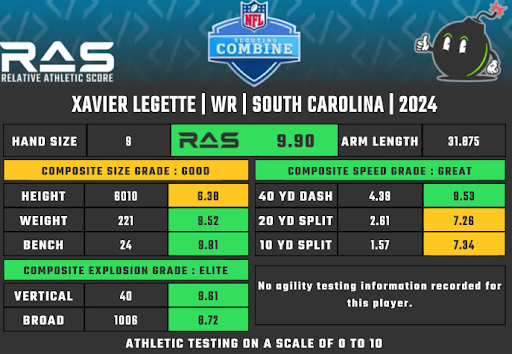
Legette possesses fantastic athletic traits that are sure to make NFL scouts drool with excitement. At 6’1” and 220 lbs., he possesses rare straight-line speed for a prospect of that size, as exhibited by his sub 4.40 forty-yard dash. His explosion is elite with a 40-inch vertical and 10’6” broad jump. His strength also grades out very well with 24 reps in the bench press at 225 pounds.
Legette’s 9.90 Relative Athletic Score was the third highest in this wide receiver class.
Legette earned 5 points in this category towards his overall WR1 score.
Yards Per Route Run
Legette accumulated 1255 yards in his senior season at South Carolina. This helped catapult him to a solid yards-per-route run of 3.15. This was good for 7th in the class.
Legette earned 12 points in this category towards his overall WR1 score.
The Bad
College Career Fantasy Points Per Game
Given Legette’s first four years in college, he had no chance to be successful in this metric.
His fantasy points per game progression was utterly unique:
- Year 1 – 2.09
- Year 2 – 3.05
- Year 3 – 1.84
- Year 4 – 4.22
- Year 5 – 19.80
Legette lost 5 points in this category towards his overall WR1 score.
The Ugly
Breakout Year
This is where Legette’s profile goes off the rails. The later the breakout year, the more unlikely a player is to hit in the NFL. A great breakout is year 1. A good breakout is year 2. An average breakout is in year 3. A bad breakout is year 4.
That brings us to Legette. Legette failed to break out until his 5th year. So I guess, as we did for Adonai Mitchell, we can call this hideous.
Legette lost 15 points in this category toward his overall WR1 score.
7. Troy Franklin
WR1 Model Score: 50.0
% Chance of a Top-24 Fantasy Season: 54.2%
Landing Spot: Average
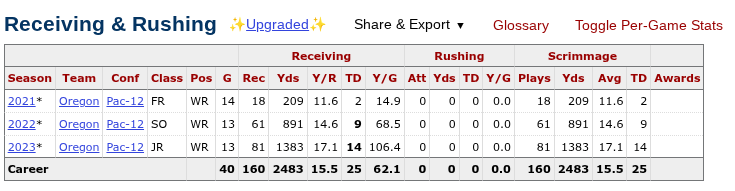
Franklin was drafted by the Denver Broncos with the 102nd pick in the fourth round of the 2024 NFL Draft. The Broncos traded up to reunite Franklin with his college QB, Bo Nix. The established rapport Franklin and Nix have with each other should make the transition to the NFL easier for both. Franklin has a path to targets competing with Courtland Sutton, Josh Reynolds, and Marvin Mims. The Broncos ranked seventh-lowest last year in pass yards per game.
Franklin earned 5 points in this category towards his overall WR1 score.
The Good
Yards Per Route Run
Franklin fared very well in this highly predictive efficiency metric. He registered a stellar 3.32 YPRR. This was good for fourth best in the class.
Franklin earned 12 points in this category toward his overall WR1 score.
Early Declare
It’s interesting that both Chris Olave and DeVonta Smith’s “play strength” concern was so prevalent that both went back to school for a 4th year.
Troy Franklin is still declaring early despite many scouts raising these same concerns due to his very lean frame.
Seems the NFL thinks it is less of an issue than Twitter, maybe due to Olave and Smith’s success
Franklin earned 5 points in this category toward his overall WR1 score.
Weighted Dominator Breakout Year
Franklin wasted no time proving himself on the biggest stage. His 891-yard sophomore campaign easily qualified him for the second-year breakout threshold we like to see out of our elite prospects.
Franklin earned 3 points in this category toward his overall WR1 score.
The Bad
Draft Capital
Franklin’s analytical profile was worthy of a first-round selection who fell to round two. The NFL has concerns about his play strength, given his very lean frame and hands. We have seen others with his body type (i.e. DeVonta Smith) succeed in recent years. Franklin was able to win vs. press coverage in college. He won’t win in contested catch situations in the NFL, but if he gets plenty of separation, that is a non-issue.
Franklin earned 5 points in this category toward his overall WR1 score.
The Ugly
None
6. Brian Thomas Jr.
WR1 Model Score: 53.0
% Chance of a Top-24 Fantasy Season: 54.2%
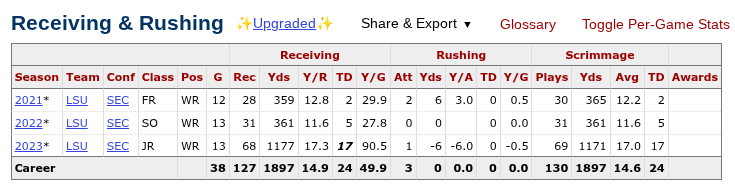
Landing Spot: Average
Thomas was drafted by the Jacksonville Jaguars with the 23rd pick in the first round of the 2024 NFL Draft. Christian Kirk and Evan Engram have proven to be prolific target earners. The Jaguars lost Ridley and added noted non-target earner Gabe Davis. The Jaguars also just traded away Zay Jones, clearing a path for Thomas Jr. to start. The Jaguars ranked ninth best last year in passing yards per game.
Thomas Jr. earned 5 points in this category towards his overall WR1 score.
The Good
Relative Athletic Score
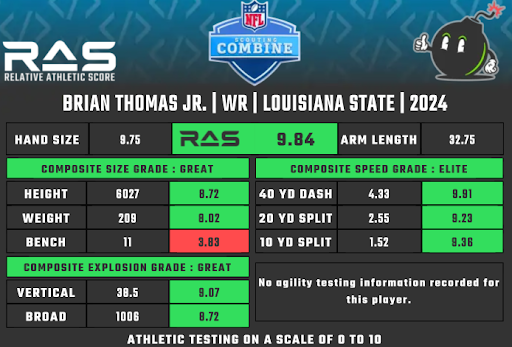
Thomas Jr. has a tantalizing combination of size and speed. Standing 6’3” and 209 lbs. while running a 4.33 is top-tier athleticism. His play strength is questionable, as evidenced by his 11 reps at the bench press, but he makes up for this with explosiveness, showcased by his 38.5-inch vertical leap and 10’6” broad jump.
He is your prototypical X receiver who can threaten defenses and be a red-zone monster.
Thomas Jr. earned 15 points in this category toward his overall WR1 score.
Early Declare
Thomas Jr. was a man amongst boys this year, but now he will be a man among men in the NFL. He has shown he is ready to compete at the highest level, and the NFL has shown they feel the same way, as indicated by his lofty draft capital.
Thomas Jr. earned 5 points in this category toward his overall WR1 score.
Film Grade
NFL.com film legend Lance Zierlein liked what he saw in Brian Thomas Jr’s film. Thomas Jr’s 6.47 grade was ranked fourth in the class behind only blue-chip prospects Malik Nabers, Marvin Harrison Jr., and Rome Odunze.
Zierlein wrote the following about Thomas Jr. in his profile, “Presents an appealing combination of size, length, and speed with experience working inside and outside. He’s elusive against the press and can uncover quickly underneath, but he still needs to improve intermediate routes and play a little more physically when crowded to become well-rounded. Thomas rarely has issues generating separation deep and could be counted on as an NFL team’s designated deep guy early in his career. Thomas is unpolished but has projectable talent to become a WR1/2 in time.”
Thomas Jr. earned 15 points in this category toward his overall WR1 score.
The Bad
Dominator Breakout Year
Some wide receivers have good excuses for not breaking out until their third year. Thomas Jr. does not. He trailed Mason Taylor and Jaray Jenkins in receiving yards in his sophomore year.
We are in the top five now. The expectation is that these prospects should have achieved the 20% team share by their second year in college.
Thomas Jr. lost 1 point in this category toward his overall WR1 score.
The Ugly
Yards Per Route Run
A 2.65 yards per route run (YPRR) just isn’t what you want to see from a wide receiver selected in the first round of the NFL draft—we at least want them above 3.00. Thomas Jr.’s performance in this metric netted him just a rank of 14 among the 24 prospects evaluated in the model.
Thomas Jr. earned 0 points in this category toward his overall WR1 score.
5. Ladd McConkey
WR1 Model Score: 54.0
% Chance of a Top-24 Fantasy Season: 54.2%
Landing Spot: Above Average
McConkey was drafted by the Los Angeles Chargers with the second pick in the second round of the 2024 NFL Draft. He immediately steps into an alpha role stacked with a historically good young passer in Justin Herbert. Expect the Chargers to run more than past years with Jim Harbaugh and Greg Roman pulling the strings on offense. The Chargers ranked thirteenth best last year in pass yards per game..
McConkey earned 8 points in this category towards his overall WR1 score.
The Good
Yards Per Route Run
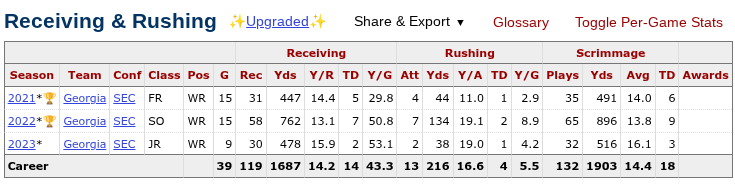
McConkey’s profile doesn’t wow you with cumulative production statistics. But his efficiency was excellent. He trailed only Malik Nabers, Marvin Harrison Jr., Johnny Wilson, and Troy Franklin in this very important predictive metric.
McConkey earned 12 points in this category towards his overall WR1 score.
Breakout Year
In an ideal world, we want our top receiving prospects to achieve a breakout (20% team receiving share) by their second year. McConkey accomplished this feat with 762 yards receiving as a sophomore at Georgia.
McConkey earned 4 points in this category towards his overall WR1 score.
The Bad
Receiving Yards Per Team Pass Attempt Per Game
It is unusual to see YPRR and receiving yards per team pass attempt per game so misaligned for the same prospect. This speaks to McConkey’s usage at Georgia. He was simply not in the game running routes as much as your typical wide receiver. Kirby Smart clearly thinks he either doesn’t add any value unless targeted or is an injury risk.
McConkey registered a mere 1.99 receiving yards per team pass attempt per game. This ranked 21st of the 24 top-receiving prospects evaluated in the model.
McConkey earned 0 points in this category towards his overall WR1 score.
The Ugly
College Weighted Dominator Rating
McConkey’s volume simply was not there. Georgia chose to play him more as a part-time player for whatever reason. This is not the end of the world. We saw the same thing with Puka Nacua at BYU. This is why we pay attention to the underlying efficiency metrics such as YPRR.
However, it is absolutely a red flag. McConkey ranked 24th of the 24 top prospects evaluated in this model.
McConkey lost 5 points in this category toward his overall WR1 score.
4. Xavier Worthy
WR1 Model Score: 62.0
% Chance of a Top-24 Fantasy Season: 54.2%

Landing Spot: Above Average
Worthy was drafted by the Kansas City Chiefs with the 28th pick in the third round of the 2024 NFL Draft. Catching balls from the best passer in the NFL is always a good thing. He has unique Tyreek-like speed and height, so Dynasty managers are drooling over the possibility he reprises that role. The Chiefs ranked sixth-best last year in pass yards per game.
Worthy earned 8 points in this category towards his overall WR1 score.
The Good
Breakout Year
Elite prospects produce early. It is that simple. Worthy came to Texas as a freshman and immediately became their best receiver—it wasn’t even close. Worthy had 981 yards receiving, while the second-most receiving yards on the team were 377.
Worthy earned 6 points in this category towards his overall WR1 score.
Relative Athletic Score

Worthy is unique because he is an absolute burner who can also run routes highly effectively. He set the record at the NFL Combine for the fastest 40-yard dash time ever at 4.21. This graded out as elite. His explosiveness was also evident with his 41-inch vertical and 10’11” broad jump, both also elite. While he has an extremely lean body type for the NFL, his measurables overcome that.
Worthy earned 12 points in this category towards his overall WR1 score.
The Bad
Yards Per Route Run
This may be a tad of a stretch to call Worthy’s YPRR performance bad, but it certainly is not good. Ideally, we want our top prospects to have a YPRR best season of over 3.00. Worthy comes in at a 2.61. This ranked 16th of the 24 wide receivers evaluated for the model.
Worthy earned 0 points in this category toward his overall WR1 score.
Film Grade
Utilizing film legend Lance Zierlein’s film grade, Worthy checks in at a modest 6.26. This checked in at 11th overall in the class. That is not terrible, but we are in the top six now, so we need higher standards.
Zierlein writes about Worthy, “Worthy’s draft slotting could come down to draft-room debates weighing his elite speed versus his thin frame. Worthy will find separation if allowed to explore vertically or across the hashes against man coverage, but he lacks play strength and release quickness to defeat a quality NFL press. His quick-strike potential adds an element of danger over the top and should open wider windows for teammates to work into. He lacks the physical tools to catch when contested and needs to prove he can hold up to a more physical brand of football. Worthy is a niche prospect for teams looking to add a legit field-stretcher, but areas of concern could create a wider gap between ceiling and floor.”
Worthy earned 3 points in this category toward his overall WR1 score.
The Ugly
PFF Receiving Grade
The graders at PFF are not fans of Worthy. Of the top-24 receiving prospects in this class, they graded Worthy just 21st. PFF grades every targeted pass attempt, so as a burner who primarily uses his speed to win, it is possible that Worthy can’t go full steam on every attempt. Twitter keeps saying AD Mitchell didn’t produce more because Ewers sucks.
PFF, which grades every targeted attempt, gave the following grades:
Xavier Worthy and AD Mitchell
79th and 65th best wide receivers in the nation
Quinn Ewers ranked 12th for QBS
Seems the Ewers’s awful narrative is overblown to this analyst.
Worthy lost 2 points in this category towards his overall WR1 score.
3. Rome Odunze
WR1 Model Score: 74.0
% Chance of a Top-24 Fantasy Season: 70.8%
Landing Spot: Below Average
Odunze was drafted by the Chicago Bears with the ninth pick in the first round of the 2024 NFL Draft. DJ Moore commanded a 28.9% target share last year, while Keenan Allen commanded a 32% target share. These are two alphas that Odunze has to compete with for targets while a rookie QB mans the helm. The Bears ranked sixth-lowest last year in pass yards per game.
Odunze earned 0 points in this category towards his overall WR1 score.
The Good
Draft Capital
We are now in the blue-chip section of the rankings, with each of the three remaining prospects having a greater than 70% chance of achieving at least one top-24 fantasy season in their career. Top-15 picks in the NFL draft predictably hit at a higher rate than receivers drafted in other rounds. Odunze now meets this criterion.
Odunze earned 20 points in this category toward his overall WR1 score.
Film Grade
Film legend, Lance Zierlein, gave Odunze the third-highest grade in this draft class with a stout 6.74. For context, this was a higher grade than any other wide receiver from the 2023 class. Zierlein had this to say about Odunze, “While most receivers look to open separation windows with speed or route running, Odunze seems to relish jump balls and contested catches. He shines in all aspects of ball skills, including positioning, body control, hand strength, timing, and mid-air adjustments. He has a tendency to cruise through routes rather than work with attention to detail and pacing. He was a decorated high school sprinter, so speed should not be an issue in the pros. He’s a high-volume target on the next level that play-callers can utilize to mismatch finesse cornerbacks. Elite ball skills are often the secret sauce for top NFL receivers, so it should not surprise that Odunze is a Day 1 starter who becomes a top-flight WR1.”
Odunze earned 11 points in this category toward his overall WR1 score.
College Career Fantasy Points Per Game
Odunze shone in this metric, which is ultimately the metric we want the prospect to succeed in for our Dynasty teams. Odunze’s mark of 17.4 fantasy points per game was second in the class. Staying the extra year helps his cause here, as production in early years is almost always lower vs. the players who were early declares, but this is still an impressive feat.
Odunze earned 3 points in this category toward his overall WR1 score.
The Bad
Weighted Dominator Breakout
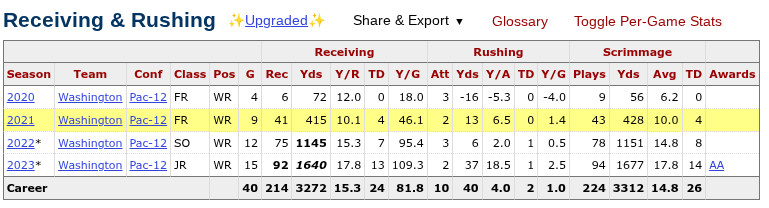
Odunze had receiving yardage totals of 72 and 415 in his first two years at Washington. This failed to meet the 20% team share criteria needed to qualify for a breakout. It was not until Odunze’s third year at Washington that he finally broke out with a 1145-yard season.
Odunze lost 1 point in this category toward his overall WR1 score.
The Ugly
Late Declare
17 of the top-20 ranked wide receivers in the WR1 model were early declares. The only ones who were not were DeVonta Smith, Chris Olave, and Corey Davis. Two of those three were hits or 67%, which is far lower than the 91.7% hit rate of the overall top 20.
Odunze lost 5 points in this category toward his overall WR1 score.
2. Marvin Harrison Jr.
WR1 Model Score: 92.0
% Chance of a Top-24 Fantasy Season: 91.7%
Landing Spot: Above Average
Harrison Jr. was drafted by the Arizona Cardinals with the fourth pick in the first round of the 2024 NFL Draft. Harrison Jr. was going to step in and be the alpha X in most offenses, so the depth chart isn’t that important. I project him for 150 targets in year one. The Steelers ranked seventh-lowest last year in pass yards per game. This should increase significantly with a fully healthy Kyler Murray and a stud WR1 target.
Harrison Jr. earned 8 points in this category towards his overall WR1 score.
The Good
Draft Capital
Before you freak out that Harrison Jr. is not number one overall, let me provide some context. Harrison Jr. would have been the number one overall wide receiver last year, but the prospect at number one this year has such a pristine analytical profile. Harrison Jr. was the first wide receiver selected in the NFL draft.
Harrison Jr. earned 3 points in this category toward his overall WR1 score.
Breakout year
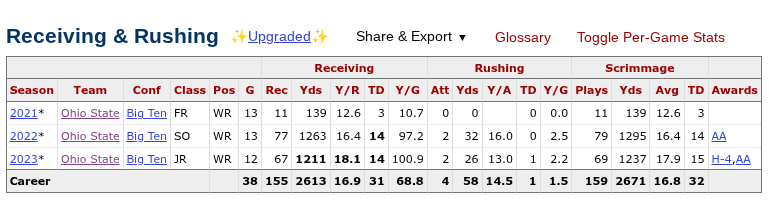
Harrison started his freshman campaign at Ohio St. buried on the depth chart behind one of the best wide receiver groups in college history with Garrett Wilson, Chris Olave, and Jaxon Smith-Njigba. After Wilson and Olave jettisoned Ohio St. for the NFL, Harrison Jr. erupted in his second year at Ohio St. As a true sophomore, Harrison caught 77 balls for 1263 yards and 14 touchdowns.
Harrison Jr. earned 3 points in this category toward his overall WR1 score.
College Weighted Dominator Rating
Harrison registered a best-season weighted dominator rating of 39.3% (team share of receiving yardage and touchdowns weighted 80% yards to 20% touchdowns). This was good for third best in the class behind the wildly productive fifth-year super senior seasons from Malik Washington and Xavier Legette. Bear in mind that Harrison Jr. was in his third year, and it is a more impressive feat.
Harrison Jr. earned 3 points in this category toward his overall WR1 score.
Yards Per Route Run
Harrison Jr.’s efficiency was not to be outdone by his cumulative production. His YPRR (best season) was a tidy 3.44. This trailed only our model’s number one overall prospect in its ranking. An elite YPRR mark such as this is more impressive when it comes with a high volume, as was the case for Harrison Jr. vs someone like Ladd McConkey or Johnny Wilson, who both posted YPRR marks over 3.20.
Harrison Jr. earned 12 points in this category toward his overall WR1 score.
Film Grade
It was hard to find much to complain about in Marvin Harrison Jr.’s tape, and Lance Zierlein reinforced this with his grade on Harrison Jr. of 6.83. This was the second-highest film grade Zierlein gave out in this class. Zierlein had this to say about Harrison Jr. in his profile. “Harrison comes from impressive NFL bloodlines and possesses similarities that made his father, Pro Football Hall of Famer Marvin Harrison, special. Harrison can run, but isn’t a burner. What makes him tough to handle is his consistent play speed paired with quality salesmanship in his routes. He’s able to uncover no matter where he’s aligned or which part of the field his assignment takes him to, and he is capable of finishing catches in a crowd… Harrison is a touchdown champ with a variety of ways to excel, and that characteristic figures to follow him into the pros. He has the traits and tools to win in all three phases of the route and on all three levels of the field. He’s a pedigree prospect and a Day 1 starter with high-end production expected.”
Harrison Jr. earned 11 points in this category toward his overall WR1 score.
The Bad
None
The Ugly
Contested Target Rate
Contested target rate is exactly what it sounds like. It is a measure of a players % of targets that were deemed contested by PFF. At its core, it is a measure of the player’s ability to separate. At the college level, it is easier for some receivers to use their physical prowess to outcompete defensive backs. That does not translate to the NFL. They need to separate.
Per Scott Barrett, the top-10 Power 5 players with the highest contested target rate since 2017 include famous draft busts like JJ Arcega Whiteside (37.3%), Denzel Mims (28.9%), Hakeem Butler (28.8%), Quentin Johnston (27.1%), Tylan Wallace (27.0%), Terrace Marshall (26.5%) and David Bell (26.5%). Coming in right after David Bell is none other than Marvin Harrison Jr. at 26.3%
Harrison Jr. lost 8 points in this category towards his overall WR1 score.
1. Malik Nabers
WR1 Model Score: 104.0
% Chance of a Top-24 Fantasy Season: 91.7%
Landing Spot: Average
Nabers was drafted by the New York Giants with the sixth pick in the first round of the 2024 NFL Draft. Daniel Jones is not an elite-level quarterback by any means, but he has also had Darius Slayton lead his receiver group in yards for four of the past five years. Nabers immediately becomes the alpha and a good bet for 150 targets. His short-area quickness is a huge benefit in an offense that has struggled mightily with pass blocking. The Giants ranked second-lowest last year in pass yards per game.
Nabers earned 5 points in this category towards his overall WR1 score.
The Good
Draft Capital
Coming in with the highest overall WR1 model score for 2024 is Malik Nabers. Nabers 99.0 is the highest score received in the model since Ja’Marr Chase received a 102.0. Nabers has long been considered a top-10 NFL draft pick, and that came to fruition Thursday in Detroit. Nabers has all the versatility to line up outside or inside and present matchup problems based on which defense they want to scheme against.
Nabers earned 20 points in this category towards his overall WR1 score.
Film Grade
Nabers was awarded the top overall film grade in this class by film legend Lance Zierlein. His 6.86 nudged out Harrison Jr.’s 6.83. Zierlein wrote this about Nabers in his draft profile, “Nabers is the next big thing coming out of LSU’s receiver room, with the pure explosiveness and talent to be mentioned in the same breath as former LSU stars starring in the league today. Despite a lack of polish and precision as a route-runner, Nabers’ gliding movements and speed alterations seem to disguise the top-end speed and separation potential that await opposing coverages. He’s a bouncy leaper with the athletic ability to make the impossible catches possible. He tucks away accurate throws and displays the toughness and play strength to fight for tight-window victories over the middle. Nabers will need to address his tendency to track and play deep throws with finesse, or his early advantages will turn into 50/50 battles. He can play all three receiver spots and has the profile to become a productive, high-volume target over all three levels as a potential WR1.”
Nabers earned 11 points in this category towards his overall WR1 score.
Receiving Yards Per Team Pass Attempt Per Game
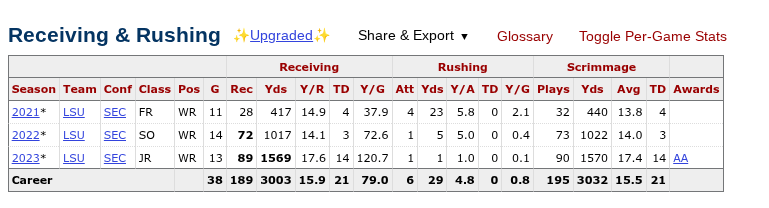
After an excellent sophomore year with 1017 yards, Nabers did not rest on his laurels. He proceeded to obliterate those numbers, posting 1569 yards receiving. Despite significant target competition with Brian Thomas Jr., Nabers easily coasted to the highest receiving yards per team pass attempt per game in this class at 3.86. Harrison Jr. finished third behind Malik Washington at 3.23.
Bear in mind Nabers did this as a junior also. Age-adjusted production is very important to forecasting future fantasy success in the NFL
Nabers earned 12 points in this category towards his overall WR1 score.
The Bad
Slot Percentage
Scott Barrett did an excellent job highlighting how Malik Nabers’ slot fade was a cheat code in college last year. This also does not translate to the NFL because of the wider hashes in college vs. the NFL. In addition, college teams don’t have the depth of NFL teams to put serviceable defensive backs in the slot.
Nabers lost 10 points in this category towards his overall WR1 score.
The Ugly
None
You made it! This is the end. I hope you enjoyed this article as much as I enjoyed all the research and analysis.
Thank you to Player Profiler, Lance Zierlein, NFL Mock Draft Database, and Spaceman Prospect Database for supplying data. Some of these metrics are dynamic and may change after this article is published.
I hope you enjoyed reading my article. My goal is to provide actionable advice you can utilize to improve your Dynasty team. You can follow me on Twitter @force_fantasy. #DFFArmy #FantasyFootball #AlwaysBeBuilding #NFL #NFLDraft #NFLTransactions #NFLTrades #AlwaysBeScouting
Click here for a 12-month DFF Membership.