
Welcome to the Dynasty Market Sweep, a weekly recurring offseason article focusing on substantial value disparities in the dynasty market consensus. The very nature of the instantaneous fantasy news feed has made the dynasty market more reactionary and volatile than ever before. Once the proverbial petrol is poured and Twitter fingers snap to ignite, player values can burn to the ground overnight. Value changes of this nature cause a ripple effect across the market. For every step up the ladder, someone must move down and vice versa.
This will not be your typical “Buy/Sell” advice column. We are going to hone in on distinct seismic shifts in the dynasty community, provide an explanation as to why these changes are happening, and tell how you can exploit said changes to benefit your roster. If a player drops or raises drastically in value, we may suggest a transaction. However, the primary goal is to understand how to adjust within the market and avoid getting swept up in the whirlwind of overreaction.
VETERAN MARKET EVALUATION
Veteran values transition through a cyclical cycle every offseason. The psychological desperation to replace the old with something new and shiny is inevitable. Dynasty strategists can’t help but fawn over incoming rookies. Even in a weakened 2022 draft class, we saw incredible market shifts propelling rookies up the rankings. The causality of the heightened rookie evaluations leading into a new season is the decreased value of veteran counterparts.
If you are interested in an extensive dynasty market report on rookie evaluations and the attachment to assumed value, check out the Dynasty Market Sweep: Rookie Series.
Throughout this offseason series, we have stated that rookies are continuously valued at their potential ceiling rather than a median range of outcomes, creating a lopsided shift in the market. Managers are enamored with the unknown. The risk may be more substantial, but the mere idea of a considerable payoff is a scintillating gamble for many.
Running backs are recycled rapidly on dynasty rosters due to a shortened age window of production. In the last ten seasons, 71% of running backs that finished in the RB1 tier in PPR scoring were aged 26 and under, per PFF. This drop-off in production is what managers often refer to as “the age cliff.” Knowing when the majority of players at a position begin to decline allows managers to sell at an increased value before the wheels fall off.
Unfortunately, in 2022, the return on investment for a veteran running back value is at an all-time low. The market is adjusting early in preparation for the influx of multiple running backs in the 2023 NFL Draft who could enter the league with top-12 positional value. This under-evaluation of established producers has caused managers to jump ship on some of the league’s top-rated workhorses.
In this episode of the Dynasty Market Sweep, we will evaluate established running backs that have received noticeable decreases in value due to offseason market shifts. We will highlight a few players that are being viewed below their potential production and provide reasoning as to why those values exist.

NOTABLE MARKET CHANGES
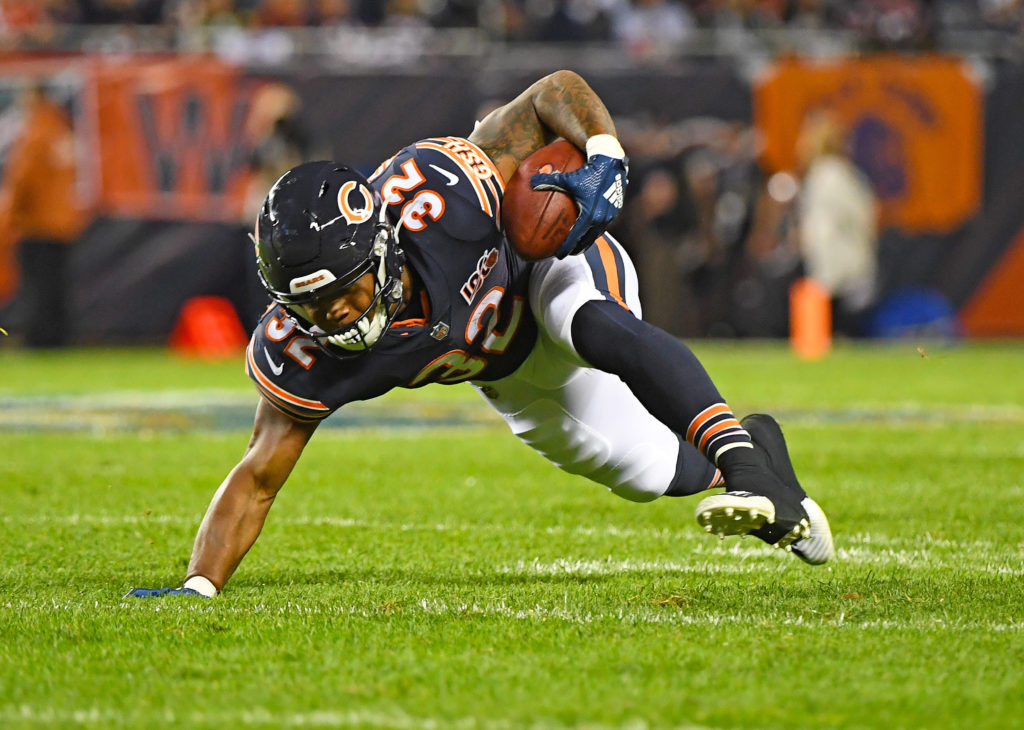
Aaron Jones RB – Green Bay Packers
Position Rank: RB 19
Overall Rank: 72
Value Adjacent Assets:
Mac Jones QB – New England Patriots
DeVonta Smith WR – Philadelphia Eagles
Zach Wilson QB – New York Jets
2022 Mid-First Round Rookie Draft Pick
David Montgomery RB – Chicago Bears
T.J. Hockenson TE – Detroit Lions
Aaron Jones is bleeding dynasty value like a sieve trying to stop a landslide. At this juncture last offseason, Jones was ranked as high as the RB5 overall on the dynasty market. The former Pro Bowler gives managers a perfect example of the volatility of running back value from year to year, regardless of their presumed production.
Jones is a player placed well below his production ceiling for the 2022 season for multiple reasons. At 27 years old, Jones’ future as a top producer is very much in question, as we exemplified in the opening statements. Secondly, the emergence of AJ Dillon has stymied some of Jones’ upside.
Dillon began to eat into Jones’ workload in 2021, finishing out the season with over 50% of the offensive snaps in five of seven games. Managers foolishly overlook that Jones was dealing with minor lower-body injuries during those seven games, which directly correlated to Dillon’s increased workload.
Dillon is likely the franchise’s future RB1. Nevertheless, if Jones is healthy, he should be considered the starter and lead back on the Packers’ offense. Furthermore, the sudden departure of Devante Adams via trade has left the offense needing a secure target in the passing game. Assuming that any Packers receiver will see an immediate increase in role and production due to the absence of Adams is false. The more likely scenario is that Aaron Rodgers is forced to check down to his running backs repeatedly as his receivers struggle to get open downfield.
Jones has the opening in front of him to lead the Packers in both rushing and receiving in the 2022 season. His age and decline in market value offer managers a chance to acquire a league-winning asset at a discount. However, it is worth noting the return on investment is likely to remain stagnant from a rebuilder’s perspective. Jones will hold premium value for contending teams only.
Jones’ market consensus ranking appears locked in as he approaches the twilight of his career, leaving managers to sell for a late-first-round rookie draft pick at most even if he does meet his lofty 2022 projections.
David Montgomery RB – Chicago Bears
Position Rank: RB 20
Overall Rank: 74
Value Adjacent Assets:
Aaron Jones RB – Green Bay Packers
Zach Wilson QB – New York Jets
2022 Mid-First Round Rookie Draft Pick
T.J. Hockenson TE – Detroit Lions
Deshaun Watson QB – Cleveland Browns
Darnell Mooney WR – Chicago Bears
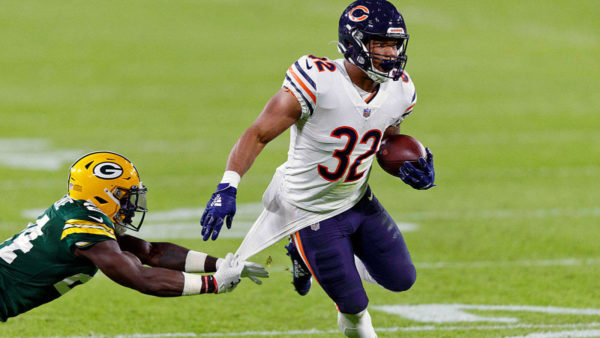
David Montgomery is lumped into a near-identical value tier as our previously mentioned player. However, he is somewhat of an outlier in this episode of aging producers. The Bears’ fourth-year back is just 25 years old and presumably has several years of exceptional production left in the tank. His decline on the dynasty market coincides with blind confidence in rookie producers. I call this the butterfly effect. The misvalue of a young established running back such as Montgomery reflects a preposterous bravado in the unknowns of current NFL rookies with mediocre profiles.
The Bears’ offensive outlook for 2022 is not overly optimistic, with a dearth of receiving talent on the roster. The one player that has proven to be a reliable cog in an otherwise broken machine is Montgomery. He ranked second amongst running backs in 2021 with 74.8% of the offensive snaps. As a volume producer, Montgomery averaged an 80% opportunity share and ranked fourth in the league. He led the Bears with seven touchdowns in 2021 despite missing four games while nursing a knee injury, accumulating 15.1 PPR PPG equating to RB12 overall on the season.
The mini-breakout of Khalil Herbert during Montgomery’s four-game absence should do nothing to wane managers’ confidence in the Bears’ franchise running back. Montgomery averaged a higher snap percentage and opportunity share after he returned from injury, further cementing Herbert as a high-upside handcuff and nothing more.
Montgomery is the one player in this episode of Dynasty Market Sweep that could see significant growth in market value if his production flourishes in the upcoming season. Montgomery has finished as a top-12 running back in PPG in both PPR and standard scoring in back-to-back seasons. If he can maintain his impressive floor of consistent production, his market price would surpass the value-adjacent veterans he is currently grouped with.

Ezekiel Elliott RB – Dallas Cowboys
Position Rank: RB 23
Overall Rank: 93
Value Adjacent Assets:
Kenny Pickett QB – Pittsburgh Steelers
Elijah Mitchell RB – San Francisco 49ers
Josh Jacobs RB – Las Vegas Raiders
James Cook RB – Buffalo Bills
Brandon Aiyuk WR – San Francisco 49ers
Leonard Fournette RB – Tampa Bay Buccaneers
During the beginning of the 2021 season, Ezekiel Elliott looked like the elite asset of yesteryear we once knew and loved. Before the Cowboys’ Week 7 bye, Zeke had amassed five weeks with RB1 production. The train was soon derailed by a Week 9 PCL tear that caused a drastic deterioration in production. Elliott was able to play through the injury but only managed two weeks of RB1 output in the final eight games. A decrease in dynasty value soon ensued, with managers fearing a slower, less effective version of Elliot this season. Adding salt to the wound, the dynasty community’s infatuation with Elliott’s younger teammate Tony Pollard has further deflated the veteran’s value.
Offseason reports suggest that Elliott is fully recovered from his injury, looking better than ever at the Cowboys’ limited OTA/Minicamp meetings. I will not attempt to falsify Elliott’s current state of health. At this stage in his career, Elliott’s overall durability should be the least of concerns for dynasty managers.
The 27-year-old running back has watched his production and efficiency widdle away as his age increases. Before his injury, Elliott was coming off a career-low 979 rushing yards on 244 carries (4.0 YPC) in 2020. He was the only player that season with over 240 rushing attempts that did not break the thousand-yard threshold.
Despite his injury and dwindling play, the Cowboys fed Elliott a whopping 237 carries in 2021. His 58.9 rushing yards per game ranked 17th in the league; his carries ranked 7th. Elliott’s Rushing Yards Over Expectation (RYOE) ranked 31st at 0.19 yards per attempt, followed by a disgustingly inefficient 0.50 Points Per Opportunity Excluding Touchdowns (PPOxTD), ranked 45th. Had it not been for Elliott’s impossibly high 12 total touchdowns in 2021, he would have finished well outside the top-ranked players at the position.
Dynasty managers should take every opportunity possible to sell Elliott for a maximum return. Meeting statistical projections in the upcoming season will do little to stem the loss of value. Elliott’s best days are behind him.
SIGNOFF
Managing a Dynasty roster is about building long-lasting success in the chaotic and unpredictable landscape of fantasy football. The idea should be to give yourself as many assets/bargaining chips as possible so that when you move all in, the deck is stacked in your favor.
“We are card counters at the blackjack table, and we’re going to turn the odds at the casino.”
Much respect; thank you for reading. If you have any continued thoughts and would like to share, I am always available for an open conversation on Twitter: @PsychWardFF or Instagram: @psychwardff.
Check out the other episodes in this multi-part series!
Dynasty Market Sweep: Veteran WR Evaluation
Dynasty Market Sweep: Veteran WR Evaluation Part 2
Dynasty Market Sweep: Veteran TE Evaluation
Don’t forget to join the #DFFArmy for exclusive fantasy football content by clicking HERE for a membership! #AlwaysBeBuilding


Pingback: Dynasty Market Sweep: Veteran RB Evaluation Part 2 - Dynasty Football Factory
Pingback: Dynasty Market Sweep: Veteran QB Evaluation - Dynasty Football Factory