

Welcome to Part 2 of the 2022 WR1 rating scores!
For those new to the WR1 rating, this is a proprietary formula I developed to provide a data-driven forecast of future dynasty value for incoming rookie wide receivers. The WR1 model scores rookies on nine predictive metrics and then combines those individual metric scores into a total WR1 rating score. The goal is to provide a single easy-to-use score for those who don’t want to spend all the time dissecting different metrics.
You may find an in-depth explanation of the model’s process and a glossary of what the metrics mean here.
Before we get into the 2022 prospects, here are the top 20 all-time prospects in the model so you can see how effective it is at forecasting future fantasy value.

Note: Relative athletic score, NFL.com film grade, and consensus projected draft capital are dynamic. Since the first players were posted Christian Watson moved into the top 10 with the newest data.
Updated WR1 model rankings:
You may find the profile writeups for the first players in the countdown here.
15) John Metchie
14) Alec Pierce
13) Justyn Ross
12) Jalen Tolbert
11) Jahan Dotson

The Good
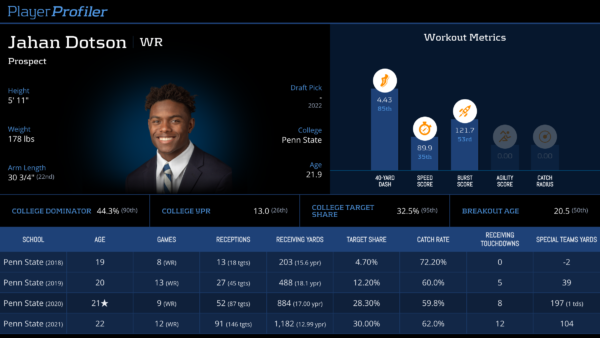
The mock draft and film community likes Jahan Dotson more than most analytics-based analysts. Lance Zierlein gave Dotson a film grade of 6.33 which is the sixth-highest in the class. He has excellent twitch and acceleration to get in and out of his breaks and create separation.
Here are some of his film highlights:
He has consistently been mocked on the fringe of round one through the first few months of the year. This is holding his WR1 rating together. Should Dotson drop to round two in the actual draft this would drop him out of the top ten 2022 wide receiver prospects. That said, Dotson performed very well in dominator rating, earning five points with his 44.3% mark.
The Bad
Receiving yards per team pass attempt (RYPTPA) is one of the more predictive individual metrics in forecasting future fantasy production. Dotson posted a mediocre 2.88 which ranked tenth among the top prospects in the 2022 class. Dotson also was subpar in his relative athletic score, breakout age, and career PPR points per game.
The Ugly
Dotson played for four years in college which is a major red flag in my model. It deducts five points from the overall score vs. adding five points if they do declare early. This is a key signal of how ready the NFL feels the player is to make an impact.
10) David Bell, Purdue


The Good
David Bell burst onto the scene as a freshman playing alongside Rondale Moore at Purdue. He achieved a breakout (Over 20% share of his team’s receiving yardage and TD production) his freshman year, compiling 86 receptions for 1035 receiving yards and a 25.2% target share. He is an early declare who has consistently produced, averaging 22.9 fantasy points per game throughout his college career. That was the top PPR PPG in this draft class.
The Bad
Bell’s receiving yards per team pass attempt of 2.39 is lower than what you want from a top receiving prospect. The top players in this class are 3.5 or greater. Film experts question his ceiling due to his lack of athleticism. Lance Zierlein recently changed Bell’s film grade from 6.11 to 5.90 after he tanked at the combine. This dropped Bell to zero points for his film grade.
The Ugly
Bell smashed a lot of his fan’s dreams at the combine. His relative athletic score of 2.72 was very bad. Players like this rarely get drafted in the top two rounds. It would seem most likely Bell goes in the third now and perhaps the fourth. Jarvis Landry is the only recent wide receiver I could find drafted in the top two rounds with a lower relative athletic score. I will be updating the WR1 scores after the draft based on actual draft capital.
9) Christian Watson, North Dakota State (Updated due to newest Lance Zierlein film grade update)


The Good
Watson was the leading receiver on the 2019 North Dakota State team which featured Trey Lance at quarterback. He vaulted up draft boards after a tremendous Senior Bowl week. He was named as the National team’s top receiver. The Athletic reported him as “virtually uncoverable in one-on-one drills”
His size (6’4” 208 lbs.), speed (4.36 forty-yard dash), and vertical (38.5 inches) make him an attractive target for NFL general managers. This gave Watson a perfect 10 relative athletic score which is the top in this class. Julio Jones, Calvin Johnson, Chase Claypool, and Andre Johnson are some other names in the top ten all-time for the relative athletic score.

Watson’s second strongest metric was his dominator rating of 44.0%. This is 90th percentile among prospects and ranked fifth overall. The RYPTPA was solid at 3.12 contributing 10 points to his WR1 rating. His projected second-round draft capital is also a highlight.
The Bad
Watson stayed all four years which subtracted five points vs if he had declared early. His PPR PPG was subpar for a top-level prospect at only 9.0 per game during his college career. The Bison were a run-heavy team who typically had big leads in games during Watson’s tenure, so Watson doesn’t have eye-popping volume stats.
The Ugly
The level of competition for NCAA’s Division I Football Championship Subdivision scored Watson negative eight points towards his WR1 rating score. Watson was a man among boys so it remains to be seen how he will fare vs bigger, stronger, faster athletes.
8) Skyy Moore, Western Michigan

The Good
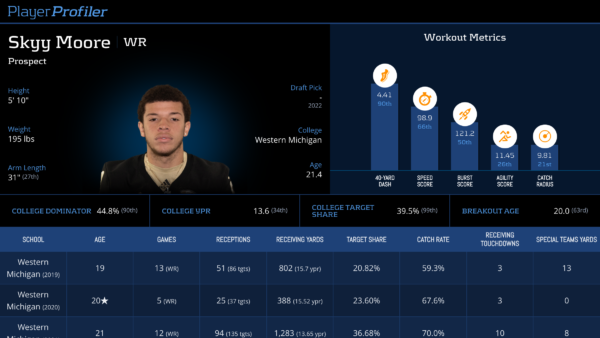
Skyy Moore is one of the most intriguing prospects in this class. Whatever Moore touches he catches. He has unusually large hands for someone 5’10”.
Moore is a G5 player declaring for the draft as a junior. That in and of itself should tell you how good Moore is. Western Michigan threw to Moore early and often. He had a 3.48 receiving yard per team pass attempt which was third-best in this class. He also led all prospects in yards per route run. The fact he excelled vs press coverage is a good sign for his ability to transition at the NFL level.
The Bad
Lance Zierlein’s film grade of 6.24 was not as high as some of the top prospects in this class. Lance described Moore as “courageous working into the teeth of the defense and tenacious to come up with contested catches from anywhere on the field. He’s a one-note route-runner lacking acceleration out of breakpoints and vertical juice to separate deep. His ball skills and toughness create opportunities as a reliable target and capable route-runner from release to whistle.”
The Ugly
The biggest red flag for Skyy Moore is his level of competition. His production has been outstanding but it should be against Kent State and San Jose State.
7) Wan’Dale Robinson, Kentucky


The Good
The WR1 model is a fan of Wan’Dale Robinson. His production profile matches up with the best in this class. Robinson is a dynamic playmaker. He will benefit most from an offense that can creatively find ways to get him in space as the 49ers have done with Deebo Samuel. Wan’Dale achieved the maximum possible points available in the model in breakout age (18.7, six points) and conference (SEC, six points). Wan’Dale led all prospects in this class in RYPTPA at 3.64. This earned him 12 points toward his overall WR1 score.
The Bad
The projected third-round draft capital is not what you want to see from a top wide receiver in the class. This accounted for a zero towards his overall score whereas a first-rounder gets 13 points.
The Ugly
He is 5’8” tall. As @ChrisMiles1017 wrote about here, 19 players since 2013 have been drafted and shorter than 5’10” but only two have become hits. The game is changing though and the field is more spread out. Little guys like Elijah Moore and Rondale Moore could soon change that stat. This height was a key driver in Robinson’s low relative athletic score.

6) George Pickens, Georgia


The Good
Pickens utilized his excellent hands to break out during his freshman year with 727 yards receiving and eight touchdowns. This earned him the maximum six points for breakout age. Pickens went up against the best competition in the country playing in the SEC and the WR1 model rewards him for that with six points. He is an early declaration earning five points. Lastly, his relative athletic score of 9.35 was one of the top scores in this class. This earned him 12 points thanks in large part to his speed for a man 6’3” tall. Here is a clip of Pickens running his forty-yard dash at the combine.
The Bad
Pickens is an interesting case study for analytics-based models given his ACL tear ruined what would have been his most productive year. Pickens best season receiving yards per team pass attempt (RYPTPA) was 1.75 but it was done as a freshman. He also achieved his best season dominator of 27.0% as a freshman.
This is where we need to adjust for context as this was not an accurate reflection of his actual production. For this exercise, we added a conservative 20% to his freshman year dominator and RYPTPA to make these numbers more comparable to other prospects. The average prospect increase from freshman year to junior year is greater than 20% but I wanted to be conservative. This is further represented when you look at Pickens yards per route run. He did not run many routes his junior year but he posted a 3.34 YPRR which ranked sixth in the class.
The Ugly
Pickens’s performance suffered when he came back from his ACL tear in 2021. It is common for it to take some time before players return to their prior form. The PPR PPG is also less than we would like to see at 12.9. As such, Pickens had five points deducted from his overall WR1 score in the dominator and PPR PPG metrics.
I hope you enjoyed reading my article. My goal is to provide actionable advice you can utilize to improve your dynasty team. You can follow me on Twitter at @force_fantasy.



Pingback: The WR1 Rating Dynasty Rookie Wide Receiver Countdown: Part 3 - Dynasty Football Factory