

Over the next few weeks, I will be revealing the Pre-NFL Draft WR1 Prospect Model Ratings.
For those new to the WR1 rating, this is a proprietary formula I developed to provide a data-driven forecast of future dynasty value for incoming rookie wide receivers. The WR1 model scores rookies on nine predictive metrics and then combines those individual metric scores into a single WR1 rating. The goal is to provide a single easy-to-use score for those who don’t want to spend all the time dissecting different metrics. If data-driven rankings are not for you, I suggest my colleague @DocFFFN‘s wide receiver review from a film perspective here.
Before I go into further explanation I want to provide a proof of concept. The WR1 rating database includes the college data for all wide receivers drafted between 2007-2022. Each prospect is graded using the same formula. Below are the top-20 WR1 prospect scores of all time based solely on how their college statistics compute into the WR1 formula.

Note: Film grade was not available pre-2014 so estimates were used that did not materially affect where they would otherwise rank.
15 of the 20 top-scoring prospects have already had a top-24 NFL fantasy season.
Of the five who have not achieved a top-24 season yet
- Three were rookies last year. Two are well on their way to achieving multiple top 24 seasons.
- DeVonta Smith was WR39 in PPG in 2021 as a rookie.
- Elijah Moore was the WR30 in PPG in his rookie season.
- The jury is still out on Rashod Bateman but given his standing in this group, I would say the odds are good he will have a top 24 season in his career.
- In regards to the other two, Corey Davis has posted three close top-24 PPG seasons with two WR32 finishes and one WR33. Justin Blackmon‘s career unfortunately was derailed by a substance abuse problem.
For further proof of concept, from the 2020 season, the model identifies Justin Jefferson as the superior prospect to CeeDee Lamb when Lamb was the consensus top wide receiver in the 2020 draft.
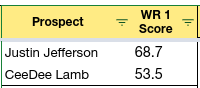
Here is how the model graded the top 2021 wide receivers.
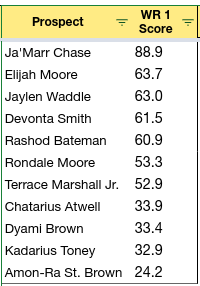
Ja’Marr Chase, Elijah Moore, Jaylen Waddle, and DeVonta Smith were each top five in rookie WR PPR PPG. Amon-Ra St. Brown was the other in the top five and he ranked 11th of 31 wide receivers graded despite the NFL drafting him 17th overall.
The metrics each prospect is graded on include:
- Breakout age
- Dominator
- Film grade
- Relative athletic score
- Conference
- Draft round
- College point per reception fantasy points per game
- Receiving yards per team pass attempt
- Early declare status
These metrics have each individually shown correlation to future fantasy success. They are defined as follows:
College dominator rating: a player’s percentage of his team’s receiving yards and touchdowns*
Breakout age: Player’s age at the start of the season when they first posted a dominator rating at or above 20%*
Film grade: The WR1 model has been using a film grade since its inception to improve its correlation to success at the NFL level. Incorporating film grades is starting to become more popular in such models. Lance Zierlein is a legend in breaking down film for incoming rookies. His numeric grades are available on NFL.com from 2014 on. Players who were drafted before 2014 were given a film grade that did not materially affect their ranking.
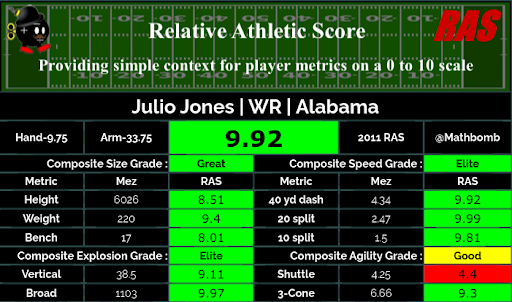
Relative athletic score (RAS): Developed by Kent Lee Platte, the relative athletic score evaluates a player’s athletic ability relative to their height, weight, and position based on several known measurables. Each player receives a score of 1-10. Below is the relative athletic scorecard for Julio Jones.
Conference: The conference score applies points based on the level of competition. SEC players receive the maximum points within this metric. G5 schools receive negative points.
Draft round: Points are awarded on a sliding scale based on the round the player was selected in the NFL Draft.
College fantasy point per reception points per game: At the pro level we know that past fantasy points per game are the metric with the highest correlation to future fantasy points per game. This is also a metric that incorporates the receptions portion of fantasy production into the model where metrics such as dominator only address yards and touchdowns. Receptions account for approximately 38% of NFL PPR PPG so it is an important metric to capture.
Receiving yards per team pass attempt (RYPTPA): RYPTPA is a favorite metric of the devy Twitter community to forecast future fantasy production. RYPTPA measures the receiving yards a player has produced per each of their team’s pass attempts.
Early declare status: If a player enters the NFL draft early it is typically because the NFL has indicated that the player will be drafted in the earlier rounds. Therefore, if a player is an early declare he is awarded five points towards his overall rating.
*Source: Player Profiler
How It Works
For each metric, a player is awarded a score based on the tier they fall in for that metric. For example, receiving yards per team pass attempt:
- 0.00 – 0.99 = -5
- 1.00 – 2.39 = 0
- 2.40 – 2.99 = 3
- 3.00 – 3.49 = 10
- 3.50 – 3.99 = 12
- 4.00 + = 17
Marquise Brown had an RYPTPA of 3.29. Therefore, he was awarded 10 points towards his overall WR1 rating for this metric. Each player metric score is then added into the combined 9 metric formula for each player. This gives them their overall WR1 score.
I hope you enjoyed reading my article. My goal is to provide actionable advice you can utilize to improve your dynasty team. You can follow me on Twitter @force_fantasy.




Pingback: The WR1 Rating Dynasty Rookie Wide Receiver Countdown: 5-1 - Dynasty Football Factory