

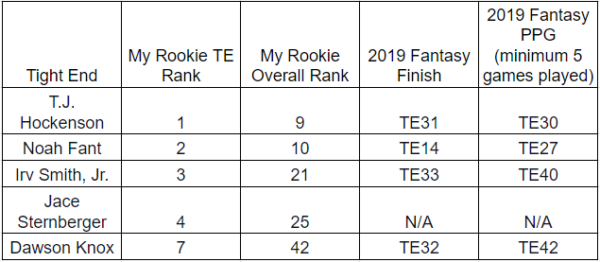
In this seven-part article series, I have looked at the rookies from the 2019 class at each position. Here are the links to all the previous parts: QB, RB part 1, RB part 2, WR part 1, WR part 2, and WR part 3. These rankings are from my rankings from back in late May or early June. The rankings assume a 1 QB, PPR dynasty format.
Hits
The Broncos drafted Fant with the 20th overall pick in the first round of the 2019 NFL Draft. Fant immediately stepped in as the lead tight end, displacing incumbent veteran Jeff Heuerman. He played in all 16 games, playing 68.4% of total snaps for the 2019 season. In those snaps, he totaled 40 receptions on 66 targets for 562 yards and three touchdowns. While those numbers don’t sound particularly impressive, he was second on the team in targets, third in receptions, and second in receiving yards.
Considering that rookie tight ends rarely are fantasy relevant, Fant’s TE14 finish was particularly impressive. Even though he only finished as TE27 in points per game, he displayed the receiving skills he brought into the NFL. Additionally, the Broncos’ offense should improve in 2020 under fellow 2019 rookie Drew Lock who replaced Joe Flacco at quarterback.
I still rank Fant around the 1.10 in rookie pick value, but he’s a hit because of the difference in quality between the 2019 and 2020 rookie classes. 2020 is a far stronger class, so Fant has moved up in my dynasty rankings since 2019. I currently rank Fant as the 75th overall player and as the TE7 in dynasty formats. I expect him to take a further step forward in 2020, and I could easily see him valued as a top-five tight end this time next year.
Knox went to the Bills in the third round of the 2019 NFL Draft. The Bills had just signed tight end Tyler Kroft to a three-year, $21 million contract in free agency. Therefore, Knox was somewhat overlooked in rookie drafts, falling behind the four tight ends listed here as well as Kahale Warring and Josh Oliver.
However, Knox received immediate opportunity when Kroft suffered an injury that forced him to miss the first five games. In Weeks 3 and 4, Knox broke out, totaling six receptions on seven targets for 125 yards and a touchdown in the two contests. He continued to be a part of the offense when Kroft returned. He received at least one target in each game and was given rest with the Bills’ starters in Week 17. Therefore, the Bills saw Knox as their clear starting tight end.
For the season, Knox had 28 receptions on 50 targets for 388 yards and two touchdowns. He finished second on the team in targets and yards and third in receptions. He was a mid-fourth round rookie pick in 2019 rookie drafts and has outperformed that price. I still only value Knox as a mid-third rookie pick now, but that’s still a hit. I also think Knox is a solid dynasty buy, as tight ends tend to take some time to develop. He showed flashes in 2019 and should move forward in 2020.
Misses
Sternberger has to be considered an extreme disappointment based on 2019. After the Packers selected Sternberger in the third round with the 75th overall pick, many had high expectations for him. He was a former basketball player who transferred around in college. Finally, in 2018 Sternberger had a huge season at Texas A&M, which led to interest from the NFL.
Unfortunately for Sternberger, his skills did not translate to the NFL at all. After beginning the season on the injured reserve, the Packers activated him ahead of Week 9. He played in six games and recorded no offensive stats. Finally, in the playoffs, Sternberger caught one pass for two yards against the Seahawks. Then, against the 49ers, he caught two passes for 13 yards and a touchdown. In both the regular season and playoffs, Sternberger played behind starter Jimmy Graham and came in for limited snaps. Even though rookie tight ends don’t typically produce in year one, I still wanted to see more from Sternberger. Playing in six games and recording no offensive stats is unacceptable for a third-round pick.
Outside of wide receiver Davante Adams and running backs Aaron Jones and Jamaal Williams, the Packers had almost no weapons in 2019. The Packers have been linked to free-agent tight end Austin Hooper, which would demolish Sternberger’s value. Additionally, I expect the Packers to select a wide receiver in either round one or two of this year’s NFL Draft. Therefore, Sternberger’s competition for targets will increase in 2020 compared to 2019. While I still think he has potential, I would be wary about buying in right now. I value him as a late-third round rookie pick, but I think I’d pass on him altogether.
Incomplete
Hockenson went to the Lions with the eighth overall pick in the 2019 NFL Draft. In Week 1 against the Cardinals, Hockenson lit the world on fire. He had six catches on nine targets for 131 yards and a touchdown. However, that performance was a mirage, perhaps due to the Cardinals’ porous defense against tight ends in 2019. In the next two games, he totaled just two receptions for eight yards.
For the 2019 season, Hockenson played 12 games before he suffered a season-ending ankle injury. In those 12 games, he put up 32 receptions on 59 targets for 367 yards and two touchdowns. For comparison, outside of Week 1 he had just 26 catches for 236 yards and a touchdown. He averaged less than 20 yards per game over that stretch.
Considering that Hockenson immediately showed the talent that caused the Lions to select him so highly, it would be irresponsible to write him off as a miss. Most tight ends don’t hit in year one, and Hockenson flashed, even if only briefly. I still value him as a TE1 in dynasty at TE11 overall. That places him around the 1.12 rookie pick value, so he hasn’t lost much value since 2019. If anyone has given up on Hockenson, I’d suggest sending trade offers for him. He could easily take a step forward in 2020.
Irv Smith, Jr.
The Vikings invested heavily in Smith, selecting him with the 50th overall pick in the second round of the 2019 NFL Draft. With that draft capital, many expected Smith to immediately surpass incumbent starter Kyle Rudolph as the Vikings’ starting tight end. Shortly after Smith’s selection, there were rumors that Rudolph could be traded or released. However, those rumors proved to be unfounded, as Rudolph signed a four-year contract extension in the summer of 2019. The extension guaranteed Rudolph’s presence on the team in 2019 and likely 2020 as well.
Both Rudolph and Smith played 16 games in 2019, so let’s compare them side-by-side.

The good news is that both tight ends saw the field a majority of the time. I expect the Vikings to continue using dual TE sets in 2020 alongside star wide receivers Stefon Diggs and Adam Thielen. If Smith can progress past Rudolph, I think he will have a chance to hit in 2020. I can’t call him a hit just yet, but he’s promising. I value him identically to last year, around 2.09 in rookie drafts. At that price, he’s a worthwhile investment, even though you might have to wait until 2021 to see him fully unlocked. The two tight ends had very similar lines in 2019. The main differences were Rudolph’s superior touchdowns and his higher snap percentage. Smith is mainly a receiving threat, so Rudolph’s higher snap count mostly comes from his blocking skills. As for the touchdowns, it could just be an anomaly, although Rudolph is well-known for his end-zone ability.
Thanks for reading this article. You can find me on Twitter at @DFF_Justin. I love to interact with anyone in the community, so reach out at any time! I take fantasy questions and help with all formats, so keep sending those questions my way.

