
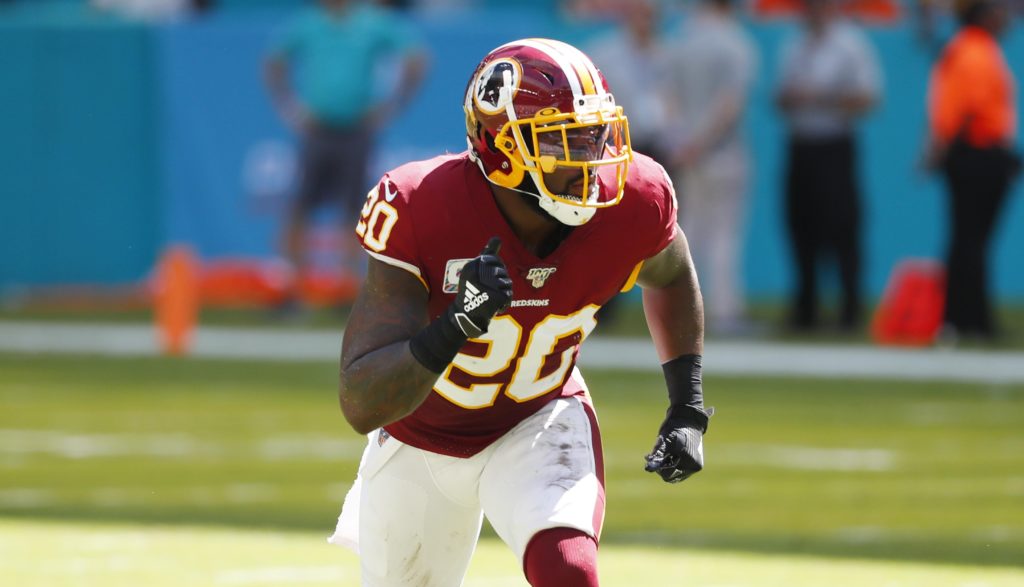
Seasonal (redraft) ranks will appear in article form this year at Dynasty Football Factory. The IDP ranks in spreadsheet form are and will remain for a dynasty format. I’ll update the dynasty ranks year-round, thus making available a rare resource for IDP gamers. I, myself, was always on the hunt for current dynasty ranks for start-up and dispersal drafts for IDP leagues before I started writing. Here are my 2020 Safety ranks, dominated by “jack of all trades” type players!
Context for These Ranks
The best assets in fantasy football are specialists who play full time: the “big slot” tight end who doesn’t block, the penetrating defensive tackle turned loose after the quarterback, and the de facto linebacker known as the box safety. The NFL is evolving, however, and versatility is the buzzword trait that earns roster spots and keeps players on the field.
The modern NFL safety must be proficient in at least two of three roles to hold a full-time role: box safety, deep safety, and slot defender. For fantasy football, the box-safety role best translates to production. The deep role offers fantasy gamers the least value because the player is lined up 15 yards from the ball when it’s snapped. Even in the passing game, the deep safety is rarely the first to reach the ball carrier to make a play.
The values of these roles to an NFL team is the reverse. Minkah Fitzpatrick arrived in Pittsburgh via trade after the season started and played deep effectively. The entire defense immediately transformed into a late-model Steel Curtain. Fitzpatrick himself thrived on big plays but finished under ten fantasy points per game, making him a boom/bust S2.
This idiosyncrasy enables fantasy gamers to find value in relatively unknown players in good situations. About half of the league’s teams display a preference for one deep safety over another. These teams typically play Cover-1 or Cover-3. One safety is deep – the ‘1’ in ‘Cover-1’ – while the other plays in the box or slot. Ideally, however, NFL coaches would prefer to have two players capable of playing the single-high role so that they could be used somewhat interchangeably.
The other half of the league’s teams show little difference in how they deploy their safeties. Typically, these teams play more Cover-2, in which both safeties are deep, or Cover-4, in which two cornerbacks play back as well. The lack of snaps near the line of scrimmage blunts the fantasy values of both safeties on these teams. Those few that are fantasy-relevant show a propensity for creating turnovers.
I calibrated my ranks for 2020 seasonal leagues for 14-team, true-position full-IDP leagues with the scoring settings of FantasyPros.com and 55 roster spots. To that end, I list here 41 safeties in the order of value they offer teams starting 11 IDPs including two safeties.
The S-1s
In decades past, the top tier of fantasy safeties would have been populated with players taking more than half their snaps in the box. Only one full-time safety played more than half his snaps in the box in 2019: Cincinnati’s Shawn Williams. Washington’s Landon Collins and Carolina’s Eric Reid came close. These three players ranked tenth, fourth, and second in fantasy points last year.
Fast forward seven months: Eric Reid has been cut and Shawn Williams has almost certainly lost his starting role to big-money free-agent signee Vonn Bell. Landon Collins, meanwhile, retains relevancy because he’s a good two-deep safety. Per his reputation, he’s strong in run defense, and he’s also an effective pass rusher.
Landon Collins’s alignments in proportion to his total snaps were very similar to those of Eric Reid last year. Washington head coach Ron Rivera was Reid’s head coach in Carolina last year and should enjoy deploying a more effective player in the role he drew up for Reid last summer.
Collins isn’t a sexy name atop my safety rankings, but he has the highest floor in the group. He has a weak linebacker group he must assist with run support, and he will get pass-rush opportunities. Collins is the increasingly rare “big nickel” talented enough to play full time.
Derwin James and Taylor Rapp are the other Tier-1 safeties that approximate the term “big nickel.” Rapp played more than half of his snaps in the box after he replaced an injured John Johnson in the Rams’ starting lineup. He might need to do so again this year because the Rams are so thin at linebacker.
All eight of these players are examples to varying degrees of “position-less” football. They play deep, in the box, on the defensive line, in the slot, and wide corner. They play the run, cover tight ends, take away the flats, spy on the quarterback, and blitz. Their defensive coordinators disguise their roles from snap to snap and use them to wreak havoc. In the words of Jets’ defensive coordinator Gregg Williams, they “Find ball, see ball, get ball.” Williams’s mentality helped propel Jamal Adams to All-Pro status.
The primary purpose of these players is not necessarily to collect tackles but to disrupt the offense. While their roles are conducive to tackle compilation, Jamal Adams’s 2018 and 2019 seasons show that a big drop in total tackles shouldn’t be a shock.
My colleague Dynasty Chef Steve, meanwhile, likes Adams to maintain a high floor for tackle numbers in Seattle. If I were as confident, Adams would remain atop my ranks despite the change of scenery.
Budda Baker and Tracy Walker must continue to improve their playmaking to earn their keep in this tier. Each has a notable downside due to possible loss of tackle opportunities. Baker, in particular, has much more competition for tackles among teammates at linebacker for 2020, but he also gets more opportunities to attack the offensive backfield than Walker.
Some of the most disruptive safeties benefit from a complementary teammate that can switch alignments with them. With Duron Harmon in Detroit to play deep, Will Harris becomes available to alternate with Tracy Walker. The Lions can be expected to put Walker into a position to make plays. This freedom to roam around the formation should help offset regression in total tackles for fantasy purposes. Other “Batman and Robin” duos include (1) Harrison Smith and Anthony Harris and (2) Tyrann Mathieu and Juan Thornhill. Derwin James and Rayshawn Jenkins constitute a prospective duo for 2020, as do Vonn Bell and Shawn Williams.
| Rank | Name | Team |
| 1 | Landon Collins | WAS |
| 2 | Jamal Adams | SEA |
| 3 | Derwin James | LAC |
| 4 | Budda Baker | ARI |
| 5 | Taylor Rapp | LAR |
| 6 | Jordan Poyer | BUF |
| 7 | Harrison Smith | MIN |
| 8 | Tracy Walker | DET |
Projectible S-1s
These four players have as much upside as most of the players ranked above them, but question marks surround them. Jeremy Chinn and Vonn Bell land on new teams. Chinn will be a rookie playing for a man who has never coordinated an NFL defense before. Ronnie Harrison and Keanu Neal play for coaches once known for deploying big nickels. The lack of recent success Dan Quinn and Todd Wash have experienced diversifying their defenses seems to have them looking back to what has worked for them in the past.
| Rank | Name | Team |
| 9 | Jeremy Chinn | CAR |
| 10 | Vonn Bell | CIN |
| 11 | Keanu Neal | ATL |
| 12 | Ronnie Harrison | JAX |
The S-2s
Justin Simmons, Malcolm Jenkins, and Tyrann Mathieu are proven stud players, but they’re not fantasy studs. Only Mathieu has shown that ceiling, but that was for James Bettcher in Arizona. In Kansas City, the defensive linemen maintain their gaps even while penetrating, thus reducing the number of tackle opportunities available to the second level of the defense.
John Johson’s new defensive coordinator Brandon Staley comes from Denver and will deploy Johnson similarly to Denver safeties Simmons and Kareem Jackson (a topic I wrote about earlier this year). Adrian Amos piled up big numbers as a Bear but hasn’t matched them in Green Bay.
| Rank | Name | Team |
| 13 | Justin Simmons | DEN |
| 14 | Malcolm Jenkins | NOS |
| 15 | John Johnson | LAR |
| 16 | Tyrann Mathieu | KCC |
| 17 | Adrian Amos | GBP |
Projectible S-2s
Players in advantageous situations who have yet to capitalize are ranked 18 through 23. Bradley McDougald is new to Gregg Williams’s blitz-happy scheme in New York. The others have simply been inefficient with their opportunities to rush the passer and stop the run for their current teams. Jordan Whitehead, Chuck Clark, and Terrell Edmunds are still young and could improve.
Kenny Vaccaro could be part of the patchwork that replaces departed slot defender Logan Ryan, 2019’s top-scoring fantasy defensive back. Titans coaches have named Adoree’ Jackson as a candidate for slot coverage duties, but he’s no backfield disruptor. Vaccaro has that experience from his time in New Orleans. This should be Vaccaro’s last chance to be an impact player.
| Rank | Name | Team |
| 18 | Bradley McDougald | NYJ |
| 19 | Jordan Whitehead | TBB |
| 20 | Chuck Clark | BAL |
| 21 | Xavier McKinney | NYG |
| 22 | Terrell Edmunds | PIT |
| 23 | Kenny Vaccaro | TEN |
The Free Safeties
Jessie Bates has poured tackles into box scores like a captain bailing his boat in Cincinnati. The Bengals’ front office finally, and surprisingly, moved to shore up its defense in free agency and invested quality picks in linebackers in the last two drafts. The Bengals defense might not struggle so mightily to get off the field this year! As a result, they shouldn’t be counted on to lead the AFC in defensive snaps or to allow so many plays to reach the third level.
The remaining players in this tier have not shown Bates’s ceiling for tackle numbers. Instead, they excel by getting their hands on footballs to break up passes and create turnovers. They rely on the defense around them to put opposing offenses under pressure. These free safeties then capitalize on risks taken by quarterbacks. Unsurprisingly then, all six contribute to some of the NFL’s better defenses.
| Rank | Name | Team |
| 24 | Jessie Bates | CIN |
| 25 | Kareem Jackson | DEN |
| 26 | Kevin Byard | TEN |
| 27 | Minkah Fitzpatrick | PIT |
| 28 | Eddie Jackson | CHI |
| 29 | Earl Thomas | BAL |
| 30 | Anthony Harris | MIN |
The Mystery Box Safeties
Numerous full-time safeties are unranked because they lack upside. If needed, they can be streamed in all but the deepest of leagues. Your writer started Marcell Harris and Adrian Colbert at safety in Week 14 of 2020 in a 20-team league. It wasn’t ideal, but that duo didn’t cost me the match-up either.
Players appearing in slots 31 through 41 all face uncertainty in 2020. The two returning full-time players in this tier, Rayshawn Jenkins and Jabrill Peppers could see their deployment change. The remainder includes part-time players that could be impactful as box safeties and slot-blitzers but must earn full-time jobs.
Chargers’ coaches have identified Jenkins as the logical choice to take over big nickel duties from Adrian Phillips. Jenkins’s responsibilities will include a deep half in two-high looks while Desmond King and Nassir Adderley compete for a part-time single-high role. Derwin James hasn’t gone anywhere, so it remains to be seen if two Chargers safeties can be fantasy-relevant, but Jenkins’s role is far more interesting for fantasy this year than last.
Patrick Graham, a former Belichick assistant in New England, will coordinate the Giants’ defense in 2020. Graham replaces James Bettcher, whose defense was built around safeties. Bettcher had a long track record of creating S1s for fantasy football in New York and Arizona. Among the roles was a “moneybacker,” almost a de facto linebacker. Peppers occupied that role in 2019, and while he piled up numbers, he proved he isn’t an instinctive player.
The Giants’ defense will show plenty of three-safety looks, but the roles will have more nuance under Graham. Conventional wisdom is that Julian Love, not Jabrill Peppers, will lose snaps to highly rated rookie Xavier McKinney. I believe Love is a better, more versatile player who will ultimately hold the full-time role, even if not right away.
Patriots’ safety Patrick Chung has opted out of the 2020 season due to COVID-19. He vacates a role more interesting than many realize. His snaps in the box have steadily increased since 2017. He played more than half his snaps in the box in 2019 in a ¾-time role. Before Chung’s decision, the Patriots dealt free safety Duron Harmon to the Lions. Devin McCourty will need to play deep much of the time as a result, so two potentially fruitful roles are available in New England’s secondary.
The Patriots drafted Kyle Dugger, a small-school prospect with great size and athleticism with high upside, in Round 2 this spring. As a rookie, Dugger will need time to learn the defensive scheme, leaving the inside track to a full-time role to Adrian Phillips. Phillips played big nickel for the Chargers. He converted his tackle opportunities in the box much more efficiently than Chung last year, and his competition for tackles among linebackers will be just as weak in 2020 as it was in 2019.
Kyle Dugger’s “Relative Athletic Score” from RelativeAthleticScores.com, created by Kent Lee Platte @MathBomb on Twitter.
But can Phillips hold off the more dynamic rookie all season? Dugger is the jack of all trades with the size to play in the box, the burst to blitz from the slot, and the speed to play deep. As for all rookies, the question is, “Will the player translate to the NFL game?”
Jabrill Peppers’s similar athleticism, for instance, has not. The video clips in these two tweets show two ends of a spectrum of duties in which modern NFL safeties must function to succeed. There are no shortcuts to a full-time job.
| Rank | Name | Team |
| 31 | Adrian Phillips | NEP |
| 32 | Kyle Dugger | NEP |
| 33 | Rayshawn Jenkins | LAC |
| 34 | Jabrill Peppers | NYG |
| 35 | Juston Burris | CAR |
| 36 | Will Harris | DET |
| 37 | Will Parks | PHI |
| 38 | Brandon Jones | MIA |
| 39 | Raven Greene | GBP |
| 40 | Khari Willis | IND |
| 41 | Tavon Wilson | IND |
Strategy
The IDP community does not seem to have internalized the principle of “value-based drafting.” Budda Baker averaged 14 fantasy points per game (FPPG) in 2019, production matched by Chandler Jones and Fred Warner. Baker will come off the board well before them in fantasy drafts if the “expert consensus rankings” at FantasyPros.com are any indication.
Sixty percent of Baker’s production will be available on the waiver wire in conventional-position IDP leagues of typical depth and uniform scoring across positions. Gamers may select a couple of warm bodies certain of full-time roles at the very end of their drafts. Such safeties would earn 8 FPPG. At linebacker, the comparable proportion is 50%, while at defensive end, a free player would yield only 30% of the top player’s output. I explored this in detail earlier this year in a piece aimed to help gamers uncomfortable with IDP apply lessons from their knowledge of offensive players in fantasy football.
The S1s and S2s will go too early in drafts. They’re name brands and proven producers. This article explores the mystery and projectible players because they offer value in an overvalued position for fantasy football. The difference makers won’t be predictable full-time players available late, but rather those with uncertain roles on the end of fantasy rosters to start the season. Eric Reid, Tracy Walker, and Taylor Rapp were these wild cards in 2019. Take chances at a position with a safety net!
Clemson and Michigan alum…Panthers and Cowboys fan…I try to see both sides of every debate and each trade. Find me on Twitter @DynastyTripp.

