
In this series, I’m looking at the backup quarterback landscape with a focus on dynasty superflex formats. In those leagues, having a starting quarterback is extremely valuable, and backups are one step away. Therefore, depending on league size, anywhere from a few to all the backup quarterbacks in the league are rostered. Keep in mind that these backups are the backup in dynasty value, not necessarily the backup on the NFL depth chart.
In part one, I examined the top tier of dynasty backups, the potential future long-term starters. Then, part two covered players that have a narrow path to starting or could be current starters for a limited period. Now, in part three, I’ll take a look at five further quarterbacks. These players are not current starters and may never receive a chance to start in the future. Each of them has more upside than a standard backup, so they’re worth focusing on as a group.
Taysom Hill
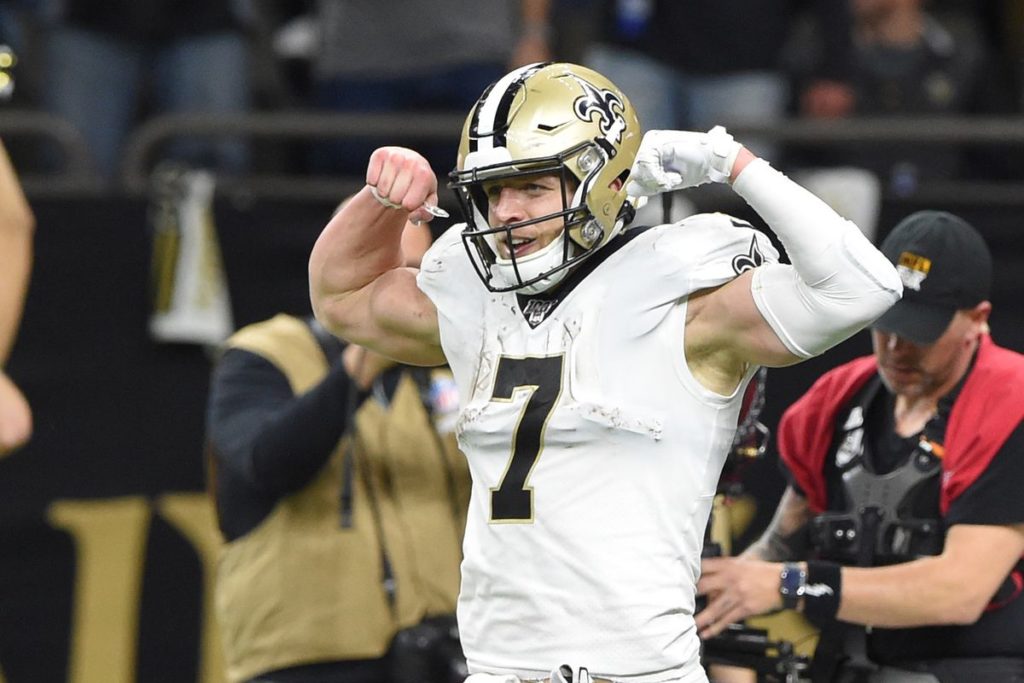
Taysom Hill‘s path in the NFL has been entirely unconventional. He took an LDS church mission out of high school and didn’t start his freshman year of college until he was 22 years old in 2012. He played in a hybrid role that year behind BYU’s other quarterbacks before getting a chance to start in 2013. He played all year as a traditional quarterback but completed only 53.9% of his passes and threw 19 touchdowns compared to 14 interceptions. Even though he was a real quarterback, he still did damage on the ground with a whopping 246 carries for 1,344 yards and 10 touchdowns.
After 2013, Hill struggled through two injury-riddled seasons in 2014 and 2015. Because of his injuries, the NCAA granted Hill a hardship waiver for a fifth year of eligibility in 2016. Hill once again played a traditional quarterback role in 2016. He improved his completion rate to 59.7% but still threw only 12 touchdowns and 11 interceptions. However, he continued as a keen runner, with 137 carries for 603 yards and eight touchdowns.
Coming out of BYU, Hill received almost no interest from the NFL. He signed as an undrafted free agent with the Packers, but the team cut him in final roster cut-downs. The Saints immediately claimed him, although he saw no action on offense in 2017. Hill contributed on special teams as a gunner and was the third, emergency quarterback behind starter Drew Brees and backup Chase Daniel. At this point, Hill was a total unknown, off the radar to dynasty owners.
On the surface, Hill should not be a superflex dynasty asset. In his regular-season career, he’s completed six of 13 passes for 119 yards and a touchdown. He’s barely seen use as a quarterback, but he has produced on the ground and as a receiver. In 2018, he had 37 carries for 196 yards and two touchdowns and three catches for four yards. Then, the Saints expanded his role further in the receiving game in 2019. Hill improved to 19 receptions for 234 yards and six touchdowns while still taking 27 carries for 156 yards and a touchdown on the ground.
Even while Hill has impressed on the field, the only reason he has dynasty value is the speculation that Hill will take over for Brees when he retires. Although Hill has thrown 13 NFL passes, the Saints’ coaching staff consistently insists that he’s at least a contender to be their next starting quarterback. News reports, especially from Jay Glazer at The Athletic, have also hyped up this possibility. Also, the Saints recently tendered Hill at a first-round level for 2020, worth $4.66 million. Then, they extended his contract through 2021, worth $21 million, with $16 million guaranteed. Based on this extension, Hill will undoubtedly be on the Saints in 2021, as he will count over $11 million against their cap, whether he plays there or not.
However, I can’t buy into Hill as the Saints’ next starting quarterback despite all this smoke. I don’t believe that an NFL franchise will turn over their future to an utterly unproven player. In 2019 when Drew Brees went down with a thumb injury, the Saints turned to Teddy Bridgewater as his replacement, not Hill. Now, going into 2020, they signed Jameis Winston as Brees’ true backup.
While Winston might not be the Saints’ future starting quarterback, I think signing him demonstrates that the Saints aren’t fully confident in Hill. In this situation, I won’t believe that Hill is genuinely the Saints’ starter until he starts a game for them at quarterback. I would sell Hill for any second-round rookie pick if I had him on my dynasty roster, and I certainly wouldn’t buy him.
Jacob Eason
Eason was a high-profile college quarterback, starting as a true freshman for Georgia in 2016. However, he didn’t play that well and lost his starting job to fellow 2020 NFL Draft pick Jake Fromm. Before the 2018 season, Eason decided to transfer to Washington but had to sit out that season because of NCAA transfer rules. At Washington, Eason flashed even more of his talent. He completed 64.2% of his passes and threw 23 touchdowns versus eight interceptions and led Washington to an 8-5 record.
Based on his 2019 play, Eason decided to enter the NFL Draft. While some thought he’d be a first or second-round pick, Eason fell to the fourth round, where the Colts selected him. The Colts signed veteran Philip Rivers to a 1-year, $25 million contract to be their 2020 starting quarterback and also have Jacoby Brissett as an expensive and reliable backup. Therefore, Eason has no clear path to playing time as a rookie.
However, neither Rivers nor Brissett is under contract for 2021. Therefore, there is some room for Eason to get a look as the Colts’ quarterback of the future. If the team crashes and burns in 2020, Eason could get some opportunities once the team gets eliminated from the playoffs. Unfortunately for Eason, if the Colts are terrible in 2020, they will likely explore bringing in a high-profile quarterback from the 2021 draft class. If the Colts are a good team, then they might retain Rivers in 2021, blocking Eason in either scenario.
Eason is just a flier in superflex formats. Based on his draft capital, I don’t expect him ever to get a real chance as a starting quarterback. He’s my 3.08 in superflex rookie rankings, so he’s valued at a mid-to-late third-round rookie pick. If you own Rivers, Eason might be a decent investment, but I wouldn’t go out of my way to acquire him.
Kyle Allen
After playing in college at Texas A&M and then Houston, Kyle Allen landed in the NFL as an undrafted free agent with the Panthers in 2018. For most of that season, Allen sat on the Panthers’ practice squad as their third quarterback behind starter Cam Newton and backup Taylor Heinicke. After 14 games, Newton went down with an injury, forcing Heinicke into the starting role and making room for Allen as the backup. Eventually, Heinicke got hurt, too, which allowed Allen to see the field. In parts of two games, Allen completed 20 of 31 passes for 266 and two touchdowns compared to no interceptions.
Going into 2019, the Panthers added Will Grier in the third round of that year’s NFL Draft. Most expected Grier to take over from Allen as Newton’s backup; however, the Panthers named Allen as the backup for Week 1. After two weeks, Newton missed the rest of the season, and Allen stepped in to start 13 games. In his first four starts, Allen was a sensation. He threw seven touchdowns and no interceptions and 901 passing yards, winning all four of those games. At that point, I believed that Allen had taken Newton’s job as the Panthers’ starter.
However, after that point, everything went wrong. Over the rest of the season, Allen totaled 10 more touchdowns but 16 interceptions. He took 36 sacks in the final nine games and completed an awful 60.8% of his passes. Eventually, the Panthers saw enough from Allen and benched him for Grier. It seemed like NFL defenses figured Allen out, and he wasn’t truly ready to be an NFL starting quarterback.
After 2019, the Panthers and their new coaching staff decided to sign Teddy Bridgewater as their new starting quarterback. They also signed XFL star P.J. Walker to compete with Grier for the backup position. Because of these additions, they decided to release Newton and trade Allen to the Redskins for a fifth-round pick. The Redskins now employ former Panthers’ head coach Ron Rivera as their head coach, replacing Jay Gruden.
Allen is the direct backup to 2019 first-round pick Dwayne Haskins. While the Redskins also have Alex Smith under contract, he is unlikely ever to play football again, so if Haskins falters, Allen could get playing time. Given that the coronavirus pandemic has disrupted the current offseason, Allen could have a leg up on learning the offense, as he’s already familiar with Rivera’s system.
I don’t expect Allen to start Week 1, but he has a path to playing time. If you own Haskins, it’s a good move to send a third-round pick for Allen for insurance. Since quarterbacks are impossible to acquire in superflex leagues, this type of move can prevent in-season struggles.
Marcus Mariota
At this point, we all know that Marcus Mariota struggled in his five years in Tennessee. He started strong, peaking in his 2016 season. He threw for 3,426 yards, 26 touchdowns, and only nine interceptions. He also added 60 carries for 349 yards and two touchdowns on the ground.
Unfortunately, after 2016, Mariota took a significant step in the wrong direction. He never threw for more than 13 touchdowns in any future season and eventually lost his job in 2019 to Ryan Tannehill. Tannehill took the same weapons that Mariota had failed with and led the Titans to the AFC Championship game.
After 2019, the Titans signed Tannehill to a long-term deal and made no effort to retain Mariota, allowing him to hit the open market. The Raiders signed Mariota to a sizable contract for a backup quarterback, two years, and $17.6 million. While only the first year’s base salary of $7.5 million is guaranteed, the Raiders see Mariota as real competition for incumbent starter Derek Carr.
However, similar to some of the other quarterbacks discussed above, I don’t see any long-term value for Mariota. If Carr succeeds and the Raiders win games, Mariota will never see the field and will have no value. If Carr fails and the Raiders are terrible, they will be able to draft a long-term quarterback replacement. The Raiders can get out of Mariota’s contract easily after 2020, so they have no commitment to him. Mariota isn’t worth much more than a potential handcuff to Carr, similar to Kyle Allen for Haskins. You could do worse than buying Mariota for a third-rounder in superflex leagues.
Josh Rosen
Unlike everyone else in this tier, Josh Rosen is in a completely different situation. The Cardinals selected Rosen with the 10th overall pick in the 2018 NFL Draft out of UCLA. While Rosen was initially the backup behind Sam Bradford, Bradford was terrible enough for the Cardinals to turn to Rosen in Week 3.
Unfortunately for Rosen, he completely failed in Arizona. He completed an ugly 55.2% of his passes and threw 11 touchdowns compared to 14 interceptions while averaging 5.8 yards per attempt. Those marks made him the worst quarterback in the league in 2018 and led the Cardinals to the worst record in the NFL. Even though Rosen had no offensive weapons and a terrible offensive line, he still performed poorly. Because of Rosen and the team’s failures as a whole, the Cardinals fired their entire coaching staff and brought in Kliff Kingsbury as their new head coach.
The Cardinals’ 2018 performance gave them the top overall pick in the 2019 NFL Draft, putting them in line to select quarterback Kyler Murray. Murray was a perfect fit for Kingsbury’s high-powered offensive system, making Rosen expendable. The Cardinals decided to trade Rosen to the Dolphins, giving him a chance potentially to start over for a new team.
However, Rosen faced similar challenges in Miami as he did in Arizona. The team around him had a bad offensive line and limited receiving weapons. He failed to excel in that environment, losing all three of his starts and throwing one touchdown and five interceptions. The Dolphins eventually settled on Ryan Fitzpatrick as their starting quarterback, benching Rosen for good after Week 6.
In the 2020 NFL Draft, the Dolphins selected high-profile quarterback prospect Tua Tagovailoa with the fifth overall pick. Therefore, Rosen is now the third quarterback on the depth chart, behind Fitzpatrick and Tagovailoa. Considering that Rosen is on a cheap contract through 2021, the Dolphins have no reason to move on from him in a trade. Fitzpatrick’s contract expires after 2020, and Tagovailoa comes with some injury risk.
Rosen seems stuck in Miami with little hope of playing time in 2020. The one bright spot for Rosen is that he’s only 23 years old, younger than this year’s first overall pick Joe Burrow. He could revitalize his career, but it probably won’t be in Miami. Perhaps in 2022, Rosen will get a chance at playing time elsewhere. However, he’s a long-shot and isn’t worth more than a flier, even in superflex leagues.
Thanks for reading this article. You can find me on Twitter at @DFF_Karp. I love to interact with anyone in the community, so reach out at any time! I take fantasy questions and help with all formats, so keep sending those questions my way.

