

The Packers signed Darrell Stewart, Wide Receiver, out of Michigan State University. He was an undrafted free agent after the 2020 NFL Draft.
Biography
Darrell Stewart is 6’1” and weighs 212 pounds. He played four years at Michigan State after red-shirting his freshman season. He will be 24 years old at the beginning of the 2020 NFL season. After a down junior season, Stewart was leading the Big Ten in receiving before breaking his leg. This dramatically affected his final year numbers and career averages.
College Production
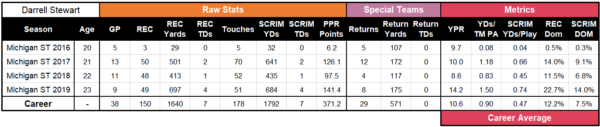
Darrell Stewart broke out at the age of 23 (age during their first season with a 20% receiving dominator rating) in his final season at Michigan State. Stewart’s breakout season was also his best season as a redshirt senior. Stewart had 49 catches, for 684 receiving yards, and four scrimmage touchdowns for a receiving dominator rating (average percentage of their team’s receiving yards and receiving touchdowns) of 22.7% (23rd percentile). Stewart had limited age-adjusted production by averaging 448 scrimmage yards (24th percentile) and 1.8 scrimmage touchdowns (7th percentile) per season throughout his career for the Spartans. He was a role player in East-Lansing until his final season. He averaged a 7.5% scrimmage dominator rating (average percentage of their team’s scrimmage yards and scrimmage touchdowns) per season (22nd percentile) throughout his collegiate career. Stewart fell short from an efficiency perspective as well. He averaged 0.47 scrimmage yards per team play (21st percentile) per season. Stewart contributed on special teams by returning kicks for the Spartans. He had 29 returns, for 571 return yards, and zero return touchdowns.
Athleticism
[profiler]DarrellStewart[/profiler]

Darrell Stewart chose not to run the 40-yard dash at the NFL Combine. He did participate in the burst drills and Stewart’s 118.0 burst score of 118.0 (34th percentile) is well below the NFL average for wide receivers. Michigan State canceled their pro day due to concerns relating to COVID-19 and his athletic profile is incomplete. On film, Stewart is a well-built receiver that will need to use his size in contested-catch situations at the NFL level.
NFL Landing Spot
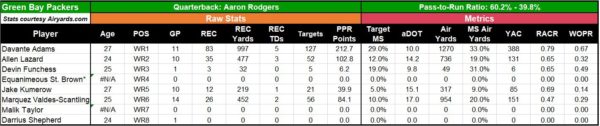
Green Bay Packers- Aaron Rodgers’ consistent lack of offensive weapons around him is one of the great existential questions of our time. While the LaFluer-Rodgers era got off to a rocky start, the team settled into a 13-3 season and won the division. Rodgers’ 95.4 passer rating was 12th best. Interestingly enough, it was his fifth worst finish but he was still way above average when targeting most of the field. The Packers ran the 14th most plays of all teams, passing on 59.7% of the time. Davante Adams is a great receiver. In 2019, he still finished as a WR2 despite missing a quarter of the season and was the WR3 when healthy in 2018. But behind Adams is an underwhelming minefield of Kumerow, MVS, and Allen Lazard. No other receiver was able to carve out at least a 10% target share. LaFluer’s system heavily involves the running backs in the passing game. Running backs accounted for 20% of team targets, and Aaron Jones had the second most targets of anyone.The door here is wide open for another receiver to slide in behind Adams as the WR2.
Analysis
Darrell Stewart is a late-age-breakout wide receiver with modest college production. Stewart has decent NFL size and without any athletic testing numbers, it will be interesting to see how he fares against NFL athleticism. The Packers invested zero draft capital into Stewart. He has a modest degree of opportunity and will compete with Adams, Lazard and Funchess for targets from Rodgers.
Darrell Stewart is in Shawn’s sixth wide receiver tier, is outside of Shawn’s top 30 rookie receivers. Shawn would target Stewart in the late fourth round of superflex rookie drafts. Darrell Stewart is an intriguing case study. His college production is not overly inspiring, but digging into the numbers a bit more, it does seem like Stewart was slotted for a bigger role as his senior year metrics all increased by a significant percentage. However a broken leg stopped that climb and COVID saw to ending any hope he had of potentially attracting attention at Spring workouts. What makes Stewart most intriguing is his landing spot.
The Packers are fascinating coming out of the draft. They had one of the best running backs in football last season, and have a phenomenal receiver in Davante Adams. But outside of those two, Aaron Rodgers has little else to lean on. Despite publicly advocating for how excited he was for the upcoming season and his hope that Green Bay would use a first-round selection on one of the many great receivers in this class, they instead drafted his replacement. When they were up again and still had a chance for more talented wide receivers, they drafted a backup running back. Addressing their two least areas of the need so high in the draft is perplexing. But for Stewart’s purposes, it means that the landscape is wide open. The WR2 (and third pass catcher) role is fully up for grabs. Behind Adams and Jones, and sitting between Stewart and relevant action, is a handful of has-beens, never-was, and sizzle but no steak pass catchers that all had a chance to solidify a role but were unable to do so. He is certainly worth a late draft flier because of the gaping opportunity in front of him.
This article was written in collaboration with Dave Wright (@ff_spaceman). Stay tuned for more rookie wide receiver UDFA articles from me in the coming days, to help you try and find the next Adam Thielen. Interact with me on Twitter at @ff_walrus. You can listen to our rivalry on our podcast @ATaleofTwoRivals with @ff_banterman.
Information found in this article was gathered from @ff_spaceman’s College Prospect Database, PlayerProfiler.com, Sports-Reference.com, AirYards.com, and a prospect’s college team website.

