

America’s Team was nearly synonymous with a 4-3 defense for decades under Tom Landry. He’s often credited for installing the scheme in the NFL, first as the Giants’ defensive coordinator and then as the Cowboys head coach.
In his 4-3 inside and 4-3 outside looks, Landry assigned each of his defensive linemen to occupy a single gap on a given play. The middle linebacker, playing over the center, was responsible for the remaining two gaps. These sets freed up an extra defender to play the pass.
Landry developed his “4-3 Flex” in Dallas. The defensive tackle on the weak side of the offense’s formation would penetrate and disrupt the offensive play in the backfield with a two-gapping defensive end behind him to clean up over-pursuit. This role helped propel Bob Lilly, originally a defensive end, and Randy White, originally a middle linebacker, into the Pro Football Hall of Fame as defensive tackles.
Rod Marinelli, the Cowboys’ defensive coordinator in 2019, ran a defensive scheme perhaps most similar to Landry’s defense of any in the NFL. A disruptive under-tackle is pivotal to the success of Marinelli’s defense. Both also relied on their defensive lines for pass rush rather than blitz, both brought a strong safety up for run support, and neither used a two-gapping nose tackle.
Ironically, the defensive scheme that rivals the 4-3 in the NFL as the most popular, the 3-4 also rose to prominence in New York. While Landry developed prototype-busting defensive tackles, Giants’ head coach Bill Parcells cultivated pass-rushing outside linebackers who could dominate the tight ends and running backs assigned to pass protect against them in the 1980s. Parcells’s defense tasked larger defensive linemen with occupying two gaps each, allowing linebackers freedom to read and pursue. Parcells then brought the 3-4 to Dallas in the 2000s.
The Cowboys have hired Mike Nolan to replace Rod Marinelli as defensive coordinator for 2020. Nolan’s first such role was for the Giants in the 1990s. He inherited Lawrence Taylor at the tail end of his career after Parcells had quit. In 2000, Nolan was hired to coordinate the Jets’ defense by then-GM Bill Parcells.
Nolan parlayed his success coordinating 3-4 defenses into the 49ers head coaching job. The offense failed to take flight with 2005’s first overall pick, QB Alex Smith, and Nolan was out.
Mike Nolan coordinated Atlanta’s defense beginning in 2012, where he inherited personnel assembled to play a 4-3 defense. He revised his scheme to advantageously deploy his Falcon defenders. He finds himself in a similar situation in 2020, so his Atlanta experience gives us insight into how current Cowboys will fit on the field and translate for IDP fantasy football.
Despite the New York roots to his career, Nolan is not a died-in-the-wool 3-4 coach. He returns to Dallas where he grew up and watched Tom Landry’s defense from the sideline. His dad, Dick Nolan was Tom Landry’s defensive coordinator and right-hand man. Nolan appreciates the disruptive tackle as much as the dominant pass-rusher off the edge.
Defensive Tackle
To help Mike Nolan implement his defense, the front office’s first task was to bring in personnel capable of carrying out Nolan’s assignments in the middle of the defensive line. Enter former Panthers Dontari Poe and Gerald McCoy, who departed Carolina’s failed 3-4 conversion.
Poe played reasonably well at nose tackle, and his impact showed after he was lost for the season to injury. The Panthers’ defense was a sieve against the run. He’ll play part-time in Dallas and do his work occupying blockers, enabling others to make plays. Accordingly, he’s not a fantasy option.
Gerald McCoy was a curious fit in the Panthers’ left/right 3-4. As a defensive end, he alternated between his natural three-technique alignment and five-technique, where he was to set the edge against the run. He’ll be at home lining up at under-tackle in Dallas. The demands of the role allowed him to shed 20 pounds, and he seems excited about the opportunity.
McCoy is an intriguing sleeper in DT-required leagues. He’ll play alongside DeMarcus Lawrence and contribute to a front that will mix up pass-rush looks and blitz to generate pressure. He’s a good hedge late in a fantasy draft as a DT2 behind a young DT1 like Ed Oliver or Jeffery Simmons.
Defensive End
IDP fantasy gamers are down on DeMarcus Lawrence after consecutive years of a decline in quarterback sacks. Per Pro Football Focus, his “pass-rush productivity” dropped only slightly from 2018 to 2019 and still matched that of Sam Hubbard.
Seth Walder of ESPN tweeted the following graphic, charting the frequency at which NFL edge defenders were double-teamed versus how often they “won” rushing the passer (i.e., beat one or more blockers within 2.5 seconds). Like Lawrence, his bookend Robert Quinn also faced numerous double teams but was even more effective, collecting double-digit sacks in 2019.
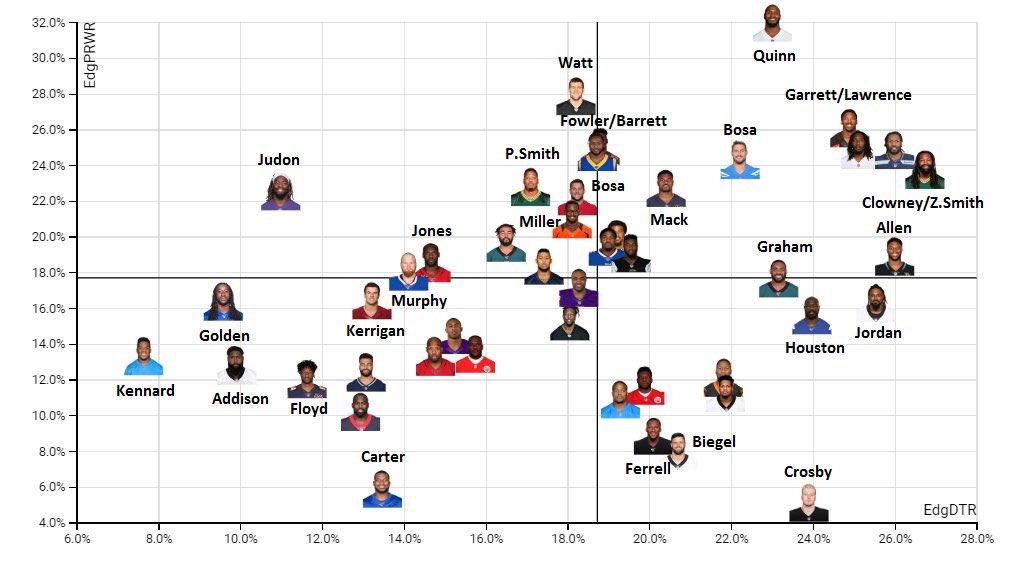
DeMarcus Lawrence is a strong bounce-back candidate for 2020. He’s a good pass-rusher in his prime and will benefit from a more creative defense. In FantasyPros.com “expert consensus ranks,” he lands at #11 among defensive ends, between two other veterans looking to rebound, Melvin Ingram and Frank Clark. Lawrence would be a great value if he slides past these two and becomes available to fantasy gamers as their DE2.
The Cowboys took no significant steps to replace unrestricted free agent Robert Quinn to the Bears. Instead, they retained Tyrone Crawford, who lost the 2019 season to injury, and his $9.1M cap hit. He fits well as an edge-setter on the strong side of Mike Nolan’s defense who can slide inside in passing situations.
The 2012 Atlanta Falcons fielded Jonathan Babineaux at big end. He collected 31 tackles, 3.5 sacks, and 11 tackles for loss. Crawford currently carries a ‘DT’ position designation on some fantasy football platforms. So, he could be an attractive free square in DT-required leagues with similar numbers.
The defense will also feature a stand-up defensive end. Aldon Smith, a former Pro-Bowler that hasn’t played since 2015, will battle third-year pro Dorance Armstrong for snaps in the 3-4 sets Nolan will surely show. Smith and Armstrong are likely just rotational players in Nolan’s multiple fronts.
Linebackers
Now, to the question most IDP gamers are asking: Can Jaylon Smith and Leighton Vander Esch coexist as LB1s on the same team? They did so in 2018. Two Browns achieved the same in 2017, and two teammate duos finished as LB1s in 2016 according to FantasyPros.
No linebacker on the 2012 Atlanta Falcons, however, reached even 100 tackles. Neither of the two full-time linebackers made tackles on as many as 11% of their opportunities (snaps minus incomplete passes on those snaps) per Pro Football Focus. LBs atop the fantasy standings exceeded 13%. Luke Kuechly and Sean Lee collected tackles on a remarkable 17% of their opportunities that year.
Veteran IDP gamers will recall Paul Worrilow as a stat compiler in 2013 and 2014. In these seasons, Nolan was transitioning his defense toward a proper 3-4 with space eaters like Paul Soliai and Corey Peters to keep his linebackers clean.
Strong-side linebacker Stephen Nicholas led the 2012 Falcons in tackles with 97. He played about a quarter of his snaps on the edge (per PFF detailed snap alignments) despite being the smallest of the three base-set linebackers. He supplemented his production with 2 sacks and 5 TFLs.
Jaylon Smith appears to have indicated he’ll take on a role similar to Nicholas’s in 2020. Pass-rushing duties will take Smith out of the box and reduce his chances to make tackles. He has scored 6.5 QB sacks over his last two seasons. So, he will need to be very productive in the offensive backfield to reach LB1 status.
Nicholas was a “switchable” linebacker, an off-ball linebacker that also contributes to pass-rush combinations on the edge. (I wrote about this during the spring.) Jaylon Smith’s athleticism and downhill mentality should translate to the scheme and the edge. He should be able to produce as well as a similar player like Tennessee’s Rashaan Evans, making him a solid LB2 in balanced scoring leagues. He would be a strong LB1 in true-position leagues with big-play scoring given the pass-rush upside.
Akeem Dent filled a part-time middle-linebacker role in Atlanta in 2012. 34-year-old Sean Lee looks like a good fit here. He was featured in the middle of the Cowboys defense and starred there earlier in his career.
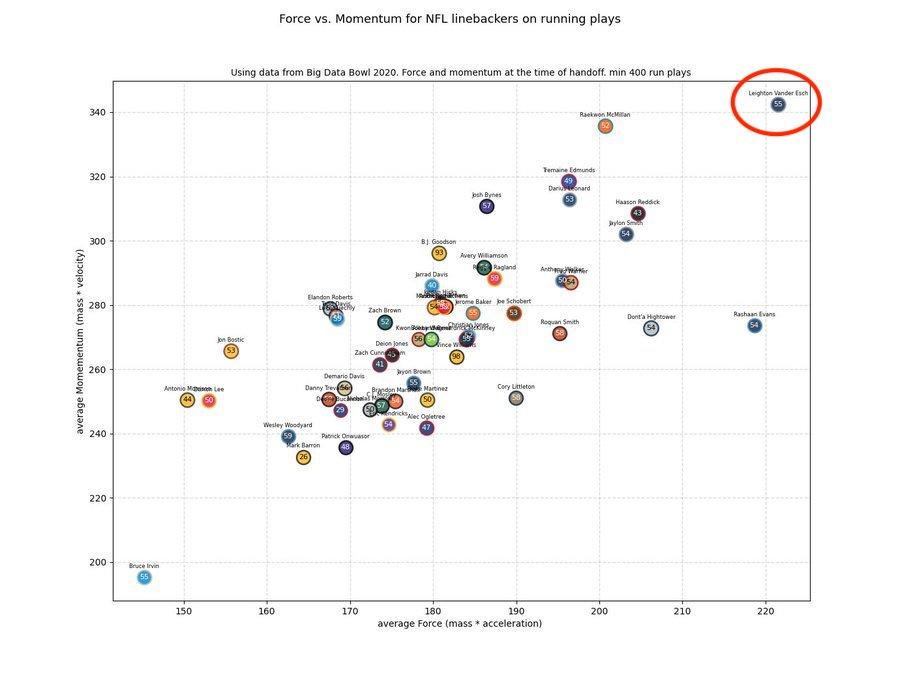
That leaves the weak-side linebacker role to Leighton Vander Esch. Although MLB and WLB roles won’t differ greatly in this scheme since neither will be a protected, run-and-chase tackler. Vander Esch will play full time, assuming he’s healthy.
Cowboys owner Jerry Jones exclaims Vander Esch is “100% healthy in my eyes.” We know that Jerruh is a salesman, so that should give us pause. That said, the third-year pro from Boise State will lead this team in tackles if he plays 1,000 snaps.
Vander Esch was the only full-time linebacker to capitalize on 17% of his tackle opportunities in 2018, his rookie year and break-out season. While he won’t be able to match that efficiency in this scheme, he’ll surely outperform Sean Weatherspoon. In 2012, the Falcons’ WLB converted 11% of his tackle opportunities despite missing 16 tackles. Vander Esch can reach 13% and low-end LB1 status. His LB2 price tag (LB #15 among “expert consensus ranks” at FantasyPros.com) bakes in the injury risk.
Defensive Backs
The Cowboy’s personnel moves in 2020 indicate they’ll show press-man coverage with two deep safeties. The linebackers won’t need a lot of help making tackles. And when they get that help, alternating safeties in the box will provide it. Xavier Woods and HaHa Clinton-Dix can be safely ignored in fantasy drafts.
The cornerbacks are more interesting. They’ll be allowed to play the ball in the air more aggressively, improving their chances for interceptions and pass break-ups. A training camp battle will decide the starters. The fantasy draft target at this point should be second-round rookie Trevon Diggs. Big, fast, and physical, he could be the rookie corner that quarterbacks can’t resist testing despite losing against.
In Summary
The Cowboys feature two big-name defenders who could prove good values even early in fantasy drafts. Gamers might let DeMarcus Lawrence and Leighton Vander Esch slide because they were disappointments last year. “Expert consensus ranks,” however, indicate fair value.
Jaylon Smith is likely to go too early in fantasy drafts. Gamers will chase last year’s production, and “experts” are endorsing it.
The Cowboys defense also provides interesting late options for leagues requiring defensive tackles and cornerbacks. Tyrone Crawford (provided he retains the ‘DT’ tag) and Gerald McCoy will be nearly free and should help a fantasy roster that missed out on high-end DT1s.
The rookie Diggs is just the kind of late-round target that lightens roster churn during the season. Cornerback streamers should keep other Cowboys in mind.
The defensive scheme change in Dallas could be quite shocking to Cowboys’ fans. Mike Nolan’s body of work combined with recent experience in the Saints’ hybrid system as a linebackers coach should yield a more varied and complex defense than fans have known.
Not only will we miss preseason action to see a preview of this defense, but also beat writers are prohibited from reporting players’ alignments during training camp. 2020 will provide more surprises than ever for IDP aficionados and this in a time when defenses are ever more multiple. September 13, 2020, will be the most astonishing day of football in a long time!
You can find more posts in my “Schemes Are Ch-Ch-Changing” series here: Cleveland Browns, Dolphins, Texans, and Titans, Lions and Giants, Rams
Clemson and Michigan alum…Panthers and Cowboys fan…I try to see both sides of every debate and each trade. Find me on Twitter @DynastyTripp.

