
Dynasty Analysis
Will someone take Ja’Marr Chase’s crown as the dynasty WR1 overall in 2027? @jim_DFF aims to answer that question in this FREE article.
There may not be a more important position in C2C, Devy, and CFF than quarterback. If you hit on the right quarterback, he can carry your roster for multiple years. If you miss, especially in deeper formats, it can set your build back fast.
This SEC quarterback group is loaded. You have future NFL upside, proven college production, high-end freshmen, dual-threat fantasy ceilings, and quarterbacks who could become major risers once they get the full job.
These rankings are based on my own board. I’m not just ranking these guys by college stats. I’m looking at the full picture: CFF production, C2C value, Devy upside, roster insulation, and how aggressive you should be in supplemental or startup drafts.
The goal is simple. I want to help you know who to target, when to be aggressive, and where the value might be.
Let’s get into my Top 10 SEC quarterbacks for Campus to Canton.
1. Arch Manning, Texas
Why He’s Ranked Here
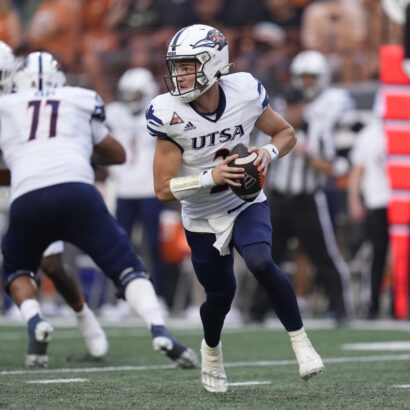
Arch Manning is my QB1 in the SEC because he gives you the best mix of name value, talent, production path, and long-term insulation.
When you are drafting in C2C or Devy, you are not just drafting what a player is today. You are drafting what he can become. Arch gives you the type of ceiling that can change a fantasy roster. He has the arm, the pedigree, the athletic ability, and the system around him to become one of the most valuable quarterback assets in these formats.
From a fantasy standpoint, the exciting part is that he is not just a statue in the pocket. He can move, extend plays, and add enough with his legs to matter. That matters in C2C, and it matters even more when you are betting on long-term upside.
Verified Stats
In 2025 at Texas, Manning completed 248 of 404 passes for 3,163 yards, 26 touchdowns, and 7 interceptions.
Supplemental Draft Outlook
In almost every supplemental draft, Manning is already going to be on a roster, and you’ll likely have to acquire him through a trade.
Startup Draft Outlook
In startups, he is a cornerstone pick. You can build around him for both Campus and Canton value. He gives you immediate excitement and long-term trade insulation.
To access the rest of this article, login or become a member. 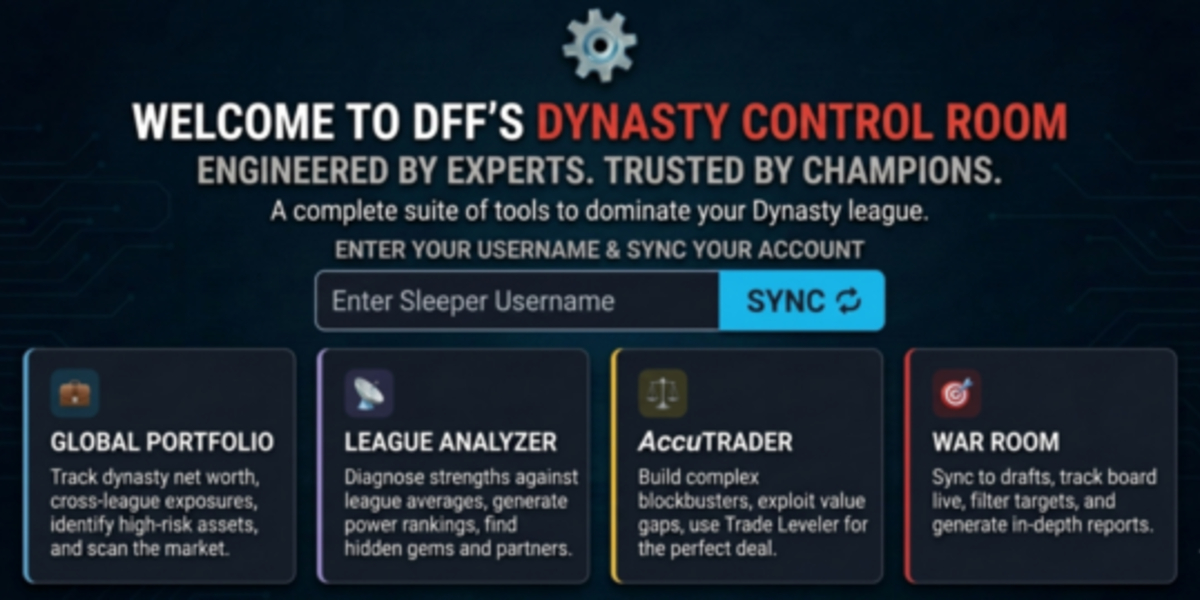
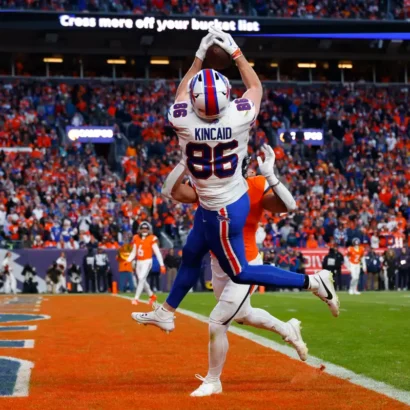
The tight end position is a tough one to pin down in fantasy. You either have one of the elite options who helps you stand above your league mates — just ask anyone who has had Travis Kelce for the past decade — or you’re stuck playing roulette with a bunch of middling options.
Unfortunately, Kelce’s run is over. The top shelf tight ends are now guys like Brock Bowers, who caught 112 passes for 1,194 yards as a rookie in 2024, and Trey McBride, who set an NFL record for tight ends with 126 receptions last year. Those two stand alone at the top, although some are trying to push Colston Loveland up into that tier. I just don’t think he’s there yet. We need to see more from last year’s No. 10 overall pick before we start anointing him.
A little further down the rankings, though, sits a very intriguing player — one who, at 26 years old, should be entering his prime. I’m talking about Dalton Kincaid.
Buffalo took Kincaid in the first round in 2023, and as a rookie, he looked the part. He reeled in 73 catches for 673 yards and two scores in Year 1. The future looked insanely bright. Dynasty managers thought they had the next big thing.
After that promising start, though, things haven’t been quite as rosy. Kincaid has dealt with several injuries, including a troublesome PCL issue that has been lingering since 2024. That has caused Kincaid to miss nine games and limited him in several others over the past two seasons.
Last year, he had just a 38.3% snap share (TE70) and ran only 189 routes (TE47), which resulted in career lows in both targets (49) and receptions (39). He still managed 571 yards and five touchdowns, averaging 10.5 fantasy points per game in PPR scoring, good for TE13.
So why am I talking about this guy?
To access the rest of this article, login or become a member.
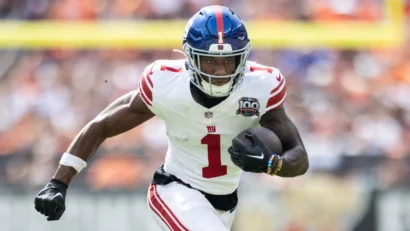
When we look at the Giants, it’s easy to get excited, concerned, and confused. When will Malik Nabers (WR – NYG) be back? How good of a season can Jaxson Dart (QB – NYG) have without his number one wide receiver? Is Isaiah Likely (TE – NYG) the best bet to make in the Giants’ offense? Can both Cam Skattebo (RB – NYG) and Tyrone Tracy (RB – NYG) be fantasy viable this season? Is John Harbaugh the missing link to the Giants’ return to glory?
Those are all legitimate questions, concerns, and reasons to be optimistic about the Giants’ offense in fantasy.
To access the rest of this article, login or become a member.
Earlier this offseason, I wrote a similar piece, breaking down the biggest gaps between my devy rankings and those of DFF ranker @Evan_Kerr_. Today, I’m covering the dynasty players where I’m furthest from consensus here at DFF, which averages my rankings with those of Evan and @force_fantasy. Some of these might not seem like huge discrepancies, but keep in mind my rankings make up a third of what consensus spits out, so the value differences are bigger than they may seem.
As always, these rankings are based on dynasty, Superflex, and Tight End Premium scoring. I’ll provide my positional ranking for comparison with the consensus.
Players I’m Above Consensus On
Luther Burden III – (WR – CHI)
My dynasty rank – WR14
DFF consensus – WR18
Here’s my bull case for Burden, plain and simple. He and Loveland were hand-selected by HC Ben Johnson. Rome Odunze was not.
It took some time for Burden to get fully acclimated, but we saw his upside in the latter part of his rookie year. Through the final seven weeks of 2025, Burden finished third in the NFL in yards per route run with 2.92 (min. 20 targets). He posted a robust 26.8% target rate during that span, confirming he was a focal point in Chicago’s passing attack.
Exptrapolate that kind of efficiency over a 17-game sample and a full route share now that D.J. Moore is gone, and you have a guy who could finish top 10 at his position in fantasy. I think there’s a very good chance Burden is a consensus WR1 (top 12) in dynasty by this time next year.
To access the rest of this article, login or become a member.
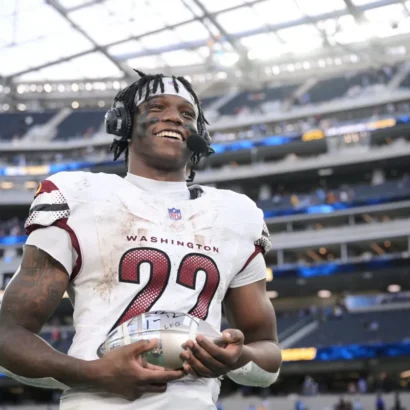
Welcome back to my One Question series, and thank you to everyone for reading my first installment. I’d love to know what you’ve done or plan to do with George Pickens (WR – DAL) this year. This week, we’re staying in the NFC East.
After a disappointing season following their appearance in the 2024 NFC Championship Game, Jayden Daniels (QB – WAS) and the Commanders didn’t live up to the hype due to an injury-riddled season. After firing offensive coordinator Kliff Kingsbury and promoting David Blough, the offense is headed in a new direction — and there is genuine excitement within the organization about the new offensive style.
My question to the Commanders is: Who is the RB1?
Jacory Croskey-Merritt (RB – WAS)
Jacory Croskey-Merritt — aka “Bob” — was a Twitter darling last offseason with only Brian Robinson Jr. in his way, playing alongside 2024 Offensive Rookie of the Year Jayden Daniels. What’s not to like? He was primed to take over the Commanders’ backfield and be a league-winner, or so we thought.
Daniels got injured early in the season, tried to fight through it, and ultimately played just seven games. However, even on a bad team with a struggling offense, Croskey-Merritt played all 17 games, totaled almost 900 yards from scrimmage, and scored eight touchdowns — all while playing second fiddle to Brian Robinson Jr. and Chris Rodriguez for most of the season.
Robinson is now with the Atlanta Falcons, and Rodriguez took his talents to Jacksonville. Surely Croskey-Merritt is the favorite to finally make good on his promise as the Commanders’ lead back, right?
One would think. But with Washington adding veteran running backs Rachaad White (RB – WAS) and Jerome Ford (RB – WAS), then drafting sixth-round pick Kaytron Allen (RB – WAS), the question becomes: is Croskey-Merritt the running back on this roster we should trust — or should we take a deeper look at the competition?
To access the rest of this article, login or become a member.
*Positional rankings in this article were pulled from Dynasty Football Factory’s Consensus Rankings
AFC East
Buffalo Bills – Dalton Kincaid (TE14)
Dalton Kincaid is a frustrating player to have in fantasy. He’s uber-efficient on a per-route and per-touch basis, yet he gets on the field an exasperatingly low amount due to injuries and a somewhat one-dimensional profile.
Despite a measly 38.3% snap share (TE70) in 2025, Kincaid finished as the TE13 on average, putting up 10.5 fantasy points per game. He accomplished that with some insane per-touch output, ranking first at the position in yards per route (3.02), first downs per route (0.143), yards per target (11.7), and QB rating per target (149.2). If his knee ever allows him to handle a full workload, Kincaid could break fantasy. Sadly, that may never happen.
Miami Dolphins – Caleb Douglas (WR133)
Expected to be a late-round selection, Caleb Douglas was a shocking pick when Miami selected him in Round 3 of the NFL Draft. Looking at his measurables, though, it’s easy to see why the Dolphins liked him. He’s 6’4”, 206 pounds and ran a 4.39 40-yard dash at the combine — numbers that will turn some heads.
Douglas can burn past defenders, and he uses his height effectively to high-point the football. Those skills helped him rack up 845 yards and seven scores at Texas Tech last season. Given his draft capital, Douglas will have a chance to carve out a role in a receiver room bereft of playmakers. Anytime after Round 20 of startups or Round 3 in rookie drafts is a perfect time to take a swing on him.
To access the rest of this article, login or become a member.

In this ~FREE~ DFF article, @jim_DFF wraps up his C2C startup series by covering his favorite late-round picks, as well as his favorite ADP value from the other 11 teams.

As the offseason progresses and news from OTAs enters the echo chamber that is the fantasy community on Twitter (or X, if you’re weird and literal) not all news is good news, unless you’re a Parker Washington stan and more importantly, not all news is relevant for fantasy, and should always be taken with a grain of salt.
We must remember, these guys are running around without pads on, playing seven on seven. We’re all excited for news updates and with the latest trades of A.J. Brown to the New England Patriots and Myles Garrett going to the Los Angeles Rams (my favorite team to win the Super Bowl, fyi) it’s hard not to get excited about any and all NFL news, especially for us fantasy guys.
To access the rest of this article, login or become a member.
*Positional rankings in this article were pulled from Dynasty Football Factory’s Consensus Rankings
AFC North
Baltimore Ravens – Zay Flowers (WR22)
At least here at DFF, we have Zay Flowers priced a little more appropriately. For some reason, last season’s WR7 in total fantasy points is currently sitting at WR27 over at KeepTradeCut. Still, I’m more aggressive than nearly everyone in the industry, with him at WR15 in my personal rankings.
He’s the top target for Lamar Jackson and in his prime as he enters his age-26 season. In addition to the top-notch raw stats, Flowers also posted some elite efficiency metrics in 2025: first in juke rate (22.9%), fourth in explosive plays (21), fifth in yards per route run (2.62), and sixth in target separation (2.15) among all wideouts. As long as I can get him for low-end WR2, high-end WR3 prices, I’m picking Flowers all day long.
Cincinnati Bengals – Tee Higgins (WR25)
While he’s never going to be the first option in Cincinnati’s passing attack, Tee Higgins is still a highly productive fantasy receiver. Even while missing seven games over the past two seasons, he’s racked up back-to-back campaigns with over 800 yards and double-digit touchdowns. Playing second fiddle to Ja’Marr Chase, Higgins ranked second in the league in receiving scores (11) and 13th in fantasy points per game (14.1) last season.
Like Flowers, I’m higher on Higgins than most. He’s my WR16 since he’s tied to Joe Burrow in an offense that loves to sling the rock. As long as he stays healthy, Higgins should flirt with WR1 output once more, making him an attractive add at cost for any manager playing for a championship this season.
To access the rest of this article, login or become a member.

In this week’s episode of Always Be Scouting, @DffFrankPanthro and @John_mancuso5 invite DFF analysts @jim_DFF and @Evan_Kerr_ back on to break down an expert C2C startup draft.

Continuing my Redraft series, I’m now going to look at the average draft position (ADP) for tight ends in 2025. My goal is to identify the ideal ADP windows for targeting the TE position versus other positions.
I looked at the top 96 players in 2025, and 10 tight ends were taken in that range. I looked to see how the player did based on their draft position. I am using Sleepers’ ADP for this exercise.
To access the rest of this article, login or become a member.
Continuing my Redraft series, I’m now going to look at the average draft position (ADP) for wide receivers in 2025. My goal for this is to identify the ideal ADP windows for targeting the RB position versus other positions.
I looked at the top 96 players in 2025, and 43 wide receivers were taken in that range. I looked to see how the player did based on their draft position. I am using sleepers’ ADP (average draft positions).
To access the rest of this article, login or become a member.
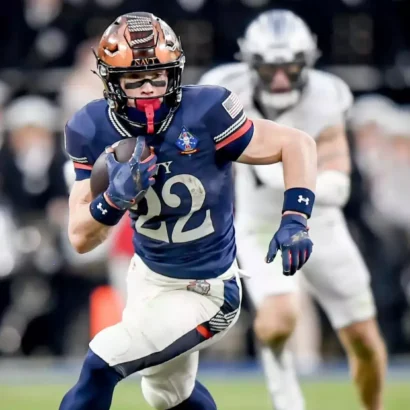
Within the Dynasty Fantasy Football community, most die-hard Dynasty enthusiasts have heard the name Eli Heidenreich. But the main question is: does he have potential? After being selected by his hometown Steelers in the seventh round (230th overall), he’s a very underrated player who would have gone a bit higher if he had played at a larger college football program and gotten more national recognition. Heidenreich will land on the Philadelphia Eagles schedule on November 22 and is an intriguing hybrid offensive player with elite pass-catching ability. When digging deeper into the analytics on Heidenreich, he’s actually an intriguing prospect who has all the talent to become a hidden gem of Dynasty rookie drafts. Let’s dive in!
To access the rest of this article, login or become a member.

Continuing my Redraft series, I’m now going to look at the average draft position (ADP) for running backs in 2025. My goal is to identify the ideal ADP windows for targeting the RB position versus other positions.
I looked at the top 96 players in 2025, and 32 running backs were taken in that range. I looked to see how the player did based on their draft position. I am using Sleepers’ ADP for this exercise.
To access the rest of this article, login or become a member.
With today’s article, I’m going to look at the average draft position (ADP) of quarterbacks for 1QB leagues in 2025. My goal is to find the ideal ADP windows to target the quarterback position in this particular format.
I looked at the top 96 overall players in 2025, and 14 quarterbacks were taken on average in the top 96. I looked to see how each player did based on their draft position. I am using Sleepers’ ADP for this exercise.
To access the rest of this article, login or become a member.
@Paul_Ryan15 makes his DFF debut, breaking down the 2026 rookie class. Find out which rookies are worth buying before the market catches up in this ~FREE~ DFF article.

You mean to tell me I can get a 26-year-old bell-cow, tied to a long-term contract, in an explosive offense at only RB19 prices? Sign me up all day. Javonte Williams averaged 15.2 fantasy points per game last season, good for RB11. After racking up 1,338 total yards and 13 touchdowns in his first season with the Cowboys, Williams re-upped with Dallas, and he’s now locked in as the unquestioned RB1.
He’s not the most electric back in the game, but volume is king, and he should get plenty of it again in 2026. With only Malik Davis and Jaydon Blue behind him, Williams could push for 300 touches this season. Low-end RB1 output is in play once again, and you only have to pay a low-end RB2 price to get him.
To access the rest of this article, login or become a member.
Welcome back for Part 2 of my C2C startup series, where I give you a behind-the-scenes look at my Campus selections and draft strategy in a league full of expert analysts. If you missed Part 1, where I covered my first ten picks, you can check that out here. I’ll run through picks 11-20 and my reasoning in this article and then wrap it up with a handful of my favorite late-round picks in Round 3.
As a reminder, this is the Campus draft in a C2C startup, and the league format is start 12, 2QB, and Superflex. No more wasting time; let’s jump right in!
11.04 – Faizon Brandon (QB – TEN)
I went with an incoming freshman for my QB3 with Faizon Brandon. He’s reportedly winning the QB competition this offseason and is tracking to be the Week 1 starter for the Vols. Brandon boasts above-average arm strength and made some impressive anticipatory throws on his high school film, displaying good footwork and mechanics. He’s not a dual-threat guy by nature but is highly athletic and mobile, amassing 24 rushing touchdowns and nearly hitting 1,500 rushing yards in his high school career. This pick could end up being a smash in the double-digit rounds.
12.09 – Jai’Den Thomas (RB – UNLV)
I wrote up Thomas a few weeks ago in another article as my Devy “sleeper” at the RB position. He’s coming off a 1,000-yard, 12-touchdown season where he averaged over 18 FPPG and should be in line for an even larger workload in Year 4. Not only should “Jet” Thomas be an every-week starter for my team, but I think he has some sneaky dynasty value as a potential scat back at the NFL level. He’s a smaller back but highly explosive and unbelievably efficient.
To access the rest of this article, login or become a member.

In this article, I am going to break down the Scott Fish Bowl scoring and try to identify who we should target in the early rounds and where the value picks are. First, I’ll look at the past two seasons to identify where the value is. It will be hard to know for sure until we know the ADP (average draft position).
To access the rest of this article, login or become a member.
We’re well into the DFF C2C Bragging Rights startup draft, a highly competitive C2C league bringing together content creators from Dynasty Football Factory and Campus 2 Canton. After wrapping up the “Canton” draft, the “Campus” draft is now underway. With roughly 20 rounds in the books, we’re approaching the halfway point.
This will be Part 1 of my draft series, where I’ll break down my picks from the first 10 rounds and walk through my macro-level strategy. Keep an eye out for future editions, where I cover my middle and late-round selections.
A few notes for context: this is a managed league (not best ball), with a start-12, 2QB/Superflex lineup, meaning you can start up to three quarterbacks. With that in mind, let’s review my picks and where I’m headed from here.
To access the rest of this article, login or become a member.

In this week’s episode of Always Be Scouting, @DffFrankPanthro and @John_mancuso5 bring on Will Stone to unveil Bluechip, the newest platform for Devy, C2C, and CFF formats.
The goal of this article is to determine whether 4- and 5-star players are the ones we should be targeting each year in our drafts. On average, there are about 22 4+ stars each year for the quarterback position. I wanted to look at the current landscape of the top 24 quarterbacks on KeepTradeCut to see what they were rated when they came out of high school. The high school star rating is from 247Sports.
To access the rest of this article, login or become a member.
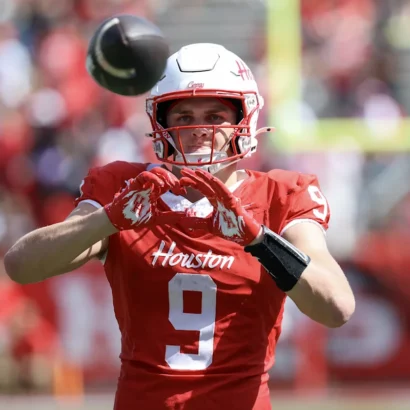
Eli Heidenreich is an off-the-radar player from Navy who played in one of the most unique offensive systems in college football, notorious for amplifying a singular player’s productivity.
Heidenreich has some eye-popping analytics. Yards per route run is one of the strongest singular predictors of future fantasy production. On its own, YPRR carries a 0.43 correlation when using current-year data to project next year’s performance. Heidenreich’s 4.73 yards per route run is easily tops in this class, well above the wide receivers who were selected in the first round of the NFL Draft.
His draft capital was poor. But he was drafted. And his Pittsburgh landing spot was pretty solid. Kenneth Gainwell was the RB 20 overall in fantasy points per game last year. Heidenreich has a shot at a similar role eventually.
Steelers beat writer, Mark Kaboly, posted on X, “ I am not saying that Eli Heidenreich should even be mentioned in the same breath as Christian McCaffrey because C-Mac is elite and a different breed … but you can’t help but notice similarities in how they move around a football field. (yeah, this is going to be taken out of context, oh well).”
To access the rest of this article, login or become a member.
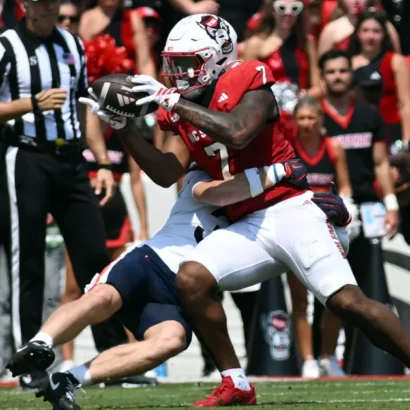
This weekend, we wrapped up my final dynasty rookie draft of the offseason (outside of my home dynasty league, which drafts during the preseason). With rookies now rostered in 17 of my 18 leagues, I thought it was a good time to discuss my top-owned dynasty rookies.
Using the “exposure” feature in the Dynasty Control Room, I’m able to see my ownership percentage of every single fantasy player. Being a “portfolio manager” in 18 leagues, this feature is especially useful, showing me who I need to invest more heavily in, as well as the guys I should look to lower my exposure on. The tool also shows you which players DFF expert consensus is above and below market on, to give you an idea of whether you’re investing in the right players.
With that, let’s take a look at my top 5 most-owned rookies right now.
To access the rest of this article, login or become a member.
