
Team Finish: Champion, First, Best, #1 Overall
Ah, sweet victory. Even without anything tangible on the line, there is always the ultimate trump card: bragging rights. The ability to tell everyone how great you are and how superior you are in every way. In this case, holding this right over other fantasy football degenerates is especially sweet. Heck, I can even spend an entire opening paragraph rubbing it in.
But enough about how awesome I am, let’s take a look back at my year and see if I can help these poor lost souls and others like them in future seasons. The league settings were 12-team, PPR, one QB, two RBs, two WRs, two Flexes, D/ST, and six bench spots.
The Draft

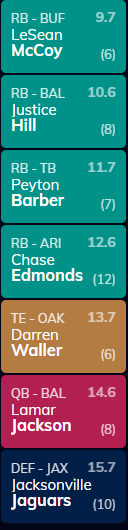
If you read my first article, you’ll know I approached the draft with a zero-RB strategy in mind. I don’t generally try to have a predetermined strategy, but for the purpose of writing these articles, I decided to try this. The movement has lost some steam in recent years, with stud running backs drawing a lot of attention. I started with six wide receivers, then six running backs, and concluded with tight end, quarterback, and defense/special teams. I typically use a late-round QB and TE strategy with the idea that I will stream the positions down the stretch. Lamar Jackson and Darren Waller turned into weekly starters, and I did not have to burn a roster spot to stream each week aside from bye weeks. My WR corps was pretty well settled, so I spent most of my attention and FAAB on the RB position.
Free Agent Moves
I made 24 moves during the season; 23 were via free agency, and one was a trade. Of these moves, 10 were to acquire RBs, and 10 were to change D/STs. I made two moves to acquire WRs, and one QB and TE move a piece (bye week fill-ins). With the zero-RB strategy, that position held the highest priority. Some notable pickups were Raheem Mostert (although I dropped him later on when it looked like Tevin Coleman was going to tank his value), Jamaal Williams, Jordan Howard, Jonathan Williams, and DeAndre Washington towards the end of the year.
There are some common themes if you look at my original roster and my free agency grabs: injury opportunism/handcuffs, muddled backfields, and middling to above-average offenses. Injuries are pretty obvious. You have to be on top of the news and willing to be aggressive with your FAAB (I didn’t have a dollar left going into the final week). Solid offenses are also a fairly common target among experienced fantasy owners. The muddled backfield is a bit more interesting.
These are team situations that people tend to avoid altogether. Take a team like San Francisco, for example. At the beginning of the year, there was Jerick McKinnon (for a minute), Tevin Coleman, Raheem Mostert, Matt Breida, and Jeff Wilson, Jr. all competing in the backfield. Due to injuries and different production levels, that cluttered backfield became a lot clearer. And if you were correct in your picks/free agent pickups, you can get a very startable asset for dirt cheap. These are great targets for a zero-RB team.
Trades
If you read my second article, you know that I traded Odell Beckham, Jr. for James Conner in Week 5. This transaction was crushed when I put it on Twitter, with something like 90% of the vote on the OBJ side. Under normal circumstances, I probably wouldn’t make that move. However, my team needed a plug-and-play guy at the RB position, and OBJ had the best value-to-production ratio, even early on. Between Conner getting hurt approximately 78 times over the final 10 games and OBJ’s lack of production, the trade worked out pretty evenly.
Final Roster


As you can see, my WR corps went relatively untouched. While there were definitely issues with the likes of Cooper Kupp and Robert Woods at times this year, the nice thing about the zero-RB strategy is that they balance out. The volatility at one roster spot can be easily made up for in another from week to week. When Kupp layed an egg, which happened more often than not down the stretch, I had insulation with high scorers like Davante Adams or Chris Godwin. The baked-in safety net with that position was very helpful.
Final Analysis
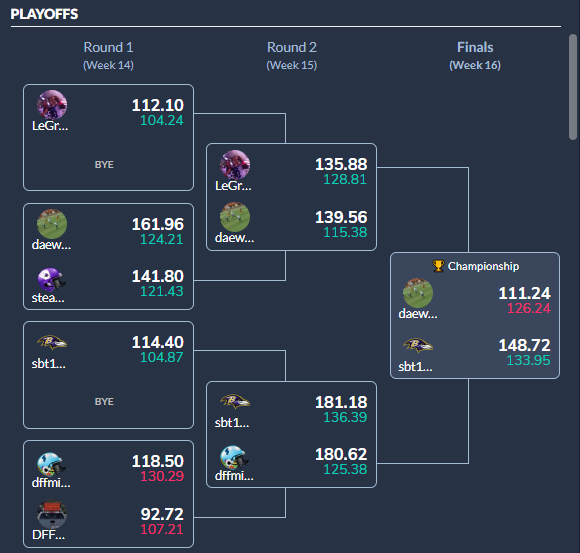
- I’m sure there are several of you thinking, “Well, of course, he did well. He had Lamar Jackson!” I can’t deny that in the slightest, Jackson was a huge boon for any late-round-QB drafter. As was Darren Waller. So there’s a tip for everyone: don’t be afraid of the late-round strategy, even in a league where other people are drafting quarterbacks and tight ends late.
- Now for the zero-RB strategy. Obviously, you can win this way, but a couple of notes: first, you need to be in a PPR league, and second, our league had two WR slots and two flexes. Therefore, a player could draft four early and establish those four positions. Keeping that theory in mind, I wanted to get George Kittle in the earlier rounds and then go running back heavy. When Kittle went before me, I decided to go all-in with wide receivers and take my RB shots later.
- As I mentioned earlier, the relative instability at the WR position is masked when you have strong players to back them up. This is kind of ironic because the premise behind the zero-RB strategy is that the running back position is replaceable because of injury, and therefore volatile. Therefore, the inverse of this theory could play out similarly: draft RB-heavy early, then load up on WRs later in the draft. Stream them from the wire as needed when opportunities and talents emerge.
- Finally, and this is something that is pretty obvious but bears repeating, don’t be sheepish with your FAAB or waiver priority, especially if you intentionally avoid a particular position in the draft. I went hard after my favorite targets until I couldn’t afford any longer. Some players are conservative with their budget, and you can score breakouts early in the season. Conversely, aggressive players like me tend to lose their FAAB early, and you can snake good deals later in the season if you hold a decent percentage or lose early bids. If you don’t have a FAAB system, the same general principle applies: be aggressive, pay attention, and don’t stop playing. Some people check out mentally at the end of the season or forget to check their priority.
All in all, fantasy can be played and won in any manner you want. Hard work and diligence pay off more than any one strategy. And if you’re in a league where only bragging rights are on the line, have some fun. There’s nothing like telling everyone exactly what you’re going to do and beating them with it. *Tosses hair and struts off the stage*
Thank you for reading! If you enjoyed this, please stay tuned for more articles similar to this one. Also, if you have a question or comment, you can find me on Twitter @DFF_sbt1030. Thanks again!

