

Some of the toughest roster management decisions that exist in dynasty leagues are knowing the exact moment to move off of an asset before his value drops. This is easier said than done. I would be highly suspect of anyone who claims to have it all figured out. While we can use age as one filtering factor, such as running backs over a certain age or wide receivers over a certain age, it’s not the only variable to consider.
Hitting that sweet spot of pivoting off of an aging veteran player, or moving on from a younger player who went on a hot streak for a few weeks can result in incredible profit. You swap out a player who quickly lost value in exchange for a young, promising asset, future draft capital, or both. It’s a wonderful feeling and one that every fantasy player seeks to find.
However, missing that window by a year, or even a week, can be crushing to your morale. Instead of cashing in on the high value, or perceived high value, you’re suddenly left sitting there rostering a player who will likely never see your starting lineup again. Can you still move them as a depth option to another owner? It’s possible, but you’ve lost all leverage by missing the train.
I will be using my main dynasty roster for the context of this article series. In this piece, I will be open and honest about some of the roster management questions I believe I will be facing as we enter this coming offseason. As always, I would love to hear your thoughts and feedback!
Darren Waller (TE, OAK)
I tweeted about Darren Waller over the holidays and tabbed him as someone I would look to “sell high” on this coming offseason. A quick disclaimer: I know everyone uses terms in their own way. When I suggest selling a dynasty asset, it is not because I do not think they will no longer have value. It is because I think their current value as likely the highest it will be.
Take a look at Waller’s career stats:
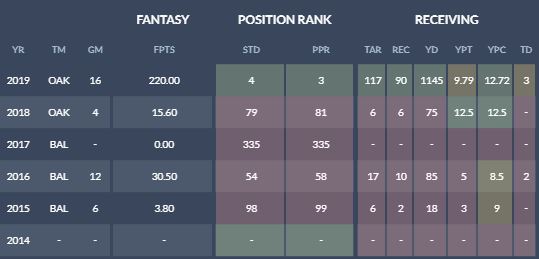
Now, to be fair, Waller has gone through significant off-the-field challenges to get where he is today. That is not something to be taken for granted. He is athletically gifted and has worked hard to get himself back onto the field. That being said, from a dynasty perspective, there are a few things I took a closer look at that give me pause.
The massive spike in his production this season compared to the rest of his career is obvious to see. I do not have to break that down for you. However, I do believe Waller was in a unique situation that allowed him to flourish as the number one pass-catching option on his team this past season.
After the Antonio Brown fiasco in Oakland, Waller was essentially guaranteed more targets once the Raiders didn’t bring anyone else in. Also, the Raiders did not have a true WR1 (sorry, Tyrell Williams). The only other true pass-catching options on that team were Zay Jones and rookie wideout Hunter Renfrow. Waller thrived as the only real viable option in that offense.
Looking to next year, it’s almost a guarantee that the Raiders will address their offense, more specifically their wide receivers. In his Mock Draft 1.0, Todd McShay from ESPN tabbed the Raiders to draft Laviska Shenault Jr. (WR, Colorado) in the first round. Regardless of what you think of that pick, it coincides with the Raiders’ need for offensive help.
Another aspect of Waller’s game that concerns me heading into next year is his relationship on the field with wide receiver Hunter Renfrow. In his final Love/Hate article of the season, Matthew Berry highlighted some information on Waller & Renfrow. He says:
“You see, when Renfrow is off the field, Waller averages 14.5 yards per catch (and 8.9 air yards per target). However, when Renfrow is on the field, those numbers drop to 9.7 yards per catch and 4.9 air yards per target. Renfrow was on the field for 46.8% of snaps last weekend, his first action in nearly a month. His nine targets (seven catches and 107 yards) on 24 routes would indicate that he is going to be on the field more this weekend, as the Raiders chase their slim playoff dreams. As those with Waller on their roster are painfully aware, he has just one red-zone target over the past five weeks.”
Now, to be fair, in that article, he was referring to discounting Waller in his Week 17 matchup; but the data does not lie. Waller sees less volume when Renfrow is on the field. The Raiders also do not seem interested in providing red-zone looks for their athletic tight end.
I do believe Darren Waller will still be a TE1 next season. As we tend to see year after year, it only takes a few big games for a tight end to sneak into the top 10 or 12 at the position. However, I think he is at his ceiling. He will likely have to score more touchdowns, which is entirely possible, to remain an elite tight end. As we’ve seen, however, the Raiders have not catered their red-zone offense to him.
For my part, I will be looking to sell Darren Waller this offseason. I will not look to trade him away for the sake of trading him away. If I can find an owner who believes he still has room to grow and produce, I will make the move and secure profit for the future.
Julio Jones (WR, ATL)
I will admit, this will be one of the tougher moves for me to make should I end up going through with it. There are so many layers to this decision. I’m equal parts excited for the research and digging I will have to do. I’m also nervous because I may conclude that it is time to sell one of the most elite wideouts who has ever played the game.
Take a look at Jones’s last six seasons:
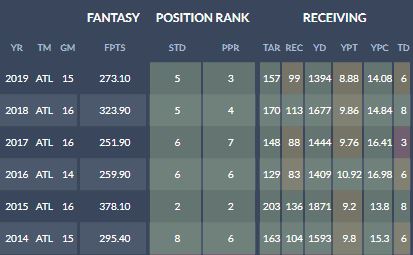
Those numbers are about as dominant and consistent as they come. When people talk about physical freaks of nature at the wide receiver position, Julio Jones will always be near the top of that list. It’s no secret that he’s dominated the league for so many years. He has the physical traits that showcase why he’s one of the most feared wideouts in the league.
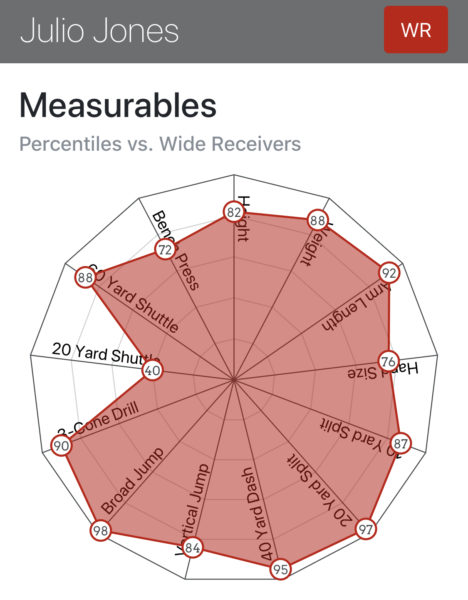
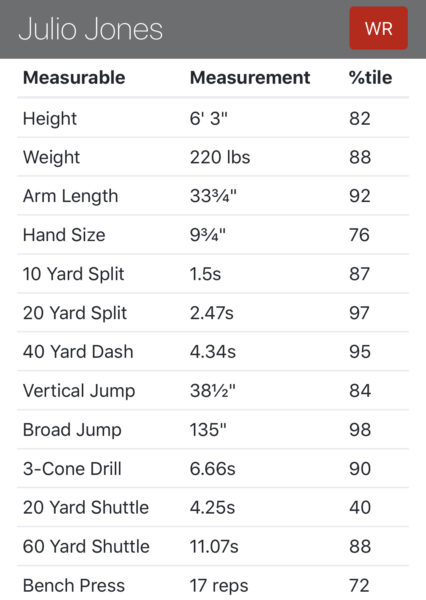
If there is a knock on Julio’s game, it’s his weird relationship with finding the endzone. It’s crazy to think how much better his numbers would have looked had he been a consistent double-digit scorer every year. Admittedly, touchdowns are tough to replicate and there are a variety of factors that go into playcalling and personnel decisions. Even so, he’s only scored 10+ touchdowns once in his career and that was back in 2012.
From a health standpoint, he’s been exceptionally durable throughout his career. It’s become the norm for him to battle a variety of lower-body injuries throughout his career. He also takes regularly scheduled “maintenance days” throughout the weeks of the regular season.
Despite his durability, numerous injuries popped up, most of them minor, throughout his career. While the majority of them haven’t forced him to miss exceptional time, the list is quite lengthy. Take a look at what Sports Injury Predictor has on file.
To me, it doesn’t matter how great and dominant you are; at some point, the injuries will start to pile up and the recovery process will take longer than it used to. Time is undefeated and takes no prisoners. At some point, Julio Jones will no longer play football at the elite level we’ve grown accustomed to.
Another variable that I, as a Julio Jones owner, will have to consider is the emergence of fellow wide receiver Calvin Ridley. Ridley has become one of the most prolific route-runners and overall young wideouts in the league throughout his first two seasons. While an abdominal injury cut his second season short by three games, he’s begun taking on a larger role on the field.
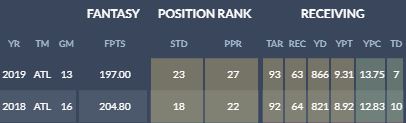
In two seasons, Ridley has scored 17 touchdowns to Jones’s 14. Two of the six touchdowns Jones scored this year came after Ridley found himself on Injured Reserve. Speaking of Ridley being placed on IR, there are some interesting stats to look at from Julio Jones’s perspective that may push me, and maybe you, to consider selling him this offseason.
During the last three weeks of the 2019 season, when Jones was playing without Ridley, here is the total line that Jones compiled: 48 targets, 30 receptions, 378 yards, two touchdowns.
That’s absurd volume and production, even for Julio Jones. Recency bias is a very real thing within the fantasy community. I believe we can all be guilty of buying into it once in a while.
For those who may not follow the closer details of fantasy football, a quick look at the box score will show Jones finishing the season on an absolute tear and ending the year with similar numbers to his recent season. However, a closer look will provide a more clear reason for the spike in production.
Before this season, Julio Jones and the Atlanta Falcons agreed to a three-year, $66 million contract extension that is fully guaranteed. As a wide receiver on the wrong side of 30 years old, this was impressive. In my opinion, it is a well-deserved reward for Jones. It’s always interesting to see how star players perform after cashing in but Jones seems primed to continue playing for the time being.
As I wrap up my research on Julio Jones, there are a few things I have to consider. First, his age is not playing in his favor. The multitude of lower-body injuries will eventually take its toll and prevent him from playing at a high level. Second, the sudden spike in production this season without Calvin Ridley may provide the bump in value necessary to sell high on this aging star. Third, he may still have a productive season or two left in him. If that’s the case, I can always try to hang on for one more year.
For my part, I will be actively shopping Julio Jones this offseason. The saying “it’s better to sell a guy a year early versus a year late” is very true. I will be looking for a sizeable return for him as I do truly believe he has another productive season or two left in him. If I am unable to sell him at the price I want, I will likely retain him and try to win a championship with him next season.
Thank you for reading the first of my multi-part series on Offseason Roster Management. Future pieces will be coming in the days and weeks ahead. As always, I would love to hear your thoughts, suggestions, and feedback.
Thanks for checking out my article! For more fantasy football content, follow me on Twitter @Samuel_DFF.

