
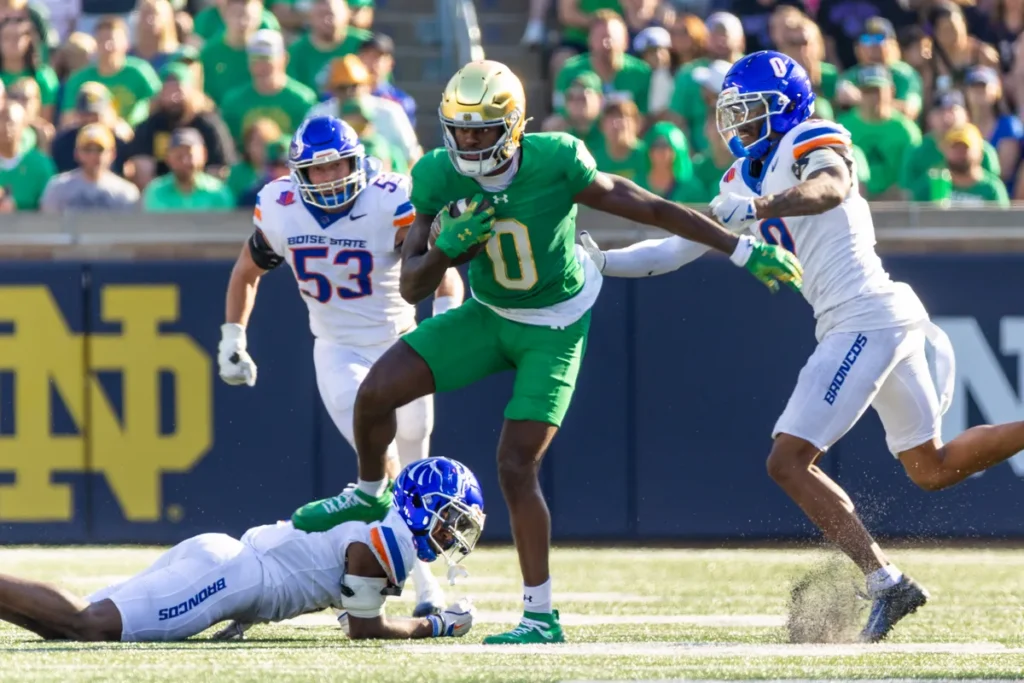
The Prospect Analytical Model Rankings are one of our members’ favorite series each year at Dynasty Football Factory. Years of refining and enhancing the models to accurately predict future fantasy value have brought us to today.
We will start with the wide receiver position. These WR1 model rankings will be your ultimate guide to predicting which prospects will produce the most fantasy points in their NFL career.
You can find the running back RB1 model here.
DFF members only can access the WR1 rankings 10 to 6 here.
For those new to the WR1 rating, it is a proprietary formula I developed in 2019 that provides a data-driven forecast of future fantasy production for incoming rookie wide receivers. There are many advanced metrics available today; we at DFF know it can be difficult to determine which ones matter and how much each matters. The WR1 model distills all that hard work into a single, easy-to-understand number. The model evaluates rookies across 13 of the most predictive metrics and combines their individual metric scores into a total WR1 rating. It was a pioneer in the fantasy analysis industry, being the first to incorporate a film-grade into the model. The goal is to provide an easy-to-use score for those who don’t want to spend hundreds of hours dissecting different metrics. Based on the prospect’s model score, I provide their probability of achieving at least one top-24 NFL Fantasy Points Per Game Season, using historical prospects with similar score ranges.
The WR1 model consistently outperforms NFL draft capital in predicting the future fantasy success of incoming prospects. For a full breakdown of the model’s past performance, click this link. You can also find the 2025 model here and the 2024 model here, where we were one of the very few publications to have Malik Nabers as the top wide receiver overall instead of Marvin Harrison Jr. Even the NFL had Harrison higher, as Nabers was drafted behind Harrison in the NFL Draft. Here is the WR1 model I published in 2023, featuring Jaxon Smith-Njigba as the WR1. The WR1 model is exceptional at identifying the true elite wide receivers. 17 of the 20 top-scoring prospects with at least three years in the NFL have had a top-24 PPR PPG NFL fantasy season.
Fourteen of the 20 have also had a top-12 PPR PPG NFL fantasy season. Nine have had multiple top 12 seasons, including perennial top-5 studs like Julio Jones, Calvin Johnson, Odell Beckham Jr., Ja’Marr Chase, and Justin Jefferson.
So let’s dive into the 2026 class.
Honorable mention #1
Deion Burks, Oklahoma | WR1 Model Score: -12
Based on historical comps, Deion Burks WR1 Model score of -12 gives him an 8.2% chance of having at least one top-24 fantasy season in his career.
Historical Players With Similar WR1 Model Scores:
The Good
I am including Deion Burks as an honorable mention out of respect for Daniel Jeremiah. Jeremiah is one of the most highly respected mock draft prognosticators in our industry. His most recent mock draft predicted Burks as a second-rounder, pick 46 overall. Jeremiah called Burks, “A 5’9″, 188 lb playmaker, Burks is noted for his explosive speed, quick feet, and ability to generate yards after the catch.”
Fam, I love Daniel Jeremiah, but I fear selecting Burks in the second round would be a brutal mistake, as you will see in the Bad and Ugly sections. In my version 2.0 of this WR1 Model write-up, my prediction is that Burks falls out of the top 15, as he will no longer have this mock draft estimate to prop up his overall model score.
Lance Zeirlein gave Burks a solid 6.18 film grade. Zeirlein writes of Burks. “Fifth-year slot receiver who is savvy against zone coverage and crafty after making a catch. Burks does a good job of utilizing his straight-line speed when the ball is in his hands. He struggles to win on vertical routes, though. He creates windows underneath by crisply breaking off short routes. He’s a compact, short-armed target who secures catches through contact.”
The Bad
The only metric that wasn’t brutal from an analytics standpoint for Burks was his weighted dominator rating. His 29.2% percent team share of touchdowns and receiving yards ranked tenth among prospects in this draft class.
The Ugly
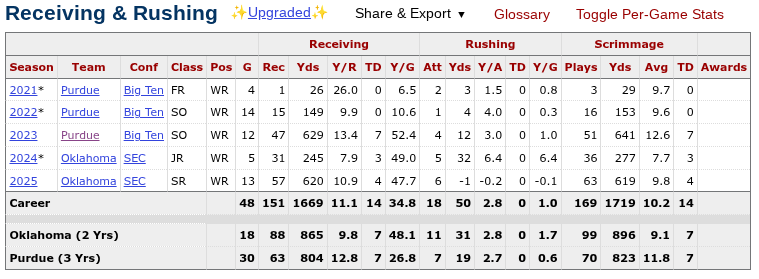
Everything else. As you can see from the stats table above, we have to go back to his sophomore season at Purdue to find Burks’ best season from a production standpoint. This is highly atypical for a prospect.
For the prospects graded for the model, Burks finished last in receiving yards per team pass attempt (1.60), yards per route run (1.58), and PFF receiving grade (65.8). #NotGood
Honorable Mention#2
Malachi Fields, Notre Dame | WR1 Model Score: -2
Based on historical comps, Malachi Fields WR1 Model score of -2 gives him an 12.1% chance of having at least one top-24 fantasy season in his career.
Historical Players With Similar WR1 Model Scores:
- Jalen Tolbert
- Tez Johnson
- Khalil Shakir

The Good
Our WR1 Model is at odds with early mock draft forecasters who predict Fields will be a second-round pick. His analytical profile does not support this draft capital, even with the projected second-round draft capital contributing 5 points to the overall score. Nonetheless, draft capital is an important input into the model. It is important to note that there are always IRL reasons for an NFL team to draft a player that do not impact fantasy. For example, Fields is a highly regarded blocker. He also plays X and can serve as a vertical threat to open up space for underneath routes. These vertical threat WR’s (H. Ruggs, J. Williams, J. Ross) tend to get drafted above their expected fantasy production because they offer other intrinsic value for NFL teams.
The Bad
Not only did Fields fail to declare for the NFL draft after his third-year out of high school when first eligible, but he also failed to declare after his fourth. He is a fifth-year red shirt Senior. This archetype rarely succeeds, although there are notable outliers such as Cooper Kupp and Terry McLaurin. Word to the wise. Do not chase outliers.
The Ugly
Fields really struggles with separation. He was largely a contested catch specialist in college. I tend to avoid this specific archetype (See Keon Coleman) because it does not translate to competing against the NFL’s bigger, faster, elite athletes. Fields does have the frame at 6’4, 222 to win in these situations. Outliers who win this way consistently include players such as Courtland Sutton.
Fields also struggled with multiple key predictive metrics for the WR1 model. His yards per route run and PFF receiving grade both ranked 15 or lower among the prospects in this class, subtracting 5 points from his overall model score.
15. Eli Heidenreich, Navy | WR1 Model Score: 4.0
Based on historical comps, Eli Heidenreich’s WR1 Model score of 4 gives him a 17.3% chance of having at least one top-24 fantasy season in his career.
Historical Players With Similar WR1 Model Scores:
- Mecole Hardman
- Tyler Johnson
- Tylan Wallace
The Good
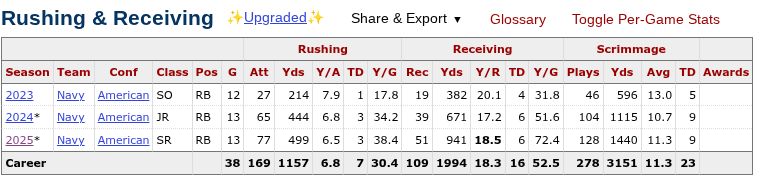
Berhe has some eye-popping analytics. Yards per route run is one of the strongest singular predictors of future fantasy production. It carries a 0.43 correlation when using current year data to project next year performance.Heidenrich’s 4.73 yards per route run is easily tops in this class, well above the wide receivers who will be selected in the first-round of the NFL Draft.
The Bad
Eli Heidenreich is an off-the-radar player from Navy who plays in one of the most unique offensive systems in college football, notorious for amplifying a singular player’s productivity He gets a major stain on his resume for the level of competition subtracting 8 points from his overall WR1 score.
The Ugly
I use Lance Zierleon’s film grades as an input into the WR1 model. Lance is the best in the business. He gave Heidenrich a film score of 5.68 which equates to a reduction of 15 points from his overall WR1 score. Zierlein writes of Heidenrich, “Versatile and productive, Heidenreich possesses good size and toughness as either a runner or slot receiver on the next level. Most of his run production came on jet sweeps from Navy’s option attack, but he appears to lack the acceleration to outpace NFL pursuit as a wide runner. He has good vision and is a physical finisher. He’s short-limbed with a limited catch radius, but he hangs on tight when it hits his hands. Teams will like the mentality, but he might lack the necessary athleticism to uncover on routes or elude tacklers with the ball in his hands.
14. Germie Bernard, Alabama | WR1 Model Score: 5
Based on historical comps, Germie Bernard’s WR1 Model score of 5 gives him a 17.3% chance of having at least one top-24 fantasy season in his career.
Historical Players With Similar WR1 Model Scores:
- Jaylin Noel
- Keon Coleman
- Tai Felton

The Good
Bernard played at the highest level of college football against the best competition for the Alabama Crimson Tide in the SEC. The WR1 Model rewards prospects who compete against the best and produce the best talent in the NFL.
The Bad
While Bernard did play against the best, he didn’t separate himself as truly elite playing against that level of competition. His quarterback this year, Ty Simpson, is expected to be a first-round pick, so you can not blame quarterback play.
Anything under a 2.00 best season yards per route run tends to be a non-starter for me when selecting a player for Dynasty. They would have to seriously outperform in other metrics for me to consider them. Bernard eclipsed that threshold but with little margin for error, with a 2.24.
Lance Zeirlein awarded Bernard a film grade of 6.29, adding 3 points to his overall WR1 model score. Zeirlein writes, “Bernard is a versatile wideout with ascending production over the last three years. He has good size, accelerates to top speed quickly, and is a smooth route runner with well-disguised breaks and clean footwork getting in and out. He can line up outside or in the slot and is capable of running a full route tree across all three levels. He has impressive run-after-catch ability. Bernard’s second gear as a field-stretcher is fairly ordinary, and he doesn’t always play to his size when it’s time to compete for catch space. Bernard projects as an above-average WR2/3.”
The Ugly
The model predicts future fantasy value, so naturally, fantasy points per game are an important contributor to the overall score. Bernard was one of only three players graded to score under 10 fantasy points per game in his career. He couldn’t crack the top ten in yards per route run (2.24) or PFF receiving grade (71.6).
13. Ted Hurst, Georgia St. | WR1 Model Score: 7
Based on historical comps, Ted Hurst WR1 Model score of 7 gives him a 17.3% chance of having at least one top-24 fantasy season in his career.
Historical Players With Similar WR1 Model Scores:

The Good
Hurst went viral recently for his highlight reel catch at Senior Bowl practice
I caution everyone from reacting to any single film highlight. Remember, this helped vault Zach Wilson to the top of the NFL Draft. The fact that they are at the Senior Bowl in the first place means they aren’t in the top tier of NFL prospects. The best prospects have already wrapped up their draft capital and do not want to risk injury or a bad showing.
Hurst had a productive college career, which contributed to his selection as one of our top 15 prospects. His 17.2 fantasy points per game were tied for the top in the class. He was also one of only eight prospects with a weighted dominator (team share of receiving yards and touchdowns) above 30.0%. His performance in both of these metrics contributed positively to his overall WR1 Model score.
Additionally, Hurst had a solid 2.76 yards per route run, which is one of the more important contributing metrics to the overall WR1 Model score.
The Bad
It is exceedingly rare to see a prospect declare early from a non-Power 4 school, and that is once again the case here. Hurst received a 5-point deduction from his overall model score for not being an early declarer.
The Ugly
It is stating the obvious that Hurst played against far weaker competition than most others in these rankings. With the modern-day transfer portal madness, you want to see your NFL prospects eventually end up playing in a Power 4 conference against top-level competition. The fact that Hurst did not level up is a significant blow to his overall WR1 Model Score.
12. Elijah Sarratt, Indiana | WR1 Model Score: 13
Based on historical comps, Elijah Sarratt’s WR1 Model score of 13 gives him an 17.3% chance of having at least one top-24 fantasy season in his career.
Historical Players With Similar WR1 Model Scores:
- Elic Ayomanor
- John Metchie
- Pat Bryant
The Good
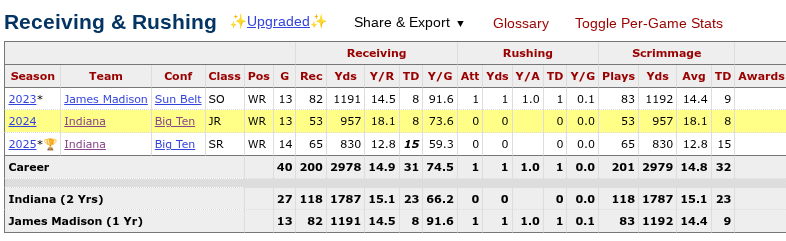
Sarratt led all prospects in the 2026 NFL Draft in college career fantasy points per game at 17.3. This helps measure age-adjusted production, an important predictor of future NFL success. This added 3 points to his overall WR1 Model score. He also had a strong PFF receiving grade of 85.2.
The Bad
Mendoza referred to his Indiana championship teammates as a “band of misfits”. So you know we aren’t dealing with 5-star recruits here. Sarrat started his college career at FCS St. Francis before transferring to James Madison and then finally to Indiana. As such, Sarratt gets dinged in our model for not declaring when he was first eligible for the NFL draft. Early declares hit at a far higher rate than non-early declares.
The Ugly
Sarratt is a fringe Day2/Day 3 prospect in early mock drafts. If he falls to Day 3, less than 2% of these prospects have a meaningful impact on fantasy teams.

11. Zachariah Branch, Georgia | WR1 Model Score: 20.0
Based on historical comps, Zachariah Branch WR1 Model score of 20.0 gives him a 35.8% chance of having at least one top-24 fantasy season in his career.
Historical Players With Similar WR1 Model Scores:
The Good
Branch is expected to get solid draft capital. NFL Mock Draft Database currently has him going 54th overall in the second round. However, it is important to note he carries significant value in the return game. He is a true game-changer as a returner with his speed, explosiveness and elusiveness. While this ability boosts his NFL Draft stock, the large majority of Dynasty leagues do not give credit for this.
We do like that Branch is an early declare. Early declares have proven over time to have a far higher hit rate than prospects who do not declare for the NFL Draft early. Being an early declare earned Branch 5 points towards his overall WR1 score.
Lance Zierlien gave Branch a solid 6.32 film grade. Zierlien writes of Branch “Slot receiver who can turn routine touches into explosive gains. Georgia prioritized quick touches at or behind the line of scrimmage to take advantage of Branch’s ability to slip tackles and add yards after catch. I expect to see more choice routes and deep crossers rolled into his workload as a pro. His routes are rushed and rounded, though. He will jump unnecessarily to make catches, which subjects him to added punishment from defenders. Branch is strong for his size and very tough. He could be pigeon-holed into a “manufactured touch” role, but he’s capable of more. He should help move the sticks and return punts before eventually settling in as a starting slot.”
The Bad
Branch will exclusively be a slot wide receiver in the NFL. 78.9% of his snaps at Georgia were in the slot role. Slots are usually taken off the field in 2 WR sets. Less snaps means less opportunities to put up fantasy points.
The Ugly
In his final year at Georgia his average depth of target was a horrifying 3.6 yards. This was 2nd lowest among qualified FBS wide receivers. As Lance Zierlein pointed out this often forecasts a low volume manufactured touch role in the NFL.
Branch’s 2.08 receiving yards per team pass attempt ranked just 18th in the class among those expected to be drafted.
Lastly, his best season weighted dominator (team share of touchdowns and receiving yards) was only 23.0%. This ranked 22nd in the class.
This article will be updated once the film grades come in. This is also version 1.0. The final version will be updated after the NFL Draft.
This concludes the player rankings outside of the top 10. Look for those in the coming weeks, as well as our other position analytical model rankings.
I hope you enjoyed reading my article. All of my articles share one goal: to provide you, our member, with actionable advice that can improve your Dynasty team. You can follow me on Twitter @force_fantasy or Blue Sky @forcefantasy.bsky.social. #DFFArmy #FantasyFootball #AlwaysBeBuilding #NFL #NFLDraft #NFLTransactions #NFLTrades #AlwaysBeScouting
Click here for a 12-month DFF Membership for just $1.67 per month. This gets you year-long access to hundreds of Dynasty articles, access to our Discord for personalized team advice from our experts, and our gigantic Dynasty Rookie draft guide covering 60+ prospects.
