

Welcome one and all to part two of one of our member favorites each year at Dynasty Football Factory: The WR1 Analytical Model Rankings. Months of research and years of dialing in and enhancing the model to accurately predict future wide receiver fantasy value bring us to today.
The NFL Draft commences on April 25th. Shortly after this many Dynasty leagues begin their rookie drafts. These WR1 model rankings will be your ultimate guide to predicting which prospects will produce the most fantasy points in their NFL career.
For those new to the WR1 rating, this is a proprietary formula I developed to provide a data-driven forecast of future fantasy production for incoming rookie wide receivers. There are so many advanced metrics out there nowadays, we here at DFF know it can be a struggle to navigate which ones matter and how much. The WR1 model takes all that hard work and boils it down to one easy-to-understand number. The model scores rookies on 13 predictive metrics and then combines those individual metric scores into a total WR1 rating score. The goal is to provide an easy-to-use score for those who don’t want to spend hundreds of hours dissecting different metrics.
It is important to note that NFL teams DO NOT CARE about your fantasy teams. Their goal is to win games and they draft wide receivers that help them do that. While fantasy production is a big piece of that, there are other factors NFL teams covet as well.
You may find an in-depth explanation of the model’s process and a glossary of what the metrics mean here. Over the years the WR1 process has been replicated and repackaged by other sites so we left out a few main ingredients to keep it proprietary but you get a good flavor of how it works.
Part one, wide receivers ranked 20 to 16, can be found here, and part two, wide receivers ranked 15 to 11, can be found here.
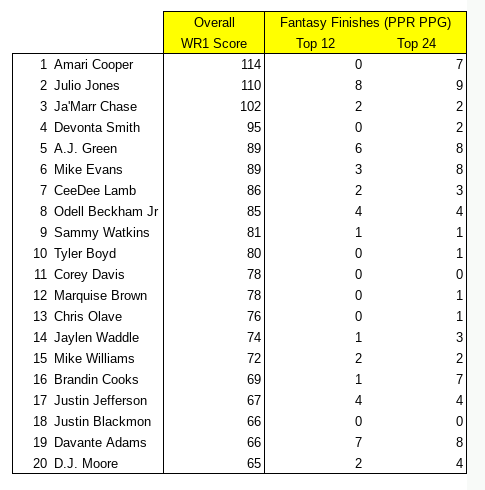
Before we get into the 2024 prospects, here are the top-20 all-time prospects in the model so you can see how effective it is at forecasting future fantasy value.
10. Ja’lynn Polk
WR1 Model Score: 21.0
% Chance of a Top-24 Fantasy Season: 28.4%

The Good
Projected Draft Capital
For a projected second-round pick you would like to see a far superior analytical profile than the one Ja’lynn Polk brings to the table. NFL Mock Draft Database projects him as a second-round pick which vaults him into the top-10 of the WR1 analytical model as draft capital is a significant input. This can all change if he is picked lower than projected.
Polk earned 5 points in this category towards his overall WR1 score.
Early Declare
Prospects who declare early have a significantly higher hit rate than prospects who declare with no eligibility remaining. Polk just finished his junior year giving him one more year of eligibility but the NFL is endorsing him by projecting a high enough draft selection to make him come out this year.
Polk earned 5 points in this category towards his overall WR1 score.
The Bad
PFF Receiving Grade
Per PFF, “The PFF grading system isolates the targeted receiver’s role on every pass attempt. Credit is given for plays in which the receiver adds value to the offense, especially when it’s above and beyond what was called for schematically.”
Polk was awarded a 76.1 PFF receiving grade this past season. He ranked 18th of the 24 wide receivers expected to be drafted in this mode.
Polk earned 0 points in this category towards his overall WR1 score.
Film Grade
The WR1 model was one of the pioneers in implementing the all-important film grade into an analytical model. The model uses NFL.com film legend Lance Zierlein’s film grading system. Polk scored a 6.15. This ranked just 18th in the class of the 24 wide receivers evaluated for the model.
Zierlein wrote this about Polk in his NFL.com draft profile, “Polk might not have the early acceleration to overtake and stack NFL press corners. He also lacks ideal suddenness getting in and out of his breaks as a route runner. He runs routes with a consistent pace — including through his stems and turns — which can create some freedom. However, Polk shines once the ball goes up. He can carve out space near the boundary, catch with strong hands when contested, and track and finish when he heads deep.”
Polk earned 3 points in this category toward his overall WR1 score.
The Ugly
Yards Per Route Run
Yards per route run (YPRR) is one of the most predictive metrics for future fantasy success. We want our elite prospects to post a result in this metric over 3.00.
Polk’s YPRR was 2.30 ranking 20th in the class.
Polk lost 5 points in this category toward his overall WR1 score.
9. Adonai Mitchell
WR1 Model Score: 26.0
% Chance of a Top-24 Fantasy Season: 28.4%

The Good
Draft Capital
Mitchell is projected as a first-rounder in the NFL draft. NFL Scouts are in love with his high-end traits and scintillating highlights.
Mitchell earned 5 points in this category towards his overall WR1 score.
Relative Athletic Score
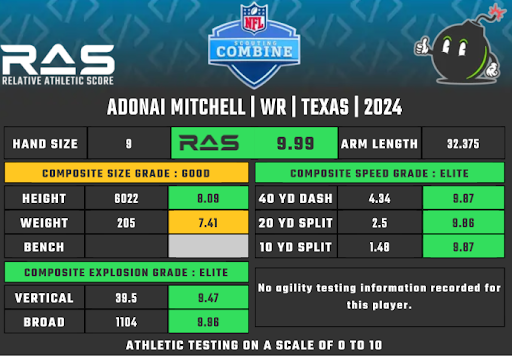
As mentioned in the draft capital section, NFL scouts are wowed by Mitchell’s traits. He has solid WR size at 6’2” and 205 lbs. His straight-line speed as measured by his 4.34 40-yard dash grades out as elite for a man of his size. He also possesses elite jumping ability as shown by his 39.5 inch vertical and 11’04” broad jump. The traits are there for a high-ceiling NFL career.
Mitchell earned 15 points in this category towards his overall WR1 score.
Early Declare
Mitchell is declaring after his third year playing college football. He is forfeiting his remaining college eligibility to enter the NFL.
Mitchell earned 5 points in this category towards his overall WR1 score.
The Hideous
Everything Else
The WR1 model uses 13 inputs. Anything that has to do with actual production Adonai Mitchell looks terrible in. That is what makes him such a fascinating prospect. He jumps off the film and has all the traits to be a top-tier elite talent. So why has he been so mediocre so far?
Many blame his quarterback play but Xavier Worthy managed to produce just fine. PFF also had Ewers graded as the 10th best QB in their PFF grading system for Power 5 QBs. It’s not elite, but not terrible.
So how bad was his production?
Mitchell ranked:
24th of 24 wide receivers in receiving yards per team pass attempt
21st of 24 wide receivers in PFF receiving grade
20th of 24 wide receivers in college career fantasy points per game
20th of 24 wide receivers in weighted dominator
And here is a stat that will blow your mind:
YPRR is one of the most predictive metrics for future fantasy success in the NFL. Mitchell’s best season YPRR ranked 24th of the 24 wide receivers in the model for this draft class. That is terrible. But what makes it even worse is Mitchell’s best season YPRR was worse than 22 of the prospect’s second-best season in YPRR. That is monumentally bad.
Ultimately this isn’t a fashion show. We play fantasy to get the most points based on player production. Mitchell can look as great as he wants on tape and has better athletic traits than 95% of the wide receivers in the NFL. But if that doesn’t translate to production I can’t in good faith recommend you draft him in your Dynasty leagues. It also says a lot that his PFF grade was so bad. This is in essence a very comprehensive film grade that rates every targeted pass attempt, not just the highlights.
8. Xavier Legette
WR1 Model Score: 34.0
% Chance of a Top-24 Fantasy Season: 41.7%

The Good
College Weighted Dominator Rating
Legette has one of the most unique analytical profiles you will ever see from a college prospect. He did absolutely nothing to receive production his first four years and then had an insanely good fifth year. Usually, a player will show a little something before a monster breakout season. And if they haven’t then it is highly unlikely they ever will.
College weighted dominator rating is a best-season metric measurement in the WR1 model. It measures the player’s share of the team’s receiving yards and touchdowns weighted 80% yardage and 20% touchdowns.
Legette had the second-highest rating in this class at 41.5% trailing only Malik Washington (Marvin Harrison Jr. and Malik Nabers were 3rd and 4th respectively).
Relative Athletic Score
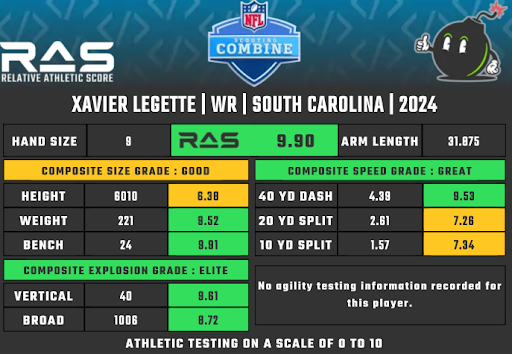
Legette possesses fantastic athletic traits that are sure to make NFL scouts drool with excitement. At 6’1” and 220 lbs. he possesses rare straight-line speed for a prospect of that size as exhibited by his sub 4.40 forty-yard dash. His explosion is elite with a 40-inch vertical and 10’6” broad jump. His strength also grades out very well with 24 reps in the bench press at 225 pounds.
Legette’s 9.90 Relative Athletic Score was the third highest in this wide receiver class.
Legette earned 5 points in this category towards his overall WR1 score.
Yards Per Route Run
Legette accumulated 1255 yards his senior season at South Carolina. This helped catapult him to a solid yards-per-route run of 3.15. This was good for 7th in the class.
Legette earned 12 points in this category towards his overall WR1 score.
The Bad
College Career Fantasy Points Per Game
Given Legette’s first four years in college, he had no chance to be successful in this metric.
His fantasy points per hame progression was utterly unique:
Year 1 – 2.09
Year 2 – 3.05
Year 3 – 1.84
Year 4 – 4.22
Year 5 – 19.80
Legette lost 5 points in this category towards his overall WR1 score.
The Ugly
Breakout Year
This is where Legette’s profile goes off the rails. The later the breakout year, the more unlikely a player is to hit in the NFL. A great breakout is year 1. A good breakout is year 2. An average breakout is year 3. A bad breakout is year 4.
That brings us to Legette. Legette failed to break out until his 5th year. So I guess like we did for Adonai Mitchell we can call this hideous.
Legette lost 15 points in this category toward his overall WR1 score.
7. Ladd McConkey
WR1 Model Score: 46.0
% Chance of a Top-24 Fantasy Season: 54.2%

The Good
Yards Per Route Run
McConkey’s profile doesn’t wow you with cumulative production statistics. But his efficiency was excellent. He trailed only Malik Nabers, Marvin Harrison Jr., Johnny Wilson, and Troy Franklin in this very important predictive metric.
McConkey earned 12 points in this category towards his overall WR1 score.
Breakout Year
In an ideal world, we want our top receiving prospects to achieve a breakout (20% team receiving share) by their second year. McConkey accomplished this feat with 762 yards receiving as a sophomore at Georgia.
McConkey earned 4 points in this category towards his overall WR1 score.
The Bad
Receiving Yards Per Team Pass Attempt Per Game
It is unusual to see YPRR and receiving yards per team pass attempt per game so misaligned for the same prospect. This speaks to McConkey’s usage at Georgia. He was simply not in the game running routes as much as your typical wide receiver. Kirby Smart clearly thinks he either doesn’t add any value unless targeted or is an injury risk.
McConkey registered a mere 1.99 receiving yards per team pass attempt per game. This ranked 21st of the 24 top-receiving prospects evaluated in the model.
McConkey earned 0 points in this category towards his overall WR1 score.
The Ugly
College Weighted Dominator Rating
McConkey’s volume simply was not there. Georgia chose to play him more as a part-time player for whatever reason. This is not the end of the world. We saw the same thing with Puka Nacua at BYU. This is why we pay attention to the underlying efficiency metrics such as YPRR.
However, it is absolutely a red flag. McConkey ranked 24th of the 24 top prospects evaluated in this model.
McConkey lost 5 points in this category toward his overall WR1 score.
6. Xavier Worthy
WR1 Model Score: 46.0
% Chance of a Top-24 Fantasy Season: 54.2%
The Good
Breakout Year
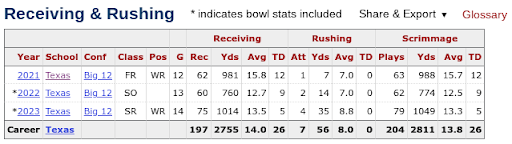
Elite prospects produce early. It is that simple. Worthy came to Texas as a freshman and immediately became their best receiver. It wasn’t even that close. Worthy had 981 yards receiving. The second most receiving yards on the team were 377.
Worthy earned 6 points in this category towards his overall WR1 score.
Relative Athletic Score

Worthy is unique in the sense that he is an absolute burner who can also run routes highly effectively. He set the record at the NFL Combine for the fastest 40-yard dash time ever at 4.21. This graded out as elite. His explosiveness was also evident with his 41-inch vertical and 10’11” broad jump, both also elite. He is an extremely lean body type to play in the NFL but his measurables overcome that.
Worthy earned 12 points in this category towards his overall WR1 score.
The Bad
Yards Per Route Run
This may be a tad of a stretch to call Worthy’s YPRR performance bad but it certainly is not good. Ideally, we want our top prospects to have a YPRR best season of over 3.00. Worthy comes in at a 2.61. This ranked 16th of the 24 wide receivers evaluated for the model.
Worthy earned 0 points in this category toward his overall WR1 score.
Film Grade
Utilizing film legend Lance Zierlein’s film grade Worthy checks in at a modest 6.26. This checked in at 11th overall in the class. That is not terrible but we are in the top-6 now so we need higher standards.
Zierlein writes about Worthy, “Worthy’s draft slotting could come down to draft-room debates weighing his elite speed versus his thin frame. Worthy will find separation if allowed to explore vertically or across the hashes against man coverage, but he lacks play strength and release quickness to defeat a quality NFL press. His quick-strike potential adds an element of danger over the top and should open wider windows for teammates to work into. He lacks the physical tools to catch when contested and needs to prove he can hold up to a more physical brand of football. Worthy is a niche prospect for teams looking to add a legit field-stretcher, but areas of concern could create a wider gap between ceiling and floor.”
Worthy earned 3 points in this category toward his overall WR1 score.
The Ugly
PFF Receiving Grade
The graders at PFF are not fans of Worthy. Of the top-24 receiving prospects in this class, they graded Worthy just 21st. PFF does grade every targeted pass attempt so as a burner who primarily uses his speed to win it is possible that Worthy can’t go full steam on every attempt. Twitter keeps saying AD Mitchell didn’t produce more because Ewers sucks.
PFF which grades every targeted attempt gave the following grades:
Xavier Worthy and AD Mitchell
79th and 65th best wide receivers in the nation
Quinn Ewers ranked 12th for QBS
Seems the Ewers’s awful narrative is overblown to this analyst.
Worthy lost 2 points in this category towards his overall WR1 score.
Thank you to Player Profiler, Lance Zierlein, NFL Mock Draft Database, and Spaceman Prospect Database for supplying data. Some of these metrics are dynamic and may change after this article is published.
I hope you enjoyed reading my article. My goal is to provide actionable advice you can utilize to improve your Dynasty team. You can follow me on Twitter @force_fantasy. #DFFArmy #FantasyFootball #AlwaysBeBuilding #NFL #NFLDraft #NFLTransactions #NFLTrades #AlwaysBeScouting
Click here for a 12-month DFF Membership.