
Methodology
After writing my redraft team breakdown series, I decided to start a new series as we approach the 2020 fantasy season. Every week, or probably more often than that, I’m going to bring you one fantasy sleeper representing a massive value in 2020 redraft leagues. Now, to get this out of the way, there are no “true sleepers” anymore. Gone are the days when there were secrets and insider values as the average fantasy owner is far more informed than 5-10 years ago.
However, even though those days are behind us, vigilant and active owners can still gain an edge on the competition. One of the best ways to do that is to draft players that most casual players look past or have dismissed for one reason or another. Whether based on previous poor performances or injuries, the average fantasy owner is often too vindictive against players that burned them. Therefore, those types of players often make up the best sleepers.
On the other hand, the typical fantasy owner is often wary of players that they haven’t seen produce in the NFL or those that don’t have “name value.” Rookies are often under drafted in most redraft leagues since they don’t have prior NFL stats. Also, players that put up decent stats but stayed off the fantasy radar can represent good sleepers. In this case, the goal is to exploit an information gap between informed and casual fantasy owners.
To keep things consistent, I will follow a particular format in this series. I’ll begin by discussing the player’s past production and history, focusing on their prior stats in the NFL and, in some cases, their draft profile. Then, I’ll move into why that player is a sleeper, specifically looking at and debunking negative narratives around that player. And finally, I’ll move into their expected 2020 outlook, and where I would draft the player on my redraft teams.
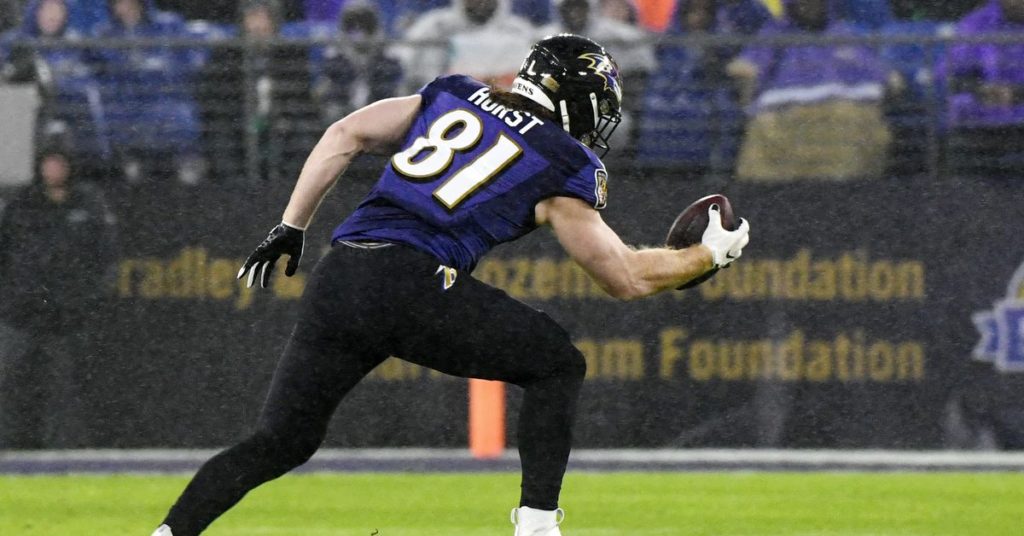
With that all out of the way, let’s get into my first sleeper, Hayden Hurst.
Past Production
Here are Hurst’s full NFL stats.
| Year | Games | Targets | Receptions | Yards | TDs | Fantasy Finish | Fantasy PPG | PPG Rank |
| 2018 | 12 | 23 | 13 | 163 | 1 | TE58 | 2.9 | 54th |
| 2019 | 16 | 39 | 30 | 349 | 2 | TE34 | 4.8 | 40th |
As you can see, Hurst has almost no relevant fantasy production. His pure stats are not impressive, and he’s never been on the fantasy radar in any week.
However, Hurst has a few things going for him. Hurst is much older than a typical third-year player, as he had a minor league baseball career before his NFL career. He didn’t start his freshman year at South Carolina until he was already 22 years old. Therefore, Hurst will turn 27 just before the coming NFL season, a prime breakout age for an NFL tight end.
At South Carolina, Hurst impressed NFL scouts, breaking out in his sophomore season. He caught 48 passes for 616 yards and two touchdowns, rather impressive for a college tight end. Then, Hurst delivered once again in his junior year with 44 receptions for 559 yards and a touchdown.
Because of his impressive college career, the Ravens selected him with the 25th overall pick in the 2018 NFL Draft. Hurst was the first tight end chosen, and the only tight end picked in the first round. Hurst went ahead of Mike Gesicki, Dallas Goedert, and future teammate Mark Andrews. All of those players were more promising dynasty tight ends, so many were surprised at Hurst’s superior draft capital.
Coming into 2018, Hurst joined a crowded depth chart that consisted of Andrews, Nick Boyle, and Maxx Williams. Unfortunately, Hurst suffered a preseason foot injury that limited him throughout the 2018 season. Because of the injury, Hurst never established himself as a rookie. In the meantime, Andrews became the Ravens’ top receiving tight end while Boyle served as the top blocker.
After 2018, the Ravens had transitioned from previous quarterback Joe Flacco to new starter Lamar Jackson. They moved on from their top two receivers from 2018, Michael Crabtree and John Brown, replacing them with Marquise Brown. In the new offense, the Ravens planned to use two tight end sets far more often, potentially opening up opportunities for Hurst. They also let Williams go in free agency to Arizona, paring the tight end rotation down to only Andrews, Hurst, and Boyle.
However, in 2019, Andrews exploded onto the scene, and he grew into the Ravens’ top overall receiving target. Andrews led the team in all receiving categories with 64 receptions on 98 targets for 852 yards and 10 touchdowns. Even though Hurst played an identical snap share to Andrews, he only produced 30 catches on 39 targets for 349 yards and two touchdowns. Hurst played a hybrid tight end role, with Andrews as the clear receiving tight end and Boyle as the primary blocker.
Even though Hurst didn’t produce for fantasy, he did well as a tight end with his limited opportunities. He caught an impressive 76.9% of his targets and averaged 8.9 yards/target, besting Andrews in both categories. Hurst also showed well as a blocker, as Hurst complemented Boyle on most running plays, while Andrews came in purely on passing situations.
In the offseason, the Ravens traded Hurst and a fourth-round pick to the Falcons in exchange for second and fifth-round picks in the 2020 NFL Draft. Unlike the 2019 Ravens, the Falcons utilize a base three-wide receiver offense with Julio Jones, Calvin Ridley, and Russell Gage. Therefore, they need a do-it-all tight end, which is precisely the skill set Hurst provides. Hurst can play on all downs, which makes him a perfect fit in the Falcons’ offense.
The Prevailing Narrative
Hurst was more valuable to the Ravens’ real-life football team than he was to fantasy owners. Therefore, Hurst remained off the radar of all but the most hardcore dynasty owners. Even after the Ravens traded Hurst to the Falcons, most casual players will look at Hurst’s stats from 2018 and 2019 when considering him. They won’t realize that Hurst is entering a completely different offense and has far more opportunity for targets than he had in Baltimore.
Many casual owners won’t even have heard of Hurst before the draft, which will cause his ADP to drop. I know that Hurst is not a sleeper in our Twitter, dynasty, and podcast bubble. Most sharps and analysts have discussed Hurst as a substantial value for the entire offseason. However, it’s important to remember that our small world is just that, a small world. Most people don’t follow fantasy football year-round, and many of your league-mates won’t look beyond the surface level.
2020 Outlook
Hurst should slide directly into Austin Hooper’s old role, who had 71 and 75 receptions in 2018 and 2019. Additionally, Hurst is a far superior blocker to Hooper. I do not doubt that Hurst will be an every-down player, especially considering what the Falcons gave up to acquire him. Hurst comes in as my TE9 in my redraft rankings, in the same tier as Hunter Henry and Evan Engram. However, you can draft Hurst multiple rounds later than those players, making Hurst one of my favorite values in 2020 redraft leagues.
Thanks for reading this article. You can find me on Twitter at @DFF_Karp. I love to interact with anyone in the community, so reach out at any time! I take fantasy questions and help with all formats, so keep sending those questions my way.

