
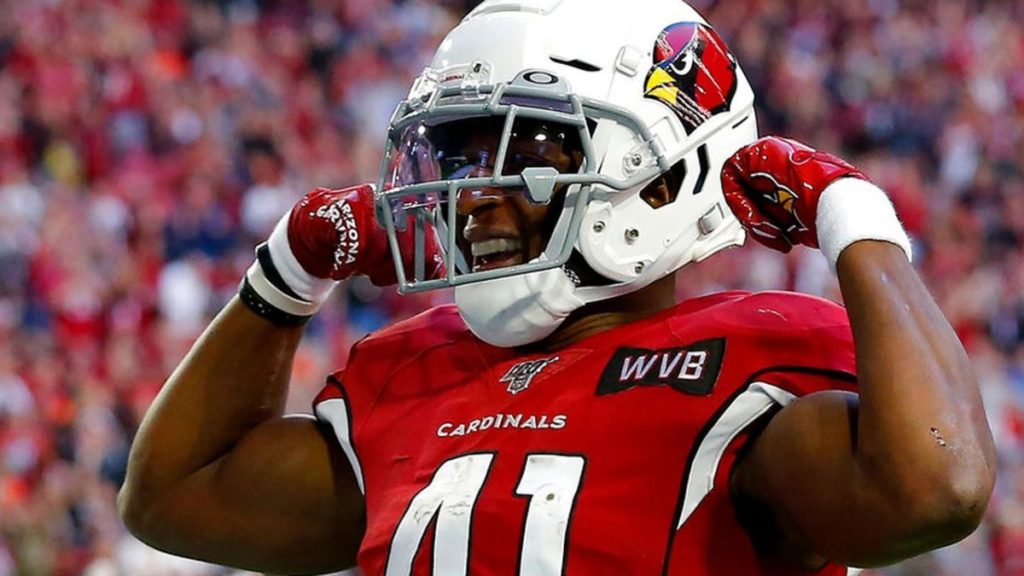
In a dynasty story, I’ll look at dynasty value and how a player has fluctuated over time, primarily based on news or events. Then, I’ll give a dynasty take on their future value and whether dynasty owners should buy or sell the player going forward. In my first dynasty story, I covered Mike Williams. While Williams has had somewhat of a roller coaster first three NFL seasons, it’s nothing compared to the next player’s journey. It’s time for a deep dive into Kenyan Drake.
College Production and NFL Draft Profile
Drake played four years at Alabama from 2012-2015. Throughout his entire college career, he never had more than 92 carries, consistently finding himself behind other running backs. Drake first backed up T.J. Yeldon and then Derrick Henry.
In 2013, his best college season, Drake had 92 carries for 694 yards and eight touchdowns, and he added 12 receptions for 135 yards and a touchdown. Unfortunately, Drake broke his leg during the 2014 season, and then he sat most of 2015 behind Henry. He served as the receiving back in 2015, with 29 receptions for 276 yards and a touchdown.
Somewhat surprisingly, Drake was one of the top backs in the 2016 running back class, despite doing little in college. As we know now, the 2016 class was one of the weakest running back groups in recent memory, with little talent outside of first-rounder Ezekiel Elliott and Henry, who went in the second round. Therefore, Drake became the third running back selected, going with the 73rd overall pick to the Dolphins.
In dynasty rookie drafts, dynasty owners mostly ignored Drake despite his draft capital. He was a consensus second-round rookie pick, behind other running backs like Kenneth Dixon and Jordan Howard. Like most NFL teams, dynasty owners saw Drake’s lack of a college workload and weren’t very interested in having him on their teams.
NFL Stat Totals
Here are Drake’s full NFL stats. For this table, I’ve split Drake’s 2019 season up between his time in Miami and Arizona to help provide relevant context.
| Year | Games | Carries | Rushing Yards | YPC | Rushing TDs | Fantasy Rank | Fantasy PPG | PPG Rank |
| 2016 | 16 | 33 | 179 | 5.4 | 2 | RB74 | 2.7 | 88th |
| 2017 | 16 | 133 | 644 | 4.8 | 3 | RB33 | 8.9 | 40th |
| 2018 | 16 | 120 | 535 | 4.5 | 4 | RB14 | 12.9 | 21st |
| 2019 (MIA) | 6 | 47 | 174 | 3.7 | 0 | N/A | 9.1 | 39th |
| 2019 (ARI) | 8 | 123 | 643 | 5.2 | 8 | N/A | 19.9 | 3rd |
| 2019 (Total) | 14 | 170 | 817 | 4.8 | 8 | RB17 | 15.3 | 13th |
2016 – Rookie Year
In Drake’s rookie year, he joined a crowded backfield made up of veteran free-agent signing Arian Foster, 2015 fifth-rounder Jay Ajayi, and 2014 UDFA Damien Williams. Foster began the season as the starter, but Ajayi quickly supplanted him. Foster eventually retired mid-season, leaving Williams and Drake to split the backup role behind Ajayi. Throughout the 2016 season, Ajayi took 260 carries, with no other running back receiving more than 35.
Drake even struggled to siphon carries as the backup, with two fewer carries than Williams. Also, head coach Adam Gase preferred to use Williams to spell Ajayi on passing downs. Williams had 23 receptions compared to Drake’s nine, and he recorded 203 more receiving yards. After Drake’s rookie year, dynasty owners mostly quit on him, as he fell outside of the top-200 in dynasty rankings and ADP. To be fair, Drake lost out to a fifth-round pick and a UDFA for touches, so I can’t entirely blame dynasty owners for that mistake.
2017-2018 – Committee Back
In 2017, Ajayi began the season as the starter once again. Ajayi averaged 19.7 carries per game through seven games, dominating the backfield touches and leaving scraps for Drake and Williams. In those games, Drake had 10 total carries and was irrelevant for fantasy purposes.
However, after Week 8, the Dolphins decided to trade Ajayi to the Eagles, opening up playing time for Drake. In Weeks 9-12, Gase stubbornly used Williams as his starter, even though Drake was the far more effective player. Throughout those four games, the two backs had almost identical touch counts, although Drake averaged more than a full YPC better than Williams.
In Week 12, Williams suffered a shoulder injury that forced him to miss the rest of the season. Drake was then the only running back left standing, forcing Gase finally to give him a workhorse role. During the final five games, Drake had 18.2 carries and 88.8 yards per game. He averaged 17.7 PPR PPG, ninth among running backs over those five games.
Drake finally had displayed his ability to command a backfield, although it came when the Dolphins and Gase had no alternatives. Therefore, dynasty owners were still unsure about Drake after 2017. That confidence became even lower after the Dolphins signed veteran Frank Gore in free agency and drafted Kalen Ballage in the fourth round of the 2018 NFL Draft.
Both Gore and Ballage projected to have roles in the Dolphins’ offense. Gore was a master of absorbing early-down touches while Ballage profiled as a prolific third-down back. Even though we know now that Ballage is a horrible running back, dynasty owners at the time were scared of him as a threat to Drake. Therefore, Drake’s dynasty value remained pretty conservative, staying in the low-end RB2 range throughout the 2018 offseason.
Dynasty owners got their fears half-right for the 2018 Dolphins. As expected, Gase leaned on the elder statesman in Gore, who led the Dolphins in carries with 156. Gore only played 14 games, and he averaged 11.1 carries/game compared to 7.5 for Drake. Both backs averaged similar YPC, with Gore slightly edging out Drake, so Gase wasn’t necessarily wrong to give Gore those touches.
However, Ballage’s role as a pass-catcher ultimately failed to materialize. While Ballage averaged 5.3 YPC, he only caught nine of 11 targets for 56 yards. Drake dominated the targets from the backfield, finishing second on the Dolphins in both targets and receptions behind Danny Amendola. Because of his receiving success, Drake had his first full fantasy-relevant season, finishing just outside RB1 territory.
At this point in his career, Drake was a clear committee back with receiving upside. He provided extreme durability, having played all 48 possible games in his first three seasons. Drake had even flashed workhorse potential late in 2017, although Gase seemed to have no interest in using Drake in that way. Dynasty owners had accepted Drake as a starting NFL running back, although playing for the Dolphins’ putrid offense majorly reduced his dynasty appeal.
2019 – Crazy Value Swings
After 2018, the Dolphins finally fired Gase and replaced him with Brian Flores. Flores and the Dolphins’ front office decided to enter a rebuilding season in 2019, and they allowed Frank Gore to move on in free agency. That left the Dolphins with only Drake and Ballage in their backfield. While they added Mark Walton off waivers, drafted Myles Gaskin in the seventh round, and signed Patrick Laird as a UDFA, none of those acquisitions were significant.
However, throughout the 2019 offseason, there were constant rumblings that Flores wanted to use Ballage in a more significant role. Even though that idea seems so bizarre given today’s information, those rumors dropped Drake’s dynasty value, as dynasty owners feared a committee approach in a weak offense. Even though Ballage didn’t take over as the Dolphins’ starter, dynasty owners were right to be wary of Drake.
In Drake’s six games as a Dolphin, he averaged 7.8 carries/game, losing touches to both Ballage and Walton. Even though he remained on the team, the Dolphins had mentally moved on from Drake, who would be a free agent after the 2019 season. After barely using Drake throughout the first six games, the Dolphins traded Drake to the Cardinals for a conditional 2020 fifth-round pick.
On the Cardinals, Drake joined a backfield with David Johnson and Chase Edmonds. At the time of the trade, both Johnson and Edmonds were suffering from injuries. Johnson was the incumbent high-paid starter for the Cardinals, so this trade was considered a short-term stopgap. Most dynasty owners saw Drake as the backup to Johnson and replacement for Edmonds, who seemed farther from full health than Johnson.
However, Drake took over as the Cardinals’ workhorse back and never looked back. Once he joined the team in Week 9, he led the Cardinals in carries every week, averaging 15.4 carries/game. Over that period, he dominated for fantasy, finally seeing workhorse touches as he did near the end of the 2017 season. This time, though, the Cardinals had other capable backs, but they chose to give Drake the top role.
Almost immediately, Drake’s dynasty value soared, as it quickly became apparent that he had supplanted Johnson as the Cardinals’ starting running back. Drake returned to the low-end RB2 range he had occupied previously throughout the 2018 offseason. Unfortunately for Drake, Johnson was still under contract through 2021, and he had an almost insurmountable dead cap hit, at least in 2020.
Therefore, at the start of the 2020 offseason, Drake’s value remained relatively stable, as most expected Drake and Johnson to form a committee in 2020. Drake would be the primary back, with Johnson mixing in on passing downs and potentially as a slot receiver. Johnson was never fully healthy down the stretch in 2019, and he had a better chance to challenge Drake for some more touches in 2020 than he did in 2019.
The Future
Luckily for Drake, his entire fantasy outlook changed in a short one-week span in mid-March of 2020. First, the Cardinals assigned him the transition tag for 2020, guaranteeing him around $8.5 million for the 2020 season. If there was any doubt, the tag ensured Drake’s status as the Cardinals’ starting running back.
Then, the Cardinals somehow managed to trade Johnson to the Texans in exchange for DeAndre Hopkins. The trade left only Drake and Edmonds in the Cardinals’ backfield, allowing Drake a clear shot at a workhorse role in 2020. Immediately after the deal, Drake’s value rose significantly, sending him into the high-end RB2 range in dynasty and making him a strong RB1 in redraft formats.
While Drake and the Cardinals have yet to agree on an extension, I believe there’s a chance the sides might still agree on a contract before the start of the 2020 season. If that happens, Drake’s value will solidify, even though he’s already 26 years old. Either way, Drake represents a great dynasty asset for contenders.
However, his value entirely depends on his role for the Cardinals, so I would recommend selling Drake if he doesn’t receive an extension by the start of the season. His value will never be higher, and he’s never been a workhorse back for an entire season. Since he’s already 26 years old, he represents an extreme risk in dynasty formats. There’s no way to buy Drake at a reasonable price, so he’s either a hold or a sell depending on your roster.
Thanks for reading this article. You can find me on Twitter at @DFF_Karp. I love to interact with anyone in the community, so reach out at any time! I take fantasy questions and help with all formats, so keep sending those questions my way.

