
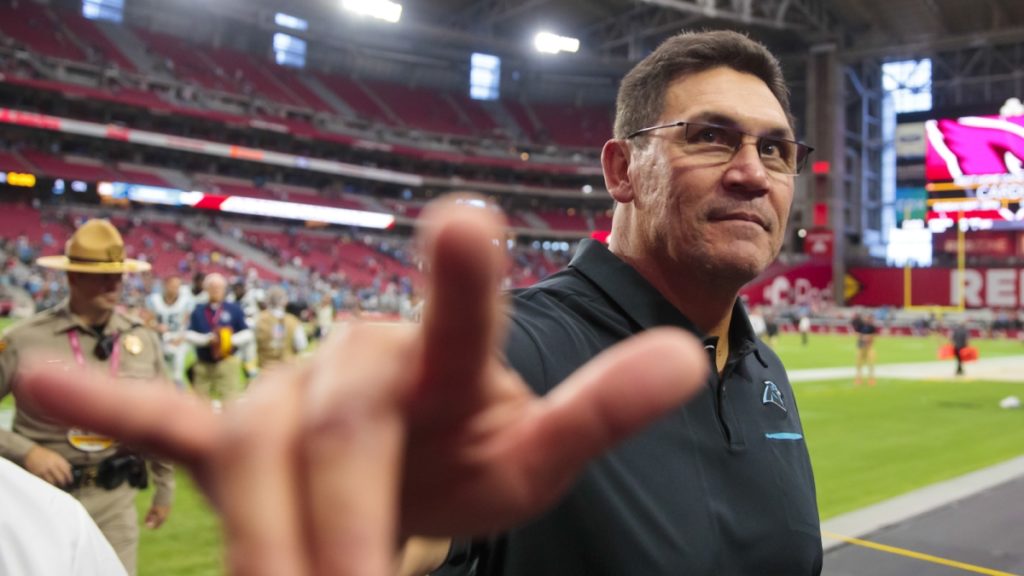
The NFL news of the New Year is the arrival of former Panthers’ Head Coach Ron Rivera in Washington. He’ll take the same position for the Redskins and has hired former Raiders’ and Jaguars’ Head Coach Jack Del Rio with him to coordinate the defense.
IDP Fantasy Twitter is downright giddy that another franchise will join the mix of teams running a 4-3 base defense. It’s a boon to the fantasy value of several players on Washington’s defensive front.
The Redskins fired their 2019 Head Coach Jay Gruden in October and Defensive Coordinator Greg Manusky in December. The defense was not as successful in 2019 as in 2018, falling from 15th to 27th in points allowed according to Pro Football Reference. Some observers criticized the scheme for being too complicated and lacking aggressiveness. Complications – or multiplicity – were to be expected when Rob Ryan joined the staff last offseason.
Ron Rivera and Jack Del Rio, two veterans of defense, have similarities in their approaches that should make them compatible collaborators. Their defenses’ blitz rates in their last stops have been slightly higher than Manusky’s (23% per Pro Football Reference) and near the league average. The players they inherit fit many of the things they like to do. Da’Ron Payne and Matt Ioannidis can ably hold the point of attack. Landon Collins will help in run support from the strong-safety position. The cornerbacks have experience in zone coverages. The pass rushers will penetrate and have opportunities to make plays in the offensive backfield.
“In confirming his hire Wednesday morning, Del Rio said he would change the Redskins defense from a 3-4 scheme to a 4-3.” https://t.co/SubeHSJ4EB
— Jake Russell (@_JakeRussell) January 1, 2020
Del Rio not only confirmed the transition to a 4-3 defense but also told reporters he expects his defense to play “fast.” A simpler defense can be expected in 2020.
OK, on to the fun part. How could Redskins players fit into a 4-3?
Montez Sweat, DE
Montez Sweat full rookie highlights out now enjoy folks 🔥 #redskins #httr @_sweat9
Full video: https://t.co/kvB0tDyy6u pic.twitter.com/uftg3gCq4V
— SWAY RUN 21 ❤️💛 (@swayrun21) December 31, 2019
This is the guy IDP Fantasy Twitter is excited about. He was a premium edge prospect in the 2019 NFL draft and clear first-round value. His landing spot in the Redskins’ 3-4 made him a marginal IDP asset in many fantasy football formats. A change from OLB to DE converts a late-round fantasy pick into a potential DE1 in future years.
Sweat not only has room to grow but needs to grow. Pro Football Focus graded him 60.2 – “average.” This number puts him in the company of other young players like Clelin Ferrell and Derek Barnett, as well as fading veterans like Jabaal Sheard and Ezekiel Ansah. He pressured opposing quarterbacks 31 times. Few year-long, nearly full-time edge defenders accumulated fewer pressures.
Sweat’s role in 2020 will be similar to that in 2019: strong-side edge defender. He played 66 of 724 defensive snaps in coverage, a number that should drop but not vanish in 2020. Greg Manusky and Rob Ryan were more prone to using edge defenders in coverage than most NFL defensive coordinators but not drastically so. He’ll line up directly on the line of scrimmage “with his hand in the dirt” in an attacking position, rather than stand up, more often.
Ryan Kerrigan, DE
The veteran pass rusher played at a Pro Bowl level for many of his nine years in Washington, but injuries cut Ryan Kerrigan’s 2019 season short. He can be cut with no dead cap in March. His departure could signal the Redskins’ intention to draft his replacement Chase Young with the No. 2 overall pick in the 2020 NFL draft.
Either Kerrigan or Young would start at weak-side defensive end. A more aggressive approach by the defensive coordinator should translate to more pass-rush opportunities and fewer responsibilities in pass coverage and run defense.
Kerrigan has compiled 90 QB sacks in his career and turns 32 in August. Ryan Kerrigan very well might have good football left in him, whether in Washington or elsewhere.
Ryan Anderson, LB
The former second-round pick showed little in his three years in the league until Kerrigan was shelved down the stretch in 2019. He looks like depth behind Sweat, Kerrigan, and/or Young for 2020.
He is, however, the only one of these edge defenders that remotely resembles a conventional 4-3 strong-side linebacker. Anderson has held up better than Sweat in coverage for Manusky and is the smallest of these players.
Coverage ability on the strong side will be his key to playing time next season but would cause him to carry over his 2019 position designation of ‘LB’ to 2020. Even then, the team will deploy nickel packages more often than base defense. The extra DB will substitute for the strong-side linebacker.
Jonathan Allen, DT
Old-school Jonathan Allen provides hope for Redskins future https://t.co/sWGWEyesdI (via @phillytrib)
— Alabama Pro Updates (@BamaProUpdates) December 8, 2019
The Redskins’ 2017 first-round pick Jonathan Allen is another IDP asset that stands to gain value in a scheme switch. He and Matt Ioannidis alternated between 3- and 5-technique in Manusky’s 3-4 defense. Allen played on the right side while Ioannidis played on the left.
In a Rivera-Del Rio 4-3 scheme, one of Allen and Ioannidis would start at defensive tackle, playing 3-technique (the gap between the offensive guard and tackle). The other would be relegated to a reserve role. The high-upside, younger Allen might the likelier candidate to start. His draft profile on NFL.com compared him to Fletcher Cox and indicated Pro-Bowl-caliber potential. He flashed some of that ability in 2018 but seemed to suffer along with much of the rest of the defense in 2019.
That upside makes him a DT1 in full IDP leagues that require a defensive tackle. His value as a DL in leagues that do not require a defensive tackle would remain intact.
Matt Ioannidis, DT
Selected in the fifth round of the 2016 draft, Matt Ioannidis has been a pleasant surprise and very productive member of Greg Manusky’s defense. His career numbers are up to 20.5 sacks and 20 tackles for loss, all accumulated in the last three years. He had his best year in 2019 and was the team’s best front-seven defender.
It might be surprising, then, to see him benched. The old regime extended him, so he’s safely under contract for three more years. The new regime needs to see what they have in younger players drafted in the first round. If they falter, Ioannidis’s playing time could tick up again late in the 2020 season.
Ioannidis would be one of the better reserve defensive linemen in the NFL behind Jonathan Allen and nose tackle Da’Ron Payne. His statistical production would likely suffer in a rotational role. He would be asked to two-gap in relief of Payne, which would slow his pass rush.
Despite transitioning to a position designation of ‘DT,’ Ioannidis will lose fantasy value if he loses his spot in the starting lineup. He’s at risk of becoming as a better real-life player than fantasy asset in 2020.
Da’Ron Payne, DT
Rivera and Del Rio covet a classic nose tackle that can “2-gap,” that is, take on the center at the point of attack and control both ‘A’ gaps in run defense. They are likely excited that such a player is already on the roster in the person of 2018 first-rounder Da’Ron Payne.
The Panthers’ defense was suddenly vulnerable in 2019 after Dontari Poe was lost to injury, a testament to the importance of the position in Rivera’s scheme. Del Rio similarly relied upon Terrance “Pot Roast” Knighton in Denver, a player he coached in Jacksonville and recruited as the Broncos’ defensive coordinator.
Payne showed in 2018 that he’s more versatile than Poe. Still, he could lose snaps to Ioannidis in passing situations. His fantasy value might have peaked in his rookie year when he collected five QB sacks.
Landon Collins, SS
Both Rivera and Del Rio have tabbed one of their two starting safeties as the preferred box safety on a number of their teams. Under Rivera, the Panthers’ Eric Reid was the second-highest scoring safety in fantasy football in 2019. Del Rio coached hard-hitting TJ Ward in Denver, who finished as the #3 fantasy safety in 2013.
In pass coverage, Collins will not be asked to play a single-high zone, a role for which he has not the speed. Rivera and Del Rio routinely deploy pass defenses with three or more defenders in zones. Collins’s responsibilities in the middle of the field will allow him to face the line of scrimmage and come downhill to stop the run as necessary. His place as a strong fantasy S1 is safe through the scheme change.
Linebackers
The Redskins contributed to a trend of teams playing without a full-time off-ball linebacker in 2019. Jon Bostic’s lead among ‘Skins’ LBs in snaps indicates coaches might not have been happy with their options at the position.
Both Rivera and Del Rio typically rely upon a full-time linebacker. Rivera prefers two, infrequently playing dime defenses. Rivera also relies on a relatively small number of players in a given week. Both coaches give their linebackers opportunities to blitz and make plays. Two-gapping in front of them by one and occasionally both defensive tackles frees up the linebackers to pile up tackles. The linebackers may also play quite a bit of zone defense, enabling them to face opposing quarterbacks, make tackles in front of them, and bat down balls farther down seams.
Current linebackers under contract for 2020, Shaun Dion Hamilton and Cole Holcomb make for interesting sleepers due to the scheme. Veteran competition for their jobs would seem highly probable, whether in the person of impending free agent Bostic or others.
Cornerbacks
Redskins’ cornerbacks have long been useful IDP options. Their stat crew perennially ranks in the top ten. They award a high number of tackles to defenders relative to tackle opportunities (basically receptions and carries that don’t reach the end zone). The Washington stat crew ranked eighth in this department in 2018. Moreover, the crew awards assists to cornerbacks at a higher rate than most.
Both Rivera and Del Rio prefer zone defenses to man coverage. In 2017, the last year both coached, their teams finished 29th and 30th in frequency of man coverage. Oakland and Carolina each played man less than a quarter of defensive snaps per PFF.
Zone defenses contribute to more tackle opportunities. Zone defenders may be tasked with keeping the ball in front of them and making sound tackles to limit offenses to short gains. In contrast, defenders in man coverage are more likely to deny their assignment the ball.
The tentative starters for 2020, Quinton Dunbar and Fabian Moreau, are high-upside sleepers in cornerback-required leagues. They (or the cornerbacks the Redskins add during the offseason) should be priority adds off the waiver wire in dynasty leagues and late-round redraft targets.
In Summary
Any defensive scheme change creates opportunity to gain value in fantasy football. In a Redskins’ 4-3, opportunities abound. At least one edge defender and one interior defender will gain significant fantasy value. Valuable sleepers at linebacker and cornerback could emerge. Redskins’ OTAs and training camp will be important to watch which players take early leads in position battles. This writer will be watching… and tweeting!
Clemson and Michigan alum…Panthers and Cowboys fan…I try to see both sides of every debate and each trade. Find me on Twitter @DynastyTripp.

