
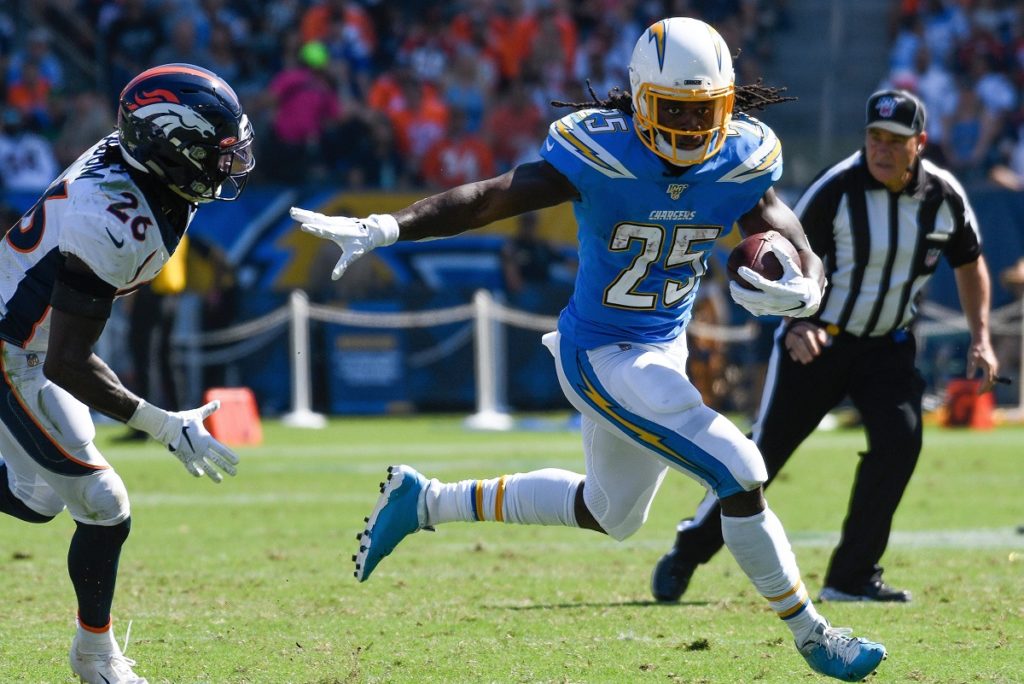
The Broncos’ backfield has been a tough one to diagnose for fantasy purposes the last two seasons, and it doesn’t seem like 2020 will be much different. The addition of Melvin Gordon muddies the water even further, and likely marks the end of Royce Freeman’s involvement in the game plan. Denver spent a third-round selection on Freeman in 2018, only for him to be consistently outplayed by the undrafted Phillip Lindsay. Lindsay, a product of the in-state Colorado Buffaloes, out-touched Freeman 486 to 319 in their first two seasons. He officially seized the lead-back role in Week 9 of 2019, accumulating 115 rushing attempts (14.4 per game) compared to just 44 attempts for Freeman (5.5 per game) over the final eight weeks of the season.
So what will the signing of Melvin Gordon to a two-year, $16 million deal (with $13.5 million guaranteed) mean for Denver’s backfield in 2020? Let’s take a deeper dive into the stats…
What to Expect from Melvin Gordon?
Melvin Gordon was the definition of a workhorse back in his five seasons with the Chargers. Gordon averaged 19.1 touches per game in San Diego and Los Angeles, peaking at 22.7 touches per game in 2016. He wasn’t just an early-down plodder for the Chargers, as he tallied at least 41 receptions and averaged 420 receiving yards over the previous four seasons. With that said, it’s hard to know exactly how Denver will utilize him alongside Lindsay, as both have made an impact in the rushing and receiving departments for their respective teams.
Gordon profiles better as the prototypical early-down, between the tackles runner with his 6’1”, 215 lbs. frame. Lindsay checks in at just 5’8” and 180 lbs., but possesses more raw speed than Gordon (4.39-sec. 40-yard dash time compared to 4.52-sec. for Gordon). The Broncos were one of the run-heavier teams in 2019 under new Head Coach Vic Fangio and Offensive Coordinator Rich Scangarello, finishing ninth in the NFL with 42.9 percent of their plays ending in a rush. Scangarello has since been let go from the OC role, with Pat Shurmur filling the void.
Shurmur was Head Coach of the New York Giants in 2018 & 2019, who finished 28th (36%) and 30th (35.8%) in rushing play percentage in his two seasons at the helm, respectively. His profile is a little more run-friendly when looking at his offensive coordinator roles, however. The Vikings finished fifth in run percentage in 2017 and the Eagles ranked top-12 in run percentage two of his three seasons as OC. We can therefore safely project Denver to be in the top half of the league in rushing percentage, if not the top 10. Considering they just invested a lump-sum in Gordon, it appears Denver will rely on Vic Fangio’s stout defense and a consistent run game to alleviate pressure on second-year quarterback Drew Lock.
Denver running backs tallied 442 touches in the 2019 season. Since we’re anticipating a similar reliance on the running game in 2020, we can project 440 touches to go around for the 2020 backfield. Let’s say Gordon will receive 60 percent of the workload, based on the fact he’s the veteran of the group and has $13.5 million guaranteed compared to Lindsay’s total salary of $750k. That would leave Gordon with 264 touches if he were to stay healthy for all 16 games, which is a big if considering he’s played in only 12 games each of the past two seasons and has just one season with a full 16 games in his five-year career (Gordon held out hoping for a contract extension in 2019, missing four games). 264 touches would’ve ranked 13th among running backs in 2019, sandwiched between David Montgomery (267) and Josh Jacobs (262).
With that projected workload, there’s potential for Gordon to crack the RB1 landscape. The key for him will be staying healthy and efficient enough to hold off Lindsay in order to receive the lion’s share of touches, and capitalizing on the ever-important goal line touches that are crucial for fantasy success. He finished ninth in rushing attempts inside the 5-yard line in 2019 with 15, despite only playing in 12 games, and turned seven of those 15 into touchdowns (data from PFF). Lindsay handled the majority of inside-the-five touches for Denver in 2019, with eight attempts (5 TDs) compared to five (3 TDs) for Freeman, but it’s likely that Gordon will assume that role based on his size and touchdown scoring prowess (Gordon scored 47 TDs in 53 games with the Chargers over the last four seasons).
Fantasy Outlook for MGIII
I would safely project Gordon as a middle-of-the-pack RB2 in redraft leagues considering his projected timeshare split with Lindsay, with strong RB1 upside if TD numbers go his way or if Lindsay gets injured. His passing role is uncertain and could affect his PPR value, as he’s transitioning from a heavy check-down QB in Philip Rivers to Drew Lock, who has just 156 career passing attempts and was more of a gunslinger at Missouri. My biggest fear with Gordon, however, is that he’ll cede too many touches to the incumbent Lindsay. Lindsay has been an extremely productive back in his first two NFL seasons, and we could potentially see a scenario where Shurmur gives entire offensive drives to Lindsay. While that’s not extremely likely given Gordon’s contract situation, it could evolve into a near 50-50 timeshare if Gordon limps coming out of the gate or misses any time due to injury.
With so much uncertainty surrounding Gordon’s role in a new offense, I’d feel comfortable taking him anywhere in the 4th-round of redraft leagues. I have a feeling he’ll go in the 3rd-round of most drafts, considering his recent fantasy production and name value, but that seems like a bit of a reach to me at this point. I would rather grab a locked-in RB1 early in the draft and swoop an RB2 like Le’Veon Bell, James Conner, or Chris Carson, who all have a much firmer grasp on their respective backfields and will likely be drafted right around Gordon. As a fantasy owner, I don’t want to deal with the headache of my RB2 constantly losing touches to his backup, so I don’t anticipate owning much Gordon stock with the threat of Lindsay constantly looming.
This will be a key situation to monitor in training camp and preseason to get any clues on how the coaching staff will utilize Gordon and Lindsay. There are a lot of moving parts with both Shurmur and Gordon coming in as new additions to the offense.
Phillip Lindsay’s Role
The undrafted back from Colorado has posted some historical production in his first two NFL seasons. That may sound like a stretch, but bear with me here. Lindsay is one of just 32 RBs since the 1970 merger to run for 1,000+ yards in each of his first two seasons. 17 of those running backs were first round draft picks, and Lindsay is the lone undrafted running back to post those numbers. Quite the accomplishment. Lindsay nearly cracked the RB1 landscape in 2018, finishing 13th in PPR scoring (T-12th in standard) and was an RB2 in 2019, ranking 20th in PPR leagues (although just RB28 in standard).
His early-career success certainly warrants a substantial role in Denver’s offense, but it’s hard to see him getting the first crack at carries considering the team’s financial investment in Gordon. Lindsay saw 58.6% of the team’s running back touches in his 2019 RB20 campaign, which will likely take a big hit with Gordon projected to receive a majority of the touches. That means Lindsay will see less than 50% of the total barring a Gordon injury, which is extremely damaging to his fantasy value. As stated in Gordon’s breakdown, Lindsay is also likely to cede his goal-line carries from 2019 over to the former Charger.
Fantasy Outlook for Lindsay
It’s tough to see Lindsay as anything more than a marginal flex option in redraft leagues. Yes, he’ll still mix in for carries, and could end up as the third-down back with more receiving upside than Gordon, but all of that remains to be seen. At this point, he should be drafted as a high-upside bench stash in redraft leagues. The main selling point to keep his draft stock from completely plummeting is that he’s arguably the most elite RB handcuff in fantasy football. He’s shown consistent production in the NFL and is working behind a back who has played all 16 games just once in his five-year career.
However, it’s not like Lindsay would then become the lead back in an elite offense. Denver ranked 26th with 5.0 yards per play in 2019, and finished the season 28th in scoring, averaging just 17.6 points per game. We want to target above-average offenses or elite workloads in fantasy, and this situation likely presents neither. This team will be built first and foremost around Vic Fangio’s defense, and will be quarterbacked by an unproven sophomore QB in Drew Lock. Once again, I’m going to let my league-mates deal with the uncertainty in Denver’s backfield, especially considering both Gordon and Lindsay could be overdrafted for their 2020 role based on past performance.
Follow me on Twitter @MarkDank for plenty of fantasy football insights and other sports musings.

