
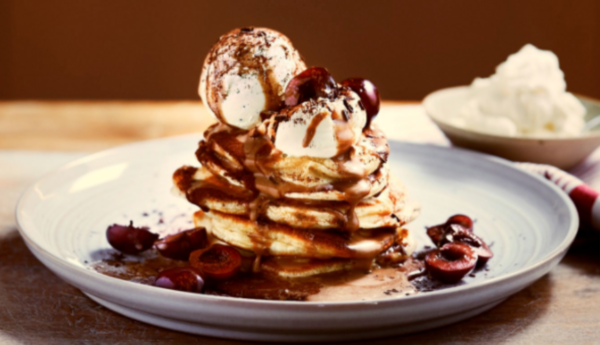
As redraft season (hopefully) approaches, the time has come to consider which strategy you will use to dominate your league-mates. These days, every fantasy player worth their salt is aware of late-round QB and late-round TE strategies, and Zero RB has become less and less viable over the years. However, there is a way to outsmart the room, even in 2020. The strategy that I’m proposing involves leveraging the positional scarcity of elite RBs and taking advantage of WR values in the middle and late rounds of your draft. I call this two-step strategy Ice Cream & Pancakes (visual representation below).
Step 1
The First Three Rounds – RB Ice Cream
The reason for prioritizing RBs in the early rounds is a pretty simple one. There are twice as many starting WRs as RBs in the NFL (more if you consider how often 11 personnel is utilized). But even among those 32 starting RBs, there is a smaller subset of “bellcow” RBs, or players that receive the lion’s share of touches in the backfield (since 2016 an average of just 14 RBs per season have received over 250 touches). Those RBs with predictable volume–touches that do not stem from injury or other unforeseen circumstances–are drafted almost entirely in the first three rounds. And if that wasn’t enough to convince you to lock down RB early, consider this: top 12 RBs score more points than top 12 WRs. This point is illustrated by the table below, which I created by averaging the PPG for the top 12 RBs and WRs each of the past four years (all scoring stats referenced are PPR).
| 2019 | 2018 | 2017 | 2016 | |
| Average RB1 | 19.2 | 20.9 | 18.6 | 18.8 |
| Average WR1 | 17.7 | 17.9 | 17.0 | 17.6 |
RBs are like the ice cream on your pancakes – it can make the whole meal, but if you wait too long to eat it, you’ll be left with a runny, room-temperature mess. By selecting an RB in each of the first three rounds, you’ll have a significant edge over your league-mates, who will be forced to reach for part-time or injury-prone players like Kareem Hunt and Derrius Guice in the middle rounds. You will be capping the upside of your WR corps in the process, but, because of the way WR scoring works, the drop won’t be as severe as you might think. Which brings us to…
Step 2
Rounds 4-10 – WR Pancake
After the top 12, WR scoring becomes bunched together. In 2019, the difference between the WR13 and the WR24 was a measly 0.8 PPG. If you extend that out to WR36, the difference is still just 3.1 PPG. Furthermore, you’d have to go down to WR58 to find a player that averaged fewer than 10 PPG. As more and more NFL teams utilize 3 and 4 WR sets regularly, it makes sense that more WRs would be able to provide consistent fantasy production from week to week. This “flattening” of the WR position has created a vast middle tier of players that is wide and flat–much like a pancake.
To take full advantage of this massive tier of players, select at least four WRs in rounds 4-10. You’ll find that the wideouts in this range are incredibly appealing as the volume and predictability of RBs begins to dwindle dramatically. Consider these two sample drafts, which were created using ADP found at fantasydata.com.
| Team A – WR Heavy | Team B – RB Ice Cream/WR Pancake |
| 1.10 – Davante Adams
2.03 – Julio Jones 3.10 – Kenny Golladay 4.03 – Mark Ingram 5.10 – Kareem Hunt 6.03 – Derrius Guice 7.10 – Matt Breida |
1.10 – Joe Mixon
2.03 – Nick Chubb 3.10 – Le’Veon Bell 4.03 – Allen Robinson 5.10 – DJ Chark 6.03 – Jarvis Landry 7.10 – Julian Edelman |
Team A has built an incredible WR corps, but their RB situation is incredibly fragile. Meanwhile, Team B likely has the strongest group of RBs in the league without making WR a point of weakness.
If you continue to compare RBs and WRs at similar ADPs late into the draft, you’ll find that the WRs are not only likely to score more points, but their production is far more predictable. Remember when I said that 57 wideouts averaged at least 10 PPG last season? For RBs, that number was just 36, and 6 of those RBs played in 10 or fewer games. With that in mind, look at what happens once you get beyond the top 36 RBs and WRs according to ADP.
Alexander Mattison RB38 — Julian Edelman WR38
Tevin Coleman RB41 — Marvin Jones WR41
Latavius Murray RB45 — Jamison Crowder WR45
Darrell Henderson RB47 — Christian Kirk WR47
Justin Jackson RB49 — Anthony Miller WR49
In each of these cases, the WR appears to be an easy choice. Edelman and Crowder are the top pass-catchers on their respective teams, while Jones, Kirk, and Miller are all starters that could see north of 100 targets. Meanwhile, the RBs in this range are backups and role players that would be lucky to see 6-8 touches per week. This seemingly bottomless well of usable WRs makes it easier to justify waiting on the position while you load up on the premium RBs that are much harder to find later on.
Final Thoughts
To summarize, the Ice Cream & Pancakes strategy is designed to take advantage of two trends:
- A limited supply of predictable, high-volume RBs in the first three rounds.
- A surplus of predictable, high-volume WRs in the middle to late rounds.
Choosing the correct RBs and WRs to maximize the efficacy of this strategy is a topic for another article, but with this framework, you will be well on your way to building a championship roster.
Thanks for reading this article! Look me up on Twitter at @fantasyfreezer if you’d like to hear more from me. I love answering fantasy questions, discussing trades, and engaging in friendly debates, so be sure to drop in and say hello.

