

Fantasy Twitter can be a very polarizing place. I’m always disappointed when I log on and I don’t see someone lamenting being blocked after a Riley Ridley route running debate. I’m pretty sure that you aren’t even playing fantasy football until you’ve been #madonline while arguing about #RBsDontMatter, #NeverJulio, or the infamous “Analytics vs. Film” debate.
The most recent battleground is wide receiver BMI and it’s doing its best to fill the void left by Denny Carter’s 69-day Twitter hiatus. If you’ve missed the Wide Receiver (WR) Body Mass Index (BMI) Crusades, I will give you the Rotoworld player-blurb version of the argument. There have been 87 wide receivers to enter the NFL since 2003, registering a top 24 WR season. Of those WRs, 82.8% of them have had a BMI of 26 or higher. Therefore, the likelihood for sub-26 BMI WR finishing in the top 24 is low.
I’m not bringing up this month-old Twitter argument to rehash WR BMI hot takes. The truth is this is my first fantasy football article and I have a reputation in my home leagues as the “BMI Guy.” During our league podcast, I would always mention running back BMI thresholds and it only seems right for me to start off with some BMI discussion. I want to make sure this BMI hysteria doesn’t spill over to the quarterback (QB) position.
The Narrative
Historically, there has been a strong narrative in the football community about QB size despite players like Russell Wilson and Kyler Murray balling out on Sundays. The QB size debate begins with how tall a QB is and if it affects their ability to make reads of the defense on passing plays. There has been a lot of discussion around QB hand size and its correlation to QB performance in cold-weather games. Analysts have even studied QB weight and how it translates to their durability in the NFL.
So I decided to use my newly released college prospect database and explore BMI and QB performance. Before going any further, there needs to be a brief overview of BMI. BMI compares an individual’s weight to their height and it’s used to describe their level of body fat or thickness. The index was derived from the works of the Belgian thinker, Adolphe Quetelet.
The Reality
My prospect database currently has 164 college QBs that entered the NFL between 2003 and 2017. The table below represents how QBs are distributed by their BMI within the sample. Approximately 66% of all QBs in my database have a BMI between 27 and 28. QBs like Kirk Cousins, Lamar Jackson, Jay Cutler, and Dak Prescott all fall within this range. QBs built like Ryan Finley, Jared Goff, and Daniel Jones are in the 25 to 26 BMI range. Meanwhile, QBs similar to Tony Romo, Kyler Murray, JaMarcus Russell, and Tim Tebow have higher BMIs at 29 and above. In my database, 92% of all QBs have a BMI range between 26 and 29.

After exploring how BMIs are distributed across QBs, the next step is to analyze how QB BMI correlates to performance in the NFL. For the purpose of this study, QB success was defined as having at least one top 12 QB PPR season. This decreased the sample from 164 to 37 QBs. All of the QBs within this sample have BMIs of 26 to 29. The range is displayed in the table below. “QBs with a top 12 season”, and “All QBs” mirror each other closely with 100% and 92% falling within the 26 to 29 BMI, respectively. Additionally, 78.4% of the QBs with a top 12 season had a BMI of 27 or 28 which also closely corresponds to the 66% within the BMI range for all the QBs in my database.
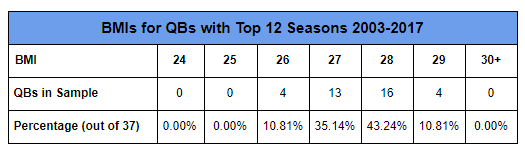
Clearly the BMIs don’t correlate exactly between the two QB samples. However, the distinct similarities in how BMIs are distributed between the top 12 QBs and all QBs indicate BMIs for QBs are insignificant. For example, there would need to have been a clear differentiation in the BMIs for the top 12 QBs compared to the entire QB sample for BMIs to predict QB success in the NFL.
If you are reading this and you are thinking to yourself, “Well there are zero successful quarterbacks with a BMI under 26 and that could be a threshold, right?” Unfortunately, no. Due to there only being nine QBs with a BMI under 26 in the database, the sample size is too small to determine. Even for an amateur data nerd like myself, real conclusions can’t be made from such a small sample size.
Never fear BMI enthusiasts, there is another way to test BMI and QB success in the NFL.
The Last Chance
In my prospect database, I ran a regression analysis for every stat, metric, and measurement in the database compared to several values that represent NFL success. In this case, the analysis returned an r-squared value. The r-squared value represents how closely the data fit a trendline created between two variables. For this analysis, the study compares BMI for QBs to PPR points per game (PPG) in years 1-3 of their career, career PPG, passing yards per attempt in years 1-3 of their career, and career passing yards per attempt. There are also several different QB sample sets like QBs drafted 2003-2017, all QBs from 2003-2017, QBs with top 12 seasons, and QBs with top 24 seasons.
The closer the r-squared value is to 1, the better that stat, metric, or measurement is, at predicting future NFL success. Below are all of the r-squared values for QB BMI. All of the r-squared values are less than .05 or 5%. These are very low r-squared values. For BMI to have some predictive qualities, the r-squared values needed to be at least .15 and preferably greater than .2.
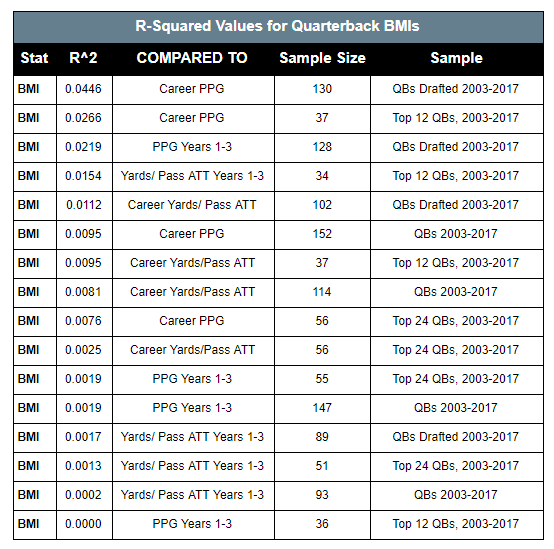
As much as I would have enjoyed writing an article about the importance of BMI for QB success, the results of this study don’t support that hypothesis. The low r-squared values and lack of differentiation between QBs who entered the NFL between 2003 and 2017 and successful NFL QBs broke a lot of BMI truther’s hearts today. If you are looking for QB stats or metrics that are predictive of NFL success, please feel free to explore the QBR metric, completion percentage, and many other stats in my free college prospect database.
But, until next time, remember you haven’t truly played fantasy football until you get blocked by film scouts for your scorching hot taeks on BMI.
Please join me on Twitter @ff_spaceman in my quest into unexplored spreadsheets and dynasty football strategies.
All stats and metrics were found on www.sports-reference.com/cfb/, team websites, team media guides, team game day programs, and ESPN.com. Measurements were found at nflcombineresults.com, playerprofiler.com, and pro-football-reference.com.

