

Wide receiver is the position in which analysts have the most different inputs for analyzing prospects. This is because it is by far the hardest position to analyze, whether that be grinding film or navigating through advanced metrics. This is because the college game for wide receivers is so drastically different than how the position is played in the NFL. Wide receivers have less room to operate, they are hit at the line of scrimmage, and they are playing against more skilled and more athletic defenders than they ever have. In this segment, we will be exploring historical hit rates with draft capital and age as the only two components.
Using DLF’s trade finder tool we will look at the market value of some of the top wide receivers in the league. For this exercise, to stay uniform with the quarterback and running back segment, we are using values based on Superflex leagues.

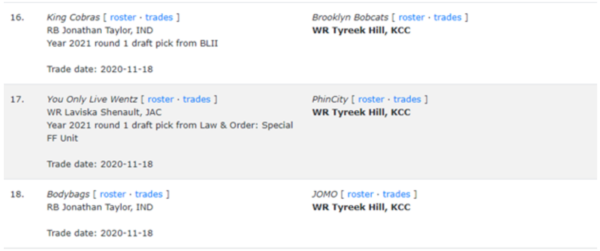
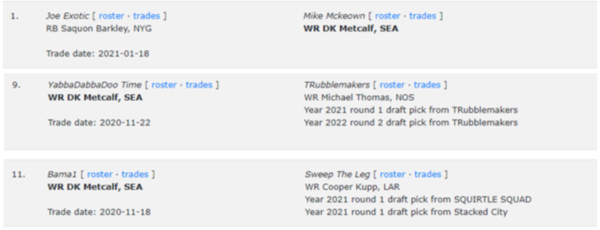

Davante Adams is many analysts’ top dynasty wide receiver in their rankings. The price to buy Adams ranges from multiple first-round draft picks to two top-tier receivers, in addition to a hodge-podge of highly valuable running back and wide receiver pairings. One can even use Davante Adams and a piece to get a top tier running back like Christian McCaffrey. Personally, I sold Adams in a league for A.J. Brown and D.J. Moore which I felt was a good return. Tyreek Hill is a player that can be the highest scoring wide receiver any week due to his explosive athleticism and elite quarterback play. Hill, as you can see is being valued close to stud rookie running back Jonathan Taylor. D.K. Metcalf had an amazing start to his season, and many people wanted to name him as the WR1 a bit too early. Acquiring Metcalf is going to cost you a top-end running back or a boatload of picks. Stefon Diggs, who drove many teams to fantasy championships is going to cost anywhere from George Kittle or Jonathan Taylor, to a big return of rookie draft picks.
The lowest investment that you will make on acquiring a wide receiver is during your offseason rookie drafts, however, since wide receivers take a bit longer to break out their value can fluctuate greatly in the first three seasons. While after their rookie season they can be acquired, you are likely going to have to pay full price on players that did not pan out yet, making rookie drafts the best spot to acquire wide receivers before they gain value.
The 2021 wide receiver class is similar to the great class that we saw in 2020. Due to many opt-outs in college football, this is an incredibly deep draft class as well. This is a great year to have stocked up on rookie draft picks. However, it’s not too late to acquire these picks because the value will continue to rise until draft day.
Wide Receiver Hit Rate
For the purpose of this exercise, I determined success to equate to averaging around 130 fantasy points per season while maintaining success across multiple seasons in the league and used records dating back to the 1980 draft class. This metric was much less subjective than some other positions; 130 points per year just happened to be a sweet spot. Wide receiver is a precious position; it is one of the few positions that have the ability to completely change a defense’s strategy. While we are measuring fantasy hit rates, actual hit rates are somewhat unmeasurable. For example, a player like Henry Ruggs III did not have an impressive rookie campaign, but his presence on the field forced defenders to play differently, roll coverage and create opportunities for players like Darren Waller and Josh Jacobs.
First Round Wide Receivers
Wide receiver has the lowest first-round hit rate among all of the positions covered thus far. Being drafted in the first round has a hit rate of 43%. Being drafted in the top-10 picks does slightly better than that, coming in at 51%. Being drafted from pick 11 to pick 20 has a hit rate of 40%. The end of the first-round sees a slight drop to 35%.
Has the NFL become better at scouting receivers recently? Generally speaking, the overall trend has had a stronger hit rate the last ten years. Interestingly first-round wide receivers over the last ten years have experienced a decreased hit rate down to 36%. The NFL is getting better at evaluating if a player is worthy of a Day Two pick, but missing on more first-round receivers. This may be because of the overweighting of the 40-yard dash. Over the past few seasons the first receiver selected in the draft have been:
2020: Henry Ruggs III (4.27)
2019: Marquise Brown (did not run but estimated around 4.3)
2018: D.J. Moore (4.42)
2017: Corey Davis (4.53)
2016: Corey Coleman (4.42)
Some other wide receivers to gain first-round capital with a heavy weighting on 40-yard dash times include:
2016: Will Fuller (4.32)
2017: John Ross (4.22)
Age
While wide receivers have much longer careers than running backs, age is a critical factor because having success at a younger age greatly impacts a player’s ability to maintain and improve upon that success. You will see breakout age as a critical component for a prospect, portraying that the younger a player succeeds at the collegiate level, the more likely they are to succeed at the professional level.
Here are the success rates among first-round wide receivers based on their age when drafted.
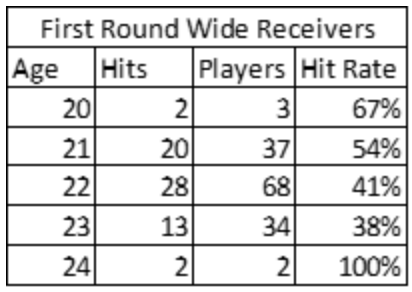
As you can see, there is a clear trend that first-round wide receivers are more likely to succeed when coming into the league at a younger age. Coming into the league at a young age and getting drafted in the first round indicate success at the college level.
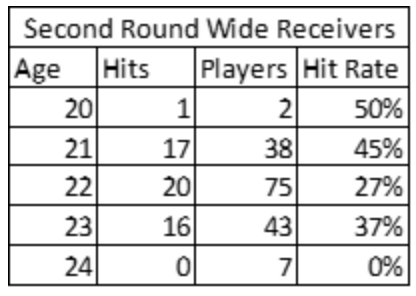
Second-round players that come at a younger age also have a higher likelihood of success than their older counterparts. However, once we hit the third-round we see an interesting turn.
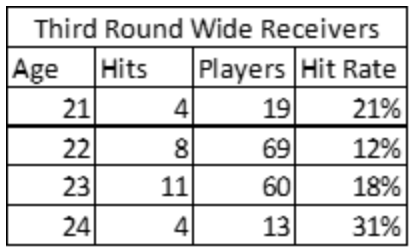
Interestingly, once we hit the third-round older prospects actually have a better chance of hitting than their younger counterparts. What this is indicating is that once we hit the third-round the NFL executives start weighting the prospects’ overall production profile rather than their athletic profile. Now we will get into the actual prospects and where their likelihood of success is based on their age and expected draft capital. Because of the sheer number of prospects with top-three round grades we will not be deep diving on the prospects until after their Pro Days.
DeVonta Smith
The 2020 Heisman winner, enters the NFL Draft after his senior season at Alabama. Smith will be a sure-fire first-round pick this year. At the time of the draft, Smith will be 22 years old, turning 23 in November of his rookie campaign. Smith will fall into the cohort that historically has a hit rate of 38%.
Ja’Marr Chase
The 2019 Biletnikoff Award Winner opted out of the 2020 LSU season to prepare for the NFL Draft. Chase is another sure-fire round-one pick this year. At the time of the draft Chase will have just recently turned 21 years old. Chase will fall into the cohort that historically has a hit rate of 54%.
Jaylen Waddle
The electric junior Alabama receiver had an injury-shortened 2020 season but returned way ahead of schedule to play in the National Championship. His activity in the Championship game, when people believed his injury may eat into his rookie season should give NFL GMs the confidence to select him in the first round. Waddle will be 22 years old when he gets drafted, putting him in the same cohort as his teammate, Smith with a historic hit rate of 38%.
Rondale Moore
The junior Boilermaker originally opted out of the 2020 season, but when the Big Ten allowed football to be played Moore opted back in for his junior season. Moore is the first player that is not a sure-fire first-rounder, though is being mocked in the first-round by many. Moore is a very young prospect and will be just 20 years old at the time that he is drafted. If he gets first-round draft capital then he will be in a cohort that has a 67% success rate, if he gets drafted in the second-round that rate will drop to 50%.
Rashod Bateman
Similar to Moore, Bateman both opted out of the 2020 season and opted back in. The Golden Gopher declared for the NFL after his junior season. Bateman will be 21 years old when he is drafted. If Bateman gets drafted in the first round he will have a success rate of 54%, however, falling to the second round would decrease that rate to 45%.
Kadarius Toney
The senior Gator receiver, skyrocketed up draft boards due to his versatility this season. He is the final receiver that is getting mocked in the first round of the NFL Draft. Toney will be 22 years old when he is drafted, so his draft capital is going to have a more drastic shift if he falls. A first-round selection would give Toney a historical success rate of 41%, and dropping to the second-round decreases the rate to 27%.
Terrace Marshall Jr.
With Justin Jefferson dominating NFL defensive backs, and Ja’Marr Chase opting out of the season Marshall took full advantage of the increased opportunities in his junior season at LSU. His production this early season has him being mocked in the second round of the NFL Draft. By the time the draft rolls around Marshall will be just 20 years old, leaving him in the historical hit rate of 50%.
Dyami Brown
The tar heels athletic junior declared for the NFL Draft after two very strong seasons with Sam Howell. Brown is a deep play threat who should show off his blazing speed during the UNC Pro Day. Brown is currently being mocked in the second round of the NFL Draft. By the time the draft rolls around Brown will be 21 years old, leaving him in the historical hit rate of 45%.
Amon-Ra St. Brown
The younger brother of Equanimeous St. Brown will be foregoing his final year of eligibility and declared for the NFL Draft as a junior. The USC Trojan is being mocked in the second round of the NFL Draft. At the time of the draft, he will be 21 years old, granting him a historical hit rate of 45% though he is being mocked quite late in the second round. If he does fall into the third round of the draft his historical hit rate would also fall to 21%.
Elijah Moore
The next great wide receiver out of Ole Miss, Elijah Moore declared for the NFL Draft after being the only wide receiver who produced at a level within spitting distance of DeVonta Smith. Moore isn’t currently being mocked in the top-two rounds but is within the top 60 on many NFL Draft analysts big boards. Moore will have turned 21 just days before the NFL Draft takes place. Third-round draft capital would give Moore a 21% historical success rate, however getting into the top-64 picks would skyrocket Moore’s historical success rate up to 45%.
Amari Rodgers
Clemson’s senior receiver will be heading to the NFL next season. His best-case outcome in the draft would be later on Day Two. At the time of the NFL Draft, Rodgers will be 21 years old. Historically. He would have a success rate of 21%, however, falling into day-three would decrease that rate to just 13% in round-four.
Tutu Atwell
Another player who is really hurt by a less efficient season followed by no NFL Combine to show off his 4.26-second 40-yard dash time is Atwell. The Louisville junior receiver will be 21 years old come Draft day. He could go as high as the second round if a team falls in love with his ability to stretch the field, however, could fall into day-three. Atwell’s historical success rate in the second round would be 45% but can fall all the way down to 13% if his draft capital falls to the fourth-round.
Tylan Wallace
Oklahoma State’s top receiver returned for his senior season after an ACL ended his 2019 campaign. Wallace has declared for the draft rather than fighting for an extra year of eligibility. Just by a couple of days, Wallace will be 21 years old when he is drafted and turn 22 before he puts on a helmet or cleats. Third-round draft capital would give Wallace a historical success rate of just 12%, and it would fall under 10% if his draft capital falls into day-three.
D’Wayne Eskridge
Eskridge is the first super-senior that we will see in this draft. The Central Michigan wide receiver converted from defensive back, which he played for the first couple of years in college. Eskridge represents the very rare 24-year-old rookie wide receiver, who hit on only 12% historically regardless of draft capital. Though it is not a death sentence, some 24-year-old rookies who hit include Cooper Kupp, Marvin Harrison, Keyshawn Johnson, and Joe Horn.
Seth Williams
The South Carolina junior receiver declared for the NFL Draft, probably because in part, he couldn’t stomach having to catch passes from Bo Nix again. I was not able to validate the year that Williams is born, however since he is a junior born in April, I superimposed 2000 as his birth year to match the many other juniors born in the springtime. If this is correct, Williams will have just turned 21 prior to the NFL Draft. A third-round draft capital would leave Williams with a 21% hit rate, which falls to 13% in round-four.
Anthony Schwartz
Another Gamecock that couldn’t leave Nix fast enough is Schwartz. The Olympic Sprinter has declared for the NFL Draft as a junior. By the time the NFL Draft rolls around, Schwartz will be just 20 years old. If his Olympic speed gets him drafted in the third-round he would be the first-ever. Schwartz would join just seven other receivers to be drafted at age 20.
Sage Surratt
The Wake Forest wide receiver opted out of the 2020 season to prepare for the NFL Draft. Despite the fact that this would have been his redshirt junior season he was granted an invitation to the Senior Bowl. Surratt was high on people’s draft boards before opting out and now will work to revamp his stock. Surratt will be 23 years old when he is drafted the year. Historically this would garner a 37% success rate if he is drafted in the second round, and an 18% rate in the third round.
Looking Forward
This was a very enjoyable exercise for me to run as I hope it was enjoyable for you to read. After the draft takes place, I will be re-examining the selections and putting these players into the correct cohorts to repeat this exercise along with expanding the components used for inputs, for a more clear picture of these rookies’ range of outcomes.
Thank you for reading my article! If you enjoyed it, keep an eye out for my future articles. You can also follow me on Twitter @DynastyDiagnos1 and reach out with any questions, comments, or ideas you’d like me to explore for a new article.

