
In part one of this article, found here, I discussed three players who broke out in the second half of 2019. I decided that since so many second-half breakouts happened, I need to discuss three more players. Here we go!
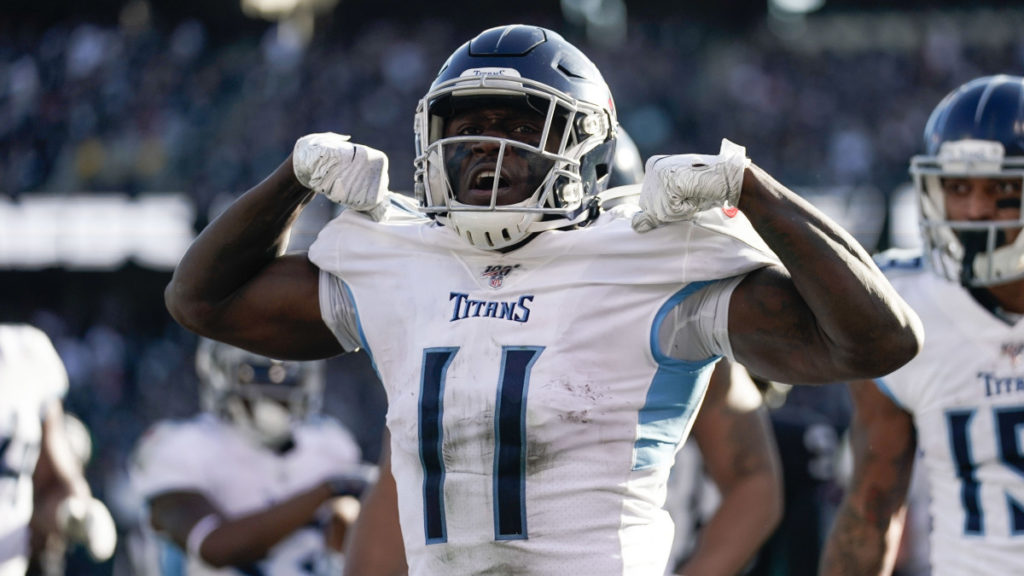
A.J. Brown (WR – TEN)
Over Brown’s first eight games, he averaged just 8.0 points in half PPR scoring. This put him outside the top 40 for wide receivers. Over his second eight games, he averaged 15.9 points per game. That was good enough to rank him third among WRs in points per game over that period. His cumulative line in games 1-8 was 22 receptions on 34 targets for 348 yards and three touchdowns. In games 9-16, Brown put up 30 receptions on 50 targets for 703 yards and five touchdowns.
There are two main reasons for Brown’s second-half surge. First, the Titans made a quarterback change from Marcus Mariota to Ryan Tannehill during their sixth game. After this change, Brown immediately received a then season-high eight targets in Tannehill’s first start. The move to Tannehill completely revitalized the Titans’ offense with Brown and running back Derrick Henry as the primary beneficiaries. Second, Brown finally took the alpha wide receiver role in the offense away from incumbent Corey Davis. Over the first few weeks of the season, Brown played on less than 50% of the offensive snaps. Davis averaged around 80% of snaps. After the switch to Tannehill, their snaps became somewhat equal for a few weeks. However, in the final five weeks of the season, Brown played 79% or more snaps in every contest, while Davis failed to hit that mark in any of the five games.
The question is: what is Brown going forward? If Ryan Tannehill remains the starter in Tennessee, we should expect Brown to continue to succeed. My main concern with Brown is that Tannehill is a low-volume passer. If the Titans manage to acquire a better secondary wide receiver than Davis and Jonnu Smith takes a step forward in 2020, it is possible that Brown could have targets siphoned away. Therefore, I can’t imagine that I will draft Brown as a WR1 in 2020 redraft formats. Though, I expect to rank him as a high-end WR2 with upside. I anticipate a Brown truther in every league, though, and that I probably will have no shares of Brown in 2020.
Kenyan Drake (RB – ARI)
When we think of second-half breakouts, Drake is a perfect example. He started the season on a different team, the Dolphins, before landing with the Cardinals. Over the first eight weeks, Drake played in six games with the Dolphins. He averaged just 7.3 points in half PPR in those contests, behind players like Chris Thompson, Frank Gore, and Rex Burkhead and outside the top 40 running backs. Mostly, during that period, Drake was irrelevant and was dropped by many fantasy owners since he was being wasted in Miami.
However, before week 9, Drake was traded to the Arizona Cardinals, after injuries to Arizona’s top two running backs, David Johnson and Chase Edmonds. In week 9, both Johnson and Edmonds missed the game, and Drake broke out with 15 carries for 110 yards and a touchdown. He also added four receptions for 52 yards. After this breakout performance from Drake, most expected Johnson to reclaim his starting job in week 10. The medical staff declared Johnson fully healthy for that contest. That did not happen, as Drake had 10 carries to Johnson’s five and six receptions to Johnson’s one.
Even though Drake worked as the lead back in week 10, most observers saw that Johnson remained involved in the offense and expected Johnson to garner a majority of touches in week 11. Not only did that not occur, but Johnson also received zero touches on just eight snaps in week 11. Drake had 16 carries for 67 yards to go with six receptions for 13 yards. After the week 12 bye, Drake continued to excel as the workhorse back, while Johnson found himself relegated to spot duty, and Edmonds displayed utter irrelevance. After the trade, Drake was the RB3 in points per game with 18.2 and was an absolute league-winner for anyone who grabbed him off waivers.
Going into 2020, Drake is an unrestricted free agent. I expect the Cardinals to retain him, with Edmonds as his backup. An impending trade in Johnson’s future seems certain, despite an $8.5 million dead cap hit that comes with such a trade. Assuming the situation I described comes to pass, Drake would have RB1 upside in 2020. I think he’ll be worth a selection as a top-15 RB, although top-12 is likely slightly too costly for me. However, I see no reason why Drake can’t replicate his second-half success in a similar situation in 2020. If Drake doesn’t re-sign in Arizona, I will likely have little to no interest in him. He will probably still be valued as an RB2 based on a massive free-agent contract. I’m not sure he’ll succeed outside of this Cardinals’ scheme.
Deebo Samuel (WR – SF)
Over the first half of the season, Samuel averaged just 7.1 points per game in half PPR scoring. Outside of a strong performance in week 2, where he caught five balls for 86 yards and a touchdown, Samuel scored no other receiving touchdowns nor topped 44 receiving yards in any other game. However, in the second half of the season, he averaged 13.9 points per game, 13th among wide receivers. Samuel finally started to receive starter’s usage in week 10, where he was in on 84% of snaps. After this, he never received less than 73% of snaps again and he cemented himself as the 49ers’ number one receiver, ahead of Emmanuel Sanders.
There are some significant warning signs for Samuel, though. During his two strongest games, Weeks 10 and 11, star tight end George Kittle missed playing time with an injury. With Kittle out, Samuel caught eight passes in each game for over 100 yards receiving in both games. Samuel failed to top five receptions in any other game the entire 2019 season and only topped 100 receiving yards on one other occasion. Additionally, Samuel scored three rushing touchdowns in 2019 on just 14 rushing attempts. For a receiver to have one rushing touchdown is unusual, but three is a clear outlier and cannot be relied on going forward.
Going forward, Samuel is the number one wide receiver on the 49ers right now, as Emmanuel Sanders will likely leave in free agency and teammates Dante Pettis, Kendrick Bourne, and others have failed to make much of an impact, at least in fantasy. However, I cannot imagine that the 49ers are satisfied with receiving weapons of just Kittle and Samuel. I expect the 49ers to address the receiver position, whether in free agency or trade.
A.J. Green would be a prime candidate to join the 49ers to supersede Samuel as the number one receiver. Even if a Green-level player doesn’t surpass Samuel, players like Robby Anderson are available in free agency that would love to join a Super Bowl quality roster. Considering that Samuel already wasn’t heavily targeted in 2019, except when Kittle was out, I will likely be heavily avoiding Samuel in 2020 redraft formats. He will probably be valued as a mid WR2, and I cannot picture selecting him anywhere near that price.
Thanks for reading this article. You can find me on Twitter at @DFF_Justin. I’d love to interact with anyone in the community, so reach out at any time! I’ve been taking fantasy questions and helping out with all formats, so keep sending those questions my way.

