

The receiver with two 1,000+ yard receiving seasons in their first three years or the receiver with just one top-24 season? Whichever way you want to portrait it, D.J. Moore has a lot of different interpreters that are struggling to find consensus. The range on Moore’s ADP is one of the most drastic out of all players. But where should we be valuing him? Is his WR16 ADP (DLF) low enough to find value gains or not quite worth the price?
We must first look at who D.J. Moore was as a prospect to get a broad sense of the ceiling we are looking at. Moore was an alpha receiver coming out of Maryland as a junior. At Maryland, he wasted no time by posting a 19.1% weighted dominator rating in his freshman season. He became so much more dominating that by his junior season he put up a whopping 52.9% weighted dominator. Posting a raw athletic score of 9.65 and running a 4.42 at the combine, Moore was ready for what the NFL had to offer. In April of 2018, he eventually was picked 24th overall by the Panthers. All of this led to an “ELITE” prospect grade.
So, what exactly does this mean for his ceiling? Prospect grades help us get a great sense of just how dominant a receiver can be in the fantasy landscape. For reference, if we take all the prospect tiers from 2010-2018 to find what percentage of them have multiple => WR5 overall seasons this is what we find.
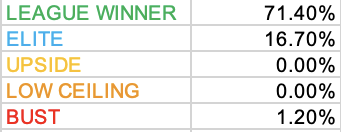
Based on Moore’s prospect status we see that he has some Fantasy Hall of Fame upside. Which is all we need out of prospects, tons of upside.
D.J. then came into the league and produced 788, 1,175, and 1,193-yard seasons. Unfortunately, due to a lack of touchdowns, he only was able to achieve just a single top 24 season. But because of the early lack of fantasy success, he’s getting knocked for a lack of receptions and too much reliability on big plays as indicative of his high yard per reception numbers. This brings a great comparison for these same knocks.


The top graphic is D.J. Moore’s combined 22 and 23-year-old seasons. The bottom is Julio Jones‘ combined 22 and 23-year-old seasons. Aside from the touchdowns, these two lines are nearly identical. This is to say that maybe the persona around D.J. Moore is disrespectful for just how good he is.
But the most important part of all of this is fantasy production. For D.J. Moore, his first three seasons in the league he posted 10.2, 15.5, and 14.1 PPR per game. That’s mighty impressive for a receiver whose team hasn’t ranked inside the top 20 in touchdowns scored since his rookie season where they ranked 12th.
Combining D.J. Moore’s prospect status and early career production status we can find comparisons to see just how highly we should be valuing him. So, who are they?

Stefon Diggs, Calvin Ridley, and Allen Robinson: all of them are year-in and year-out threats to be top-five wide receiver fantasy finishers. Not to mention, they all possess higher value than D.J. Moore (courtesy of www.keeptradecut.com) despite all being 26 and 27 years old while Moore is still just a 24-year-old as of a couple of months ago. This means a few things; because of his age and where he’s at in his career arc, he will continue to hold value. It is also becoming obvious that his upside involves a top-five finish with multiple top-12 finishes.
The safety in his value makes WR16 much closer to a floor value than a ceiling, meaning we can gain much more value than what we spent while having less risk of losing its value. Appreciating assets are the key to lasting and winning dynasties. D.J. Moore is a buy.
Until the next article, follow me on Twitter @dynasty_im!

