
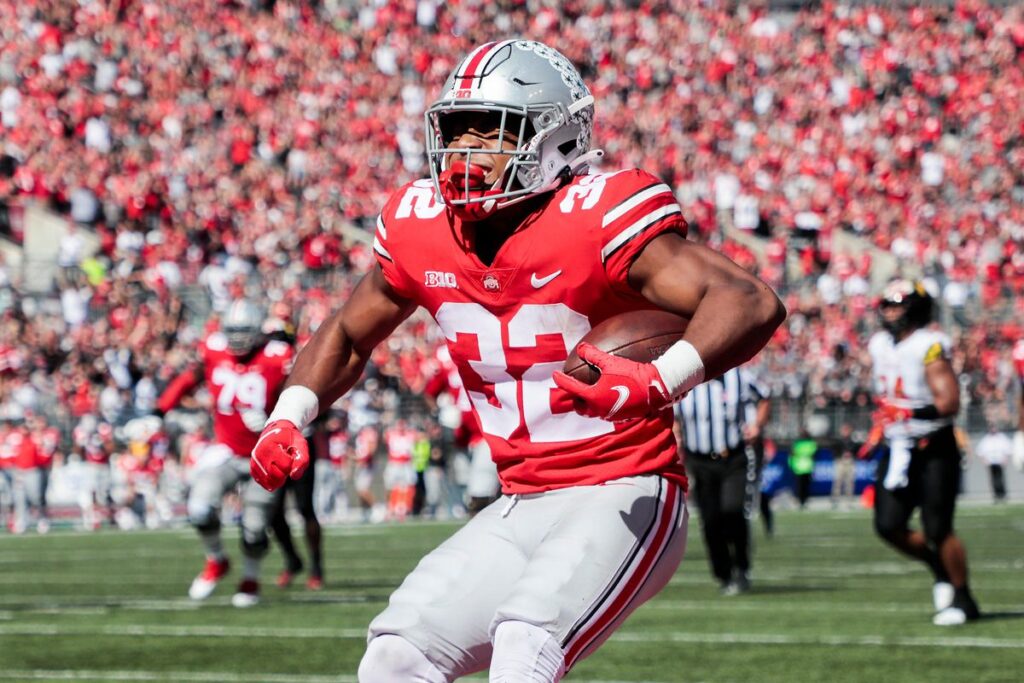
For my first Devy article, I wanted to discuss the basic strategy behind a Devy startup draft. I’ve recently jumped into the Devy world, and I can safely say there’s no looking back. For those unaware, the Devy format is just a Dynasty league format, plus the addition of drafting current college players in a separate “Devy Draft”. You roster these college players until they (hopefully) are drafted into the NFL, and you can place them into your weekly lineups. You can trade these players like any other asset; they just won’t earn you points until they’re in the NFL (at least in standard Devy leagues).
In most Devy leagues, you’ll have a combined Devy/Rookie draft every subsequent off-season. These are “Devy Depleted”, meaning the talent pool is much sparser since most of the elite guys were taken in the startup draft. As the league ages, the talent pool continues to get thinner and thinner as more college standouts make our fantasy rosters.
The Devy format is gaining popularity in the Dynasty community. It creates that added layer of interest and strategy and generally promotes more active leagues, as there are endless ways to construct trade offers. Now that we’ve discussed what Devy means, let’s discuss some “do’s and don’ts” to consider in your Devy startup draft.
Fade TEs
Okay, the exception this year is Brock Bowers. That guy is elite. But for the most part, unless you’re coming across a generational talent like Kyle Pitts or Brock Bowers, I would steer clear. The price is not worth the risk.
According to FantasyPros, out of the top 5 tight end recruits from 2015-2019, only 30% made the NFL, and 6% are “starter-worthy” in fantasy football (Kyle Pitts and Cole Kmet). Drafting a TE prospect is worse than a blind dart throw, specifically the underclassmen. And even if they pan out in the NFL, it typically takes TEs some time to acclimate, so you’ll be waiting for quite some time to cash out your initial investment.
Contender vs. Rebuild
Giving up Devy picks can be difficult, as half the fun of Devy is grabbing your favorite college guys and rooting for them on Saturdays. But if the opportunity presents itself, take advantage of the chance to acquire some elite veterans at a discount. Typically, 1-2 league mates immediately go “rebuild mode” and sell their startup picks for as many early Devy picks as possible. If this is the case in your startup, roll with it. Stay fluid and be willing to give up some Devy picks for immediate production. After all, if multiple teams are tanking right off the bat, your odds of a 2023 championship have already improved exponentially before Week 1. Acquiring Cooper Kupp for a mid-round startup and a couple of Devy picks could improve your odds even more and make you the team to beat in Year 1.
On the flip side, if you see many teams looking to move up in your draft and sell their Devy picks, consider taking on the role of rebuilder. It’s challenging to gauge fair trade value in a Devy startup, as we truly don’t know which players will hit and which won’t. Typically, countering trades and asking for an extra late-round Devy or two won’t move the needle a ton for the aspiring contender, so you can get that sweetener in your trade and acquire tons of picks quickly. Quantity can be a bit underrated here; you never know which college player might break out.
All this being said, be wary of going “full-blown rebuild” in Devy. It’s fun to load up your Devy roster with 20+ college guys in hopes of fantasy domination down the road, but you’ll probably be waiting for longer than you think. Unless all your Devy players are in the 2024 draft class, it’ll be 2-3 years before your initial college roster hits the NFL. Even then, you’ll have a few busts that never make an NFL roster. You’ll also have some that make an NFL roster but don’t produce enough to start in fantasy, and your Devy players that do wind up being “hits” probably aren’t league winners for you as rookies. So, we’re talking about 4+ years before this initial investment pays off. That takes some serious patience. If you’re in a bunch of Devy leagues, I’d be fine taking this approach in one or two of them, so long as you’re confident in the longevity of said leagues.
Team Build
Don’t make your Devy selections based on projected future team needs. For instance, if you’ve drafted several veteran WRs that could see a sharp decline in value shortly, don’t feel obligated to grab Devy WRs as their future replacements. Assessing college talent is hard enough as is. Just take the best guy available. View it from a total value standpoint. If you have two young foundational QBs on your Dynasty roster and you feel the best Devy player available is a QB, pull the trigger without hesitation. Trade value is arguably more important than internal value with Devy players. We’re looking to buy the stock that has the potential to soar in value over the next 1-3 years. Ascending talent equals liquidity.
Look for RBs Early
The running back position is the most depleted of any skill position in fantasy football today. There are so few “league winners” out there that if you land a difference-maker in the Devy draft, you’ve given yourself an incredible positional advantage for a pretty nice discount. There’s no magic eight-ball to tell us which RBs will become elite at the NFL level, but searching NFL mock draft databases is generally a decent place to get started. NFL mock drafts this far out are a crapshoot as well, but we do know draft capital is a significant predictor of future NFL opportunity, so I would make this my top point of consideration.
If you search 2024 NFL mock drafts, you’ll see several mocks that don’t have a single RB being drafted in the first round. The only name that appears on a semi-consistent basis is TreVeyon Henderson. As the consensus RB1 in his class this offseason, I’d be fine taking a swing on Henderson in the early-to-mid first round of Devy drafts. Because of the short shelf life of the RB, it makes sense to focus on youth and upside. Regarding wide receivers, I prefer to take the young, established NFL talent. WRs generally stay relevant longer, so we don’t have to worry about replacing them with youth quite as frequently.
Late Round Picks
I’m looking for the college guys with the highest possible ceiling in late-round picks. I don’t care much about grabbing the 2024 WR with a decent floor and could potentially carve out a role as a WR3 on an NFL team. I prefer the younger prospect that has yet to establish himself but has a foreseeable path to becoming elite, even if those odds are slim. This could mean either an incoming freshman that was highly recruited or a player who’s walking into a position with plenty of vacated snaps.
An excellent source for these late-round picks is the ESPN recruiting database. Look for those incoming freshmen that were mid-to-high 4-star recruits (the 5-star guys will be long gone by now) and take a shot on them—specifically the WRs, RBs, and dual-threat QBs.
If an unproven sophomore or junior RB at a Power 5 program has been playing behind an RB that just got drafted, and the starting spot is now open, I’d also take a shot on that guy. If you’re playing with sharps, these guys will likely go off the board early, but if you’re starting a Devy league with your hometown buddies, they may get overlooked. Finally, when in doubt, draft guys from the most elite schools, even if they have yet to prove themselves. I’m talking about Alabama, LSU, Texas, Georgia, USC, Oklahoma…you get the point. The programs that have produced NFL-level talent year after year. There’s a reason the blue bloods offered these guys a scholarship. Put your faith in their recruiters and coaching staff; they know more than we do.
Thank you for taking the time to read this article, and I hope you got some valuable information you can use for your fantasy team! If you’d like additional insight into Dynasty Football news and analysis, please follow me on Twitter at @DynastySavant. Until next time, keep grinding out there, Dynasty family! #DFFArmy #AlwaysBeBuilding

Pingback: Beginner’s Guide to Devy Startups - North Las Vegas News Station