
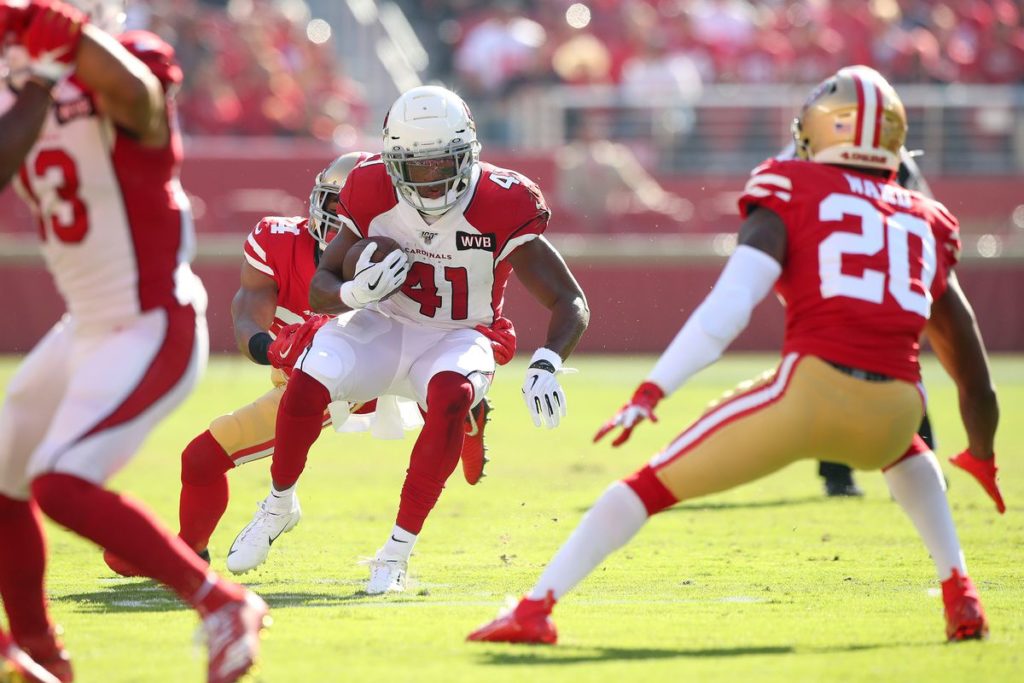
In this article series, I’m analyzing every one of the 32 NFL teams and all of their redraft-relevant fantasy assets. It’s a long project, but I want to make sure that our readers have something they can refer to for every team. For each article, I’ll split up the fantasy assets into three categories: high-end assets, usable contributors, and dart throws. I’ll reference my PPR redraft rankings at the time of writing, which can be found here. If you want to read my previous work in this series, the full list with links can be found at the bottom of the article. Let’s jump into the Arizona Cardinals.
High-End Assets
DeAndre Hopkins
The Cardinals acquired Hopkins this offseason in a blockbuster trade with the Texans, sending David Johnson and draft picks for his services. Hopkins will immediately slot in as the top receiver in head coach Kliff Kingsbury’s air raid offense. Even though wide receivers often struggle when joining new teams, Hopkins is one of the best in the NFL. He is a target monster, with over 150 targets in each of the last five seasons. In 2017, he finished as the WR1, then duplicated that in 2018, before a WR6 finish in 2019.
He goes from one top quarterback in Deshaun Watson to another in Kyler Murray, so he shouldn’t miss a beat. At just 28 years old, Hopkins is squarely in his prime and will likely be excellent once again in 2020. Hopkins is a reliable, high-end WR1, and I’m comfortable selecting him in the first round in PPR redraft leagues.
Kenyan Drake
Drake is also a star performer on the Cardinals. Once he took over as the Cardinals’ starting running back after a trade from the Dolphins, he averaged 19.9 PPR fantasy points per game, putting him at fourth among running backs over the period. In the trade mentioned above for Hopkins, the Cardinals shipped out Johnson, their previous starting running back. Therefore, Drake has no serious competition in 2020, with Chase Edmonds and rookie Eno Benjamin simply serving as his backups.
The one concern with Drake is that he’s never performed at a high level for fantasy teams across an entire season. In Miami, Drake was always in and out of the lineup, garnering a workhorse role only when there were no other options. However, since the Dolphins had Adam Gase as their head coach during most of Drake’s tenure, it’s hard to put all of that inconsistency on Drake. Gase has a history of misusing talented players, with Drake, DeVante Parker, and Ryan Tannehill all excelling after parting ways with him. Drake is an RB1 and a second-round redraft pick for 2020. He comes with both higher upside and higher risk than similar players in his value range, so keep that in mind if building your team around him.
Usable Contributors
Kyler Murray
Murray had an exceptional rookie season in 2019, finishing as the QB8. He completed 64.4% of his passes for 3,722 yards. Most notably, he ran for 544 yards and added four rushing touchdowns. However, he threw only 20 touchdowns compared to 12 interceptions and had a touchdown rate of only 3.7%. Therefore, Murray has plenty of room for positive touchdown regression in 2020, especially with the addition of Hopkins to the offense.
Even though Murray is my QB3, I still list him in the usable contributors section instead of the high-end assets section. As always, I recommend waiting on quarterbacks, and outside of Lamar Jackson and Patrick Mahomes, I don’t consider any other quarterback to be worth a premium pick in fantasy drafts. Murray is my 72nd overall player, right at the back of the sixth round. I know that he will go in the top-50 in most drafts, so, unfortunately, I won’t have any shares of Murray in redraft for 2020.
Christian Kirk
Kirk had a nice 2019 season, finishing as the WR38. He built on his rookie season from 2018 and caught 68 passes on 108 targets for 709 yards and three touchdowns in 13 games. He also added 10 carries for 93 yards. Kirk was second on the Cardinals in targets, just behind Larry Fitzgerald’s 109.
However, once the Cardinals traded for Hopkins, Kirk’s 2020 outlook became muddied. Hopkins is the clear top target on the team, relegating Kirk to the number two receiver. While I don’t believe Fitzgerald will provide the same competition for targets that he did in 2019, I can’t see Kirk approaching his 108 targets from 2019, even if he plays a full 16 games. Kirk comes in at my WR41 for 2020. He doesn’t have the upside I’m looking for in a late-round wide receiver, and I don’t see the need to draft him.
Dart Throws
Chase Edmonds
As in both 2018 and 2019, Edmonds is one of the best handcuffs in fantasy football. Before the Cardinals traded for Drake, Edmonds had one massive game in place of David Johnson in Week 7 of 2019. He erupted on 27 carries for 126 yards and three touchdowns. Now, Edmonds is Drake’s primary backup, with only seventh-round rookie Eno Benjamin joining them in the backfield. While I believe Benjamin is a talented player, Edmonds has experience in the system and should get the first chance if anything happens to Drake. He’s worth a late-round selection in deeper leagues or if you drafted Drake early.
Larry Fitzgerald
As discussed above, Fitzgerald led the Cardinals in targets in 2019. He played well, turning his 109 targets into 75 receptions for 804 yards and four touchdowns and finished ahead of Kirk as the WR35. However, down the stretch of the season, Fitzgerald started to suffer a decline in performance. In the last four games, he caught only 14 of 26 targets for 155 yards and a touchdown. I don’t expect much from Fitzgerald in 2020, as he will turn 37 years old before the season, and most players that age don’t tend to improve over time. While my ranking of WR74 for Fitzgerald is almost certainly too low, I have no interest in drafting him. He provides no upside and will struggle to finish in the top 50, let alone match his WR35 finish from 2019, especially with Hopkins on the team.
The Rest
Since the Cardinals are a high-powered offense, any player that gets significant playing time or targets could be fantasy-relevant. As mentioned above, seventh-round rookie Eno Benjamin is a solid player who had an excellent career at Arizona State. In his final two years, he played a workhorse role, with over 250 carries and 35 receptions in each season. I can’t see a path for playing time for Benjamin, but if he does see the field, he’ll put up points in this offense.
Also, the Cardinals still have two highly-drafted holdovers at wide receiver from the 2019 NFL Draft, second-round pick Andy Isabella and fourth-rounder Hakeem Butler. If the Cardinals return to running a base four-wide offense, one of these two players will likely fill a starting role. If Fitzgerald finally can’t fill a regular role, either of these players could emerge as the WR3 on the Cardinals behind Hopkins and Kirk. Isabella is a speedster while Butler is more of a big target. I don’t recommend drafting either player, but don’t forget about them on waiver wires if either receives early playing time.
Thanks for reading this article. You can find me on Twitter at @DFF_Karp. I love to interact with anyone in the community, so reach out at any time! I take fantasy questions and help with all formats, so keep sending those questions my way.
Previous Redraft Team Focus Articles: Giants

