

In Part Two of this series, we turned to face the strange defensive schemes of former Patriots’ assistant coaches. The three defenses covered last time – Dolphins, Texans, and Titans – along with this edition’s subjects are among the NFL’s least understood defenses. They show both 4-3 and 3-4 alignments. Their linebackers are often lined up in disparate positions from drive-to-drive or even play-to-play.
These defenses differ starkly in scheme from those of the NFL’s last trend. Seahawks Head Coach Pete Carroll brought the 4-3 Under to fame eight years ago with the Legion of Boom and two Super Bowl berths. Carroll’s assistants earned jobs as head coaches and defensive coordinators across the league. They deployed a simple game plan that asked players to do a few things well in narrowly defined roles.
Part One of this series provided an example of a former Seahawks assistant, Robert Saleh, who modified his approach to be more nuanced. The desire among an increasing number of NFL teams is to be more deceptive. To achieve that, full-time defenders must be “switchable” between distinct roles (e.g., stack linebacker to edge defender, deep safety to slot defender). The switchable player’s position in the defense disguises the role he’ll play in that rep.
While the popularity of Pete Carroll’s straightforward 4-3 wanes, former Patriots assistants are spreading Bill Belichick’s multiple defensive scheme (“multiple” in that it shows three- and four-man fronts). Part Three of my series investigates the two NFC defenses with new coordinators from the Belichick coaching tree: Patrick Graham of the Giants and in Detroit, Head Coach Matt Patricia and his new defensive coordinator, Cory Undlin.
New York Giants
The Giants swept out their previous coaching staff and replaced both the head coach and defensive coordinator with former Patriots assistants Joe Judge and Patrick Graham. Graham is one year removed from New England. He spent 2018 coordinating the Dolphins’ defense.
In Miami, Graham worked under defense-minded Head Coach Brian Flores. Graham should have more freedom to construct a defense and call plays in New York under Judge. We’ll nevertheless contemplate how current Giants defenders would fit the scheme Graham coordinated in 2018. Graham’s own wrinkles and play-calling tendencies must be monitored in this summer to test theories laid out here.
Edge Defenders
The Giants ran a 3-4 base defense in 2017 and 2018. James Bettcher was tasked with implementing his defense after years of huge investments in 4-3 defensive linemen by the franchise. It’s not surprising that it ended poorly for him in New York.
The Giants traded away 2016’s starting defensive ends, Jason Pierre-Paul and Olivier Vernon. They invested two third-round picks in Lorenzo Carter and Oshane Ximines to play outside linebacker along with Markus Golden.
Each seems best suited as a dedicated weakside pass rusher, a role that would make each a part-time player in Graham’s scheme. Golden’s contract is expiring, so Carter and Ximines will be tested by the new coaches for their range and utility in multiple positions. Both should be designated as outside linebackers by fantasy football platforms, thus negating most of their value in leagues using conventional positions (DT, DL, DE, LB) rather than true positions (IDL, EDG, LB)
Among the Giants’ 2020 free-agent additions is former Packers’ OLB Kyler Fackrell. Graham is familiar with Fackrell from his time in Green Bay as an assistant coach. Fackrell figures as a rotational piece on the edge.
Interior Defenders
DC Patrick Graham inherits two defensive tackles from James Bettcher’s scheme that should transition well. Dalvin Tomlinson and Dexter Lawrence should both be capable of occupying the middle in both the 4-3 and 3-4 looks Graham will deploy. While both could prove to be good NFL players in this scheme, neither will be particularly useful fantasy options.
Perhaps the only story relevant to fantasy football on the Giants’ front is Leonard Williams. He would be a switchable inside/outside player setting the edge on the strong side and shooting gaps from the interior playing 3-technique in Patrick Graham’s defense. He’s compiled at least 46 quarterback pressures in each of his five seasons per Pro Football Focus, ranking no lower than 13th among interior defenders in any season. Leonard is not as far from emerging as a premier pass defender as his QB-sack totals would lead us to believe.
Williams might need a ‘DT’ position designation to be relevant, then only in DT-required, full-IDP leagues. He would be a deep sleeper as a defensive end.
*Note: Williams shows 9-technique, not 5, in the third and final play.
Linebackers
The Giants return one full-time linebacker from 2019: Ryan Connelly. The fifth-round rookie surprised by winning a job in training camp and impressed on the field. He collected 20 tackles, including two for loss and a sack, plus two interceptions in only four games. His season was lost to a torn ACL in Week 4.
Connelly profiled as a high-motor player that would succeed in coverage. PFF grades bore this out and also reflected juice in his pass rush. He lacks sideline-to-sideline speed, but the Giants’ new staff won’t need that from him if he can fit in a switchable linebacker role.
Charles Vitolo of G-Men HQ suggests that Lorenzo Carter could be a fit as a switchable linebacker. Vitolo notes that Carter showed well in coverage (confirmed by PFF grade) from his strong-side edge role and wasn’t a liability in run defense. Vitolo’s take stands in stark contrast to that of Gene Clemmons of Giants Country. Clemmons feels Carter’s duties in coverage and edge-setting detracted from his pass rush.
Lorenzo Carter’s path to a significant role is Vitolo’s route. Fantasy relevance, in that case, is in reach for Carter but only in deeper IDP leagues with big-play scoring.
The free agent signed by the Giants most significant to fantasy football is ILB Blake Martinez. The former Packer has finished among the top ten linebackers in fantasy football in consecutive years. Graham was Martinez’s position coach in 2018.
A league-leading 97 solo tackles fueled Martinez’s ninth-place finish among linebackers in 2019. Martinez also led all full-time linebackers in Pro Football Focus’s metric “Tackles per Opportunity” (TPOP) at 15.5%. (A tackle opportunity is a run play or completed pass in which the subject player is on the field.) In other words, if there was a tackle to be made, Martinez made it every sixth or seventh play.
Jerome Baker, Patrick Graham’s every-down off-ball linebacker in 2019, made a tackle on 11.1% of his tackle opportunities. For comparison, the Lions’ Jarrad Davis’s TPOP share was 9.1 in 2019, near the bottom of the list of full-time off-ball linebackers in the NFL.
The Lions’ defense under Matt Patricia should be similar to what Graham installs in New York. Graham was a position coach in New England while Lions Head Coach Matt Patricia coordinated the Patriots’ defense from 2012 to 2017.
Blake Martinez seems unlikely to capitalize on tackle opportunities to fuel another LB1 finish in 2020. He’ll need big plays to boost his scoring. Five QB sacks and ten tackles for loss padded his 2018 fantasy value in a manner uncommon to both his four-year career and most off-ball linebackers’ stat sheets.
Defensive Backs
Measured in dollars, the Giants’ biggest free agent is CB James Bradberry. The former Panther was among the league’s worst man coverage players at any position in 2019. The Dolphins utilized man coverage nearly half the time, good for fourth-most in the NFL per Sports Info Solutions in data provided directly to your writer. Bradberry looks likely to give up lots of receptions in 2020, forcing him to make lots of tackles.
The days of a strong safety playing 70-80% of snaps in the box are long past. To be a successful NFL safety, a player must succeed in at least two of three roles: box, deep, and slot defender.
Graham is fortunate to inherit players that look the part. Antoine Bethea continues to play at a functional level after 14 seasons in the NFL. He can play deep or in the box. Rookie Julian Love got on the field late in 2019 and showed out well in the slot and in the box. The tape shows assignment-sound football from Love, which compares favorably to running mate Jabrill Peppers’s need to make up for lapses with athleticism.
This group of versatile safeties may not include Peppers. The 2017 first-round pick played a variety of positions in college, including weakside linebacker as well as safety. Former Cleveland Browns Defensive Coordinator Gregg Williams deployed him at free safety, where even Head Coach Hue Jackson said he was playing out of position.
Peppers seemed to be liberated by a trade to the Giants. James Bettcher’s scheme highlights safeties, typically deploying three at a time. Peppers seemed like a good fit in a box role and in man coverage on a tight end or blitzing from the slot. His run defense earned him a weak grade of 55.4 from Pro Football Focus in 2019. Whether the Giants see Peppers as a fit in Graham’s scheme could show when they decide on a fifth-year option in his rookie contract in the coming days.
Like many coaches from the Belichick coaching tree, Graham relies on a lot of man coverage. The scheme benefits from a single high safety. None of the Giants’ current group fits that role particularly well. Should the team address this need this spring, one of the aforementioned incumbents could be pushed off the field or, in Bethea’s case, off the roster. Bethea is a cheap cut.
The safety that emerges as the preferred box safety will hold some fantasy value. That role, however, won’t be nearly as profitable for fantasy gamers as in Bettcher’s scheme. Bettcher turbocharges safeties’ IDP value. His scheme has delivered a DB1 in fantasy points per game in each of the last five seasons (Tyrann Mathieu 2015, Tony Jefferson 2016, Tyvon Branch 2017, Landon Collins 2018, and Jabrill Peppers 2019) per FantasyPros.com statistical records.
Detroit Lions
Paul Pasqualoni was seemingly forced into retirement from the Lions as defensive coordinator after the 2019 season. He will be replaced by Cory Undlin, formerly the Eagles defensive backs coach. The last defense he coordinated was at California Lutheran in 2001. Head Coach Matt Patricia seems likely to call plays. The defense in 2020 will look much like the 2019 version.
Defensive Line
The Lions defense, like that of other former Belichick assistants, will use both three- and four-man fronts. The Lions, however, show more 4-3 looks in part because they have a good defensive end in Trey Flowers. Flowers was paid handsomely to depart New England for Detroit, but he has not transformed the Lions’ pass rush as hoped. They allowed opposing quarterbacks much more time to throw than any team in the league. Flowers finished 27th among defensive linemen in total fantasy points.
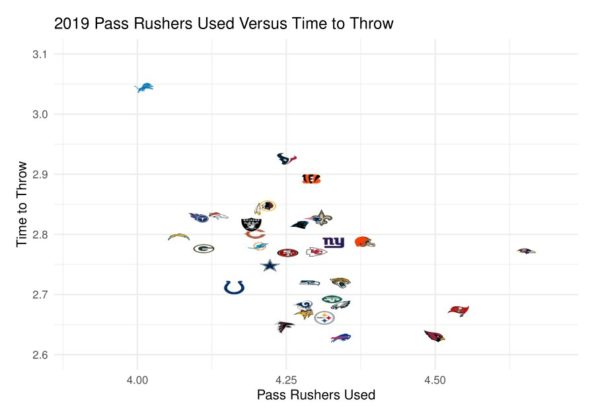
Image generated by Pro Football Focus and found at lionswire.usatoday.com
Romeo Okwara bookends the line opposite Flowers. The strong-side defensive end was extended in 2019, so he’s likely in the mix for another season. Okwara isn’t a fantasy option because he isn’t very good. He’s never finished among the top 80 edge defenders in PFF’s pass-rush productivity metric.
The Lions are searching for answers on the interior. They might have one in Da’Shawn Hand, who flashed as a rookie but lost most of 2019 to injury. He’s not a nose tackle, so he may need to earn snaps at strong-side defensive end to emerge as a core player and fantasy option. Like Leonard Williams, Hand would be a more useful IDP in a DT-premium format with a ‘DT’ position designation.
Linebackers
Two of the Lions’ four regular linebackers from 2019 are switchable. Christian Jones and Jahlani Tava’i are deployed in off-ball and edge alignments. This flexibility enables the defensive coordinator to threaten the opposition with four edge rushers on any play. Those not pursuing the quarterback set the edge or drop into coverage.
The following video shows Christian Jones coming off the edge in a blitz package. The Lions prefer to generate pressure not with sheer numbers but by disguising who’s coming.
The other two linebackers lack this position-flexibility. The team has a decision to make on the contract of off-ball linebacker Jarrad Davis for a fifth-year option, which would extend him through 2021.
The Lions cut JACK linebacker (edge defender) Devon Kennard and replaced him with former Patriot Jamie Collins. Collins is a plus athlete who excels rushing the passer as well as a linebacker that can play off the ball. Collins split time between edge and off-ball roles, finishing 2019 in New England with 81 tackles, 7 sacks, and 7 turnovers.
Collins is easily the most gifted athlete among Lions’ edge defenders, including Kennard, which could lead to a larger pass-rush role. Austin Bryant is the remaining unmentioned pass rusher on the roster, so additional free-agent signings or draft choices could be needed for depth and development.
Defensive Backs
Cory Undlin brings to Detroit successful experience masking coverages to hide weak cornerbacks. One notable wrinkle the Eagles deployed in 2019 is a “Cover-2 Invert.” To set it up, the Eagles show Cover-1 or Cover-3. Just before the snap, the cornerbacks sprint back to deep zones on each side of the field. The safeties are tasked with making plays in the typical weak points within Cover-1 and Cover-3 zone defenses.
The Lions obtained free safety Duron Harmon from the Patriots for a pick upgrade. Harmon can hold down the deep safety role (the ‘1’ in Cover-1). His addition to the roster frees other Lion’s safeties to roam closer to the line of scrimmage.
The lynchpin of the Eagles’ secondary has been strong safety Malcolm Jenkins. He’s used all over the field, contributing to his value as a solid second starting defensive back in fantasy football for several years. Tracy Walker displayed similar versatility on his way to finishing sixth among DBs in fantasy points per game. The following table analyzes Pro Football Focus data to report the proportion of defensive snaps each played in 2019.

Conclusions
Blake Martinez remains comfortably within the top-20 fantasy linebackers but expectations of another top-5 season would be misguided. He’s unlikely to achieve a third straight season of 90 solo tackles due to a decreased share of tackles per opportunity. He’ll be hard-pressed to make big plays in a defense short on talent undergoing yet another significant scheme transition. Fantasy gamers’ recollection of past success will cause them to reach for Martinez in drafts. Dynasty gamers would be wise to deal him for an LB1 plus.
Trey Flowers is an interesting buy-low candidate. He’s finished no lower than 19th in QB pressures in the last three seasons, as recorded by Pro Football Focus. That same service grades each of the defenses he’s played for in the bottom half of the NFL in pass rushing. If the Lions can find an interior pass rush, upgrade from Okwara, and get the help they need from Collins, Flowers could get home on a higher proportion of his pass rushes and improve his IDP scoring.
Tracy Walker and Jabrill Peppers finished sixth and seventh, respectively, in fantasy points per game among defensive backs. Both carry risk they won’t repeat as DB1s in 2020. A former first-round NFL pick, Peppers has more brand-name fantasy value. Walker and Julian Love are likely cheaper to obtain in fantasy leagues. The smaller investment merits the risk versus Peppers.
Switchable players often lack fantasy upside and serve as depth in conventional leagues. Wide-9 defensive ends discussed in Part One of this series on defensive schemes have high fantasy ceilings because they dedicate a high proportion of snaps pursuing quarterbacks. Other linemen have more responsibilities in run defense. The switchable linebacker will struggle to reach double-digit sacks or the 100 tackles fantasy gamers desire from their LBs.
As a Lion, Collins is a candidate to sell. IDP fantasy gamers are strongly prone to recency bias. Collins is needed more on the edge than off the ball in Detroit, meaning his tackle totals should come down. Seven turnovers is a difficult feat for any defender to repeat.
Inside/outside defensive linemen like Leonard Williams and Da’Shawn Hand could be assets in full-IDP leagues. Two interior defenders finished among the top-6 defensive linemen in 2019 fantasy points, per FantasyPros.com (Cameron Heyward and Aaron Donald). The top-scoring switchable linebacker, Patriot Jamie Collins, finished 18th.
I miss the simple application of the 4-3 Under already! It delivered the prototypical box safety, a tackling machine in the middle of the defense, and a nearly full-time pass-rush specialist on the weak edge. But like the game itself, we must adapt.
Good luck mining IDP value! Three more teams with new defensive coordinators remain to cover: the Cowboys, Rams, and Vikings.
Clemson and Michigan alum…Panthers and Cowboys fan…I try to see both sides of every debate and each trade. Find me on Twitter @DynastyTripp.

