

Welcome back for part two of this series, where I look at the wide receiver group from each draft class and see which college metrics were most predictive of their fantasy football success in the NFL thus far. In this article, we’ll discuss the 2022 wide receiver class. If you haven’t read part one, where I broke down the 2023 class, you can check that out here. My goal is to hopefully find one or two efficiency metrics that are consistently reliable year over year regarding wide receiver fantasy projection.
The independent variable in this study is NFL fantasy points per game (FPPG). We’re looking at the FPPG from their best season, and all the college season metrics I pulled were also based on their best season in that particular metric.
For this study, I pulled 20 wide receivers from this draft class. These are a combination of the top 15 dynasty WRs in the class (according to KeepTradeCut) and any wide receivers that went in the first two days of the NFL Draft. Those players include Garrett Wilson, Drake London, Chris Olave, George Pickens, Christian Watson, Romeo Doubs, Jameson Williams, Jahan Dotson, Khalil Shakir, Rashid Shaheed, Treylon Burks, Wan’Dale Robinson, Alec Pierce, John Metchie, Skyy Moore, Tyquan Thornton, Velus Jones Jr, Jalen Tolbert, David Bell, and Danny Gray.
For the 2022 WR class, I looked at the following statistics: Targets per route run (TPRR), Yards per route run (YPRR), Dominator Rating, Breakout Age, PFF Receiving Grade, Draft Capital, College FPPG, and yards per game (YPG). All the numbers I pulled were based on the prospect’s best season, with a minimum threshold of 100 routes run. So we can compare with the 2022 class, I’ve listed below how these metrics graded out in terms of predictiveness for the 2023 class.
2023 Class
Most Predictive: College FPPG, TPRR
Some Predictiveness: PFF Receiving Grade, YPG, Breakout Age
Completely Random: YPRR, Draft Capital, Dominator Rating
Now, here’s how this compared with the 2022 class:
2022 Class
Most Predictive: Breakout Age, Draft Capital, PFF Receiving Grade
Some Predictiveness: YPRR, TPRR
Completely Random: College FPPG, YPG, Dominator Rating
As you can see, the tiers differ drastically in terms of which college metrics are most predictive of NFL FPPG. While this isn’t necessarily what I hoped for, a couple of metrics were at least moderately predictive in both draft classes. Let’s look at the charts from the three most predictive college stats from this 2022 class, and then I’ll discuss lessons learned.
Breakout Age

Breakout age has been the most reliable statistic for this 2022 WR class thus far and has had some reliability with the 2023 class (though to a lesser degree). I pulled these numbers directly from playerprofiler.com.
The R^2 for Breakout Age to FPPG on this 20-player sample of the 2022 class was .264, while the R^2 with the 2023 sample was .122. As mentioned in my original article, R^2 simply shows how much a particular metric can be explained by the independent variable (in this case, rookie FPPG). The R^2 number ranges from 0-1, with 1 being 100% correlation. These numbers may seem low, but this is to be expected when comparing a single college metric to fantasy points per game. Any degree of consistent correlation is worth our attention when we’re discussing analytical profiles.
Guys like Drake London, Chris Olave, and George Pickens all had early college breakouts and have found at least some success from a fantasy perspective at the NFL level. Staying with the trend, later breakouts like Treylon Burks, Velus Jones, Jalen Tolbert, John Metchie, and Danny Gray have not found much success. There were some outliers, like David Bell (18.7 breakout age) and Tyquan Thornton (19.1), but very few.
Draft Capital
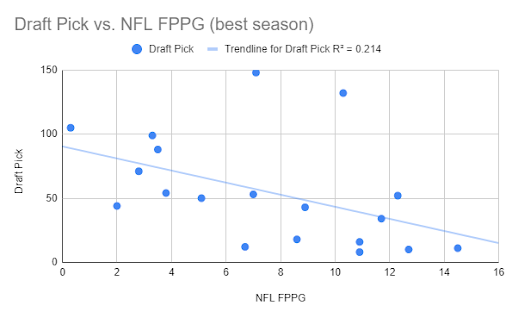
Draft Capital also had a nice correlation in this draft class. As we know, there was no correlation in the 2023 class. Guys like Puka Nacua and Tank Dell outperformed their late draft capital, while other early picks like Quentin Johnston and Jonathan Mingo faceplanted. The 2022 class, on the other hand, stayed with the status quo for the most part. There were a couple of outliers, like Romeo Doubs (4th round) and Rashid Shaheed (UDFA), who have put up some nice fantasy production early in their careers. But for the most part, the NFL’s evaluation of this class aligned closely with fantasy points per game.
PFF Receiving Grade
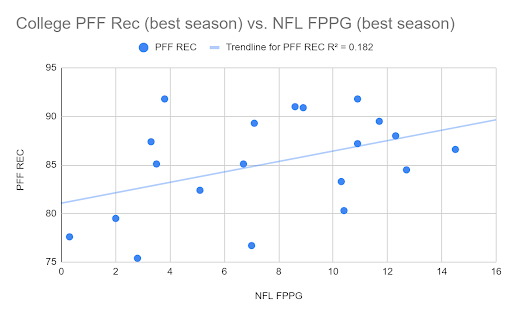
College PFF Receiving Grade came in third with an R^2 of .182, while the R^2 for the 2023 sample was .13. Not a ton of correlation, but you can see the trend there. For those that don’t know, PFF Receiving Grade is essentially a film grade given by the PFF team, putting a numerical value on a receiver’s “contribution to production” when running routes. Some swear by PFF grades, while others take it with a grain of salt. But there has been enough correlation between these two classes that I think it’s worthwhile to consider when grading our rookie prospects. While PFF certainly had its misses, it also had some nice wins. They scored Khalil Shakir highly (89.3 best season) while scoring Round 2 pick John Metchie relatively low (79.5).
Lessons Learned
I was humbled by the lack of correlation between college TPRR and NFL FPPG in this class. Targets per route run is one efficiency metric I look at first when studying these prospects, but the R^2 was just .117 in this sample (from .208 in the 2023 sample). It was less predictive than YPRR, which I find a less reliable metric in most cases. Still, there was some degree of correlation between these two statistics and FPPG, so they certainly weren’t useless. There were just more outliers, like Skyy Moore (32.89%) and David Bell (28.18%). TPRR and YPRR are useful efficiency metrics to consider, provided we are considering competition level. Moore’s 33% best season TPRR is not more impressive than Garrett Wilson’s and Chris Olave’s best season of 28%+.
Another lesson I learned is that I don’t plan to put any stock in dominator rating moving forward unless presented with new information in favor of the metric that I haven’t considered. In the same vein as TPRR and YPRR (and really any efficiency metric), competition must be considered. Guys like Jalen Tolbert can finish with a dominator rating over 50% at South Alabama, but we need to discount this number based on the schedule he played and the guys he competed for targets against. The question is how much we discount the production of these Non-Power 5 players. This is when film study comes into play to help determine who truly has what it takes.
College FPPG’s lack of correlation to NFL FPPG surprised me, as it was the most predictive of my 2023 sample. Guys like George Pickens and Christian Watson averaged about 15 PPG in college, while others like David Bell, Jalen Tolbert, Skyy Moore, and Treylon Burks averaged well over 20. Some massive outliers really skewed the numbers in this statistic, but I have to think it’s typically one of the more reliable metrics to consider.
Thank you for taking the time to read this article, and I hope you got some valuable information you can use for your fantasy team! If you’d like additional insight into Dynasty Football news and analysis, please follow me on Twitter at @jim_DFF. Until next time, keep grinding out there, DFF family! #DFFArmy #AlwaysBeBuilding
