
In late February and early March, I published a pair of articles about my early redraft Round 1 and Round 2 rankings. In this piece, I’m going to take a quick look at the top 24 now and compare it to then. If you want to find my full rankings, they are updated continuously and can be found here under the redraft tab. These rankings assume a 1QB, PPR format where there is an equal number of running back and wide receiver starters. The tiers divide players by their position to provide the best possible context for my rankings. I’ll cover the top 13 players in this piece, and I’ll put out a part 2 shortly covering the final 11 players as well as the two who fell out of the top 24.
| Current Rank | Previous Rank | Change | Player | Team/Position | Tier By Position |
| 1 | 1 | 0 | Christian McCaffrey | RB – CAR | Tier 1 – RB |
| 2 | 2 | 0 | Saquon Barkley | RB – NYG | Tier 2 – RB |
| 3 | 3 | 0 | Ezekiel Elliott | RB – DAL | Tier 2 – RB |
| 4 | 4 | 0 | Alvin Kamara | RB – NO | Tier 2 – RB |
| 5 | 5 | 0 | Dalvin Cook | RB – MIN | Tier 2 – RB |
| 6 | 6 | 0 | Michael Thomas | WR – NO | Tier 1 – WR |
| 7 | 10 | +3 | Davante Adams | WR – GBP | Tier 2 – WR |
| 8 | 13 | +5 | Julio Jones | WR – ATL | Tier 2 – WR |
| 9 | 9 | 0 | DeAndre Hopkins | WR – ARZ | Tier 2 – WR |
| 10 | 17 | +7 | Travis Kelce | TE – KC | Tier 1 – TE |
| 11 | 11 | 0 | Derrick Henry | RB – TEN | Tier 3 – RB |
| 12 | 8 | -4 | Nick Chubb | RB – CLE | Tier 3 – RB |
| 13 | 7 | -6 | Joe Mixon | RB – CIN | Tier 3 – RB |
| 14 | 14 | 0 | Tyreek Hill | WR – KC | Tier 3 – WR |
| 15 | 21 | +6 | George Kittle | TE – SF | Tier 1 – TE |
| 16 | 19 | +3 | Chris Godwin | WR – TB | Tier 3 – WR |
| 17 | 28 | +11 | Kenyan Drake | RB – ARI | Tier 4 – RB |
| 18 | 20 | +2 | Austin Ekeler | RB – LAC | Tier 4 – RB |
| 19 | 23 | +4 | Kenny Golladay | WR – DET | Tier 4 – WR |
| 20 | 16 | -4 | Josh Jacobs | RB – LV | Tier 4 – RB |
| 21 | 22 | +1 | Odell Beckham | WR – CLE | Tier 4 – WR |
| 22 | N/A | N/A | Clyde Edwards-Helaire | RB – KC | Tier 4 – RB |
| 23 | 18 | -5 | Mike Evans | WR – TB | Tier 4 – WR |
| 24 | 12 | -12 | Aaron Jones | RB – GB | Tier 4 – RB |
The Top Six
The top six players remain entirely unchanged from my previous article even though some of them had significant changes to their situation. Christian McCaffrey is still the clear 1.01 in my redraft rankings. The Panthers decided to move on from quarterbacks Cam Newton and Kyle Allen and to sign Teddy Bridgewater in free agency. They also signed deep threat Robby Anderson to a 2-year, $20 million contract. McCaffrey also received a massive contract extension, further cementing him as the 1.01 in redraft formats.
Saquon Barkley has a new backup in Dion Lewis, and the Giants drafted offensive tackle Andrew Thomas with the fourth overall pick. Neither move affects his stock much, although improved offensive line play can only help him. He’s still my pick at 1.02.
Elliott remains my choice at the 1.03 slot. The Cowboys drafted CeeDee Lamb in the first round, which could open up boxes for Elliott. However, adding another receiving weapon will likely reduce Elliott’s target volume, so I consider that move to be a wash for him. Elliott has taken over 300 carries in his three seasons where he played 15 or more games. Also, he has only missed two games due to injury in his career, having missed six games in 2017 due to suspension. He’s as safe of a top-5 pick as you can find.
Alvin Kamara slots in at 1.04 in my rankings. The Saints drafted Cesar Ruiz in the first round, adding a new interior defensive lineman. They also didn’t draft a running back or sign one in free agency, ensuring that they will once again go into 2020 with Alvin Kamara and Latavius Murray in the backfield. While they did sign Emmanuel Sanders in free agency, I don’t project that signing to reduce Kamara’s target volume significantly. Kamara has put up precisely 81 receptions in each of his first three seasons, so in PPR formats, he’s another safe choice at the top of drafts.
Dalvin Cook remains 1.05 for me. The Vikings traded away star receiver Stefon Diggs, further demonstrating their commitment to deploying a run-first offense. Cook hasn’t received a contract extension yet, but I fully expect the Vikings to get a deal done before the season begins. The Vikings replaced Diggs with rookie Justin Jefferson in the first round, but again I don’t think that will have much of an impact on Cook. If anything, they could use Cook in the passing game a bit more. Like the rest of the running backs, I didn’t move Cook in my rankings since my last pair of articles.
Finally, Michael Thomas is still 1.06. I have to draft the five star running backs ahead of him in drafts, as the running back pool dries up far faster than the wide receivers as fantasy drafts move into the middle and later rounds. Thomas broke the NFL receptions record with 149 in 2019, and he did that despite playing five games with Teddy Bridgewater as his quarterback. The Saints signed Jameis Winston in free agency to back up Drew Brees, and Winston supported two WR1s in 2019 in Chris Godwin and Mike Evans. I’m fully confident in Thomas for 2020.
Tier 2 WRs and Kelce
In this group, I started with Davante Adams. Since the Packers failed to add any significant wide receivers in free agency or the 2020 NFL Draft, Adams will continue to be a target monster. He still has Aaron Rodgers as his quarterback and comes with the highest floor of any WR in fantasy outside of Michael Thomas. He did miss four games in 2019 with turf toe, but I don’t expect that injury to be a long-term concern. Adams had a 16-game pace of 111 receptions and 1,329 yards in 2019 and will likely score more than five touchdowns. He’s the clear WR2 overall for me.
Julio Jones comes in at the eighth slot. The Falcons lost Austin Hooper to free agency but acquired Hayden Hurst in a trade from the Ravens. I think that Hurst will have slightly fewer targets than Hooper did since he’s joining a new offense. While new running back Todd Gurley should receive a few more targets than the previous starter Devonta Freeman, I don’t see any reason to downgrade Jones based on the running back position. While I’ve moved Jones up five spots, it’s more based on some changes to other players and less based on his situation. My projections and expectations for Jones have not changed since my previous article.
DeAndre Hopkins remains ninth overall in my rankings but has gone from my WR2 overall down to my WR4 now. Unlike the previous two players, Hopkins now plays for a completely different team and is in a new situation. The Texans traded Hopkins to the Cardinals, pairing him with Kyler Murray. In Arizona, Hopkins will be the clear number one target on the team, with Christian Kirk and Larry Fitzgerald sharing the WR2 and WR3 roles behind him. Since Hopkins did change teams, I moved him behind Jones and Adams in my rankings, as receivers on a new team with a new quarterback can have a bit of trouble adjusting. However, Hopkins is one of the best receivers in the NFL, so I still feel comfortable with him as a first-round redraft selection.
Finally, I’ve decided to move Travis Kelce up to 10th overall in my rankings. This change comes from two factors. First, I believe that having a top tight end is an advantage in redraft formats that you cannot make up at other positions. Kelce scored 256.3 PPR points in 2019, more than double the TE13, Greg Olsen. If you want to take a full look at how tough it is to stream tight end, you can read my look back at 2019 tight end streaming article. Therefore, there is simply no way to replace Kelce’s high-end production later in drafts. He has finished as the TE1 for four straight seasons and is extremely safe. Also, despite playing with Patrick Mahomes, Kelce only scored five touchdowns in 2019, so he has room to perform even better in 2020. I will likely be starting many of my redraft teams with Kelce if I have one of the final picks in the first round.
Tier 3 RBs
Derrick Henry is the 11th player in my rankings. At this point, I’ve finally come around to the idea that I have to rank Henry as a solid RB1 and as a first-round redraft pick, even in PPR formats. The Titans assigned the franchise tag to Henry and are reportedly planning to negotiate a contract extension with him. After paying a massive deal to Ryan Tannehill, the Titans are in win-now mode and should lock up Henry. Even if they don’t, Henry already signed his franchise tender, so he is unlikely to hold out in 2020. The Titans drafted Isaiah Wilson in the first round to replace outgoing right tackle Jack Conklin and drafted Darrynton Evans in the third round to take on the Dion Lewis role. I expect Henry to repeat his 2019 success, as the Titans have made virtually no changes to their offensive scheme.
Nick Chubb comes in at 12th overall and as my RB7. Since my last article, the Browns have made some significant changes to their offense. First, they formally re-signed Kareem Hunt, so Chubb and Hunt will split carries once again in 2020. However, even with Hunt in the backfield, Chubb’s 16-game pace was still 1,382 rushing yards. While he lost passing game work to Hunt, Chubb will remain an absolute workhorse on the ground. The Browns also brought in Jack Conklin from the Titans to play right tackle and drafted Jedrick Wills in the first round as their new left tackle. They also signed tight end Austin Hooper in free agency, who is a far superior run blocker to the previous starter David Njoku. I expect Chubb to improve as a runner in 2020, especially considering he scored only eight rushing touchdowns on 298 carries.
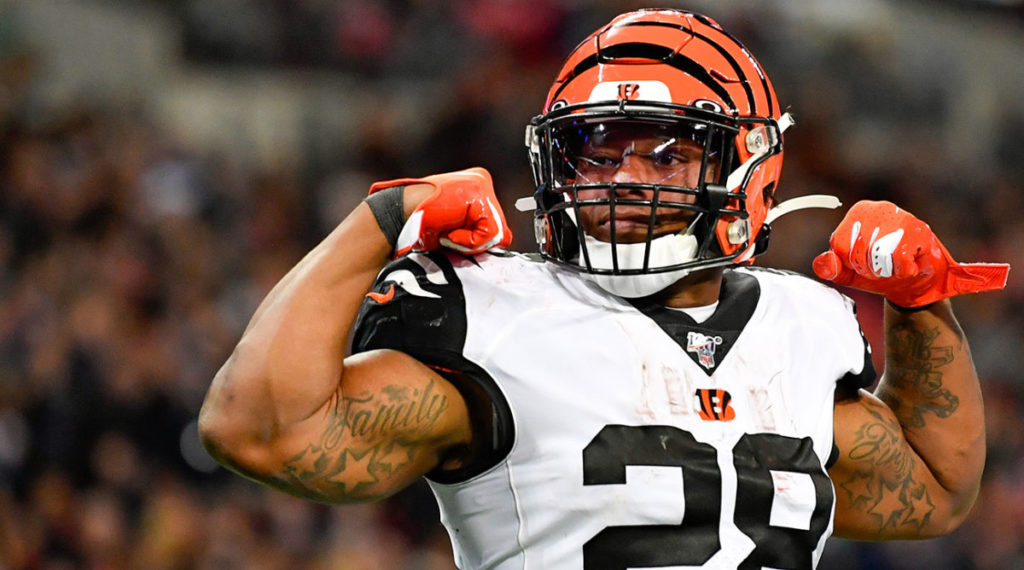
Joe Mixon rounds out this tier of running backs at 13th overall and RB8. As expected in my previous article, the Bengals selected quarterback Joe Burrow with the first overall pick, so Mixon will play with a new quarterback in 2020. Burrow used running back Clyde Edwards-Helaire heavily in the passing game at LSU, with Edwards-Helaire’s 55 receptions in 2019 exceeding any mark Mixon has put up in the NFL. Therefore, Mixon has the upside to be the RB1 overall and is worthy of this draft spot. However, unlike some of the other running backs mentioned, Mixon represents a serious threat to hold out. He was a second-round pick and hasn’t received any big money so far in his career. His contract expires after 2020, and I’m not 100% confident that Mixon and the Bengals will reach a long-term deal. Therefore, I’ve dropped Mixon in my rankings. If he receives a sizable contract, I’d raise him above Henry and Chubb, and have him as a clear first-round redraft pick.
Thanks for reading this article. You can find me on Twitter at @DFF_Karp. I love to interact with anyone in the community, so reach out at any time! I take fantasy questions and help with all formats, so keep sending those questions my way.

