
It’s start-up season! Fantasy gamers are setting their draft boards and hunting player lists from fantasy advice sites for average draft position (ADP) and expert ranks.
Sage advice on fantasy twitter is to avoid running backs that might be overtaken on the depth chart by rookies. Plenty of veterans are deemed “sells” in the community, particularly as we watch 2018’s elite backs face unemployment this March. Start-up drafters, however, must grapple with just how far they let “sells” slide down the fantasy draft board.
While we fantasy gamers rub our hands together in anticipation of a loaded class of prospects, let’s contemplate the whole picture of the draft goals of each team. Equally important, do these teams have the draft picks necessary to bring in impact players to immediately push incumbents?
Wide receivers, meanwhile, seem immune to this worry. Not a day passes on Twitter without an analyst promoting a profile piece of an interesting wide receiver. Concerns of an incumbent taking a back seat to a rookie appear readily dismissed. Corey Davis, Dante Pettis, and (arguably) Tyler Lockett likely enter 2020 as second fiddle on their respective teams.
Not every draft pick is created equal, of course. Mike Tagliere, the accomplished analyst from FantasyPros.com discusses here that few rookies chosen after the NFL’s third round make an impact. Tagliere allows that useful committee backs occasionally arise from the fourth. Expert draft analyst Daniel Jeremiah identifies 27 wide receivers worthy of Round-3 picks. His peer, Mel Kiper, Jr., predicts that teams will choose 25 of them by the middle of Round 4.
These observations leave us with a simple question to consider. How many picks does each team have to spend on a potentially impactful running back or wide receiver? I have constructed two tables, one for each position. We’ll look at nine running backs generally losing value and six wide receivers fantasy owners are targeting in start-ups and trades. Each table reports a player with his team, the number of picks that team owns to bring in the player’s competition or replacement, and the team’s needs by position. Needs are those observed by The Draft Network.
The players are sorted by the latest average draft position (ADP) from FantasyFootballCalculator.com. That site reports from drafts beginning in February. Mock league settings for this exercise are twelve teams, one QB, no IDP, and half-PPR.
Faded Running Backs
| ADP | Team | RB | Picks | Primary Needs | Secondary Needs |
| 21 | Titans | Derrick Henry | 3 | EDGE, IDL, OT | CB, TE, IOL |
| 41 | Bears | David Montgomery | 2 | IOL, CB, S | OT, QB, WR, EDGE |
| 44 | Steelers | James Conner | 2** | IDL, IOL | QB, OT, EDGE, RB |
| 47 | Bills | Devin Singletary | 2* | CB, EDGE | RB, WR |
| 67 | Cardinals | Kenyan Drake | 2 1** | OT, EDGE, LB | WR, TE, IOL, IDL |
| 70 | Redskins | Derrius Guice | 2 1** | EDGE | OT, IOL, TE, CB, WR, RB |
| 112 | Chiefs | Damien Williams | 3 | CB, IOL, RB | LB, EDGE, IDL |
| 118 | Saints | Latavius Murray | 2* | LB, CB, WR | QB, IOL |
| n/a | Chargers | Justin Jackson | 3 2* | QB, OT, CB | IOL, WR, LB, RB |
| *
2 |
Represents 4th-round pick
See text for explanation |
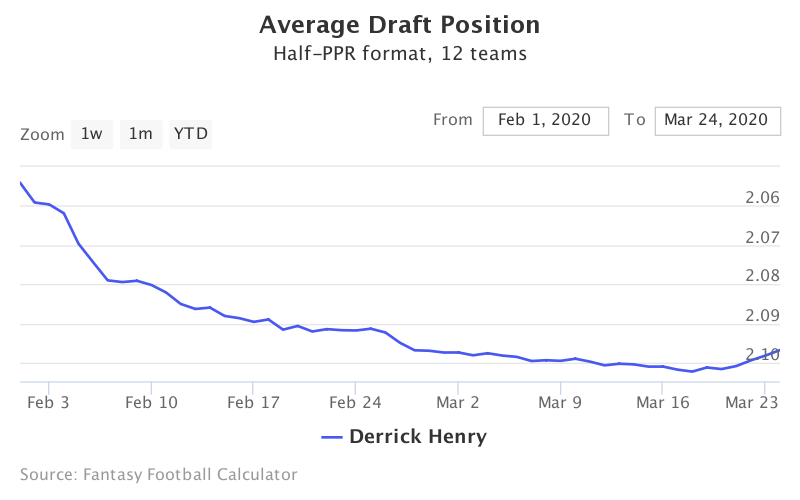
21) Derrick Henry, RB, Tennessee Titans
The titanic running back sits twelfth among his peers at the bottom of a tier. A point of conventional wisdom is that the Titans will replace Dion Lewis with a satellite back who will eat into Derrick Henry’s touches. Henry’s ADP faded as free agency arose on the calendar.
My purpose in this article is not to tell you this won’t happen or even that it shouldn’t. What I know is that Lewis didn’t affect Henry in 2019. As of this writing, Lewis has been released but not replaced. The Titans have three picks in the first four rounds of next month’s NFL draft and plenty of needs to fill outside the running-back room.
41) David Montgomery, RB, Chicago Bears
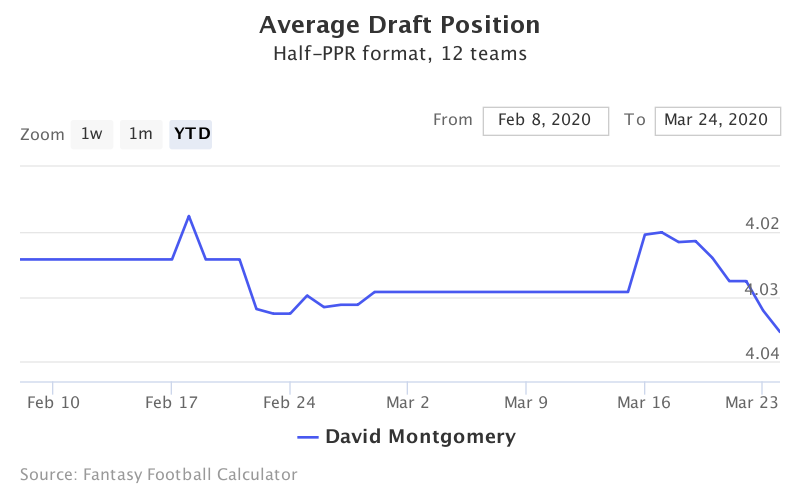
The fantasy football community loves to hate the Bears’ rising sophomore. His ADP faded during the first wave of free agency even though the Bears didn’t sign a running back. Deserving or not, David Montgomery appears likely to return as the primary back in 2020. The Bears have only two picks in the first four rounds.
44) James Conner, RB, Pittsburgh Steelers and 47) Devin Singletary, RB, Buffalo Bills
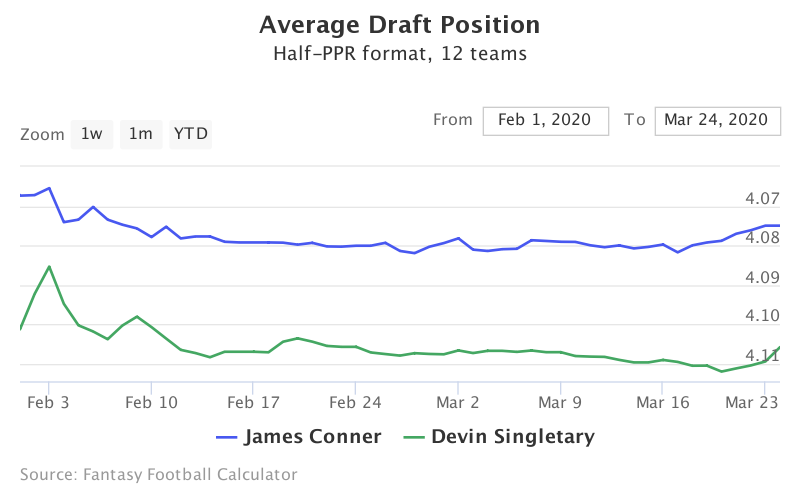
These two ball carriers seem to attract the most skepticism in the community over fears they’ll have company soon. A report surfaced that the Bills tried to sign new Broncos RB Melvin Gordon, but ESPN’s Adam Schefter authoritatively refuted it. After dealing away a package of picks for WR Stefon Diggs, the Bills have three picks remaining in the first four rounds of this month’s NFL Draft. Devin Singletary’s only new company to date in the RB room is free-agent signee Taiwan Jones. Given the number of picks they hold, the Bills might as readily draft a depth piece rather than a primary back.
The Steelers have drafted a complementary running back in each of the two years since selecting James Conner. Both received playing time in relief of Conner and remain on the roster going into 2020. The Steelers have two picks in the first three rounds of the 2020 draft plus two fourth-rounders.
Steelers beat writer Ed Bouchette recently said he “fully expects” the team to use a pick on a running back. Analyzing that report, Adam Patrick of StillCurtain.com writes as follows:
If the Steelers are hoping to add an immediate upgrade to their offensive backfield this year, it’s likely going to have to be done with one of their first two selections. Pittsburgh also only has six picks this year and their first selection doesn’t come until midway through the second round, so they will have to make the most of their lack of options.
67) Kenyan Drake, RB, Arizona Cardinals and 70) Derrius Guice, RB, Washington Redskins
The 2020 class features 3-4 elite defenders, 3-4 elite offensive tackles, and 3-4 premium quarterback prospects. These players will occupy the first ten picks. The Cardinals and Redskins own two of these and won’t use them on RBs. Each team has only one other pick in the first three rounds of the draft. Each team also owns two picks in the fourth round that could be used on a complementary back. (For this reason, their picks totals are represented as so: “2 1**.”)
Both Kenyan Drake and Derrius Guice have three-down potential for 2020. Drake dominated touches after arriving in Arizona midseason. Redskins offensive coordinator Scott Turner, like his father Norv before him, relied on one back in Carolina last year. While Guice has much to prove before a comparison to the Panthers’ Christian McCaffrey, competition for passing down snaps currently on the roster is limited.
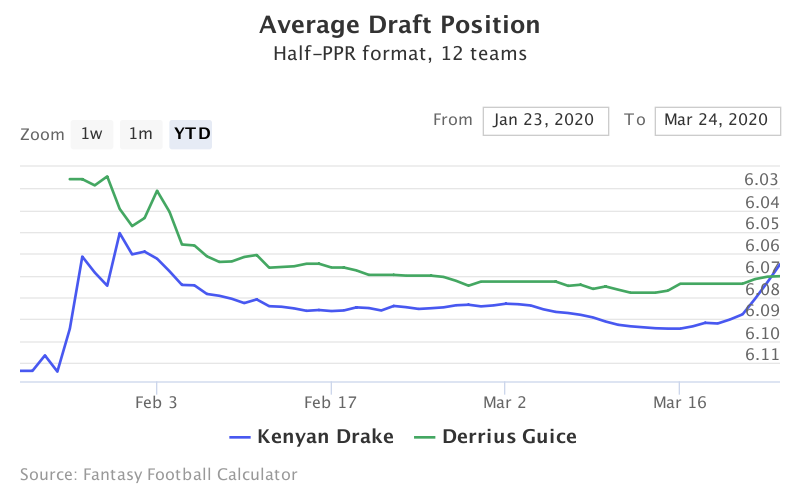
The risk of their teams adding complementary backs seems fully baked into their current ADPs. Drake’s ADP has risen since the trade of RB David Johnson to Houston, but he remains well below other committee backs like Marlon Mack and Austin Ekeler. Both the Cardinals and Redskins have multiple holes to fill on rosters that struggled to compete in 2019. An investment in spite of the negative assumption stands only to gain value or remain level.
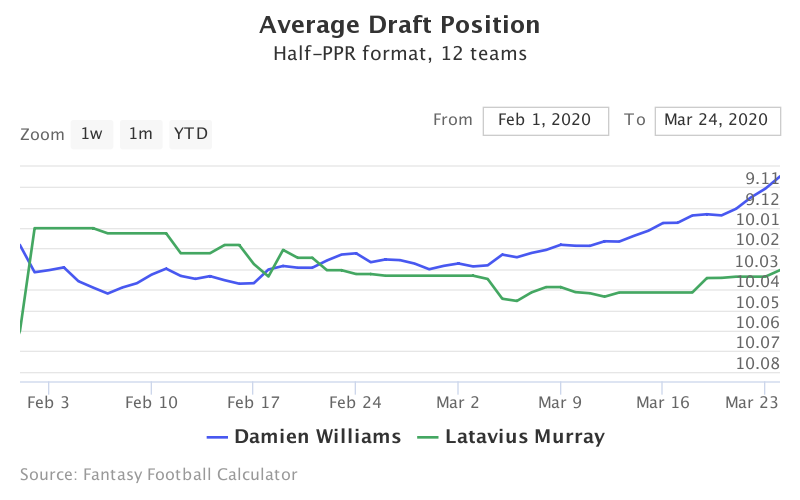
112) Damien Williams, RB, Kansas City Chiefs and 118) Latavius Murray, RB, New Orleans Saints
The Chiefs might very well draft a premium prospect at the running back position and create a big splash for fantasy football. That risk to Damien Williams’s fantasy value is baked in as a full-blown assumption. Like the Saints’ Latavius Murray, Williams’s roster spot is under no threat. In the scenario implied by ADP, both players are top-notch handcuffs with limited stand-alone value. Each team has only three picks in the draft’s first four rounds to upgrade from them. It remains to be seen if the Chiefs invest in a player to push Williams into handcuff status.
Justin Jackson, RB, Los Angeles Chargers
The Chargers’ second running back doesn’t even have an ADP. His injury-plagued 2019 caused him to be forgotten by most fantasy managers. Justin Jackson enjoyed a significant role in games Melvin Gordon missed in 2018. Fantasy darling Austin Ekeler was only leaned upon as a bell cow in games that both Gordon and Jackson missed. The Chargers have one pick in each of the first four rounds to upgrade from Jackson. Their first pick, number 6 overall, seems almost certainly a quarterback or an offensive tackle.
Glowing Wide Receivers
| ADP | Team | WR | Picks | Primary Needs | Secondary Needs |
| 17 | Lions | Kenny Golladay | 4* | CB, IDL, EDGE | IOL, S, WR, LB |
| 22 | Broncos | Courtland Sutton | 5* | WR, CB, OT | IOL, LB, IDL, WR |
| 34 | Vikings | Adam Thielen | 5 | CB, WR, EDGE | IOL, IDL, OT, CB, S, IOL |
| 40 | Jaguars | DJ Chark | 4* | IDL, CB, S | QB, WR, EDGE, IDL, IOL, LB |
| 77 | Ravens | Marquise Brown | 5 | LB, IOL | WR, EDGE, RB |
| 135 | Dolphins | Preston Williams | 6 | QB, OT, IOL, S | EDGE, RB, OT, IOL, WR |
| * | Represents NFL picks 4.01-4.16 |
Several sought-after wide receivers play for teams with an unusually high number of picks. Each of these teams simply has more opportunities to add to their wide receiver corps.
The purpose of this article is not to address the quality of the players listed as fantasy assets. Instead, this piece notes the numerically higher risk of competition for their current roles. In that way, the wide receivers’ table stands in juxtaposition to that for running backs. The subject running backs of this article are numerically less likely to lose roles.
The table indicates the number of picks each team has to add fantasy-relevant players, as studied by Mike Tagliere. An asterisk is added to acknowledge the aforementioned draft experts’ belief that the supply of quality receivers should outlast the draft’s first two days and slide into the top half of the fourth round.
If RBs Damien Williams and Justin Jackson have lost most or all of their value due to projected additions to the position groups on their teams, why not wide receivers? It’s practically a forgone conclusion that the Broncos and Vikings will each add a receiver with an early pick to pair with Courtland Sutton and Adam Thielen, respectively. The risk that CeeDee Lamb or Jerry Jeudy takes over like AJ Brown did in Tennessee last year is not non-existent.
The Lions and Jaguars don’t seem as likely to use their highest picks on wide receivers, but that isn’t certain either. The Ravens and Dolphins have ample ammunition to add to their wide receiver corps. Additions could push Marquise “Hollywood” Brown and Preston Williams down the pecking order for targets. (DeVante Parker’s ADP of 86th reflects the risk that he mightn’t be the Dolphins’ WR1 going forward.)
Conclusions
The NFL’s “lying season” is upon us! All 32 teams are coy about their intentions for the draft. This year, we have no more pro days or Top-30 Visits in which teams tip their hands. The narrative surrounding these RB “sells” is that their NFL teams will draft their replacements late in April. Why should we be so sure?
Fantasy value arises at the intersection of talent, situation, and opportunity. Let’s not jump to conclusions about what these 15 players’ situations will be in six months based on what we think might happen in the NFL Draft. Let’s instead appreciate the levels of risk accompanying each player as a fantasy asset and ensure we’ve discounted our investments appropriately.
Thanks for reading and good luck in those start-up drafts!
Clemson and Michigan alum…Panthers and Cowboys fan…I try to see both sides of every debate and each trade. Find me on Twitter @DynastyTripp.

