
A rookie rewind is a way of gauging the value change of rookies from pre-season to post-season. It not only discusses the value change but also examines why the value changed. All of the quarterback value data comes from KeepTradeCut, as it crowdsources information in real-time. Many of the statistics are sourced from ProFootballFocus (PFF).
Definition list:
- Quarterback Rating (QBR) – a metric that gauges overall QB success
- PFF’s Average Depth of Target (ADoT) – how far the QB was attempting to throw the ball
- PFF’s Adjusted Completion Percentage – the percentage of aimed passes thrown on target ((Completions + Drops) / (Attempts – Throw Aways – Spikes – Batted Passes – Hit As Thrown))
- PFF’s Big-Time-Throw Percentage (BTT%) – the percentage of passes where the quarterback throws a “pass with excellent ball location and timing, generally thrown further down the field and/or into a tighter window” (Monson and Pallazzo)
- PFF’s Turnover-Worthy-Play Percentage (TWP%) – the percentage of passes where the quarterback throws “a pass that has a high percentage chance to be intercepted or do a poor job of taking care of the ball and fumbling” (Monson and Pallazzo)
Pre-Season Ranks
While there were a couple of polarizing quarterback prospects in the 2023 NFL Draft Class, the Top 4 consensus prospects were Bryce Young (QB – CAR), C.J. Stroud (QB – HOU), Anthony Richardson (QB – IND), and Will Levis (QB – TEN). Their QB value data is from September 7th, the opening day of the regular season. Going into this season, I had them ranked:
- Anthony Richardson (QB9)
- C.J. Stroud (QB12)
- Bryce Young (QB10)
- Will Levis (QB29)
Pre-Season Overview
C.J. Stroud was in a rough situation in Houston, with the Texans having little other talent besides left tackle Laremy Tunsil (LT – HOU). I believed there would be few receiving weapons to help him in the 2023 NFL Season, only having running back Dameon Pierce (RB – HOU) to open the field for him.
Anthony Richardson had one of the best-supporting casts of the four rookie QBs. He had an excellent offensive line and Michael Pittman Jr. (WR – IND) as a receiving weapon. There were still questions about running back Jonathan Taylor’s (RB – IND) future with the Colts, but he was supposed to either be traded for a useful player to help Richardson’s development or be that player himself, assisting in the Colts’ run game.
Bryce Young was walking into one of the worst systems in the NFL, as the Panthers had no established run game or solid receiving options, and the offensive line was one of the worst in the league. However, many regarded the new coaching staff as potentially one of the best in the league.
Will Levis was the backup quarterback to Ryan Tannehill, so the expectation did not include Levis to see much of the field this year. He had two solid receivers in DeAndre Hopkins (WR – TEN) and Treylon Burks. He also had one of the league’s best running backs Derrick Henry (RB – TEN).
Current Outlook
(The dropbacks threshold for PFF stats is 98+, so all four QBs qualify; a total of 45 QBs qualify)
Anthony Richardson got hurt early in the year and only played four games. Across those four games, his QBR was 44.7. His ADoT was eight and ranked 24th. He had an adjusted completion percentage of 71.1%, which ranks 38th. His BTT% was 3.3%, ranking 28th. Finally, his TWP% was 3.7%, ranking 32nd lowest.
During the four games he played, Richardson flashed elite traits similar to what showed up on his collegiate tape. He showed a tremendous deep ball and looked dynamic in and out of the pocket. The big issue was Richardson putting his body on the line too much, the reason he got injured in the first place. Richardon’s cause for concern is comparable to Josh Allen’s (QB – BUF), where they are willing to fight through contact instead of sliding.
Richardson must get healthy and stay healthy to become a consistent fantasy contributor. He is currently going in the second round of Superflex startups and his KTC value reflects this as the QB8.
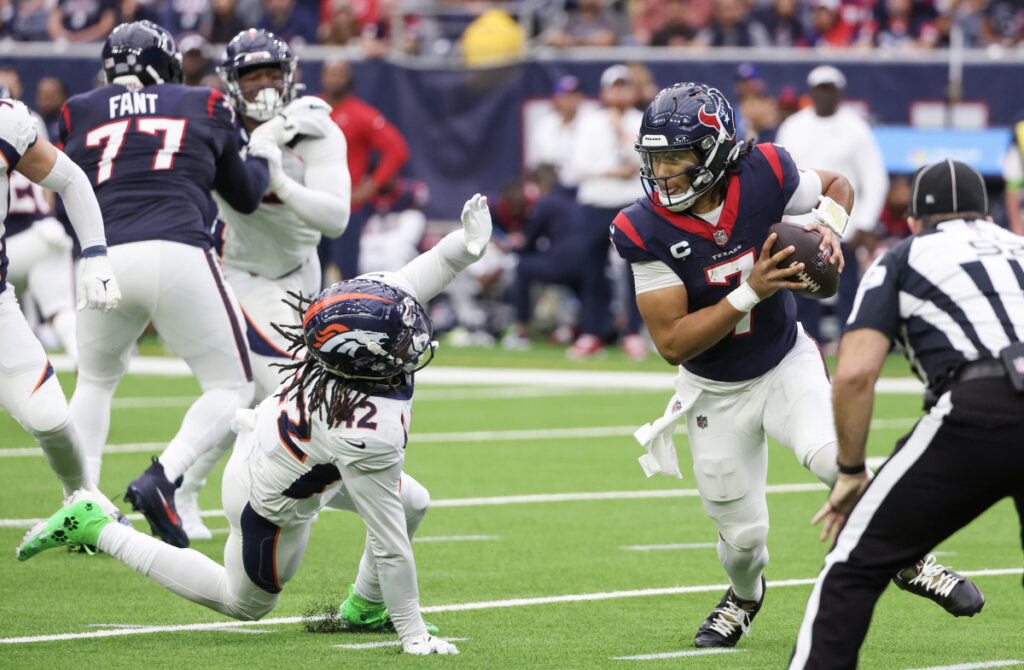
C.J. Stroud has taken the league by storm. He is currently the runaway favorite for Offensive Rookie of the Year; many people have even included him in the MVP discussion. He has had one of the best rookie quarterback seasons ever. He has the 2nd most passing yards in the league, only behind Tua Tagovailoa, with 3,631 yards. However, he only ranks 27th in adjusted completion percentage at 73.1%, and his QBR is 54.9. Stroud is 3rd in ADoT with 9.7. In BTT%, Stroud ranks 19th, with a percentage of 4.2%. In TWP%, Stroud ranks 23rd lowest, with 3.2%.
When I watch Stroud play, the best skills I see are throwing with elite timing and accuracy. Most NFL personalities say that attacking the middle/intermediate area of the field is most important. Stroud dominates this area, especially with digs, posts, and crossers. Stroud plays with a lot of poise and stands in the pocket nicely. The big flaw in his collegiate profile that many saw, myself included, was his inability to play out of structure. While Stroud has not looked like one of the best QBs in the league in this area, he silenced the questions about this area of his game.
Stroud is a cornerstone piece of your dynasty rosters. He typically goes in the first round of Superflex startups, and KTC has him as the Dynasty QB4.
What most analysts said about Bryce Young before this season, such as the fact that he was a high-floor prospect who would elevate his team, is untrue. Young has struggled a lot this year, with an adjusted completion percentage of 71.8%, which ranks 34th, and a QBR of 31.9. His ADoT is 7.6, ranking 34th, his BTT% is 2.8%, 36th, and his TWP% is 3.6%, 30th lowest. Is it his talent, the system, or the supporting cast letting Young down?
The issue is a mix of all three. On Young’s collegiate tape, he never had the strongest arm and never looked elite throwing downfield or outside the numbers. However, he was pretty strong throwing into the intermediate level and between the numbers. He has also shown off his ability to play out of structure. The other big flaw with Young was his height, standing at only 5’10”. This causes Young to sometimes look uncomfortable throwing over the middle because he cannot fully see over his offensive linemen. Young has one of the worst offensive systems in a long time. Most of his receivers’ routes are static, meaning they get to a spot and stay there. Most of the time, they are running curl routes. His receivers are pretty slow, making it hard to get rid of the ball behind his struggling offensive line.
Now, where does Young project for fantasy? He was the first overall pick, so he has the Panthers’ executives tied to him. Young has had some nice moments, like when he played great against the Houston Texans. Currently, he is going in the sixth to seventh round of startups, and KTC has him as the Dynasty QB17.
After Ryan Tannehill got hurt in week six against the Ravens, Will Levis took the starting job and held onto it after Tannehill recovered. Levis has an adjusted completion percentage of 69.4%, ranking 41st. His ADoT is first at 11.0. Levis has a BTT% of 5.7% and a TWP% of 4%, which rank 9th and 34th, respectively.
Levis has had very high-level and very low-level moments, which is reflected in his Big-Time-Throw Percentage and Turnover-Worthy-Play Percentage. He has an excellent deep ball, but the placement could be much better. In the short to intermediate area, he has been horrible. He is out-performing many community year-one expectations. There were some questions about his drive, but he silenced those doubts. He has played tough, and the play that encapsulates Levis’ toughness and resilience was when he threw an interception against the Colts in week 13 and forced the fumble to get the ball back. When a team has a QB play like Levis who’s not scared of risk, they typically have to forget the mistakes in previous plays, but you can tell he moves on moments after.
Levis is an inconsistent player who needs more time to develop before I crown him a good long-term Dynasty asset. He is in the seventh round in Superflex startups, and KTC lists him as Dynasty QB19.
Summary
C.J. Stroud is my top quarterback in this class and he cemented that with this excellent rookie season. I then have Richardson second, mostly staying the same compared to my preseason rankings because we only saw four games. Finally, I have Levis at three and Young at four. They are back-to-back in my overall ranks. I favor Levis due to the higher ceiling.
Thank you for reading this article. It means a lot to me! If you’re interested in more Devy, Dynasty Fantasy Football, and NFL Draft content, check out my Twitter/X, @Justin_Massie_ #DFFArmy #DynastyFootball
Bibliography
Monson, Sam and Pallazzo, Steve. 2018. “PFF Grading: The most effective quarterback evaluation method out there.” PFF, January 10. https://www.pff.com/news/pro-pff-qb-grading-most-effective-tool-there-is.

