
Introduction
Whether the running back position “matters” in football can be debated, and likely will continue to be debated as analytics become more commonplace. However, it cannot be argued that running backs are ultimately the lifeblood of a fantasy football roster. In this segment, we will be looking at the hit rate of rookie running backs based on the inputs of draft capital, and age.
Using DLF’s trade finder tool we will look at the market value of some of the top running backs in the league. For this exercise, to stay uniform with the quarterback segment, we are using values based on superflex leagues.
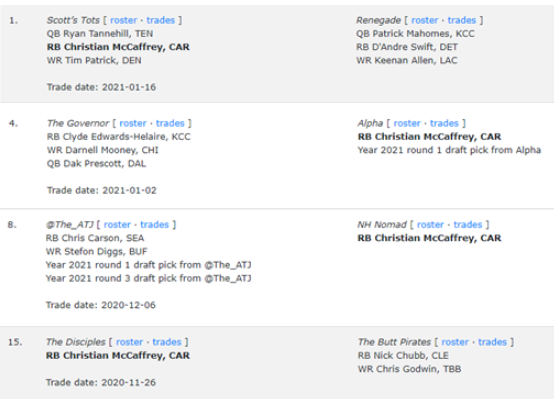
Christian McCaffrey
Alvin Kamara
Saquon Barkley
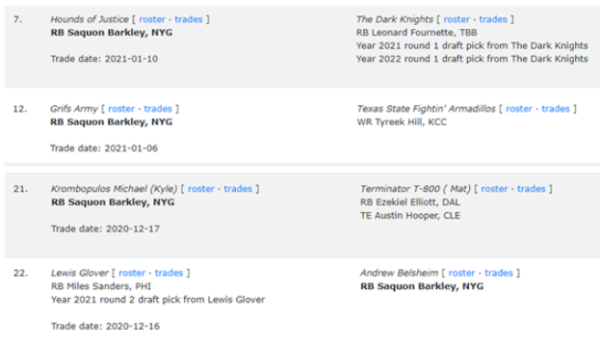
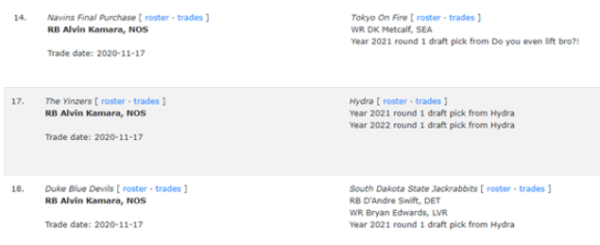
As you can see, to trade for a player like McCaffrey, you need to give up a very good running back and a very good wide receiver. You may even have to trade a top quarterback like Mahomes. Alvin Kamara does not have clarity at the quarterback position on the Saints. You will still need to trade a first-round pick, along with a very valuable asset like D.K. Metcalf or D’Andre Swift. Saquon Barkley missed nearly the entire 2020 season. He still requires a top-end talent or multiple valuable rookie draft picks along with another valuable asset like Miles Sanders or Ezekiel Elliott.
The lowest investment that you will make on acquiring a running back thus is during your offseason rookie drafts. Making it incredibly important to hit at the position with those picks. This is true even more so than quarterbacks because the running back position does not hold the positional value that quarterback does in real football.
The 2021 running back class includes the ACC all-time rushing leader Travis Etienne, and Najee Harris who was a Heisman finalist this year. The 2021 running back class is not very deep after those two, with players like Javonte Williams, Chuba Hubbard, Jermar Jefferson, and Kenneth Gainwell. These players’ market value will be heavily based on their draft capital and landing spot, unlike Etienne and Harris who have the potential to be landing spot resistant.
Historically, running back selected in the first round of the NFL Draft have a nice hit rate of 69% when it comes to fantasy football success. Etienne and Harris are the two backs with the highest likelihood of being first-round picks.
Running Back Hit Rate
For this exercise, I determined success to equate to averaging around 100 fantasy points per season while maintaining success across multiple seasons in the league and used records dating back to the 1980 draft class. This hit rate is much more subjective than the quarterbacks for a multitude of reasons. Mainly, multiple running backs can make a major impact on the same team while for quarterbacks this is the case only with injuries, meaning the pool of running backs succeeding is much larger.
Also, using average outputs is not a great way to judge running backs since they innately have shorter careers and most times have a much sharper production to age curve. Because of this, we had to manually smooth the data set to credit players who played many seasons so their average is below 100, but the last years of their career were unproductive. Players included in this data set are Adrian Murrell who had multiple 1,000-yard seasons or Dave Megett who was before his time as a receiving back.
First Round Running Backs
Since 1980, there have been a total of 129 running backs drafted in the first round. On average, that puts the number of first-round running backs selected at 3.15, though drafting running backs with first-round picks have become more of an outlier. Over the past five drafts, only 1.6 running backs have been drafted in the first round. This is a product of the committee running back spreading through the league, over the past five years there have only been seven backs to receive over 300 carries.
Compare this to 2005 where there were 10 backs to get over the 300-carry mark in that year alone. The running back by committee paired with increased passing rates are leading teams to prioritize the running back position lower.
Historically speaking, first-round running backs still hit at an impressive rate of 59.7%. However, since 2011, 12 of the 14 first-round running backs have hit, a rate of 85%. Dropping to the second-round in the NFL draft decreases a back’s likelihood of hitting to 40%. Similarly, that rate has increased over the past ten years, with second-round running backs hitting at a 50% rate. NFL teams are getting better at evaluating the running back position. With no NFL Combine this season, we will be relying on draft capital for running back rankings and values more than ever.
Draft Capital
While first-round draft capital is ideal for any position, not getting drafted in the first-round does not have quite the restrictions that it does for running backs as seen for quarterbacks. The first-round draft capital hit rate is 59.7%, but the second-round success rate is still rather strong at 40.2% and dropping dramatically in the third-round to under 20%. Thus being drafted within the first two rounds is our threshold for success in the NFL.
Being selected in the first two rounds historically has a success rate of 50.4% since 1980 and second-round running backs over the past ten drafts maintain above a 50% hit rate. While Etienne and Harris will almost certainly be selected within the first two rounds several other players are fringe second-round picks such as Javonte Williams, Chuba Hubbard, Jermar Jefferson, and Kenneth Gainwell.
Age
A major contributor to running back success is the age at which they are drafted, which usually has a very strong correlation to whether a player declares after their junior season, or if they go pro after their senior season. As I mentioned before, running backs innately have shorter career lengths, so getting to the NFL early and cashing in on a second contract is crucial for running backs. This year is a unique situation in which the unanimous top-two backs are both entering the NFL after their senior season. Since 1980 there have only been four running backs drafted at age 20, for this exercise we will bin players as 21 or younger, 22 years old, and 23 or older.
There have been 143 running backs drafted at age 21 or younger, with 55 of them being deemed as successful, for an average of 38%. Of the 414 players who were drafted at age 22, 93 of them were deemed as successful for an average of 22%. Running backs who enter the NFL at age 23 or higher have only a 12% success rate, with 49 total hits out of the 393 total players. Also, please note that 210 players did not have listed ages, none of these players hit the thresholds of success.
We can also take this a step further and cohort players by age and the draft capital.

From this chart, we can see that the round drafted matters much more than the age of the running back when they are drafted. However, outside of the first round, the success rate declines much more rapidly as the draft capital slips. In Etienne and Harris’ case, their likelihood of success if drafted in the first round is 61%. A rather strong figure, however slipping to the second round dramatically decreases that likelihood to 26% and so forth. Whereas running backs who are drafted at the age of 22 or younger, do not see that big of a gap when falling from the first-round to the second-round. With age considered, falling to the third-round or after dramatically lowers the likelihood a running back will succeed.
Travis Etienne
Travis Etienne and Najee Harris are currently a 1a and 1b ranking right now. Etienne is favored by people who value elusiveness and quickness, whereas Harris is more of the ground and pounder. Travis Etienne is the running back who I believe is the most likely to get drafted in the first round. Purely based on his versatility and pass-catching ability. Clemson’s senior will likely run a sub-4.4 40-yard dash at his Pro Day. He also set the ACC rushing record in his four years at Clemson with 4,952 yards.
He added over 100 catches and 1,100 yards an insane progression after he was quoted as being ‘scared to catch the ball’ heading into the 2019 season. The Mock Draft Database has Etienne being selected 29th to Tampa Bay. Checking both first-round draft capital and a positive landing spot for Etienne. Travis Etienne has not yet accepted an invitation to the 2021 Senior Bowl.
Najee Harris
My 1b to Travis Etienne’s 1a is Najee Harris, Alabama’s senior running back. Harris is a big back, standing at 6’2” and 230 lbs. He last recorded a verified 40-yard dash in high school running a 4.66. Though we can expect him to run around a 4.5 at his Pro Day. He showed off his ability as a pass-catcher. As well as his ability to either run over or around defenders with his top-level agility. Harris did not take over the starting spot in Alabama as Etienne did as a freshman, but he was playing behind professional-caliber players like Josh Jacobs and Damien Harris.
Najee Harris finished his career with 3,843 yards and 46 TDs, averaged six yards per rush. He also added 80 catches for 781 yards and 11 receiving TDs. The Mock Draft Database has Etienne being selected 23rd to the New York Jets. Garnering first-round draft capital, though not landing in a favorable spot. Najee Harris, unlike teammates Mac Jones and DeVonta Smith, has not yet accepted an invitation to the 2021 Senior Bowl.
Javonte Williams
Williams is a junior running back coming out of North Carolina, a program that was infused with success since the re-hiring of legendary Texas coach Mack Brown in 2019. Williams saw a direct correlation between team success and individual success with the hiring. The junior capped off his UNC career with a 1,445-yard and 22 TD season. He checked the boxes of averaging over seven-yards per carry, as well as having 25 catches. Williams is not currently being mocked in the top-two rounds of mock drafts. Thus his draft capital is tied to his Pro Day performance.
Chuba Hubbard
The Oklahoma State running back’s decision to return for his senior year was a head-scratcher. He was coming off a 2,000-yard rushing season in 2019, which was capped with 21 TDs. His 2020 season was not quite as explosive, rather it was not explosive at all. Hubbard showed no development as a pass-catcher or pass-blocker. He failed to average over five yards per carry against a weak Big 12 conference. He finished with just 677 yards from scrimmage and 6 TDs.
Hubbard is not being mocked in the top-two rounds. But he will be taken in the third if a team is awed by his 2019 season. It is most likely that he will be a day three draft pick. Luckily for Chuba, he is young for his class. He will be turning 22 years old in June. Chuba will most likely fall in the 22-year-olds drafted in the round-four cohort which has an 18% hit rate. Given his early success at Oklahoma State, his success rate would likely increase when taking in factors outside of age and draft capital.
Jermar Jefferson
Jefferson is a player who is gaining hype as the offseason continues. The Oregon State running back had a very impressive freshman season in 2018. Injuries plagued his sophomore season, and the pandemic impacted the Pac-12 more than any other Power Five conference this year. In his freshman season, Jefferson erupted with 1,527 yards from scrimmage and 12 TDs. Jefferson will be turning 21 just before the NFL Draft and is another player with day-two draft capital potential.
His success likelihood based on his age and draft capital will skyrocket to 52%. However, going in the third or even the fourth-round will not crash his stock completely. As both have above 20% success rates. With only 34 players total in that dataset, the possibility of hitting is much more enticing than that of the older running backs drafted.
Kenneth Gainwell
Finally, we are touching upon the lone running-back who opted out of the 2020 college football season. As a redshirt freshman, Gainwell ran for 1,459 yards and 13 TDs in Mike Norvell’s offense. He added 51 catches for 610 yards and three TD bringing his yards from scrimmage up to 2,069. Gainwell notably kept Antonio Gibson from getting opportunities, Gibson was a second-round draft pick with only 77 career touches for Memphis.
With all of this considered it seems that Gainwell would be a lock to get second-round draft capital. However, none of the reputable sources are mocking him there. Gainwell will be 22 years old for the 2021 NFL Season. But the wildcard will be how NFL executives view opting out. The range of possibilities for Gainwell is anywhere from a surprise first-round pick to a late day-two grab. This means Gainwell’s range of outcomes in terms of running back hit rates will be anywhere from 51% to 22%. I am confident he will be selected in the second-round yielding a 43% success rate at age 22.
Looking Forward
This was a very enjoyable exercise for me to run as I hope it was enjoyable for you to read. I will be re-examining the selections and putting these players into the correct cohorts to repeat this exercise.
Thank you for reading my article! If you enjoyed it, keep an eye out for my future articles. You can also follow me on Twitter @DynastyDiagnos1 and reach out with any questions, comments, or ideas you’d like me to explore for a new article.

