
You hear it all the time, “Landing spots matter!” It does matter: a team’s make-up and circumstances make a difference. Landing spot doesn’t affect just one player. In some cases, it influences other positions on the team. Maybe that sounds like common knowledge to some. However, many in the dynasty and fantasy community neglect this essential piece of the puzzle. In this article, I will discuss why landing spots are important, not necessarily just for the player, but for the team. To demonstrate, I’ll focus on a few examples of how teams were impacted in 2019 while also looking forward to how teams could be impacted in 2020 based on what we know right now.
2019
ARIZONA CARDINALS
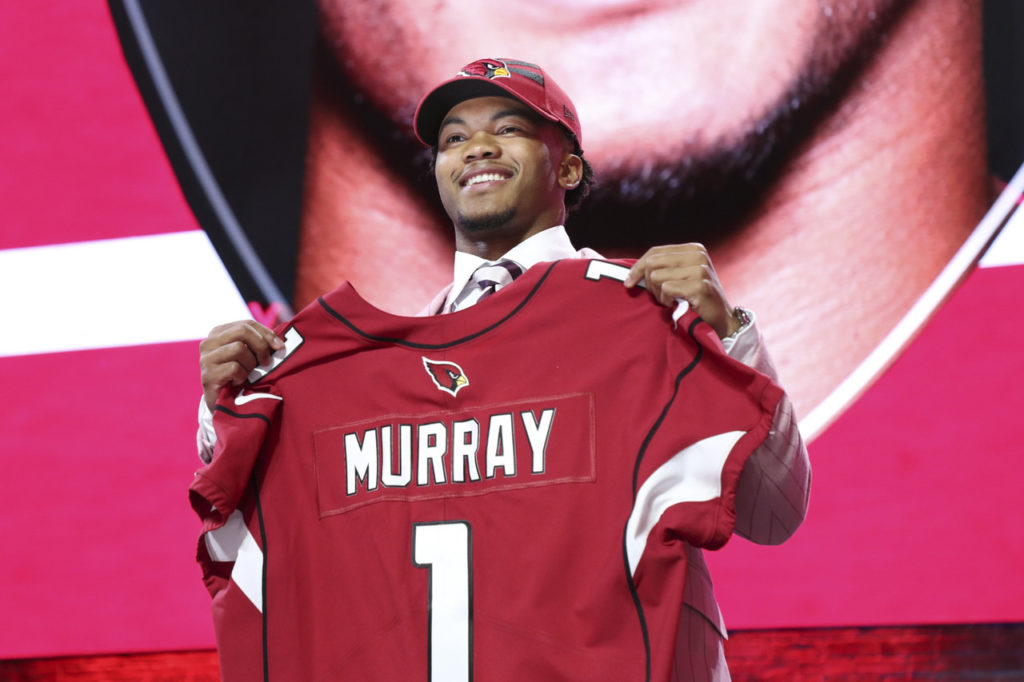
Kyler Murray is probably one of the best recent examples of why landing spot is so important. There aren’t too many 5’10” quarterbacks that even get a shot in the NFL. Murray landed in one of the few situations with the potential to foster success.
Arizona’s head coach Kliff Kingsbury said “I would take him with the first pick of the draft if I could” when he was coaching at Texas Tech and that’s exactly what he did. Murray’s journey to Arizona was almost pre-destined. Kingsbury was extremely confident about Murray, but there were a ton of questions about his ability to succeed in the league because of his height, weight, and style of play. That’s why landing spot matters.
Kingsbury’s air raid offense is designed for a quarterback who is accurate but can also use his legs to create extra time and yards. Murray finished 2019 with a 73.5% on target rate which is fairly good for a rookie and ahead of players like Tom Brady and Carson Wentz. He also rushed for 544 yards and five touchdowns on 93 attempts in his rookie season.
It should be noted that Kingsbury’s offense wouldn’t be able to do the same things without a player like Murray. Josh Rosen wouldn’t be breaking off big runs and creating a ton of separation for his receivers with his legs. Murray allows the team to play an entirely different style than they could with other quarterbacks. Would Murray have been on track to be so successful if he had landed with another team? Who knows, but we can be sure he probably wouldn’t have gotten the same opportunity in such a strong situation.
LAS VEGAS RAIDERS
Josh Jacobs landed on the Raiders with head coach John Gruden and everyone knew he was in for a heavy workload. This underappreciated tweet illustrates just how much Gruden has relied on his number one running back over his entire career.
His number one running backs have averaged over 1,200 yards per season! Jacobs fell just 50 yards short, finishing with 242 rushes for 1,150 yards and seven touchdowns in just 13 games. He finished fifth in yards after contact per attempt (2.8).
Jacobs had a great rookie season but here’s the real question: would he have been as productive if he’d been drafted by the Chicago Bears? David Montgomery was also a highly touted running back talent but didn’t end up in such an advantageous situation. His workload was limited by Tarik Cohen’s presence. Cohen received 64 rushing attempts and a whopping 104 targets, cutting heavily into Montgomery’s workload. Montogomery finished with 242 carries as well as Jacobs, but he played three more games and wasn’t nearly as productive. He amassed 889 yards and six touchdowns. I doubt the community would have been as eager to draft Jacobs if he had landed in Chicago. The moral of the story is that landing spots matter.
TENNESSEE TITANS
Landing spots can be deceiving. We have to be diligent in our scouting efforts and remain confident in our analysis. Some players do overcome unfortunate circumstances. Most analysts had A.J. Brown pegged as one of the top three rookie WR prospects last year, some even had him as number one. That was, until he was drafted by the Tennessee Titans, oh no!
It seems ridiculous that our evaluations would shift so drastically just because a player falls into a situation the fantasy community as a whole deems disappointing, but it happens. I will admit, I fell victim to the narrative: “Tennesee doesn’t have a quarterback or the passing volume for Brown to succeed, exhibit A: Corey Davis”. We were wrong and I think there’s a lesson to be learned. He finished the year as the WR23 with 52 receptions for 1,051 yards and eight touchdowns.
Landing spots are important, but as previously stated, they are just a piece of the puzzle. As dynasty owners, we must look ahead and part of our job is to anticipate opportunity. For instance, it was well known Ryan Tannehill was breathing down Marcus Mariotta’s neck for the starting job and we all knew he was a much better fit for the pass catchers. We also knew how talented of a prospect Brown was, he had very few questions about his game coming into the league compared to a player like Kyler Murray. Brown’s ability to succeed wasn’t as contingent on the landing spot. Each situation is unique and we must remember to not apply the same conclusion across the board.
2020
Ok, now that we’ve examined the 2019 landing spot ramifications, let’s look ahead to the 2020 NFL draft and how teams and players could be impacted. Clearly we can’t predict where all these prospects are going to land. We can, however, discuss the few we can be fairly certain of.
CINCINNATI BENGALS
Heisman winner Joe Burrow being selected first overall in the NFL Draft by the Cincinnati Bengals is all but guaranteed, so I feel it’s necessary to consider the impact. He finished his senior year at LSU with 5,671 passing yards and 60 touchdowns with just six interceptions. A year that will likely go down as one of the best passing seasons in college history. He also played in a pro-style offense overseen by Joe Brady, who is now with the Carolina Panthers. Burrow’s success in Brady’s offense should allow for a relatively seamless transition into the NFL. It won’t be perfect, but the point is he should be more prepared than his peers.
So, is Cincinnati a good landing spot for a quarterback? I would argue it is. They roster a veteran receiver in A.J. Green whose presence will surely assist in Burrow’s acclimation to the NFL. He’ll be surrounded by youth and talent with Joe Mixon, Tyler Boyd, and an emerging and improving offensive line. Again, nobody is suggesting the Bengals are on their way to a Super Bowl or that we’re about to witness the next Tom Brady or Peyton Manning, but a good situation is a good situation. If Burrow is as talented as we all think he is then he’s going to have as much a positive impact on these players as they will on him. The hope is that we see an increase in fantasy production from Mixon and Boyd because Burrow is providing them with better opportunities than Andy Dalton.
The Bengals lack of defense is another factor to consider, especially in regards to fantasy production. Burrow will be required to pass far more often if the defense is giving up a ton of points and trailing the entire game. This is a perfect example of a situation in which the incoming player affects the team and the team affects the player.
ARIZONA CARDINALS
The Cardinals are in a unique position making it quite easy to predict their first-round selection. They drafted what should be a franchise quarterback last year, hired Kliff Kingsbury, and traded for Kenyan Drake and one of the best wide receivers in the NFL in DeAndre Hopkins. Any organization would be delighted to have these kinds of weapons and leadership. Still, the Cardinals lack talent in a key offensive unit. Their offensive line ranked 22nd in both runs and pass protection according to FootballOutsiders. The Cardinals offensive line had a difficult time protecting Kyler Murray. They were tied for the least amount of pocket time on average (2.3s) and the most sacks in the league (48).
Almost any mock draft you find has the Cardinals taking an offensive lineman eighth overall in the 2020 NFL Draft. I’ve seen a number of mocks connecting them to OT Tristan Wirfs out of Iowa. We can see how Arizona’s porous offensive line negatively affected Murray’s time and comfort in the pocket last year. In this case, an offensive lineman landing in Arizona will have ramifications for the quarterback, running back, and the rest of the offense. These are the kind of conditions we need to pursue and understand as dynasty owners.
MIAMI DOLPHINS
Miami has shown sincere interest in Tua Tagovailoa since very early in the offseason, even prior to the nifty workout videos attempting to prove his health. Chris Mortensen posted video footage of Tua’s Pro Day showing little to no limitations because of his hip, hoping to instill confidence in a team like the Dolphins who hold the fifth overall pick in the 2020 NFL Draft.
Tua could be a game-changer. Just consider his potential impact on the offensive weapons currently on the roster. Former NFL quarterback Dan Orlovsky posted a video on Twitter in which he compared Tua’s style of play to Drew Brees.
Imagine what he could do for players like DeVante Parker, Preston Williams, and Mike Gesicki who have seen their fair share of bad quarterback play. He’s a dual-threat quarterback known for medium-range accuracy and good decision making, something the Dolphins have lacked for some time. Looking ahead, we can see how the Dolphins wide receivers would instantly get a boost if Tua is drafted. That said, this could present a buy-low opportunity for Parker, Williams, and Gesicki.
Final Thoughts
Hopefully, the examples provided offer readers a better-understanding of landing spot ramifications. Each of the aforementioned scenarios illustrates how landing spots are affected by the incoming prospect and how the prospect affects the team and the surrounding cast. We even explored how fantasy value and decision making can be altered based on potential landing spot implications.
Thank you for reading. If you have any thoughts or would like to discuss, you can find me on Twitter @WillieBeamanDFF

