

Modern medicine moves fast. Jameson Williams might move faster. He made that clear almost immediately after transferring from Ohio State to Alabama before his junior season. Targets turned into track meets, and track meets turned into touchdowns. To go along with those touchdowns (he scored 15 last season) Williams posted a more than respectable 1,572 receiving yards on 79 receptions with an insane 19.9 yards per reception average. That’s right, 18% of his receptions ended up with him in the endzone. He established himself as Heiman winner Bryce Young’s go-to target and quickly shot up draft boards on the way to another Crimson Tide National Championship appearance.
Unfortunately, the fighter jet-like ascension of Jameson Williams came to an abrupt stop when he suffered an ill-timed left Anterior Cruciate Ligament (ACL) tear in the final game of Alabama’s season. Despite his injury, Williams was selected 11th overall in the 2022 NFL Draft by the Detroit Lions. He was the fourth WR selected and was still widely considered one of the more promising receivers in his class despite a limited collegiate sample size and not having the opportunity to participate in the NFL Combine. Fast forward 9 months later and Jameson Williams is moving closer and closer to making his NFL debut.
As Dynasty managers, what exactly should we expect upon his return?
Will “Jamo” continue to display the game-breaking speed, acceleration, and change of direction that he did at Alabama, or will he fall into the category of college studs that could have been? To answer these questions we must look at how the nature of ACL injuries, ACL reconstruction surgery, and ACL rehabilitation has changed, and why the dreaded “ACL” isn’t nearly as horrifying as it used to be.
Let’s briefly take a step back to talk about the anterior cruciate ligament and why it’s important. The ACL is one of four major ligaments that stabilize the femur (thighbone) on the tibia (shinbone). Along with the meniscus, these ligaments work in tandem to provide stability and support to the knee throughout a variety of movement patterns and positions. The ACL, specifically, prevents the tibia from moving forward on the femur and is most taut when the knee is fully extended (straight). The ACL additionally plays a role in the rotational stability of the knee during change of direction movements like cutting and pivoting. Consequently, the ACL is commonly injured when athletes attempt to change direction or pivot when their knee is fully extended and planted on the ground.
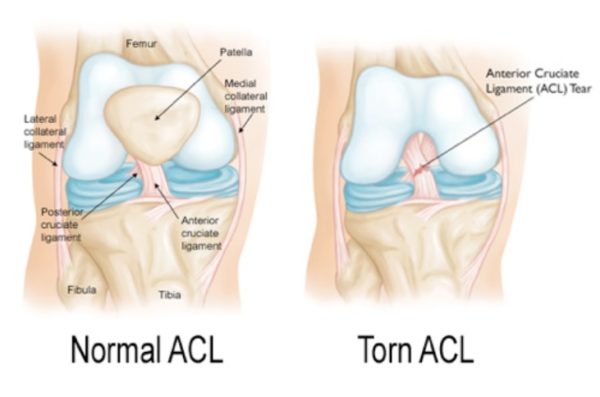
Timelines for recovery post ACL reconstruction can be highly variable. Some factors that can influence injury severity and individual recovery timelines include multi-ligament involvement (ie. injuring the ACL, MCL, and lateral meniscus at the same time), contact vs. non-contact ACL injuries, and age. Jameson Williams has a few positive factors going for him here. He experienced an isolated ACL tear and was only 20 years old at the time of the injury. Both are positive indicators of improved outcomes post-rehabilitation. Unfortunately, the non-contact nature of his ACL injury could potentially signify strength asymmetries or generally poor biomechanics. With that being said, the majority of ACL injuries are non-contact, so his method of injury shouldn’t scare us off all that much. Jameson’s timeline for return seems to fit into the typical 9-10 month range for return to sport. Athletes, however, will often take an additional year after their return before they begin to exhibit production close to their previous level of performance. Saquon Barkley is a recent example of this drastic improvement in the second season post-surgery.
Now that we have gotten that out of the way, please let me make one thing clear. ACL reconstruction surgery and rehabilitation have changed significantly in the last decade. Advancements in rehabilitative protocols, improvements in surgical techniques, and enhanced understanding of the relationship between biomechanics and re-injury risk have turned a once dreaded injury into something that we often forget about. Let’s play a quick game: Which stat line was compiled by a wide receiver returning to play post-ACL reconstruction?

As you probably guessed, that was a bit of a trick question. Player #1 is the player coming off of an ACL injury, while Player #2 is a 21-year-old wide receiver who posted the best season of his career at the time. What you might not have guessed is that both players are Keenan Allen. Not only did Allen demonstrate improvements in yards and receptions upon returning to action, but he also nearly matched the excellent 14.1 yards per catch average he posted as a rookie while maintaining a significantly higher target share. The purpose of this example is not to show that all players return to peak levels of performance (the research suggests otherwise), but rather that a return to previous level of performance is a very plausible and fairly common outcome for athletes who experience ACL tears earlier in their career. With that being said, the dynasty community in general is far too pessimistic on long-term player outlook post-injury. It is important to exhibit caution and a good bit of patience (especially within the first year of return to play) when evaluating players returning from injury, but by appropriately timing when trading for players post-injury you can acquire long-term assets at insane discounts.
But when exactly should you make your move?
In my opinion, there are two optimal buying windows for players who experience significant injuries. The first is immediately after the injury occurs. Managers are often nervous and might be in situations where they need to immediately replace lost production as contenders. This is a solid window to make a move, but I prefer to wait patiently until after a player returns to the field. From my experience, managers tend to lose patience when players returning from injury don’t immediately produce despite ample opportunity. Temper your expectations at first, and remember if you are excited about the production profile of a player before ACL injury you should be just as excited to acquire the player at a steep discount after they return to the field and underperform. I know I will be doing just that when I attempt to acquire Jameson Williams for a 2024 1st round pick a few weeks after he returns.
Oh, hey. I didn’t see you there. Thanks for reading. If you found this content interesting, actionable, or straight up incorrect, throw me a follow @WaiverWolf (Twitter, Instagram, & TikTok) or meet me at a local Philly bar so we can hash it out.

