
You know that feeling when you’ve reached the highest peak of the rollercoaster, and you’re just about to plummet back down to earth? In that moment, time seems to slow down as your body is flooded with pure joy and adrenaline. That’s how it feels to complete a dynasty trade.
Unfortunately, there tends to be a lot of hard work and frustration before that moment comes. Initial offers are rejected, direct messages are ignored, and promised counters never arrive.
Maybe you’ve almost given up on negotiating deals altogether. I get it. I’ve gone through plenty of dry spells myself. But trading is not only the most exciting part of playing dynasty; it’s also the most effective way to change the direction of your team. A few well-executed deals can send you to the Promised Land where bragging rights and prize money await or down to the bottom of the standings when it’s time to rebuild.
In this piece, I’ll reflect on four dynasty trades that I’ve made this season. I’ll include some information about my team and an explanation of how and why I made the deal. My hope is that seeing these deals will lead you to more successful trade talks and more of that completed-trade-euphoria we all crave.
Note: All trades come from 12-team, Superflex, PPR leagues.
Trade #1
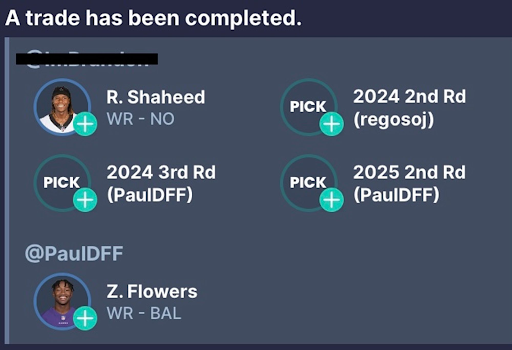
This was the first trade I completed after Week 1.
I thought Zay Flowers was a fine college prospect worthy of a first-round selection in rookie drafts, but I wasn’t very excited about him. I was worried that Mark Andrews and Rashod Bateman (yikes) might draw too many targets for Flowers to produce as a rookie. But after Flowers commanded 50% of the targets in Week 1, I quickly changed my tune. I sent out offers in many leagues, hoping to snag some additional shares before the ramifications of his performance really sank in.
Action Point: Don’t be afraid to “chase” strong performances from rookies. A high price today might look like a clearance sale tomorrow.
Bonus: The easiest way to sell high on bench pieces (like Rashid Shaheed) is to throw them into larger trades as “sweeteners.”
Trade #2
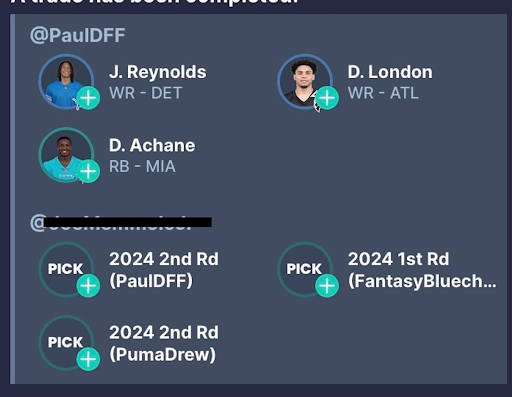
This trade was completed after Week 2.
Drake London was coming off a strong game, but the goose egg from Week 1 was still lingering in the minds of many dynasty managers. I saw an opportunity to buy low (at least by my evaluation of London) from a manager who was trying to acquire draft picks and get points off his roster.
At this point, De’Von Achane had done basically nothing. He was inactive in Week 1 and got a couple of touches in Week 2. It was pretty easy to get him added to the deal. He scored over 50 points in Week 3.
Action Point: Buy rookies that struggle early in the season. We usually see rookie production ramp up towards the end of the year, but many dynasty managers aren’t patient enough to wait. You can capitalize on that impatience and make low-risk, high-reward moves like this one.
Trade #3
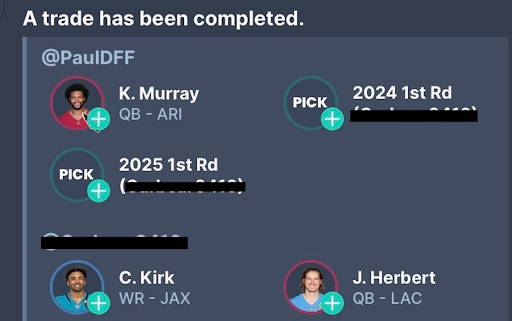
This trade was completed after Week 4.
Despite having Justin Herbert, Christian Kirk, and some other interesting pieces, this roster was just not ready to compete in 2023. My team was 1-3, so I set my sights on the 1.01 and began to trade away my most productive pieces.
Justin Herbert is one of the best QBs in fantasy and he’s just 25 years old, so trading him away might seem a bit backwards in this situation. But when I close my eyes, it’s easy to picture Kyler Murray’s value rebounding in a big way. He was ranked similarly to Herbert before his ACL injury, and he could find himself there again if he comes back healthy to end the season, even for a couple of games.
Action Point: When you make trades as a rebuilder, try to take the long view. Consider how players might be valued in the offseason, not just how they’re valued at the present moment.
Bonus: Send offers that actually help the other team. This manager had a stacked roster with a thin QB room. Justin Herbert filled a clear need for him, which made negotiations quick and painless.
Trade #4

This trade was completed after Week 7.
At the time of this trade, my team was 5-2. I was the fourth seed and third in points scored. With no no additional moves, my team would probably coast effortlessly to the playoffs. But I saw an opportunity here to dramatically improve my starting lineup, replacing Dallas Goedert’s 10 PPG with Travis Kelce’s 20 PPG. The other manager was trying to unload Kelce and look ahead to next season, which made us ideal trade partners.
Action Point: Don’t be afraid to buy veteran production if you have the chance to secure a playoff bye. Teams with a bye win the championship at a much higher rate.
Bonus: This is the type of trade you want to make as early in the season as possible. More weeks from Kelce means more opportunities for your team to benefit from his production.
That’s all I’ve got for you today. Now get out there and make some trades!
Thanks for reading this article! Follow me on Twitter at @paul_dff if you’d like to hear more from me. I love discussing strategy and trades and engaging in heated debates about this very silly game we play.

