
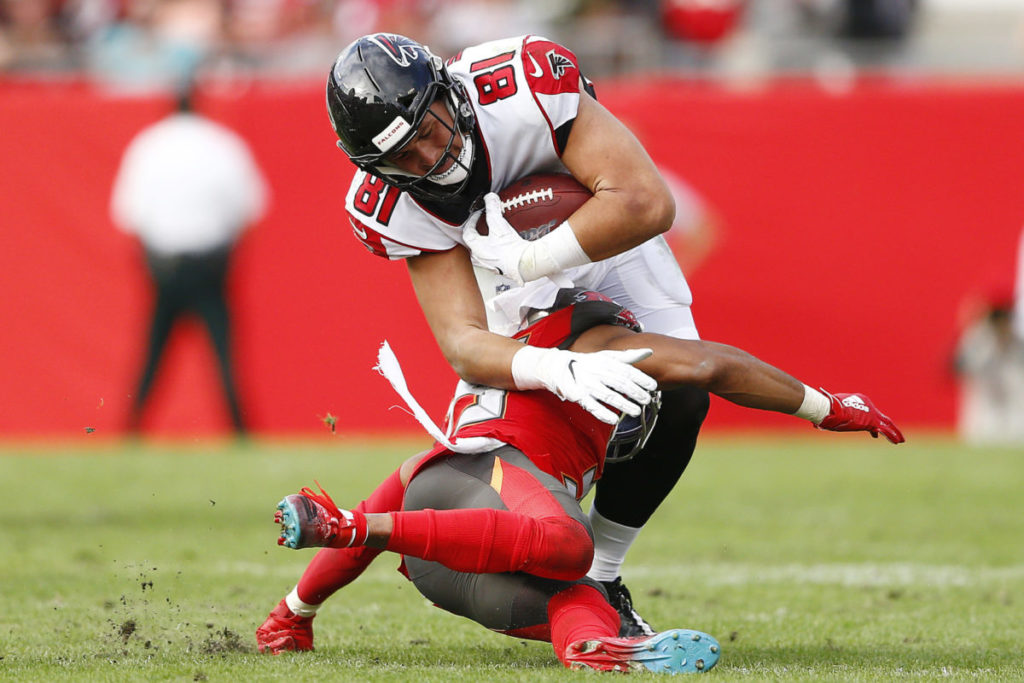
Unrestricted free-agent Austin Hooper signed a four-year, $42M contract to play for the Cleveland Browns last month. The deal makes him the second-highest-paid tight end in the NFL behind only Hunter Henry. He’ll join a team that finished 2019 at 6-10, results that prompted ownership to fire the GM and coaching staff.
Hooper leaves a high-volume pass offense in Atlanta for one in Cleveland featuring a duo of strong running backs and a quarterback who’s still developing. New head coach Kevin Stefanski arrives in Cleveland after a season of coordinating a run-heavy approach for the Vikings under the thumb of the conservative Mike Zimmer.
Hooper’s 2019 season with the Falcons was his career year. In 13 games, he collected 75 receptions for 787 yards and six touchdowns. With these numbers, he joined the small contingent of strong TE1s in fantasy football listed in the following table. The change of scenery begs the question of whether he can remain in that tier. It’s no secret that Austin Hooper benefited from a high volume in 2019. He finished the season with the sixth most targets, fantasy gamers’ favorite indicator of opportunity. Minnesota’s top two tight ends, Kyle Rudolph and Irv Smith Jr. attracted 95 targets combined, two short of Hooper’s season total.
2019 Fantasy Leaders at Tight End
| PLAYER | Games | TGT | REC | YDS | Y/REC | TD | FPTS | FPTS/G |
| Travis Kelce (KC) | 16 | 136 | 97 | 1,229 | 12.7 | 5 | 205.8 | 12.9 |
| George Kittle (SF) | 14 | 107 | 85 | 1,053 | 12.4 | 5 | 180.0 | 12.9 |
| Darren Waller (OAK) | 16 | 117 | 90 | 1,145 | 12.7 | 3 | 176.0 | 11.0 |
| Mark Andrews (BAL) | 15 | 98 | 64 | 852 | 13.3 | 10 | 175.2 | 11.7 |
| Zach Ertz (PHI) | 15 | 135 | 88 | 916 | 10.4 | 6 | 171.6 | 11.4 |
| Austin Hooper (ATL) | 13 | 97 | 75 | 787 | 10.5 | 6 | 154.2 | 11.9 |
*Data collected from FantasyPros.com, 2019 TE fantasy finishes, half-PPR
Can Hooper simply fill both players’ roles in Stefanski’s offense in Cleveland? Let’s keep digging through data to assess.
The comparison of tight end targets belies the stark differences between the offenses for the Falcons and Vikings. Atlanta was the most pass-heavy offense in the league according to The Football Database. Two-thirds of the plays were called passes amounting to 734 total pass plays (including those that ended in sacks). The Vikings ran only 494 called passes, roughly half of their total plays.
In games in which he was active, Hooper played 85% of the Falcons’ offensive snaps. Kyle Rudolph, meanwhile, played 78% of the Vikings’ snaps according to Pro Football Reference. Rudolph’s teammate Irv Smith Jr. also played 60% of those offensive snaps as the Vikings’ second tight end. In light of this playing-time information, comparing Hooper to Rudolph for one role and incumbent David Njoku to Irv Smith Jr. in a secondary role appears to be the best path forward for analysis.
Hooper had twice as many opportunities (targets) as Rudolph in 2019, but what about utilization? Hooper is part of a tier of four players atop the position when adjusting for the number of games played. In fact, a prorated number of routes run for 16 games would make Hooper the busiest receiver at the position, with 628 routes run. Kyle Rudolph, meanwhile, ran 362 routes in the Vikings’ pass game in 2019 according to Sports Info Solutions’ data hub (sisdatahub.com). That ties him for 20th. Rudolph is an example of just how fast tight end utilization falls off in the passing game from team to team.
2019 Leaders in Routes Run at Tight End
| PLAYER | Games | Routes Run | ADOT | REC | TGT | YDS | Y/ REC | TD | FPTS | FPTS/G |
| Travis Kelce (KC) | 16 | 614 | 8.9 | 97 | 136 | 1,229 | 12.7 | 5 | 205.8 | 12.9 |
| Zach Ertz (PHI) | 15 | 578 | 8.4 | 88 | 135 | 916 | 10.4 | 6 | 171.6 | 11.4 |
| Mike Gesicki (MIA) | 16 | 559 | 9.8 | 51 | 89 | 570 | 11.2 | 5 | 110.5 | 6.9 |
| Austin Hooper (ATL) | 13 | 511 | 6.8 | 75 | 97 | 787 | 10.5 | 6 | 154.2 | 11.9 |
| Darren Waller (OAK) | 16 | 492 | 7.3 | 90 | 117 | 1,145 | 12.7 | 3 | 176.0 | 11.0 |
| Jimmy Graham (CHI) | 16 | 480 | 9.7 | 38 | 60 | 447 | 11.8 | 3 | 81.7 | 5.1 |
| Jason Witten (DAL) | 16 | 476 | 6.4 | 63 | 83 | 529 | 8.4 | 4 | 108.4 | 6.8 |
| Greg Olsen (CAR) | 14 | 472 | 8.7 | 52 | 82 | 597 | 11.5 | 2 | 97.7 | 7.0 |
| Vance McDonald (PIT) | 14 | 427 | 4.6 | 38 | 55 | 273 | 7.2 | 3 | 64.5 | 4.6 |
| Hunter Henry (LAC) | 12 | 418 | 9.5 | 55 | 76 | 652 | 11.9 | 5 | 122.7 | 10.2 |
Notes: (1) Routes Run collected from Pro Football Focus snap count data (www.profootballfocus.com); (2) Average Depth of Target available at sisdatahub.com.
Any expectation that Hooper will again run more routes than any other tight end in the league in Cleveland seems unduly optimistic. In light of Rudolph’s experience in 2019, Hooper could fall outside the top 10 in such utilization.
If Austin Hooper will be hard-pressed to repeat as a top-10 tight end through volume, then can he do so through efficiency?
Of the top-10 most utilized tight ends (measured in routes run), Hooper has the eighth-shallowest Average Depth of Target (ADOT). Passes thrown his way were shallower routes, indicating more check-down passes relative to the players known as oversized flankers like Travis Kelce and Zach Ertz.
Your writer calculated fantasy points per route run (FPTS/RR) and sorted the top-21 tight ends by the result (21 because Kyle Rudolph is 21st in this metric). Hooper stands outside the top 12 on this list. The highest scorer of fantasy points per route run, Mark Andrews is a fascinating case. He’s effectively the flip side of an early-down running back. He played a limited snap share, but when he was on the field, his number was called often. Third on this list, George Kittle finished second in yards after the catch in 2019 after leading all receivers in the stat in 2018. Will Dissly and Foster Moreau appear here due to small sample sizes with several touchdowns each.
2019 Leaders Among Tight Ends, Fantasy Points per Route Run
| PLAYER | Games | Routes Run | ADOT | REC | TGT | YDS | Y/REC | YAC/REC | TD | FPTS | FPTS/RR |
| Mark Andrews (BAL) | 15 | 308 | 10.4 | 64 | 98 | 852 | 13.3 | 4.7 | 10 | 175.2 | 0.569 |
| Will Dissly (SEA) | 6 | 117 | 9.4 | 23 | 27 | 262 | 11.4 | 3.2 | 4 | 62.4 | 0.533 |
| George Kittle (SF) | 14 | 361 | 5.8 | 85 | 107 | 1,053 | 12.4 | 7.3 | 5 | 180.0 | 0.499 |
| Foster Moreau (OAK) | 13 | 133 | 3.6 | 21 | 25 | 174 | 8.3 | 5.0 | 5 | 57.9 | 0.435 |
| Tyler Higbee (LAR) | 15 | 304 | 6.4 | 69 | 89 | 734 | 10.6 | 5.9 | 3 | 125.9 | 0.414 |
| Jared Cook (NO) | 14 | 365 | 10.5 | 43 | 65 | 705 | 16.4 | 5.9 | 9 | 146.0 | 0.400 |
| Darren Waller (OAK) | 16 | 492 | 7.3 | 90 | 117 | 1,145 | 12.7 | 6.6 | 3 | 176.0 | 0.358 |
| Jonnu Smith (TEN) | 16 | 249 | 4.9 | 35 | 44 | 439 | 12.5 | 8.3 | 3 | 87.2 | 0.350 |
| Travis Kelce (KC) | 16 | 614 | 8.9 | 97 | 136 | 1,229 | 12.7 | 4.8 | 5 | 205.8 | 0.335 |
| Blake Jarwin (DAL) | 16 | 213 | 10.6 | 31 | 41 | 365 | 11.8 | 5.1 | 3 | 70.0 | 0.329 |
| Eric Ebron (IND) | 11 | 225 | 9.1 | 31 | 52 | 375 | 12.1 | 5.3 | 3 | 71.0 | 0.316 |
| Austin Hooper (ATL) | 13 | 511 | 6.8 | 75 | 97 | 787 | 10.5 | 4.4 | 6 | 154.2 | 0.302 |
| Zach Ertz (PHI) | 15 | 578 | 8.4 | 88 | 135 | 916 | 10.4 | 3.2 | 6 | 171.6 | 0.297 |
| Dallas Goedert (PHI) | 15 | 392 | 6.0 | 58 | 87 | 607 | 10.5 | 6.2 | 5 | 115.7 | 0.295 |
| Hunter Henry (LAC) | 12 | 418 | 9.5 | 55 | 76 | 652 | 11.9 | 3.2 | 5 | 122.7 | 0.294 |
| Hayden Hurst (BAL) | 16 | 219 | 8.6 | 30 | 39 | 349 | 11.6 | 5.0 | 2 | 61.9 | 0.283 |
| Darren Fells (HOU) | 15 | 334 | 5.0 | 34 | 48 | 341 | 10.0 | 4.9 | 7 | 93.1 | 0.279 |
| Evan Engram (NYG) | 8 | 315 | 6.0 | 44 | 68 | 467 | 10.6 | 5.9 | 3 | 87.4 | 0.277 |
| Gerald Everett (LAR) | 12 | 264 | 7.4 | 37 | 60 | 408 | 11.0 | 5.1 | 2 | 71.3 | 0.270 |
| Ryan Griffin (NYJ) | 13 | 307 | 5.1 | 34 | 41 | 320 | 9.4 | 5.4 | 5 | 81.0 | 0.264 |
| Kyle Rudolph (MIN) | 16 | 362 | 6.4 | 39 | 48 | 367 | 9.4 | 4.9 | 6 | 94.2 | 0.260 |
Austin Hooper excelled in neither Average Depth of Target (ADOT) nor Yards After Catch (YAC). His numbers in both categories are in fact similar to those of Kyle Rudolph. Both also scored six touchdowns. Volume alone accounts for the spread between Rudolph at 21 and Hooper at 13 on this list.
Efficiency doesn’t typically carry over from year to year. Can Hooper become significantly more efficient in 2020 than in 2019?
Scott Barrett of Pro Football Focus identifies another efficiency metric that he has found to be predictive: Yards per Route Run (YDS/RR). Barrett writes, “On average, wide receivers who ranked top-20 in YDS/RR in one season scored 154% more fantasy points than bottom-20 wide receivers in the following season.” He continues, “The correlations are even stronger at the extremes.”
2019 Primary Receiving Tight Ends by Yards per Route Run (YDS/RR)
| PLAYER | Games | Routes Run | REC | TGT | YDS | YDS/RR | FPTS | FPTS/G |
| George Kittle (SF) | 14 | 361 | 85 | 107 | 1,053 | 2.92 | 180.0 | 12.9 |
| Mark Andrews (BAL) | 15 | 308 | 64 | 98 | 852 | 2.77 | 175.2 | 11.7 |
| Tyler Higbee (LAR) | 15 | 304 | 69 | 89 | 734 | 2.41 | 125.9 | 8.4 |
| Darren Waller (OAK) | 16 | 492 | 90 | 117 | 1,145 | 2.33 | 176.0 | 11.0 |
| Will Dissly (SEA) | 6 | 117 | 23 | 27 | 262 | 2.24 | 62.4 | 10.4 |
| Travis Kelce (KC) | 16 | 614 | 97 | 136 | 1,229 | 2.00 | 205.8 | 12.9 |
| Jared Cook (NO) | 14 | 365 | 43 | 65 | 705 | 1.93 | 146.0 | 10.4 |
| Jonnu Smith (TEN) | 16 | 249 | 35 | 44 | 439 | 1.76 | 87.2 | 5.5 |
| Blake Jarwin (DAL) | 16 | 213 | 31 | 41 | 365 | 1.71 | 70.0 | 4.4 |
| Eric Ebron (IND) | 11 | 225 | 31 | 52 | 375 | 1.67 | 71.0 | 6.5 |
| Hayden Hurst (BAL) | 16 | 219 | 30 | 39 | 349 | 1.59 | 61.9 | 3.9 |
| Zach Ertz (PHI) | 15 | 578 | 88 | 135 | 916 | 1.58 | 171.6 | 11.4 |
| Hunter Henry (LAC) | 12 | 418 | 55 | 76 | 652 | 1.56 | 122.7 | 10.2 |
| Dallas Goedert (PHI) | 15 | 392 | 58 | 87 | 607 | 1.55 | 115.7 | 7.7 |
| Gerald Everett (LAR) | 12 | 264 | 37 | 60 | 408 | 1.55 | 71.3 | 5.5 |
| Austin Hooper (ATL) | 13 | 511 | 75 | 97 | 787 | 1.54 | 154.2 | 11.9 |
| Evan Engram (NYG) | 8 | 315 | 44 | 68 | 467 | 1.48 | 87.4 | 10.9 |
| Noah Fant (DEN) | 16 | 395 | 40 | 66 | 562 | 1.42 | 91.0 | 5.7 |
| Nick Boyle (BAL) | 16 | 233 | 31 | 43 | 321 | 1.38 | 59.6 | 3.7 |
| Foster Moreau (OAK) | 13 | 133 | 21 | 25 | 174 | 1.31 | 57.9 | 4.5 |
| Greg Olsen (SEA) | 14 | 472 | 52 | 82 | 597 | 1.26 | 97.7 | 7.0 |
| T.J. Hockenson (DET) | 12 | 311 | 32 | 59 | 367 | 1.18 | 64.7 | 5.4 |
| O.J. Howard (TB) | 14 | 401 | 34 | 53 | 459 | 1.14 | 66.9 | 4.8 |
| Tyler Eifert (JAC) | 16 | 382 | 43 | 63 | 436 | 1.14 | 85.1 | 5.3 |
| Jack Doyle (IND) | 16 | 394 | 43 | 72 | 448 | 1.14 | 90.3 | 5.6 |
| Jacob Hollister (SEA) | 11 | 313 | 41 | 59 | 349 | 1.12 | 73.4 | 6.7 |
| Jason Witten (OAK) | 16 | 476 | 63 | 83 | 529 | 1.11 | 108.4 | 6.8 |
| Dawson Knox (BUF) | 15 | 352 | 28 | 50 | 388 | 1.10 | 65.7 | 4.4 |
| Kaden Smith (NYG) | 9 | 253 | 31 | 42 | 268 | 1.06 | 60.3 | 6.7 |
| Ryan Griffin (NYJ) | 13 | 307 | 34 | 41 | 320 | 1.04 | 81.0 | 6.2 |
| Jordan Akins (HOU) | 16 | 406 | 36 | 55 | 418 | 1.03 | 71.8 | 4.5 |
| Darren Fells (HOU) | 15 | 334 | 34 | 48 | 341 | 1.02 | 93.1 | 5.8 |
| Mike Gesicki (MIA) | 16 | 559 | 51 | 89 | 570 | 1.02 | 110.5 | 6.9 |
| Kyle Rudolph (MIN) | 16 | 362 | 39 | 48 | 367 | 1.01 | 94.2 | 5.9 |
| Cameron Brate (TB) | 16 | 308 | 36 | 55 | 311 | 1.01 | 73.1 | 4.6 |
| Irv Smith Jr. (MIN) | 16 | 322 | 36 | 47 | 311 | 0.97 | 61.1 | 3.8 |
| Jimmy Graham (CHI) | 16 | 480 | 38 | 60 | 447 | 0.93 | 81.7 | 5.1 |
| Vance McDonald (PIT) | 14 | 427 | 38 | 55 | 273 | 0.64 | 64.5 | 4.6 |
Your writer calculated YDS/RR for fantasy football’s top-38 scoring tight ends (half-PPR). (Players outside the top 38 were true reserves or currently unemployed players.) Former Atlanta Falcon Austin Hooper lands in the middle of the pack. Both Vikings tight ends, Kyle Rudolph and Irv Smith Jr. finished near the bottom. Importantly, this low standing is despite the fact that Rudolph played well in 2019. It’s due to Stefanski’s scheme.
Football Outsiders rank Hooper and Rudolph sixth and eighth, respectively in their metric Defense-Adjusted Yards Above Replacement (DYAR) among NFL tight ends. Rudolph furthermore finished fifth in Defense-Adjusted Value Over Average (DVOA) while Hooper finished 13th among NFL tight ends. According to www.footballoutsiders.com, high DYAR indicates a tight end with more total value, and higher DVOA means a tight end with more value per play. Their receiving grades from Pro Football Focus for their 2019 seasons are similar. Austin Hooper’s grade is 80.5. Kyle Rudolph’s is 76.8. In short, Hooper and Rudolph appear to be similar players with similar capabilities. In head coach Kevin Stefanski’s offense, it’s reasonable to expect Hooper’s future output to resemble Rudolph’s immediate past result.
Based on the investments made in the position in Minnesota last year and Cleveland this year, it’s clear that the position is more valuable to the coach than to fantasy football in Stefanski’s scheme. Austin Hooper is set to make $10.M per year. Rudolph will make $9M in 2020 after signing a contract extension ahead of the 2019 season. The Vikings invested a 2019 second-round pick in Irv Smith Jr. Perhaps unsurprisingly then, the Browns will hold onto former first-round pick David Njoku as he enters his age-24 season.
How does Hooper’s path impact tight ends on his current and former teams? Can the next man up in Atlanta capitalize on the opportunity?
The tight end the Falcons acquired to replace Hooper, Hayden Hurst stacked up well against Hooper across these statistics and metrics. Hurst fell well short of Hooper in volume-based statistics because he competed with Mark Andrews for playing time. The efficiency numbers above indicate an outstanding season from Andrews and hints as to why the Ravens felt comfortable trading Hurst away for a second-round draft pick.
2019 Statistical Comparison: New Vs. Old Falcons Tight End
| PLAYER | YDS/REC | ADOT | YDS/Route Run | FPTS/ Route Run | DYAR | DVOA | PFF Rcvg Grade |
| Hayden Hurst (BAL) | 11.6 | 8.6 | 1.59 | 0.283 | 89 | 28.1% | 79.3 |
| Austin Hooper (ATL) | 10.5 | 6.8 | 1.54 | 0.302 | 130 | 12.5% | 80.5 |
If Hayden Hurst can attract even 80% of the volume in 2020 that Hooper did in 2019, he’ll land comfortably within the top-12 fantasy tight ends. Hooper, meanwhile, will need 150% of Rudolph’s 2019 volume even to sniff the top 12. He can’t get there even with 100% of snaps if Stefanski’s utilization of tight ends is consistent from 2019 to 2020.
The Browns’ incumbent tight end, David Njoku is likely irrelevant for fantasy football in 2020. He has a career ADOT of 8.6, similar to that of primary receiving tight ends. Irv Smith Jr.’s ADOT of 5.7 as Minnesota’s second tight end last season suggests a usage of Njoku that will make him appear stuck in second gear. Fantasy gamers in dynasty leagues can only hold Njoku and hope he shows enough in 2020 to compete for a starting job elsewhere in 2021.
In dynasty fantasy football, there’s never a better time to trade players than before the new realities of their situations sink in. Thanks for reading and good luck dealing!
Clemson and Michigan alum… Panthers and Cowboys fan… I try to see both sides of every debate and each trade. Find me on Twitter @DynastyTripp.

