

Generally, in the vigorous battle that is an annual redraft, fantasy players tend to favor an early or late first-round pick.
However, in the latest Dynasty Football Factory (DFF) Early Off-Season Redraft Mock, the fantasy gods blessed me with the obscure and oftentimes unwanted seventh overall draft position.
Still more than four months out from peak redraft season, and surrounded by 11 other writers, editors, and podcasters – this is my mock draft diary from the elusive seventh selection using an RB-heavy approach.

Derrick Henry, RB, Tennessee Titans (1.7)
Part of the reason pick number seven is difficult to gauge, especially this season is because it’s often the first pick following the tier fall off.
The assumed top tier of players this season include running backs Christian McCaffrey, Saquon Barkley, Ezekiel Elliott, Dalvin Cook, Alvin Kamara, and 2019’s number one fantasy wide receiver, Michael Thomas.
As expected, this top tier went picks one through six, leaving me at a crossroads. Many analysts suggest going with a top-tier receiver like Davante Adams, or DeAndre Hopkins in this 7-9 range.
However, taking a top tier receiver here could leave you with a borderline RB1 instead of a safer option at the position. For me, the safest workhorse running back remaining was Derrick Henry, who will be returning under the franchise tag.
2019 Henry was everything 2018 owners wanted him to be – The RB5, in 15 games. Henry lead the league in both carries and rushing yards, while mildly improving in the passing game as well. However the Titans used Henry last season, in the downhill running game or the screen attack, he was efficient – averaging 5.1 Yards per Carry (YPC) and 11.4 Yards per Reception (YPR).
Yes, his 18 touchdowns were a lot, and the odds are likely for that number to reduce as Tennessee was the number one Red Zone scoring team in the league by a wide margin.

via TeamRankings.
But I believe, on a good team, with a wise head coach in Mike Vrabel, that Henry might have more skills yet to be unlocked. He was second in the NFL in YPR, behind only San Francisco’s Kyle Juszczyk (Minimum 20 targets). So at least he has the potential to be an efficient passing weapon.
With Dion Lewis now a Giant, expect the Titans to add a new pass-catching back in the draft, in addition to expanding Henry’s role. Henry, if used correctly, could take another jump in the air attack – similar to Leonard Fournette in 2019 where he increased his receiving production by 162 percent.
For me, Henry is a safe, second-tier RB1 and deemed worthy of the seventh selection.
Kenyan Drake, RB, Arizona Cardinals (2.6)
In most of my redrafts, the second round is usually about targeting a second elite running back option. This season, with second-tier backs falling into the mid-second round, followed by a deep receiver pool, the opportunity is there.
When I came back on the clock at 2.6, the only considerations for the pick were Kenyan Drake, Austin Ekeler, and Chris Godwin. But because of my early RB preference, I had to ultimately pass on Godwin – narrowing it between Drake and Ekeler.
I was thrilled to have a shot at either newly re-signed back, as I have both of them as early off-season starts. Ekeler’s a CMC Light, carrying a high floor. But the current question mark at the Chargers’ quarterback position, lead me to draft Drake.
Another Alabama product, Drake is the top back on an offense that includes talented receivers like Hopkins, Christian Kirk, the infamous Larry Fitzgerald, and lead by quarterback Kyler Murray. His 16-game pace with Arizona last season was 246 rushing attempts, 1286 yards, and 16 touchdowns. Factor in his receiving work and Drake’s 16-game pace would’ve been good for RB5 on the season.
While you can see the full extent of my love for Drake in my latest, “Start, Sit, & Seth” column, you could be getting a prime David Johnson caliber fantasy player for a second-round pick.
Courtland Sutton, WR, Denver Broncos (3.7)
Courtland Sutton, another player I’ve recently shared my love for, could be absolute dynamite in 2020. This will be his first full-offseason to work with a quarterback that he played with the season before.
And even though Denver will probably never be a high-powered vertical offense under head coach Vic Fangio, Sutton looks like a player who can overcome that. In just his second NFL season, Sutton was sixth in the league for team target share percentage with 24.8 percent. Now entering the presumed prime of his career, that number should increase.
If the rumors that Denver is targeting Jerry Jeudy, CeeDee Lamb, or Henry Ruggs III with their first pic is true, it could help Sutton, forcing the defense to ease up on double coverages, and pay more attention to the Z receiver. I’m expecting a run-heavy approach, setting up the play-action and some deep shots to Sutton.
While the decision to pick Sutton with my third pick was tough because of the availability of fellow third-year receiver D.J. Moore, I went with the higher-upside, and lower-floor pick in Sutton.
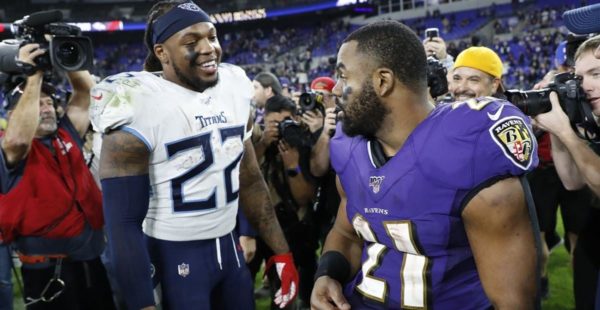
Mark Ingram II, RB, Baltimore Ravens (4.6)
Selecting Mark Ingram with my fourth-round pick solidified my early and heavy running back approach. Although there were some enticing young receivers at the top of the draft board who would’ve pair nicely with Sutton, I went RB here, hoping one of my targeted receivers would come back to me in the following rounds.
Truthfully, as a fantasy analyst and owner, I was out on this former-Crimson Tide last season. I had seen too many Baltimore backs recently not pay back their steep draft capitals, (i.e. Alex Collins in 2018, Justin Forsett in 2015, and Ray Rice in 2013) to allow me to take him.
However, I was humbled when Ingram put up a Pro-Bowl caliber season in 2019, rushing for 1018 yards and ten touchdowns. His effective rushing, combined with 26 receptions, 247 receiving yards, and five touchdowns was good enough for an RB11 finish.
To have a 2019 RB1, who is still the lead back on an elite team, fall into the fourth round is a value here. The no-brainer pick gives me three potentially elite running backs, allowing me greater flexibility down the road to trade for a top-tier wide receiver if need be. And although I missed out on one of the top-tier backs and receivers early, the trio of Henry, Drake, and Ingram is hard to beat.
Deebo Samuel, WR, San Francisco 49ers (5.7)
As happy as I was to land Deebo Samuel in the fifth round, he was my third option here. With my first Calvin Ridley and second option DK Metcalf both off the board, I slotted in the former gamecock as my WR2.
Samuel currently slates as the team’s number one option, likely being joined by Kendrick Bourne and Jalen Hurd in two and three-wide receiver sets. Despite, rumors the San Francisco going with a receiver in the first round of Thursday’s draft, Samuel should hold his top receiver status heading into the season.
While fellow-rookie wide receiver A.J. Brown was praised for his second-half season heroics, Samuel’s was equally as impressive. From Week 8 on Samuel was the WR8, averaging 15.1 Fantasy Points per Game (FPPG). With the arrow still pointing up for Samuel in his sophomore season he should serve any roster as a steady asset.
Julian Edelman, WR, New England Patriots (6.6)
Julian Edelman, 2019’s WR7, is going to be a blatant value pick this season. In this mock alone, he was drafted as the WR31. To think that a former-Super Bowl MVP, under what is arguably the greatest head coach in NFL history, can’t produce solid WR2 numbers is a fool’s errand.
In 2008, when Brady was lost in Week 1 to a torn ACL, Matt Cassel supported both Randy Moss and Wes Welker as top-13 receivers that season. These value wide receivers, like Edelman, is a prime reason I’m comfortable going running back heavy early in drafts and capitalizing on false receiver narratives later.
Marquise Brown, WR, Baltimore Ravens (7.7)
Trying to change his own narrative that he can’t be a team’s true number one, is Baltimore’s Marquise “Hollywood” Brown. A rollercoaster ride of a season for Brown and his owners ended with Brown posting 46 receptions, 584 yards, and seven touchdowns.
And while his WR46 season finish doesn’t prove that Brown is an every-week fantasy asset yet, he had two weeks as a top-10 WR and one week as a top-5 WR, making him a team’s ideal WR4 with week-winning upside.
Raheem Mostert, RB, San Francisco 49ers (8.6)
I understand people’s skepticism with 2019 breakout Raheem Mostert. Kyle Shanahan is known to use an almost sporadic-like running back by committee. Tevin Coleman is still in the Bay Area with a hefty contract. Matt Breida just signed his one-year franchise tender. And even both Jerick McKinnon and Jeff Wilson Jr. are still hanging around.
However, San Francisco’s running backs received the most carries in the league, and Mostert was the most efficient back on the team both on the ground (5.6 YPC) and thought the air (12.9 YPR). Now, by adding Mostert to this mock roster, I have the presumed lead back on 2019’s three run-heaviest teams (Baltimore, San Francisco, Tennessee).
Noah Fant, TE, Denver Broncos (9.7)
With the preferred tight end Tyler Higbee being sniped just a few picks before and feeling comfortable at both running back and receiver, Denver’s Noah Fant was the clear pick here at 9.7.
Fant still has some fine-tuning to make into the elite tier at the position But Denver has made it clear that Fant, a 2019 first-round pick, and Sutton are their main receiving options going forward.
And although his command over the team’s targets will need to improve, the big-play potential is there. As a rookie, Fant was second among tight ends in yards per reception (minimum 15 receptions) with 14.1 YPR, behind only Jared Cook.
Mike Gesicki, TE, Miami Dolphins (10.6)
If it’s not the year-two breakout we expect for Fant, maybe it’s a year three breakout for Miami’s Mike Gesicki. While Fant’s ceiling is great, there is still a cause for concern with his floor.
For Gesicki the high-floor is there. Last season he ranked sixth among tight ends in team target percentage with 14.5 percent of Miami’s total targets. Only behind the top tier of tight ends (Travis Kelce, George Kittle, Zach Ertz, Mark Andrews, and Darren Waller), Gesicki is in prime contention to make the leap.
With such a shortage at the position, I never have an issue with grabbing two tight ends in later rounds to sure up the position. If it does pay off and you hit on two tight ends, one can make great trade bait, or you can occasionally roll out the rarely-seen, yet-potent two-tight end lineup.
Zack Moss, RB, Rookie (11.7)
Because of taking tight ends back-to-back, I did miss out on some sleeper candidates like James White, Diontae Johnson, and Coleman. But, I was still content I was able to add one of my favorite rookies running backs, Utah’s Zack Moss.
He can be a threat in the passing game, and what he lack’s in top speed, he can make up with a unique acceleration and burst.
The most common projected landing spots for Moss have been Buffalo, Tampa Bay, Detroit, and Washington. If he lands in any of these ideal situations, he could be a great end-of-bench stash who has a chance to make an impact somewhere mid-way during the season.
Boston Scott, RB, Philadelphia Eagles (12.6)
To set the record straight, no, I am not a “Boston Scott truther.” However, I do believe in following the trend of Doug Pederson’s running back by committee and am willing to take a late shot at Scott being the change-of-pace back in Philadelphia.
Jordan Howard and Darren Sproles departing Philadelphia leave over 130 carries and 20 targets up for grabs. Even if you believe Miles Sanders takes on a majority of that, and if Philadelphia doesn’t add a running back in the draft, there will be plenty of work to go around to make Scott, who was RB7 in the last month of the season, to be relevant and worth the late-round pick.
Ryan Tannehill, QB, Tennessee Titans (13.7)
Tom Brady was the target here in round 13. But, with “TB12” off the board why not take the man who defeated Brady in his final game with the Patriots, Ryan Tannehill. Tannehill, who was second in FPPG after he took over as The Titan’s full-time starter in Week 7 and just secured a 4 year/ $118 million contract extension, could be a late-round steal.
And if not, don’t worry. It’s the quarterback potion and there should still be at least one more potential QB1 floating around undrafted, as there’s been at least one top-12 fantasy quarterback undrafted in leagues in each of the last five NFL seasons.
Pittsburgh Steelers, D/ST (14.6)
2019’s D/ST2 now returns their Hall-of-Fame quarterback, helping them sustain actual offensive drives? Sign me up at 14.6.
Corey Davis, WR, Tennessee Titans (15.7)
Corey Davis, being virtually undrafted is another prime example of just how deep the position truly is. His career has been rather disappointing, considering he was drafted fifth overall in 2017, as he’s never finished a season better than WR28.
But, with A.J. Brown now likely taking over the duties as the team’s number one, Davis could see fewer defensive looks, triggering a fourth-year breakout. And while a fourth-year breakout is rare to none, Davante Parker was a league winner thanks to his fifth-year breakout in 2019.
Altogether, Davis is a great deep sleeper candidate this season and is pretty much free. He’s also a solid option for leagues that offer last round sleeper keepers.
The final mock roster for this running back heavy approach at pick seven is as follows:
QB: Ryan Tannehill
RB: Derrick Henry (1.7)
RB: Kenyan Drake (2.6)
WR: Courtland Sutton (3.7)
WR: Deebo Samuel (5.7)
TE: Noah Fant (9.7)
Flex: Mark Ingram (4.6)
D/ST: Pittsburgh Steelers (14.6)
BE: Julian Edelman (6.6)
BE: Marquise Brown (7.7)
BE: Raheem Mostert (8.6)
BE: Mike Gesicki (10.6)
BE: Zack Moss (11.7)
BE: Boston Scott (12.6)
BE: Corey Davis (15.7)
Let me know your thoughts on how you think this strategy paid off and the entirety of the mock. And for more fantasy football and uplifting content, you can find me on Twitter @Between_SethFF.

