
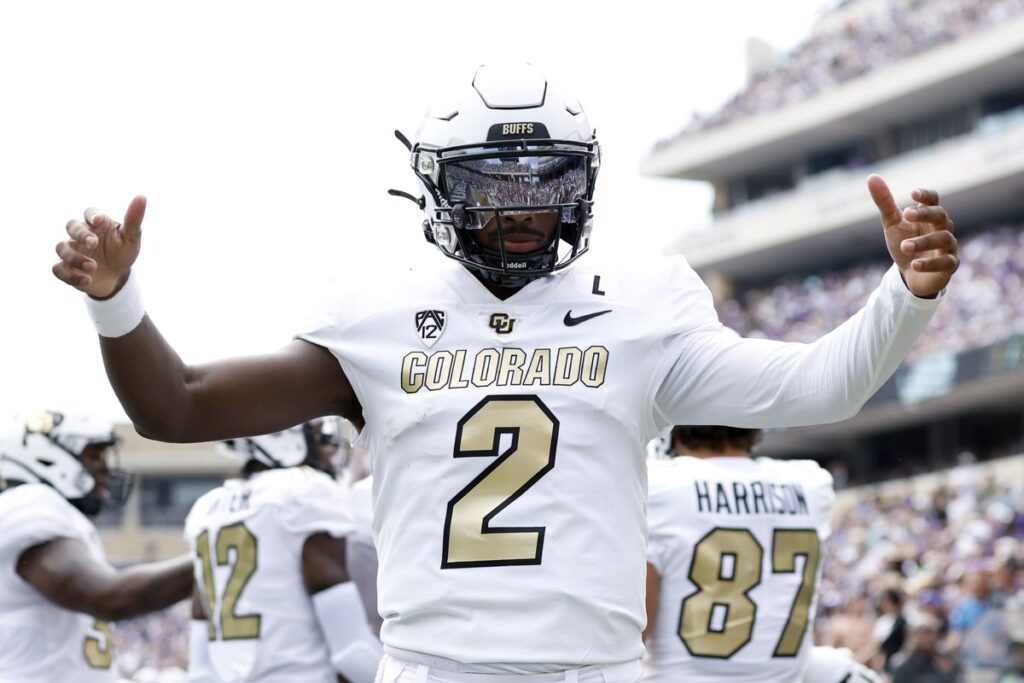
In case you missed it this past weekend, Colorado traveled to Fort Worth to take on a ranked TCU team. The result was a 45-42 victory in a game that could end up being one of the best of the year in college football. Deion Sanders making the jump from Jackson State to Colorado has placed the Buffaloes firmly in the national spotlight, and he brought some fantastic football players with him. Perhaps the two brightest stars that joined Deion in Colorado are his son, Shedeur Sanders, and his favorite playmaker, Travis Hunter.
The duo made an early impact in their week one victory, connecting 11 times for 119 yards. Sanders finished the game with a Colorado record of 510 passing yards, four touchdowns, and an 80.9% completion rate. Hunter failed to find the endzone on the aforementioned 119 yards receiving, but did make a spectacular interception to help keep the Buffs in the game. With Sanders and Hunter making a splash early in the 2023 College Football season, I thought it would be a good time to highlight them regarding their Devy outlook.
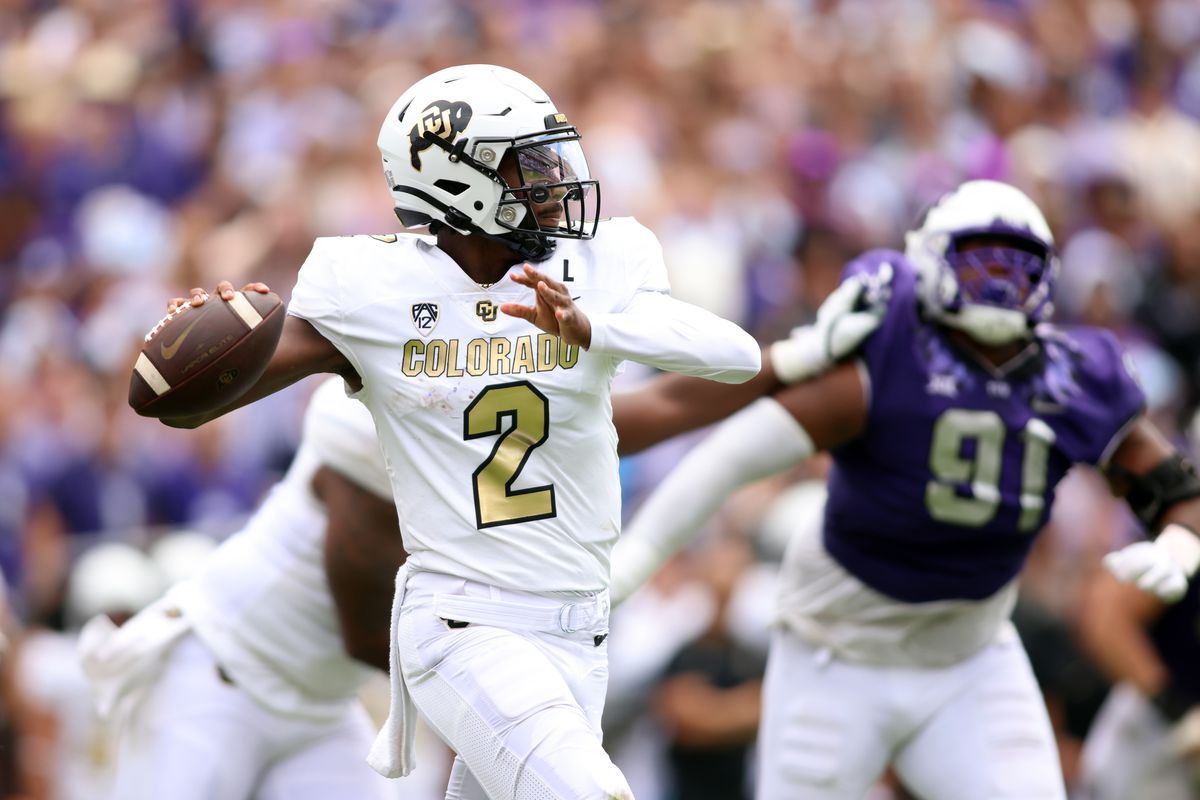
Shedeur Sanders | QB | 6’2” 215 lbs | 2024 Draft Eligible
Shedeur Sanders transferred to the University of Colorado from Jackson State after starting for two seasons. During his time with Jackson State, he managed to throw for nearly 7,000 yards and a TD:INT ratio of 70:14. If you were able to turn on any of the Jackson State games, you would have come away impressed with Sanders’ arm strength and decision-making. Despite such gaudy numbers in his first two seasons of college football, the concern was always the lower level of competition. This question was quickly answered in week one, as he threw for over 500 yards against a team that played in last season’s national championship game.
Sanders displays nice poise and surgically goes through his reads while navigating the pocket. He can make initial pass rushers miss and extend plays while keeping his eyes downfield. Though he is mobile, I wouldn’t consider him a true dual-threat quarterback in the same vein as Kyler Murray, Justin Fields, and others, but he can pick up big chunks of yards with his legs when his team needs him to.
He has plenty of arm strength to spread the ball all over the field but can struggle with accuracy on intermediate throws and his placement/touch on deep balls. He will have plenty of opportunity to improve on this now that he is surrounded by playmakers with more talent than he was throwing to at Jackson State. Some notable names on the Colorado offense include Travis Hunter (also highlighted in this article), Jimmy Horn Jr. (son of Hall of Fame WR Joe Horn), Xavier Weaver, and Dylan Edwards. Analytically, I worry about Sanders’ 7.7-yard ADOT in his career, which is extremely low and suggests that he has played on the conservative side to this point. He will be forced to increase this number if he wants to put pressure on defenses he will be facing in the PAC-12 and Big 12 (2024 season).
At this point, Sanders offers some tools that intrigue me for a potential NFL future. If he can fix some of these red flags while playing in the Power 5 for the first time, he could easily find himself in a first-round draft capital discussion, if not a top-10 pick in the NFL draft. I do not expect Sanders to declare after this season for a few reasons. To start, he is playing with his brothers and his father. Family members rarely get to be on the field together at the same time, and I expect Sanders to enjoy that for as long as it remains reasonable. Secondly, the 2025 quarterback class is wide open. If he were to declare in 2024, he would be hard-pressed to be a top selection, as Caleb Williams and Drake Maye seem to already have QB1 and QB2 locked up. In 2025, however, Sanders could very well be the top quarterback on most NFL teams’ draft boards. The class at this point is shaping up to include Drew Allar, Cade Klubnik, Conner Weigman, and Riley Leonard as its top signal-callers — and potentially only Allar has more raw talent than Sanders.
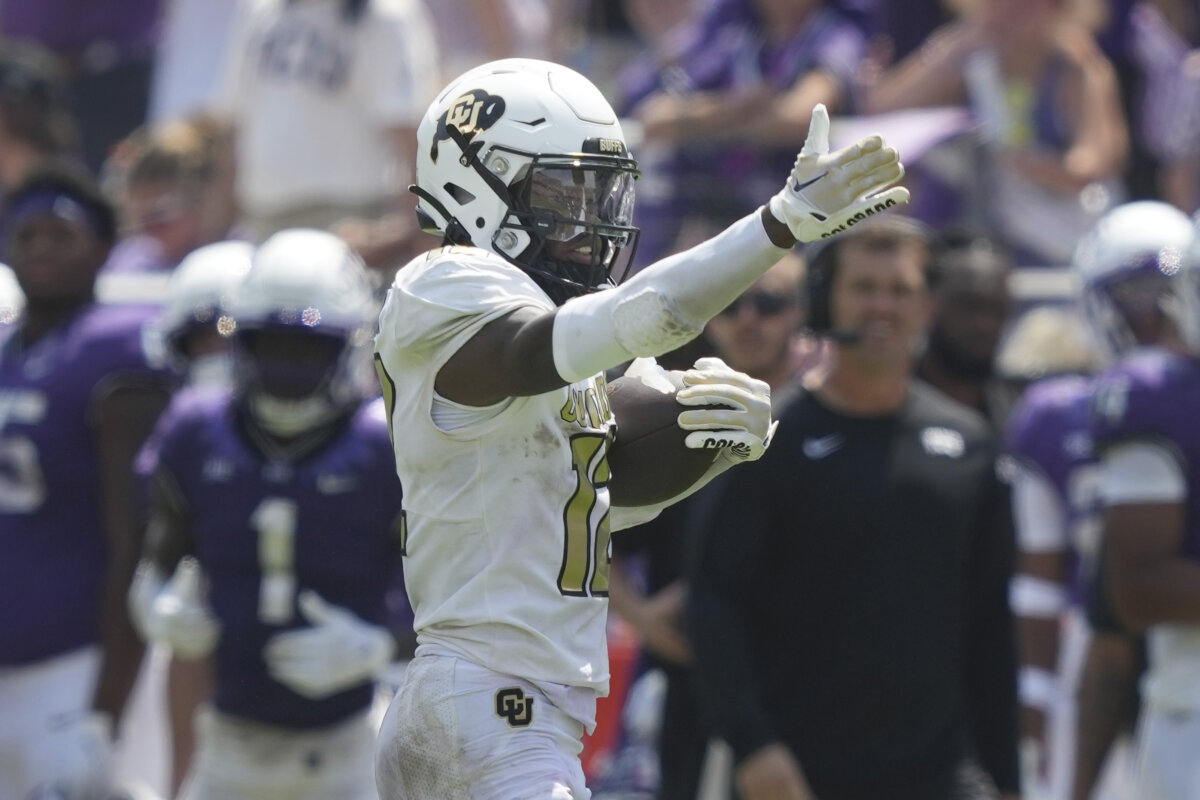
Travis Hunter | WR, CB | 6’1” 185 lbs | 2024 Draft Eligible
Similar to Shedeur Sanders, Travis Hunter also transferred to the University of Colorado from Jackson State after playing there for two seasons. Coming out of high school, Hunter was referred to by many as a generational talent. He was recruited simultaneously as the number-one cornerback prospect AND the number-one wide receiver prospect in the class of 2022.
While playing for Jackson State, Hunter contributed 18 receptions for 188 yards and four touchdowns on offense, adding 20 tackles, two interceptions, and ten pass break-ups on defense. If you are looking for more gaudy numbers than these, look no further than his prep stats leading up to college — 3,600 receiving yards, 46 touchdowns, and 19 interceptions.
On the field, Hunter makes everything he does look easy. He is smooth and explosive with good hip fluidity. He also displays shifty footwork and a good change of direction, but despite this footwork, he is not a very refined route runner. What he lacks in route-running and separation, he does make up for with his extreme competitiveness and elite ball skills. He has an exceptional ability to high-point the football and elevate over defenders to make contested catches. Finally, and perhaps most importantly, he radiates confidence and has a knack for making big-time, highlight-reel plays.
While Hunter has played on both sides of the ball in both high school and college, the biggest fear in drafting him in Devy is that the NFL may view him primarily as a cornerback rather than a wide receiver. Drafting him in an IDP league provides some form of value insulation since he can be inserted into your lineup regardless of position designation, but drafting him in a non-IDP league provides a considerable measure of uncertainty.
I would like to present an argument that I believe puts the above scenario in a better perspective. As a thought experiment, let’s make Hunter the wide receiver and Hunter the cornerback two separate players. Now, put both players on some of the top-tier college programs around the country. Travis Hunter, the cornerback, would be the top option at the position for Ohio State, USC, Alabama, Georgia, and so on. In contrast, Travis Hunter, the wide receiver, would likely struggle to see the field for each of these teams. I believe the NFL will see him in a similar light and push for him to play mainly on the defensive side of the ball.
With all of this in mind, Travis Hunter has the potential to be a game-changing talent on either side of the ball in the NFL and should be drafted in your fantasy leagues accordingly. He will eventually need to add some body weight to his frame, but at this point, it is the least of my concerns. For now, we can sit back and enjoy the weekly show that is Travis Hunter while we wait to see where NFL general managers want him to play.
Thank you for reading, and be on the lookout for more Devy spotlight articles throughout the remainder of the college football season. If you have any thoughts or questions and would like to discuss them, you can reach out to me on Twitter @Evan_Kerr_. #DFFArmy #AlwaysBeBuilding


Pingback: Devy Spotlight: Shedeur Sanders and Travis Hunter | DailyWise.com