
Building a league-winning roster involves being competent across many different criteria. The first box to check is having a high and consistent weekly floor. A weekly floor is important because inconsistent teams tend to not make the playoffs. It’s a long season, and your team getting cold for a couple of games here and there can be the difference between making a championship run and trying to not finish last. Now I understand that talking about players’ floors is not the sexiest topic in the world, but points win weeks. It’s as simple as that. This series will be written for those in normal PPR redraft leagues, starting 1QB, 2RBs, 2WRs, 1TE, and 1RB/WR/TE along with a Kicker and Defense. Follow these steps, and you will be on top of your league’s podium at the end of the season.
When it comes to balancing floors and ceilings of players and teams, my general rule is to get more aggressive as the draft goes on. This doesn’t mean to start with a passive mindset, but don’t get cute with the first two rounds either. Get players that produce consistently and produce well. There is upside in every round of the draft, but the top players are those that blend upside with consistency. After the first round, players start to fall short in either one of the categories.
Throwing around the term “high floor” does not mean anything unless it’s defined. In the first round, you should be looking for players that produce consistently. It is hard to project weekly stat totals, but it’s much easier to predict how many touches the player will get. For running backs, I like to use what I call the Opportunity Index. The formula for the Opportunity Index = Rushing Attempts + Targets x 3. The reason that Targets get tripled is that good running backs average five yards per carry, and average slightly over that in yards per target. Since there is a one-point bonus per catch, This means that the average target yields a running back 1.5 PPR points, while the average rushing attempt yields .5 PPR points. To find a running back with a high floor, their Opportunity Index must be over 25. This number is low enough to allow pure runners the chance to meet the threshold, while it still gives value to pass-catching running backs.
Take players with sure-fire floors early on so you don’t have to reach late in the draft; those players tend to have extremely low ceilings. Draft potential league-winners, or at least players that give you a shot at having a competitive advantage over the rest of your league. If you shoot for the stars in the ninth round and that player ends up being a total bust, who cares? But if your second-round pick ends up being someone that is floating between your Flex spot and your bench you’re fighting an uphill battle to win your league.

Okay, so a consistent and high floor is good, but what does that look like, and who are some players that fit that mold? Each position will have different criteria for what defines a great floor. With running backs, which you should be targeting heavily early in your draft, two elements provide a great floor. The first is targets in the passing game. Targets are great because they provide the catch bonus, but they are also better opportunities for yards. You can look at the best rushers in the best situations, who are not pass-catching backs at all, and they will still average more yards per catch than yards per rushing attempt. This includes Derrick Henry, Nick Chubb, and even J.K. Dobbins, who led the league in yards per rushing attempt. This is also why players like Christian McCaffrey, Alvin Kamara, and Austin Ekeler are so productive. Targets are king, even for running backs.
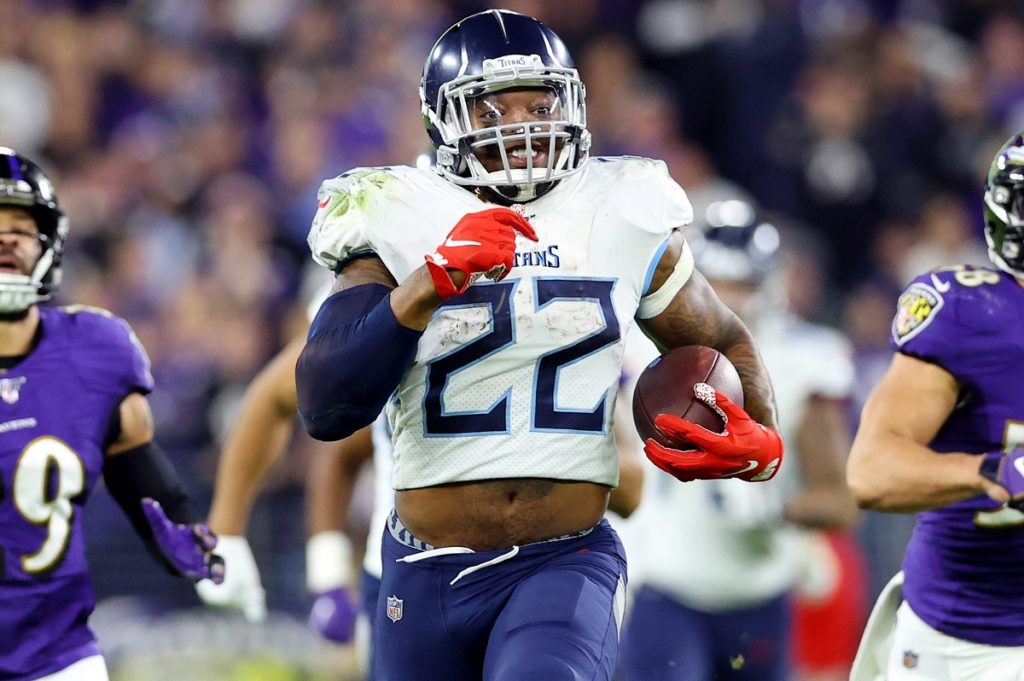
Outside of targets, rushing volume is the other driver of having a high floor. The epitome of a high running back floor is Derrick Henry. Last year, Henry never saw fewer than 15 carries in a game. This allowed him to finish top-3 in PPG last year despite lackluster receiving volume. Your starting running back gets both receiving work and carry volume in an ideal world, but those players are hard to come by if you aren’t picking the nearly unanimous top two picks in Christian McCaffery and Dalvin Cook. If you can’t get a back that meets both criteria, at least be sure that they meet one.
First-round players are there for a reason. Most provide upside while also maintaining a high floor. Two players that do not fit this mold are Jonathan Taylor and Aaron Jones. To win your league, your first-round pick cannot be a bust. Jonathan Taylor plays alongside Nyheim Hines, who is one of the best pass-catching backs in the NFL and is a major part of their offense. He also will split carries with Marlon Mack, who missed nearly all of last year with an Achilles injury. Do not draft a player who is probably going to be splitting reps with two other RBs in the first round. Aaron Jones is slightly safer since he does not have nearly the same competition for targets, but I would avoid him as well because he is likely going to be losing goal-line carries to his 247 lbs. running mate AJ Dillon. To have a consistent, playoff-bound roster, you need a sure-fire pick in the first round. Jonathan Taylor and Aaron Jones are far from that.
High-floor players exist in other positions as well. In standard roster leagues with only one quarterback, there will be wide receivers and tight ends that come off the board in the first two rounds. There is perhaps no player in the entire NFL that embodies a high floor better than Chiefs’ TE Travis Kelce. Kelce had at least 70 yards or a touchdown in 14/15 games last year and had at least one touchdown in 10/15. With Sammy Watkins gone, there is even less competition for targets. Even as he continues to age, he remains a dominant fantasy weapon in your TE slot. While there is one elite option with first-round contention at the tight end position, there are more options for wide receivers. Tyreek Hill, Davante Adams, and Stefon Diggs all have an argument to be selected in the first round. This is because they command a high number of targets and are extremely good at converting them into big plays and touchdowns.

While wide receiver and tight end are less popular picks in the first round, more come off the board in the second and third round. Instead of just looking for slot receivers who see a lot of targets or TEs that play alongside weak WR corps, I take a different approach when it comes to how to view a WR’s floor. On your team, you’re going to have more than two or three WRs. The position is too deep, and that depth will allow you to have a solid floor. You can afford to take shots on players that might break out. After you load up on running backs early, keep taking dart throws at WR. You only need a couple to hit, and you can still find great players in the middle rounds.
Look at your RBs on an individual basis, starting with a high floor and slowly working more and more aggressively. For your WRs, look at them as a complete group. They should all be players that have great upside, so you can have a high floor through depth at that position. You’ll have more opportunities to take WRs in your draft, that’s just the nature of fantasy football. Make sure every shot you take has great upside. Even if you miss a couple of times, you have so many options that some are bound to hit.
The next article in this series will look at how to have a high weekly ceiling, so you know who to target in those mid-to-late rounds of your draft.
Thank you so much for reading my content. If you have any questions about this article or anything fantasy football-related, you can find me on Twitter @DecaFantasy. While you’re here, you should check out other great content written by DFF, or you can check out our YouTube Channel. Thanks for being part of the #DFFArmy!

