
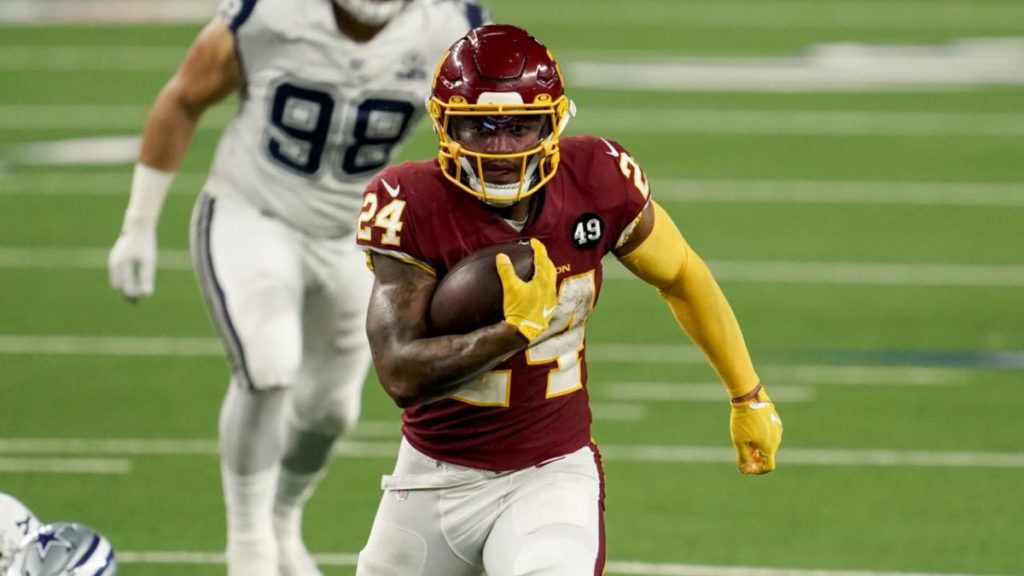
Stress Fractures – An Antonio Gibson Update
The Antonio Gibson stress fracture injury has been weighing on me lately. Originally, I felt like this was a pain management injury (which it is) but Gibson’s decline in both production and usage as well as his post-game MRI report, and DNP this Wednesday has me going back to the literature.
So let’s start from the basics, what is a stress fracture?
A stress fracture or a hairline fracture is a small crack in the bone that doesn’t go all the way through. Sometimes it is so small that even a radiograph or x-ray doesn’t pick it up.

So shin splints?
No, shin splints are just the inflammation of the muscle, tendons, or bone around the tibia or shin bone. A stress fracture involves physical damage to the bone itself.
How do we get a stress fracture?
Stress fractures aren’t due to trauma like a motor vehicle accident or taking a big hit on the field. Stress fractures normally are caused by repetitive trauma, they are an overloading issue. Oftentimes they are due to athletes ramping up too quickly to high impact, repetitive activities such as running. It’s why the injury is very common in distance runners.
How common are stress fractures?
Stress fractures account for around 10% of all sports injuries. While I couldn’t find a study for American football, I found a study showing that just 0.5 % of elite soccer players sustained stress fractures which are likely comparable to the NFL.
Antonio Gibson has a tibial stress fracture which is the main bone of two that makes up the shin. The research tells us that 75% of stress fractures occur in the tibial diaphysis which is a fancy way to say the shaft or long part of the bone. So it’s fairly safe to assume this is likely the case with Gibson.
Now we can break that down further as there are two main types of fractures that can occur to the tibia. Injuries to the anterior cortex and the posterior cortex. I bring this up not to confuse more but to discuss the recovery implications of each.
Posterior cortex injuries
In the systematic review, 77 athletes were found to have injuries to the posterior cortex. According to the study, all 77 were able to be treated conservatively and had a 100% return to sport rate.
Anterior cortex injuries
In the same systematic review, 160 athletes were found to have injuries to the anterior cortex. According to the study, 111 of the 160 required surgery after first attempting conservative management of the stress fracture. Of the 160, 88.5% were able to return to sport.
Of the athletes with anterior injuries that were treated with just modified rest, the return to sport rate was only 55%.
Return to Sport Time
Posterior Injuries
Athletes were able to return to sport as early as 0 months but on average returned around 1-2 months following a bracing and modified rest protocol.
Anterior Injuries
Athletes were able to return to sport as early as 3 months with anterior cortex stress fractures with the average being 6 months. The longer heal times are likely due to decreased blood supply on the anterior tibial cortex.
Risk of playing on a stress fracture
Although extremely unlikely, the biggest risk would be a complete fracture of the tibia. The second risk and the most likely outcome is that the athlete continues to delay healing of the bone which prolongs symptoms and could lead to a non-union of the bone which would result in surgery.
What does this mean for Antonio Gibson?
In Week 6, fantasy managers saw Gibson’s workload drop to a season-low 10 rushing attempts and snap percentage of 39% as it is clear the team is attempting to manage Gibson’s workload. Following the game, coach Ron Rivera indicated that Gibson had re-aggravated the injury and was being sent for an MRI. We are still awaiting the results.
After breaking down the research, I think it’s very possible the Washington Football Team shuts down Gibson for at least a few weeks to allow for some conservative management of his symptoms. Assuming it’s a posterior injury, I would suspect Gibson is shut down at least through his bye week which is Week 9. If symptoms persist or if the injury is indeed an anterior cortex injury, he may be out much longer. If Gibson continues to play or is rushed back again, we likely will see his load managed and his effectiveness significantly decline.
Redraft Outlook
Right now, I’m treating Gibson like a back-to-middle RB2 for the remainder of the season until Washington decides to shut him down and let him heal. It’s an unfortunate injury but an injury where we understand the treatment plan… rest. It’s not something fantasy managers want to hear but it will likely be better for Gibson’s production over the back half of the season. In the meantime, J.D. McKissic and Jaret Patterson have the most to gain from a potential absence of Antonio Gibson.
With Gibson, McKissic is already the RB 29 on the season in 0.5 PPR averaging nine fantasy points per game. In the three games in which McKissic has seen at least 10 attempts, he is averaging 15.7 fantasy PPG which would be the 13th-highest ppg in 0.5 PPR on the season. In Week 6 against Kansas City, where Gibson was clearly limited, McKissic played 61% of the snaps. Up from his previous high of 46% in Week 3. In that game, McKissic saw 10 targets through the air catching eight of them while also receiving eight carries on the ground averaging 5.6 yards per carry.
Washington is dead last in points allowed per game with 31 points surrendered on average. Washington plays Green Bay on Sunday who has averaged 31 points per game at home on the season. The game script and the usage should be there for McKissic this week and possibly beyond if Gibson sits. The Washington defense doesn’t look to be improving and even with Gibson, McKissic has averaged 5.4 targets per game with Heinicke as the starter.
As for Jaret Patterson, he likely steps into the early-down workload if Gibson were to miss. Patterson is a versatile, do-it-all rookie running back out of Buffalo. He is small at just 5’9”, 195 lbs. but led CFB in 2020 in yards after first contact. He averaged 7.6 yards per carry at Buffalo in his final year of college but didn’t record a single target that year. However, in three preseason games, Patterson looked like a capable pass catcher with almost four receptions per game. Patterson is worthy of a pickup as he has the talent to fill in as an early-down, workhorse running back. However, expectations should be tempered as Washington’s next three games include the Packers (away), Broncos (away), and the Buccaneers (home). The 13th, 4th, and 1st best defense against the run this season, respectively. Plus, the Packers and the Bucs likely put the Football Team in negative game scripts.
Dynasty Outlook
The return to sport rate is nearly 100% even following the worst possible outcome of surgery. So dynasty managers can hold right knowing that this injury likely won’t impact him long term nor does it have a high recurrence rate.
Conclusion
Overall, Antonio Gibson needs rest. I’m fairly confident the Football Team is going to sit him down in the near future. Even upon return, I expect his load to be managed giving way to McKissic as a valuable fantasy asset. Given the DNP already this week, and the lack of information released following Gibson’s MRI there is potential that this injury is more serious than just taking a few games rest. McKissic should have already been rostered and Paterson is now a must-add as we await news on Gibson’s injury. Hopefully, this isn’t a situation where Gibson requires surgery, but given the above evidence, there is still a small percentage chance that it does.
-Zach Pavlichek, PT, DPT
Feel free to follow me on Twitter @zachpav42 as I break down injuries and answer fantasy football questions daily!
References
Ekstrand J, Torstveit MK. Stress fractures in elite male football players. Scand J Med Sci Sports. 2012 Jun;22(3):341-6. doi: 10.1111/j.1600-0838.2010.01171.x. Epub 2010 Aug 30. PMID: 20807388.
10. A. J. Robertson, A. M. Wood, Return to sports after stress fractures of the tibial diaphysis: a systematic review, British Medical Bulletin, Volume 114, Issue 1, June 2015, Pages 95–111, https://doi.org/10.1093/bmb/ldv006

