

Amari Cooper is a top tier talent at the wide receiver position, there’s no doubt about it. He was an elite prospect, coming into the league with some eye-popping metrics. He finished in the 89th percentile for 40 yard dash time, 92nd for speed score, and 98th for agility score. Cooper also came out of college with a dominator rating (47.2) in the 93rd and breakout age (18.2) in the 99th percentile!
Not only did he dominate in college but his talent transferred well to the NFL. He’s finished as a top 24 receiver four out of his five seasons in the league and finished as a top 10 PPR receiver in 2019. Cooper completed four of five career seasons with 100+ receptions and 1000+ yards. He’s certainly a valuable fantasy asset but is he really the top 10 fantasy receiver you want to own? I don’t think so and here’s why.
SHARING IS CARING?
Amari Cooper has monopolized his team’s target share over his career. He’s seen at least 20% every season since 2015. This is something just 10 other wide receivers have accomplished. The thing is, of the wide receivers who’ve received at least 20% target share over the last three seasons, Cooper is last in average target share (20.2%). He’s received exactly 20% two of the last three seasons and it didn’t get much better in Dallas (20.7%). Cooper is dangerously close to falling below the 20%+ target share threshold. This is a benchmark almost all top-10 fantasy wide receivers reach in a given season. Brandin Cooks is the only receiver to finish in the top 10 since 2015 with below a 20% target share and he finished with 19.4%.
You may ask yourself: “Why worry now if he’s reached at least 20% every season he’s been in the league. What are we concerned about?” Cooper reached the threshold every year but has just one top 10 fantasy season under his belt. He consistently finishes with one of the lowest target shares over 20% and lands on a team with Michael Gallup, who commanded a 21.7% target share in 2019. It’s rare to find two receivers on the same team with over 20% target share. Gallup was very productive and there’s no reason to think Prescott will suddenly avoid him and shift targets to Cooper. This consolidation of targets seriously limits Cooper’s upside.

Sure, we have to account for the vacated targets from the departure of Randall Cobb and Jason Witten; but we haven’t even mentioned the addition of rookie Ceedee Lamb or the emergence of tight end Blake Jarwin. Jarwin will likely receive the majority of Witten’s targets. Also, I doubt many will argue that Ceedee Lamb will be good enough to receive at least 10% of the target share. I see Cooper having a tough time maintaining his career average target share even if we project Dallas to match their highest passing attempt total since 2011 (597 attempts) again in 2020. Mike McCarthy runs a pass-first offensive, but the Packers pass attempts exceeded 600 just one time since 2011. I don’t see the Cowboys passing volume increasing over 600 attempts with both Ezekiel Elliot and Tony Pollard available in the backfield, who will also be given significant targets.
Sharing is caring, right? I bet Cooper owners don’t think so.
CONSISTENCY & AVERAGE FPPG
I’m putting forth somewhat of a disclaimer before I really get going on about consistency.
I recently took part in a twitter debate about whether or not Odell Beckham Jr. was still a better dynasty asset than Amari Cooper…which he is! This debate turned into a discussion about fantasy consistency. Subsequently, I was taught a very valuable lesson from some very smart people.
Adam Harstad, who works with Matt Waldman on the rookie scouting profile and has done other great work crunching the numbers, provided some really valuable insight. I encourage everyone to go read this thread.
I know everybody doesn’t have the time so in summation, consistency is worth very little. Adam actually quantified it as about “one extra 20-yard reception over the entire season”. That’s just two extra fantasy points, therefore consistency doesn’t provide a ton of value if any at all.
Not only is consistency not worth a whole lot but in fantasy, you want players who outperform the average because they give you the best advantage to win throughout an entire season. This makes sense. It means players like Amari Cooper, who can score 30+ PPR points one game and one point another, is still valuable.
Shockingly, even high levels of consistency aren’t worth much.
That said, I think it’s just common sense to prefer the more consistent option if two players have a similar floor and ceiling. In the grand scheme of things, consistency isn’t the most valuable trait. But, in fantasy football, every edge counts. You want to maximize your advantages, and consistency may be a piece of that equation for you.
Now that we have some context, we can explore Cooper’s inconsistency. Let’s first look at ESPN’s consistency ratings over the last three years. He has the sixth-worst rating from 2017-2019 and finished with the third-worst (.54) rating last year of receivers with over 100 targets. Christian Kirk and Mike Evans were the only two to finish ahead of him.
To make things worse he’s one of two top 10 receivers in 2019 who finished 15+ games among the worst at his position (ranked 51st+) over the last three years. Chris Godwin was the other but he started just two games his rookie year, what’s Cooper’s excuse? He finished among the worst at his position 17 of his 45 (43%) games since 2017. You might say “but Cooper gives you those huge boom games”, but how often has that actually happened? He’s finished in the top five at his position just five times since 2017, as many as Robby Anderson and one fewer than Marvin Jones Jr. An elite group, I guess you could say. Additionally, he owns the seventh-highest drop rate (5.78) since 2016 among receivers with at least 90 targets. He’s one of the most unreliable fantasy receivers scratching the top 10.
Lastly, while consistency isn’t everything it’s interesting to note he averaged 15.4 FPPG in 2019 while his counterpart Michael Gallup average 15.2 FPPG. They finished with strikingly similar stat lines. Yet, Gallup is going at least two rounds later in dynasty startups and mock drafts. I’d much rather take the value on Gallup in the high volume passing offense than pay all the way up in the second or third round for Coop.
CONTRACT ESCAPE HATCH
We’ve all seen it or heard it: “I’d take Amari Cooper as the Cowboys WR1 for the next five years.” Okay, but what if he’s not there for five years?
Now, I’m not here to insult anyone’s intelligence. NFL contracts can hurt your brain–they certainly hurt mine. Somehow, five-year deals aren’t always five-year deals. In Cooper’s case, they snuck in what they call an escape hatch.
Cooper signed a five-year deal worth up to $100M with $40M guaranteed but here’s how it really works. He receives a $10M signing bonus, $10M in 2020, and another $20M over the next four years of which only one is guaranteed. So, by 2022 he’ll have received his $40M fully guaranteed but another $22M is due to kick in March 2022. The Cowboys have given themselves an out if Cooper isn’t providing them the proper return on their investment or if they just decide he’s not worth the money anymore. This tactic effectively turns a five-year deal into a two-year deal with limited risk from an organizational perspective.
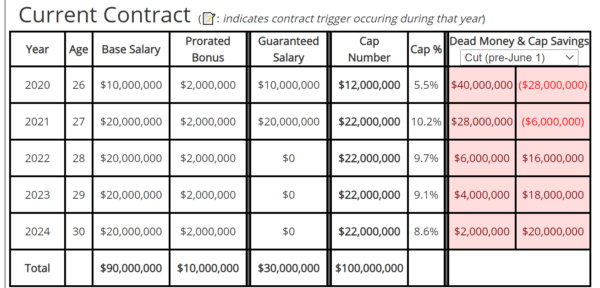
Dallas is a high volume passing offense, a trait coveted by the dynasty community, especially in regards to wide receivers. Volume means opportunity and we know Cooper thrives off of a high target share. We know how he’ll be utilized in Dallas, but we can’t project him to be on the Cowboys for five years. That uncertainty is a cause for concern.
As a dynasty owner, this issue won’t reach your doorstep for a while. However, he just slipped into the top 10 last season and I’m not so sure that is a given going forward. This could be the most auspicious time to sell Cooper before things become very unclear.
CONCLUSION
These factors by themselves may not be of great importance to you. In combination, they begin to paint a fairly concerning picture. Especially, for a player valued as a top 10 fantasy wide receiver. To put it in perspective, I’d prefer a player like Cooper Kupp. He’s not a sexy pick but provides the boom games with much more consistency.
Cooper is still just 25 years old. He should have a long career and a lot of valuable fantasy production ahead of him. My advice is to temper expectations based on a reasonably projected distribution of targets and competition, inconsistency from week to week, and future uncertainty due to the contract escape hatch.
Thank you for reading. If you have any thoughts or would like to discuss, you can find me on Twitter @WillieBeamanDFF

