

The dust is settling from the 2020 NFL Combine and 2020 wide receiver (WR) rankings are falling into place. Currently, the debate is focused around the top tier wide receivers in this class. However, NFL Draft experts like Daniel Jeremiah and Mel Kiper Jr. have emphasized the depth of this year’s class. Daniel Jeremiah has, “27 wide receivers with top 3-round grades in this draft.” Mel Kiper predicts, “There will be 25-30 receivers going off the board in the first three rounds, with as many as five in the first and eight in the second rounds.”
It’s understandable that dynasty players are concentrating on first-round wide receivers. Missing an early pick can be a significant setback for their squads. Conversely, hitting on a third-round, fourth-round, or even an undrafted player can add significant value to your team. One of those potential late-round picks in dynasty is Aaron Parker, WR, Rhode Island.
Age-Adjusted Production
Aaron Parker checks a lot of boxes. First and foremost, Aaron has impressive age-adjusted college production. He broke out during his true freshman season at age 18 for the Rhody Rams. The Gwynn Park High School product was URI’s primary receiving option. He also had a 34.7% dominator rating (average market share of receiving yards and touchdowns) in his first season. Parker continued to produce at an elite level for Rhode Island. He earned over 35% of their receiving production in each of his final three seasons. He did so with his cousin and fellow NFL Combine invitee, Isaiah Coulter, playing opposite him as well. Parker leaves Rhode Island second all-time in team history with 3,460 career receiving yards. He also takes home third all-time in touchdowns with 30.
Personally, I like to dig a little deeper than college dominator when looking at wide receiver prospects. A lot of smart analytics people use a player’s last college season when looking at college wide receiver metrics. I’ve tested college wide receiver’s best, last, best and last (dominator rating), and the career average stats/metrics in relation to their fantasy football success. Currently, I’ve had the most success using the college average for wide receiver stats and metrics. Aaron Parker’s career averages are excellent in comparison with other wide receivers in this class. They also are stellar when compared to wide receivers that have entered the NFL since 2003. Parker averaged 1.18 scrimmage yards per team play (90th percentile) over his entire career.* That’s just ahead of Ceedee Lamb for first in this class.
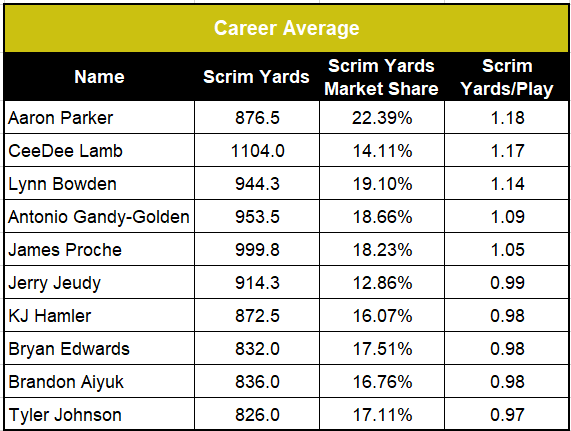
When juxtaposed against wide receivers with at least one top 24 PPR season, Parker had +0.17 scrimmage yards per team play over the average. Compared to how other historical wide receivers performed in the context of their conference (other FCS schools for Parker), he had +0.12 scrimmage yards per team play over expected (66th percentile).
Many analysts tend to shy away from looking at touchdowns because they are volatile year to year in fantasy football. However, I found a relatively strong r-squared correlation between college career average scrimmage touchdowns and fantasy success for NFL wide receivers. Parker does well compared to wide receivers in this class and historical wide receivers since 2003. He averaged 7.8 scrimmage touchdowns per season (81st percentile) at Rhode Island and that ranks 11th in this class. He ranks second in this class in career average scrimmage touchdowns per team play.
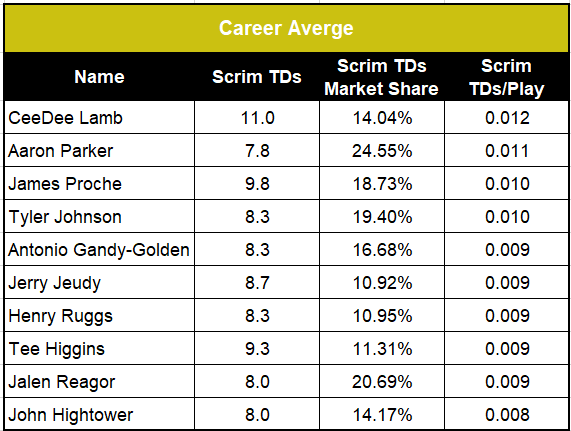
Compared to wide receivers with at least one top 24 PPR season, Parker performed around the average by having -0.1 scrimmage touchdowns under the average (81st percentile). Contrasted to how other historical wide receivers did within the context of their conference (other FCS schools for Parker), Parker didn’t fare as well by having -1.3 career average scrimmage touchdowns under expected (36th percentile). In Parker’s defense, not many other FCS school wide receivers had another NFL Combine invitee on their team competing for targets (Isaiah Coulter).
A lot of us in the fantasy community are conditioned to rely on receiving market share data or dominator ratings to summarize a wide receiver’s college production. I prefer to use a career average scrimmage dominator (average market share of scrimmage yards and touchdowns). Aaron Parker’s 23.5% career average scrimmage dominator is far ahead of the other wide receivers in this class. Also, he is in the 95th percentile of all wide receivers to enter the NFL since 2003.
Athletic Testing
College production constitutes the largest part of my wide receiver evaluation. That being said, I do consider athleticism to an extent. In the past, I used to be all-in on the NFL Combine and what it means for wide receiver prospects. However, more analytically focused analysts like Peter Howard (@pahowdy) have been downplaying the significance of athleticism testing compared to the fantasy success of NFL wide receivers. After testing NFL Combine numbers myself, I now also deemphasize athletic testing. The one combine metric I do pay attention to is height-adjusted speed score (HaSS).
Aaron Parker’s HaSS is 96.2 (52nd percentile) and is sufficient for NFL success. Unfortunately, Parker does have a few red-flags in his other ancillary athletic tests. These tests are not always predictive of future NFL success. His 12 reps (23rd percentile) in the bench press, 26.5” vertical jump (1st percentile), and 112” broad jump (3rd percentile) are all well below league average. His 4.24-second short shuttle (56th percentile) and 6.94-second 3-cone drill (58th percentile) are at or slightly above the wide receiver average.
Besides HaSS, I pay very close attention to the height and weight measurements for wide receivers at the NFL Combine. Body measurements can be more of a descriptive tool rather than a predictive metric. NFL wide receivers come in all different shapes and sizes. Their height and weight measurements begin to paint a picture of how a wide receiver will win in the NFL. Smaller wide receivers usually need to win with speed, agility, and precision. Bigger wide receivers tend to use their size and strength to win against NFL defenders. This is a blanket statement and there are exceptions to every rule.
I like to use this information paired with analysis from trusted film analysts to see if landing spots are a good match after the NFL Draft. At the NFL Combine, Parker was 6’1 ⅞” and weighed 209 pounds for a Body Mass Index of 27.1. These are solid measurements for a bigger slot wide receiver or a boundary wide receiver at the NFL level.
Conclusion
Despite not playing wide receiver until his true freshman season at Rhode Island, Aaron Parker displayed age-adjusted dominance at the wide receiver position in college. He has an age 18 breakout age. Also, he was such a dynamic player for the Rhody Rams he was their punt returner during his freshman season. Parker’s market share and scrimmage metrics are at the very top end of the 2020 wide receiver class. After adjusting his advanced metrics for Parker’s level of competition his numbers aren’t as dominant but they are still respectable.
However, most FCS prospects didn’t have another NFL caliber talent competing for targets like Parker had at URI. While Parker’s supplementary athleticism metrics are poor for an NFL wide receiver, his speed and agility metrics prove he has NFL requisite athleticism. In reality, Parker’s poor broad jump and vertical will hopefully prevent any hype from increasing his average draft position in your dynasty rookie drafts. Meanwhile, Parker’s 6’1 ⅞” frame, at 209 pounds fits the archetype for a big slot wide receiver or boundary receiver.
Ultimately, I hope Parker is an early Day 3 draft pick, but there is a chance the depth of this class could have him going undrafted in April. I would like to see him land on a team with top-heavy wide receiver talent. That scenario allows Parker a chance to compete for a small role early on in his career. Regardless of his landing spot, Parker is a player I’m targeting in the late fourth round of rookie drafts or as a waiver wire target to stash on my dynasty taxi-squads. At the very least, Aaron Parker needs to be a name to monitor during rookie minicamps and NFL training camps. If Parker creates any buzz in the offseason, I recommend picking him up off the waiver wire. I love to target inexpensive players with excellent age-adjusted college production to fill out the end of my dynasty rosters.
Follow me to the moon and back, @ff_spaceman on Twitter, in my quest into unexplored spreadsheets and dynasty football analysis. If you enjoyed the advanced metrics discussed in this article you can explore them yourself in my college prospect database.
*Analysts like J.J. Zachariason (@LateRoundQB) and Peter Howard (@pahowdy) use receiving yards per team pass attempt. My data likes receiving yards per team pass attempt as well but I have a higher R-Squared value for yards per team pass attempt.
All stats and metrics discussed in this article were found on www.sports-reference.com/cfb/, team websites, team media guides, team game day programs, and ESPN.com. Measurements discussed were found at NFL.com, nflcombineresults.com, playerprofiler.com, and pro-football-reference.com.

