
On Wednesday, Baker Mayfield was ruled out of the Thursday Night Football game in which the Cleveland Browns defeated the Denver Broncos 17-14. Mayfield was ruled out after suffering his second dislocation of the season on his non-throwing left shoulder. However, it was what Mayfield said before the Thursday Night game that spoke to the seriousness of his injury.
Jay Glazer reported/tweeted that “Baker Mayfield tells me in addition to his torn labrum he also has fractured his humerus bone (shoulder) according to a scan this week. Baker said his fracture is preventing his rotator cuff from firing.” He ended the thread with a direct quote from Mayfield, “I need the fracture to heal for me to get back out there.”
There’s a lot to break down here, but like always let’s start with the anatomy. The shoulder joint is a ball and socket joint. A commonly used analogy is like a golf ball sitting on a tee. So just like a golf ball on a tee, it’s prone to fall off. That’s where the labrum comes in. The labrum extends the tee and creates a better socket for the golf ball to sit on. The ball and socket joint is then further held in place with the rotator cuff muscles of the shoulder.
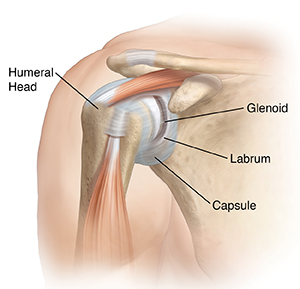
When Mayfield first injured his left shoulder in Week 2 attempting to make a tackle, he more so partially dislocated his shoulder and it reduced or returned into place on its own. More so a subluxation. During this injury, he likely tore his labrum which placed him at higher risk for reinjury. So then on his second injury in Week 6, Mayfield appeared to dislocate his shoulder without it reducing, meaning it stayed dislocated making it a much more serious injury. This likely further tore his labrum and is what caused the shoulder fracture.
The Fracture
The good news is that although Mayfield likely does indeed have a shoulder fracture. It’s not the same type of unstable fracture you likely are thinking of where you need to wear a cast and not use your arm for 6-8 weeks. Remember, Mayfield returned to the game in Week 6 after injuring his shoulder for the second time. He would not have been allowed back into the game if this was an unstable fracture. Unstable means the fracture is displaced or can be displaced with normal forces applied to it.
The likely fracture Mayfield is referring to is called a Hills-Sachs fracture or lesion. This fracture is very common in acute injuries with an almost 50% incidence rate in first-time anterior dislocations. This type of fracture occurs when the posterior-lateral (back-outside) section of the humeral head (the ball) impacts the glenoid (the socket) and causes a compression fracture (dent) to the humeral head. Below is a cartoon version of the injury and a real radiograph (x-ray) of the injury to better understand.
As long as less than 20% of the humeral head is impacted by the fracture, conservative management of the injury can occur. Meaning Mayfield can avoid surgery at this time by focusing on decreasing inflammation and stabilizing the joint. So to put it bluntly, yes, Mayfield has a fracture but he likely can play through the injury on his non-throwing shoulder. If he required immediate surgery, we likely would have already heard.
When Will Mayfield Return?
Just because Mayfield does not need surgery at this time (he will after the season) does not mean he is back to 100% either. His labrum tear is the bigger issue rather than his fracture as it means his shoulder will remain unstable. He will likely play in a harness all year but he will still be at high risk for reinjury. One study found that NFL players had nearly a 42% recurrence rate of dislocation which Mayfield has already proven to be true as this is his second already in just six games. It’s possible that if Mayfield continues to dislocate, eventually doctors may shut him down as with each subsequent dislocation more damage occurs.
One study looked at 92 NFL players who dislocated their shoulders and found that the average return to play time was 3 weeks which places Baker’s return at Week 9. In Mayfield’s situation, as he plays one of the more protected positions in football and he injured his non-throwing arm, it’s very possible and even likely that we see him return to action in Week 8.
What to Expect
We saw after Mayfield’s Week 2 injury that he came back into the game and continued to play very well, again speaking to the lesser severity of his initial injury. Following his Week 6 injury, Mayfield returned to the game for two series and struggled in his play. While he does not throw with his left arm, his left shoulder requires mobility and strength through his throwing motion and stability to hold on to the football while passing, running, or handing the ball off.
I would expect a slight dip in production following the injury as Mayfield is likely managing inflammation and pain for many weeks to come. Mayfield ended Week 6 as the 22nd ranked fantasy QB in 4-point passing touchdown leagues and 25th in fantasy points per game. The Browns rank 30th in passing rate per game and appeared ready to lean on the running game and defense even before the Mayfield injury. While I believe that Mayfield is likely still the better option to run this offense due to his leadership and abilities compared to back-up QB Case Keenum, Mayfield should not be in consideration in one QB leagues.
Mayfield has yet to throw for over two touchdowns and does not provide a rushing floor. Now injured, Mayfield will likely continue to avoid contact due to the risk of reinjury and may see a further decrease in passing volume and a lower average depth of target. The Brown’s pass-catchers likely maintain a similar value in fantasy football for whatever that’s worth. While the running backs, once healthy, will continue to maintain the focal point of the offense. Jarvis Landry may be the only pass-catcher to receive a slight boost in value (if healthy), as he likely remains Mayfield’s safety valve as he likely relies more on shorter passing routes to avoid hits and protect himself from further injury.
Conclusion
Overall, the injury news is positive in the sense that Mayfield can continue playing into 2021 even with his fractured left shoulder. That being said, we likely see a dip in already a low volume passing offense, and a dip in efficiency as Mayfield manages his symptoms throughout the season.
-Zach Pavlichek, PT, DPT
Feel free to follow me on Twitter @Zachpav42 for more injury analysis and content every day throughout the season.
References
1. Savoie F, O’Brien M. Management of Hill-Sachs Lesion, International Congress for Joint Reconstruction, 2014.
2. Okoroha KR, Taylor KA, Marshall NE, Keller RA, Fidai M, Mahan MC, Varma V, Moutzouros V. Return to play after shoulder instability in National Football League athletes. J Shoulder Elbow Surg. 2018 Jan;27(1):17-22. doi: 10.1016/j.jse.2017.07.027. Epub 2017 Sep 20. PMID: 28941971.
3. Leclere LE, Asnis PD, Griffith MH, Granito D, Berkson EM, Gill TJ. Shoulder instability in professional football players. Sports Health. 2013;5(5):455-457. doi:10.1177/1941738112472156

