
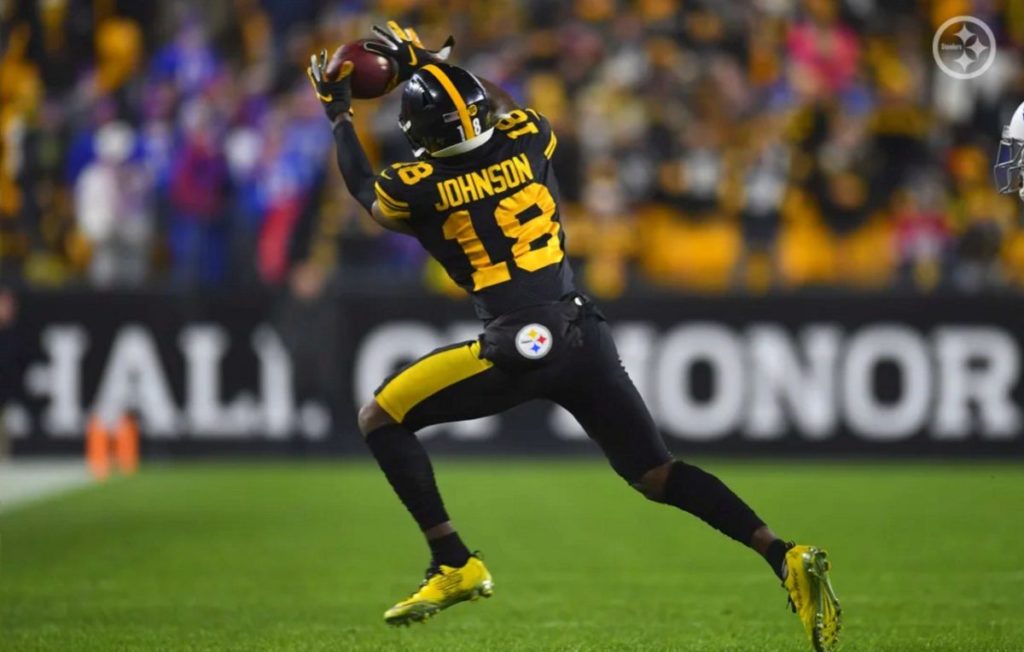
Film vs Analytics is one of the most hotly contested debates in the fantasy community. Both are important and one hand washes the other. Scouting and watching film are the foundation of evaluating talent. If data was the only indicator of success, NFL scouts wouldn’t need a scouting department. They would hire a Google Intern to run algorithms for them. On the flip side, data can help you make unbiased decisions and adjust your rankings by having a macro-level view of a pool of statistics. It’s important to understand what coaches look at on the field or in training camp because they decide if a player will even see the field. Not your algorithm. Moreover, learning scouting and theory can help you understand why players perform the way they do and what makes your data sing or choke.
Film study can help you catch players that data will undoubtedly miss because they lack production or they excel in other areas that aren’t as quantifiable. So let me be your film guru to guide and improve your football knowledge with scouting, starting with blue-chip route-running receivers. We’ll break down four different wide receivers throughout the season featuring different archetypes and evaluate the traits that help them excel, how they’re deployed, and traits to look for when you’re scouting. We’ll start with one of my favorite route technicians in Diontae Johnson.
Diontae Johnson
Height/Weight: 5’10” – 183 LBS
40 Time: 4.53
Shuttle: 4.45
Cone: 7.09
I always ask myself two questions during the first run through a receiver’s film or highlights. Can they get open? Can they catch the football? This is a very basic test to see if a receiver is worth your time. We’ll focus on the “can they get open” portion and sprinkle in some “can he catch.” Specifically, how route running is used to create separation. Why not talk about Diontae Johnson: “Separator Supreme” and “King of Drops”.
Route-running is by far the most underrated aspect of scouting wide receivers in fantasy. It’s not a flashy number that can be quantified and plugged into an algorithm unless you create Madden player ratings, and in that case, you don’t know what you’re doing (Kidding, but Beasley isn’t better than D.J. Moore). But route running is what makes good prospects great NFL players. It’s the easiest way for a seventh-round quarterback from Kent State to have a successful 12-year career and winning a Super Bowl MVP as a receiver.
So what makes a good route runner? Short-area quickness, field awareness, crisp cuts in and out of breaks, and the subtlety to sell fakes. The only quantifiable trait in that list is short-area quickness which we can measure with shuttle and cone drills. Diontae Johnson has above-average times in both, but nothing gaudy. It’s how he uses above-average quickness that makes him special. Few receivers have the body control to create the suddenness of his movements that break ankles. For data folks who don’t understand suddenness, imagine it as incredible stop-and-go ability, or just look at this punt return below.
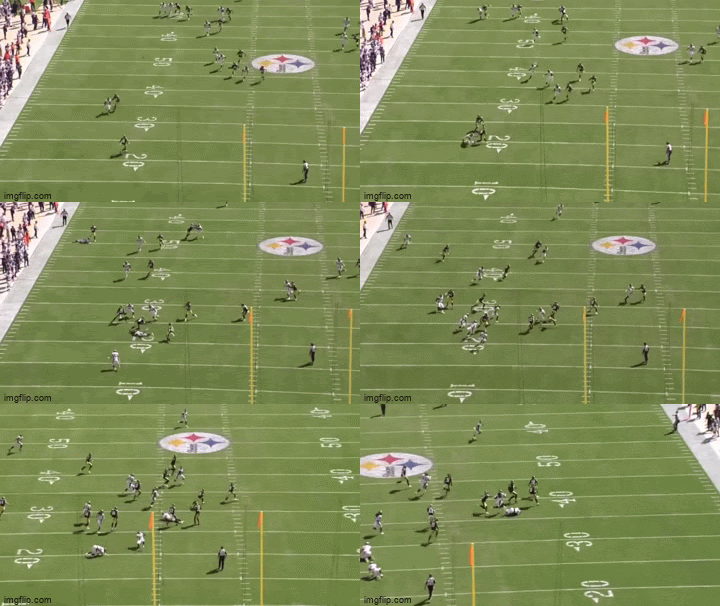
No, this isn’t a route, but Johnson makes five defenders miss before advancing 10 yards. Beginning from fielding the punt, Johnson is able to jab-step and plant his foot to make the defender commit to the tackle, then bursts ahead. Normally, a player would probably call a fair catch. So when he didn’t, I’m sure the defender was salivating for a big hit. I don’t think he’s wrong to believe he’d get the tackle because the gunner was in a position to either stop the play there or force the returner towards the sideline. Moreover, the average player without his short-area quickness would need to try and turn the corner towards the sideline and hope for a 10-yard gain. But alas, Johnson isn’t average and is able to stick his foot in the grass and reverse field.
This is a pure example of good defense, but even better offense. After Johnson makes the first guy miss, he picks his way around three defenders and bursts forward to completely break down the rest of the punt coverage. The punt was properly placed towards a corner inside the red zone for a touchback at the least. The punt coverage was in a position to wall off the side of the field but made two more defenders miss. The defense is now playing chase as Johnson has completely reversed field and put the remaining defenders out of position for good pursuit angles. This gives him room to turn the corner and finish the run. A player with these capabilities just has to apply this level of natural talent to route-running and you a blue-chip separator like Diontae Johnson.
But it takes more than being a great runner in the open field to run routes. It’s about understanding the nuances that place the defense out of position by understanding coverage of the entire unit, as well as the man in front of you. Julian Edelman excelled with the Patriots not just because of quickness and route running, but by adjusting his routes to the coverage. Many elite receivers failed in New England because they couldn’t read the defense like a QB and wouldn’t adjust their routes, or chose incorrectly in option routes. Johnson doesn’t get asked to do many option routes but is an absolute technician at working defensive backs out of position and timing his route perfectly to be open quickly. Reference the play below.

It’s no secret that the Steelers had a terrible offensive line, so they needed to scheme to get the ball out quickly, and Johnson has the perfect matchup and play call to move the chains two seconds after the snap.
Johnson is lined up by himself on the weak side of the field at the top left of the screen. The defense telegraphs man coverage with a single high safety, leaving Johnson only needing to work on one guy. Johnson was already in a great position to make this play from the snap, but what really sells this is the timing and trust between the QB and receiver on a 10-yard out. Johnson wastes little movement, takes the corner’s outside shoulder and pushes the route upfield deep. This opens the DB’s hips towards the sideline, setting up easy separation before his break towards the sideline. Johnson breaks exactly at 10 yards. He sinks his hips, cuts towards the sideline, and makes the catch with room to wiggle after. Keep in mind that this is on the short side of the field, and Johnson is able to get ample separation within five yards
This may seem like a boring route and play, but without precision and quickness, this play couldn’t be made. The QB doesn’t even need to go through his progressions and sells the play action then throws to where Johnson is supposed to be. You can be an athletic monster but fail without precision and field awareness. Imagine what he could do with more room for activities. Take the play below for example.

Diontae Johnson is working in the slot against man coverage inside the numbers in a perfect position to set up a wheel route. Johnson pushes the DB up the seam for five yards before jab stepping and selling the slant to break the DB’s ankles. This gives Johnson over three yards of separation and the DB is now playing catch up. Meanwhile, Chase Claypool is opening up the sideline for Johnson with a shallow post route that’s working as more of a downfield block with that amount of contact. Johnson finishes the out and flashes his hands for the catch before turning, planting his left foot, then bursting upfield and leaving the DB on skates again. The only thing wrong with this play is Johnson wasn’t able to get the ball.
It’s details like this that fantasy players sometimes overlook. Johnson would be a bonafide WR1 on any team that has a QB with a good arm and decent protection because he is always able to get open. Yes, he has drops, but this is a very coachable aspect of receiving. Johnson could benefit by relying on his hands more and not using his body to catch, as well as securing the ball before running to make a play. What’s harder to coach is the body control to truly be a deceptive separator from NFL-caliber DBs. Many of his drops are because he’s asked to make a harder catch because Ben Roethlisberger no longer has the velocity to push the ball upfield deep, or hitting outs to the sideline. Like this final play, I want to highlight below.

Diontae Johnson is lined up in the slot stacked in front of the outside receiver against Cover 2 Man. Johnson takes the slot DBs outside shoulder on the release and pushes upfield without contact for 11 yards, then breaks for the sideline with plenty of separation. There are actually TWO receivers open on the strong side because the outside receiver hits an out underneath Johnson. It’s an absolute shame that this couldn’t be completed because it would’ve certainly moved the chains. This is a poor read, and a poorer throw by the QB.
A quarterback can normally eliminate the deep route against Cover 2 Man because the receiver has to beat his own man and then the safety support over the top. Yes, the safety might have to choose to honor the go-route and leave single coverage of the tight end underneath. But the out routes on the strong side already ask the safety to blow the deep coverage and make an athletic play that most can’t. The safety has to stay at home in case a receiver turns upfield for a wheel route, so this is where the QB should’ve been looking at before the snap. Furthermore, the ball is on the right hash, and your receivers have plenty of room to make a play.
Now let’s fast forward to the actual throw. Not only did the ball come out late, but it was poorly placed with no velocity. This is the worst thing you could do while throwing an out because the ball needs to be placed high, away, and fast off the receiver’s break. The DB only needs to dig his foot in the grass and undercut the route to make a play without these three things. Luckily, the ball came too late and got there too slow because nobody was able to make a play. The ball was placed too high and away and Johnson is forced to make an impossible play. Time and time again you can watch films of poorly placed balls with no velocity. Mistakes like this set your receivers up to attempt the impossible, and in some cases, take unnecessary punishment.
This small sample size is why film can help you have context on why receivers have a drop problem, or why they succeed despite low stats that are overly emphasized like Average Depth of Target or Yards Per Target. It’s not like these are stats to ignore, but you shouldn’t ignore others, like Johnson being WR14 in First Down Receiving. This stat reflects that Roethlisberger can guarantee he’s the guy to be open. Diontae Johnson and Jerry Jeudy are WR5 and WR6 in drop percentage, respectively. We think Jeudy is a breakout candidate due to his stellar route-running and being hampered by poor quarterback play. So why are we fading Johnson already? Probably because we overly obsess over analytics and don’t provide any other context besides Twitter hype.
It’s easy to cherry-pick data to make you love, hate, or be more confused about a player more than ever, which is why I chose a player with polarizing stats like Diontae Johnson. Johnson ranked first in Target Separation as a rookie but fell to 96th in 2020. That stat says the player regressed, but in all reality, the stat just regressed, the player’s skills did not.
The tape will tell you that in 2020, Johnson was playing on a team with a deteriorating quarterback behind a weak offensive line. This means that Johnson barely had time to separate because routes were shorter and balls coming shorter. Things that make it hard for your receivers to run complex routes, and making timed throws. You can’t expect every receiver to be a DeAndre Hopkins who can make anybody look like a Pro Bowler. Football is a game of specialists, and Johnson is a chain-moving specialist that can be relied on to be open. He’s so good at this that most teams are willing to accept drops and gamble that they can iron them out. Data isn’t always going to tell you that.
I believe it’s important to understand how your players are being used, and providing context as to why they aren’t performing in certain areas. I’m not saying you should ignore all your data, but if others are high on players that you aren’t, maybe you should look at what others are seeing. The film can help you understand coaching tendencies that can give you an edge on potential breakout players like stellar route-runners that don’t pop on spreadsheets.
Think I’m the enemy because I’m a boring film guy, or that I’m preaching to the choir? Angrily Tweet stats or say “amen” to @SportsJag and give me a follow for more content.

