
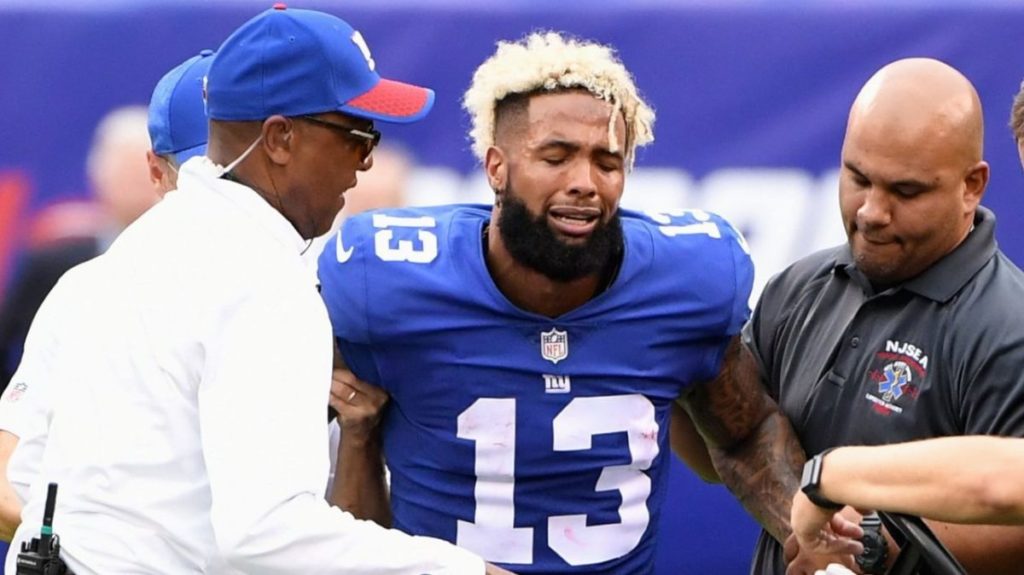
I think at this point we are all well aware of how unwanted a high ankle sprain diagnosis is for our fantasy football superstars. No injuries are good injuries when you are competing for fantasy football championships, but high ankle sprains have been a death sentence in recent years.
Why? Well to understand why it derailed the fantasy football seasons of Michael Thomas, Raheem Mostert, and Christian McCaffrey in 2020, we need to better understand high ankle sprains.
What Are They?
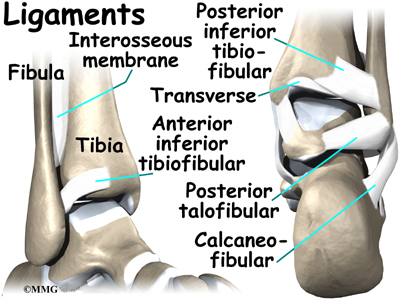
The ankle joint or the talocrural joint consists of three main bones: the tibia, the fibula, and the talus. The tibia and fibula are the two bones that make up the lower leg. At the ankle joint, these bones come together to form a socket that the talus bone of our foot sits snugly in.
What holds this socket together are several ligaments most commonly grouped as the tibiofibular or syndesmotic ligaments. Specifically, the ligaments we are most concerned with are the AITFL, PITFL, and the interosseous membrane which are shown below. These are the ligaments that are most commonly injured or damaged with a high ankle sprain.
These ligaments are different from the ligaments that are injured in the much more common lower ankle sprain which is traditionally associated with “rolling” one’s ankle. These lower ankle ligaments, although painful when injured, are much less severe and athletes miss little to no time depending on the severity.
How Do High Ankle Sprains Occur?
High ankle sprains typically occur with excessive external rotation of the foot which causes the tibia and fibula to separate which injures the syndesmotic ligaments. Think of your foot being planted while your body twists inward.
This can occur when an athlete is cutting or pivoting with internal rotation while their foot stays planted, but they typically occur due to an outside force or impact to the lateral/outside ankle while the foot is planted. See below for the reference of Michael Thomas’s high ankle sprain last season.
Normally these ligaments are extremely strong and stable which is why these injuries typically require high levels of force and normally aren’t very common in day-to-day life.

Recovery Time?
Recovery time depends on the severity of the high ankle sprain. The severity of all sprains is typically graded as grades 1-3
Grade 1: Mild. These injuries involve the stretching and disruption of the ligaments but typically don’t involve tearing. Severity can still vary depending on the “height of the zone of injury” which is basically how high up the syndesmotic ligament was injured. This is determined via a physical exam and ultrasound.
Recovery Time: Six weeks but this varies based on the severity
Grade 2: Moderate. These injuries involve the partial tearing of the syndesmotic ligaments. The more severe grade 2 tears may require surgery.
Recovery Time: 6-12 weeks
Grade 3: Severe. These injuries involve a complete tear to one or multiple of the syndesmotic ligaments. Normally these injuries require surgery where a screw is placed to hold the tibia and fibula together so the ligaments can heal properly.
Recovery Time: 14 weeks
Why Are High Ankle Sprains Difficult so Difficult to Recover From?
High ankle sprains are difficult to recover because when there is damage or pain through the syndesmotic ligaments, activities as light as walking can cause the tibia and fibula to spread causing sharp pain.
As the athlete recovers, activities like standing, walking and other low force-generating movements cause minimal force through the joint and therefore minimal pain. However, as force is increased, more stress is put onto the ligament therefore more pain is experienced and the athlete isn’t able to generate as much power/force/speed.
This is why oftentimes we will see an athlete return relatively quickly from a high ankle sprain just to watch them play like a shell of themselves. High ankle sprains limit an athlete’s power and explosion because as the athlete generates more force, it’s directly correlated to more force being placed on the syndesmotic ligaments.
How High Ankle Sprains Have Affected Our Fantasy Football Superstars?
2020
Michael Thomas
- Injured: Week 1
- Total Games Missed: Eight Games (nine weeks)
- Returned From Injury: Week 9, played Weeks 9-15, missed remaining two games due to his ankle
- Fantasy Finish: WR98
- Fantasy Finish Previous Season: WR1
- Next 5 Games Fantasy PPG Post Injury: 9.7
- Previous 10 games Fantasy Points per Game Before Injury: 19.2
- Difference: -9.5 FPG
Christian McCaffrey
- Injured: Week 2
- Total Games Missed: Six games
- Returned From Injury: Week 9, injured his shoulder and missed the rest of the year
- Fantasy Finish: RB53
- Fantasy Finish Previous Season: RB1
- Next Five Games Fantasy PPG Post Injury: 32.1 FP *1 game sample size
- Previous 10 games Fantasy Points per Game Before Injury: 25.1
- Difference: +7.0 FPG
Raheem Mostert
- Injured: Week 6
- Total Games Missed: Six games total (seven weeks)
- Returned From Injury: Week 12, played Weeks 12-15, missed the remaining two games to his ankle
- Fantasy Finish: RB48
- Fantasy Football Finish Previous Season: RB24
- Next Five Games Fantasy PPG Post Injury: 7.2 FP *4 games
- Previous 10 games Fantasy Points per Game Before Injury: 14.95
- Difference: -7.8 FPG
2019
- Injured: Week 6
- Total Missed Games: Two games (three weeks)
- Returned From Injury: Week 10
- Fantasy Finish: RB12
- Fantasy Finish Previous Season RB4
- Previous 10 games Fantasy Points per Game Before Injury: 16.3
- Next Five Games Fantasy PPG Post Injury: 11.6 FP
- Difference: -4.7 FPG
- Injured: Week 3
- Total Missed Games: Three games (three weeks)
- Returned From Injury: Week 7
- Fantasy Finish: RB10
- Fantasy Finish Previous Season RB2
- Next Five Games Fantasy PPG Post Injury: 12.98 FP
- Previous 10 games Fantasy Points per Game Before Injury: 20.3
- Difference: -7.3 FPG
2017
- Injured: Preseason
- Total Missed Games: One game (four weeks)
- Returned From Injury: Week 2, played Weeks 2-5, Week 5 suffered an ankle fracture on the same ankle
- Fantasy Finish: WR83
- Fantasy Finish Previous Season: WR4
- Next Five Games Fantasy PPG Post Injury: 15.4 FP *4 games
- Previous 10 games Fantasy Points per Game Before Injury: 15.5
- Difference: -0.1 FPG
2013
- Injured: Preseason
- Total Missed Games: Three games (four weeks)
- Returned From Injury: Played Weeks 1-5, missed Weeks 7-9 as he was unable to return to form
- Fantasy Finish: WR44 (PPR)
- Fantasy Finish Previous Season: WR9
- Next Five Games Fantasy PPG Post Injury: 5.4 FP
- Previous 10 games Fantasy Points per Game Before Injury: 15.3
- Difference: -9.9 FPG
What Does the Data Tell Us?
On average, NFL running backs and wide receivers missed 5.7 games following a high ankle sprain. This does not include the extra weeks that many missed in the preseason and over bye weeks. If we remove Odell Beckham (since we can’t assume his fractured ankle was a result of his high ankle sprain) it still results in players missing 4.7 games on average.
This makes sense as most injuries need recovery time to heal. These players range in age, position, and severity of injury so we can expect some variance in how quickly they return to play.
However, why high ankle sprains result in the fantasy football death sentence is not the time off as these players won’t be in our fantasy lineups, it’s what comes after the athlete returns to the field. It’s a death sentence because these injuries result in a significant drop in production once each player returns.
When we compare an athlete’s fantasy points in .5 point PPR in his next five games following the return from a high ankle sprain to his previous 10 games before his ankle injury, on average, the athlete is averaging almost six fewer fantasy points per game.*
*Removing Christian McCaffrey due to one-game sample size
So not only is your fantasy player going to miss an average of almost six games, but most players also have a significant drop in production for the next five games if not longer in some situations. This resulted in a drop of over 43 positional spots in end-of-season rankings compared to these players’ previous seasons.
Which makes sense, because as we have talked about above, these athletes are some of the best in the world at generating force. More force equals more stress on the ankle and more specifically the ligaments of the ankle. If the ligaments haven’t properly healed this increased force/stress is going to result in increased pain which zaps these players of their speed, power, and quickness “Space Jam” style.
The Long Term Outlook
The good news is that these injuries do not have significant long-term outcomes as each player returned to form the following season.
Season’s PPG (.5 PPR) Following Their High Ankle Sprain
Roddy White: 15.2 PPG – WR10 in PPG
Odell Beckham: 16 PPG – WR6 in PPG
Alvin Kamara: 22.4 – RB1 in PPG
Saquon Barkley: Tore his ACL
Conclusion
It’s a small sample size of elite fantasy running backs and wide receivers that have suffered high ankle sprains but recent data support the notion that these injuries are a fantasy football player death sentence. Although all players have different levels of injury severity and heal at different speeds, high ankle sprains still lead to increased time off and decreased fantasy production upon return.
If your player suffers from a high ankle sprain, at this point, the data tells us to sell because seldomly will this player will return to the form in which you have drafted them that season.
-Zach Pavlichek, PT, DPT, @ZachPav42
References:
- Molinari A, Stolley M, Amendola A. High ankle sprains (syndesmotic) in athletes: diagnostic challenges and review of the literature. Iowa Orthop J. 2009;29:130-138.
- D’Hooghe P, Grassi A, Alkhelaifi K, Calder J, Baltes TPA, Zaffagnini S, Ekstrand J. Return to play after surgery for isolated unstable syndesmotic ankle injuries (West Point grade IIB and III) in 110 male professional football players: a retrospective cohort study. Br J Sports Med. 2020 Oct;54(19):1168-1173. doi: 10.1136/bjsports-2018-100298. Epub 2019 Aug 31. PMID: 31473593; PMCID: PMC7513252.

