
After years of proven success with my WR1 Analytical Model outperforming NFL Draft Capital at predicting future fantasy success of rookie wide receiver prospects, I unveiled the RB1 Analytical Model last year. Similar to my long-running WR1 model, which you can find here, this RB1 model was developed using a recipe of the most predictive advanced college statistics that prior NFL fantasy superstars exhibited.
The goal of these analytical models is to outperform draft capital, as it should. After all, fantasy managers are trying to accumulate the most fantasy points. NFL teams are trying to win football games. For example, in 2024, Bucky Irving and Tyrone Tracy were drafted 6th and 12th in the NFL draft among running backs. The model ranked them 4th and 6th, respectively.
You can find last year’s 2025 RB1 post-draft published model here. Our model was largely in line with draft capital, with 7 of the first 8 players selected in the NFL draft also in the model’s top 7. A big outlier came a little later. Our model ranked Jacory Croskey-Merritt 11th overall, despite the NFL drafting him 26th among all running backs.
Now on to the 2026 class.
Fam, I have bad news. This 2026 running back draft class isn’t good. It isn’t bad. No. It is downright atrocious. In these model series, I can typically find 15 “draftable” running backs and wide receivers with ease. Last year, 26 running backs were drafted. This year, even with a terrible overall 2026 class, I don’t have 15 running backs with a “draft-worthy” grade.
That said, bear in mind that in this first group of 5 running backs on this countdown, some may not be drafted.
After that, DFF Members can visit the rest of the rankings beginning with RB’s ranked 10 to 6 here.
Honorable Mention
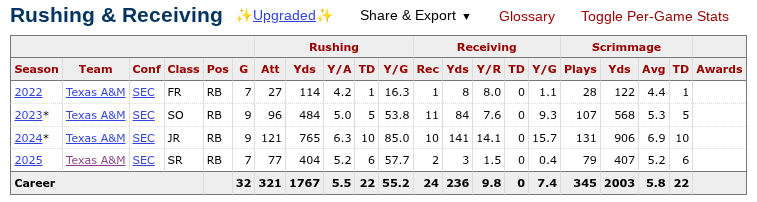
Le’Veon Moss, Texas A&M | RB1 Model Score: -33
Based on historical comps, Le’Veon Moss’ RB1 Model score of -33 gives him a 2.2% chance of having at least one top-24 fantasy season in his career.
Historical Players With Similar RB1 Model Scores:
The Good
Iron sharpens iron. If you want to be the best, compete against the best. SEC running backs deal with this game in and game out. This reasoning is why SEC running backs earn extra points than others in our RB1 model.
The Bad
Missed tackles forced per attempt is one of the more important predictive metrics feeding the RB1 model. That is where the 26 class really falls short. Last year, 27 running backs had a career MTF/A above 20%. This year, only 9 do. Moss misses this threshold, albeit not as badly as several others in the class.
NFL.com, film guru Lance Zierlein gave Moss a 6.14 film grade. Zierlein writes Early-down runner with adequate size, good finishing strength and consecutive seasons of injury concerns. There won’t be anything flashy on tape, but Moss consistently adds yards after collison. He has adequate burst to race to the second level and keeps runs alive with solid contact balance, but he lacks the elusiveness and top-end speed associated with more dangerous backs.”
The Ugly
While running backs are most valued IRL for their rushing acumen, in fantasy, their path to consistency is largely reliant on their receiving. The most consistent perennial top fantasy performers are the Christian McCaffrey, Alvin Kamara, and Devon Achane archetypes. Moss doesn’t give you much in the pass game. He averaged only 15.5 receiving yards per game in his best season of college.
15. Demond Claiborne, Wake Forest | RB1 Model Score: -22
Based on historical comps, Demond Claiborne’s RB1 Model score of -22 gives him a 8.0% chance of having at least one top-24 fantasy season in his career.
Historical Players With Similar RB1 Model Scores:

The Good
Nothing on Claiborne’s analytical profile is eye-popping. He screams JAG (Just Another Guy). Yet he also doesn’t have anything startlingly bad. So, in a bad overall class, what is good about Claiborne is that he doesn’t have any absolutely terrible analytics. He is middle-of-the-road in most things. He seems like a perfect practice squad player who can be elevated for a game when the top two running backs are out.
The Bad
Claiborne is a smaller back. He is listed at 195 pounds. The NFL likes the running backs in the 215 range. Though lighter backs have become more acceptable thanks to Christian McCaffrey and De’Von Achane, it is still a ding on his overall profile.
Claiborne earned a film grade of 6.00 fro Lance Zierlein, Zierlein writes, “Claiborne is a twitched-up, elusive slasher who can turn minimal gains into explosive runs. He’s creative in tight quarters, using lateral agility and sudden feet to escape trouble. While willing to run between the tackles, his lack of size and strength limits his effectiveness in that area. His unpredictable nature — sometimes pulling runs off-track when profit is available — might frustrate coaches, but it also generates unexpected chunk plays.”
14. Roman Hemby, Indiana | RB1 Model Score: -20
Based on historical comps, Roman Hemby’s RB1 Model score of -20 gives him a 8.0% chance of having at least one top-24 fantasy season in his career.
Historical Players With Similar RB1 Model Scores:

The Good
Roman Hemby was the leading rusher on the National Champion Indiana Hoosiers. After spending 4 years with Maryland, Hemby proved to be an integral cog in the Indiana championship machine. We know from earlier in this article that receiving ability is key to sustained fantasy success. Hemby has that ability. His 26.8 receiving yards per game in his best season ranked fourth among all running backs in this class who we expect to be drafted. His career yards per route run of 1.14 ranked fifth overall. His 3.3 receptions per game ranked third. These receiving categories contributed 27 combined points to his overall RB1 model score.
The Ugly
Wait…if Hemby received 27 points in these receiving categories, how did he end up with a total RB1 model score of -3, you ask? Uhhh. Unfortunately, as a running back, the NFL considers it fairly important to be able to run the ball effectively. Well, unlike Claiborne before him, who was mediocre in just about everything, Hemby excels in the receiving game, but he is pretty dreadful as a rusher.
Hemby’s career missed tackles forced per attempt rate of 16.0% ranked last among the running backs expected to be drafted. This is a key predictive metric. The top six in just this single metric over the last 3 years are Trey Benson, Bijan Robinson, Tyrone Tracy, Ashton Jeanty, and Bucky Irving, each well over 30%. Hemby also misses our thresholds for top running backs of yards after contact 3.2 (Threshold 3.5), Breakaway run % 6.0 (Threshold 8.5%), and career yards per carry 4.9 (Threshold 5.5).
Perhaps Hemby’s polar-opposite performances in receiving and rushing are better for his overall outlook on securing a role, and he can profile as a 3rd-down back. For that to happen, he would need to improve his pass protection, as he received just a 37.6 PFF pass blocking grade.
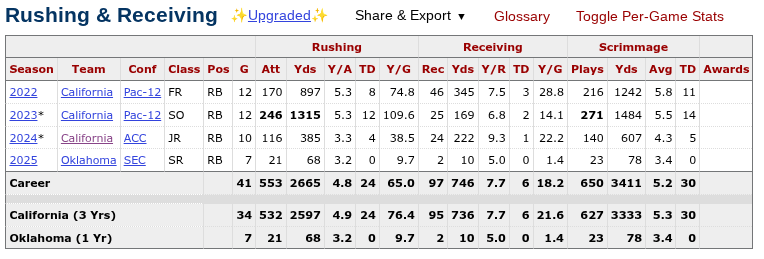
13. Jaydn Ott, Oklahoma | RB1 Model Score: -12
Based on historical comps, Jaydn Ott’s RB1 Model score of -12 gives him a 8.0% chance of having at least one top-24 fantasy season in his career.
Historical Players With Similar RB1 Model Scores:
- Dwayne McBride
- Sincere McCormick
The Good
Ott has some of the best age-adjusted production in this entire class. After his scintillating sophomore year at California, Jadyn Ott was on a path to be a first-round Dynasty Rookie draft pick. Then he suffered a steady stream of injuries. In 2024, it was his ankle and knee limiting him to 10 injury-marred games. In 2025, Ott opted for a fresh start and a change of scenery in Oklahoma. Then, in training camp, he suffered a shoulder injury, causing him to fall out of the running back rotation.
He showcased his receiving prowess in both his freshman and sophomore seasons. He ranks first in the class in college career yards per route run, second in receptions per game, and third in receiving yards per game.
The Bad
Despite Ott’s tremendous early production, he still ranked only 14th of the 15 running backs in these rankings in career yards per carry. This failed to earn him any points towards his overall RB1 model score.
The Ugly
Ott’s college career progressed in reverse of the traditional curve. While injuries were a major contributor, Ott still should have been able to break into the Oklahoma running back rotation his Senior year. Alas, he did not, and he posted just 1.4 fantasy points per game, which cost him 10 points on his overall RB1 model score. Ott’s final season PFF rush grade of 62.1 was the worst overall in the class, resulting in another 10-point loss to his overall model score. Finally, he ranked last among the top 15 overall running backs in the model in career yards after contact.
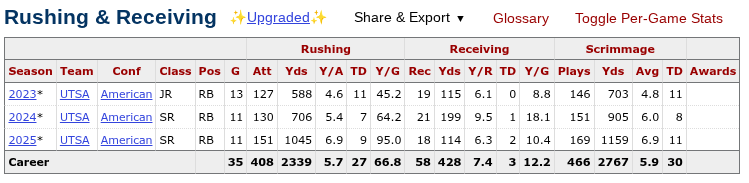
12. Robert Henry Jr., UTSA | RB1 Model Score: -6
Based on historical comps, Robert Henry Jr.’s RB1 Model score of -6 gives him a 11.1% chance of having at least one top-24 fantasy season in his career.
Historical Players With Similar RB1 Model Scores:
- Dylan Laube
- Kaleel Mullings
The Good
Henry is one of the more explosive backs in this class, as evidenced by his 10.5% breakaway run (15+ yards) rate. This result earned him 7 points to his overall RB1 model score. Henry was also one of the 9 running backs in this class to break the 20% missed tackles forced per attempt threshold. Anything under that is a non-starter for me to consider the player for Dynasty Rookie Drafts. It is not great. Just a solid number that does not disqualify him.
The Bad
He doesn’t offer a lot in the receiving game. His best season yielded only 10.4 receiving yards per game. This subtracted 5 points from his overall RB1 model score. Additionally, Henry Jr. was not an early-declare. The best prospects are those the NFL deems talented enough to leave college early.
The Ugly
The UTSA Roadrunners compete in the American Athletic Conference. When you are competing at a lower level, it is easier to achieve better results in the advanced metrics the RB1 model measures. For that reason, Henry earns 8 points less in this category than a running back who competes against the best prospects in college football, such as those in the SEC.
Henry also got roasted in his film score from Lance Zierlein with a 5.67. Zierlein writes, “Fifth-year senior whose splashy early season performance against Texas A&M put him on the map. Henry is a slasher with a wiggly lower half, allowing him to make sudden cuts and elude tacklers in tight quarters. He’s quicker than fast and struggles to consistently read/react to the development of run lanes. While his burst can create occasional chunk gains, he too often does not keep runs on their designed tracks. He’s yet to show he can be a major factor on third downs and fumbled six times in the last three seasons, which could be impediments in his pursuit of a roster spot.”
11. Terion Stewart, Clemson | RB1 Model Score: 8
Based on historical comps, Terion Stewart RB1 Model score of 8 gives him a 18.8% chance of having at least one top-24 fantasy season in his career.
Historical Players With Similar RB1 Model Scores:
LeQuint Allen
Ollie Gordon
Kimani Vidal
The Good
Last year, I ranked Jacorey Croskey-Merritt in this same 11th position despite the NFL ranking him far lower as the 26th running back selected in the NFL draft. Croskey-Merritt finished with the 4th most rushing yards as a rookie. A huge win for the RB1 model vs the NFL valuation on JCM.
Stewart is my pick for this year’s JCM. The running back with the best chance of emerging from the late round/UDFA shadows to become NFL relevant.
Let’s begin with his missed tackles forced per attempt. This is one of the most important singular metrics to predict future NFL success. When I saw Stewart’s result, I did a double take and checked my math 3 times to make sure what I was seeing was correct. It’s that extraordinary.. Over the last 5 years the running backs with the highest missed tackles forced per attempt rate are:
- Bijan Robinson 39.3%
- Trey Benson 39.2%
- Tyrone Tracy 38.5%
- Ashton Jeanty 37.8%
- Bucky Irving 36.2%
In this years class 2 players have over a 30% rate: Jeremiah Love and Jonah Coleman. These are also the 2 expected top running backs to be drafted. 27 running backs were drafted last year. Only 10 running backs in this class even have a MTF/A over 20%. Ok enough backstory are you ready for Terion Stewart’s result?
46.9%!
That is absolute insanity. The man can not be tackled by mere mortals. The NFL is sleeping on this man if he goes undrafted. Well I am not and for this metric he had 23 points added to his overall RB1 score.
Stewart also ranked 2nd in the class in breakaway run rate, 1st in yards after contact and 3rd in yards per carry.
The Bad
Stewart is a nothing burger in the pass game. That will not be his role for sure. He is at or near the bottom in any receiving related metric.
The Ugly
It’s the draft capital. That’s it. Unfortunately, players who go undrafted or selected in the 7th don’t even get the opportunity most times to showcase their talents. This deducts 15 points from Stewart’s overall RB1 model score.
I hope you enjoyed reading my article. All of my articles share one goal: to provide you, our member, with actionable advice that can improve your Dynasty team. You can follow me on Twitter @force_fantasy. #DFFArmy #FantasyFootball #AlwaysBeBuilding #NFL #NFLDraft #NFLTransactions #NFLTrades #AlwaysBeScouting
Click here for a 12-month DFF Membership for just $1.67 per month. This gets you year-long access to hundreds of Dynasty articles, access to our Discord for personalized team advice from our experts, and our gigantic Dynasty Rookie draft guide covering 60+ prospects.
