
This will be a two-part article that will cover players that had half a good season in 2019. In part one, I’ll talk about players who excelled in the first half of the season but not the second half. In part two, I’ll do the reverse. I’ll also avoid discussing players I touched on in my busts and values article, so these will be all new players for me. Let’s jump right in.
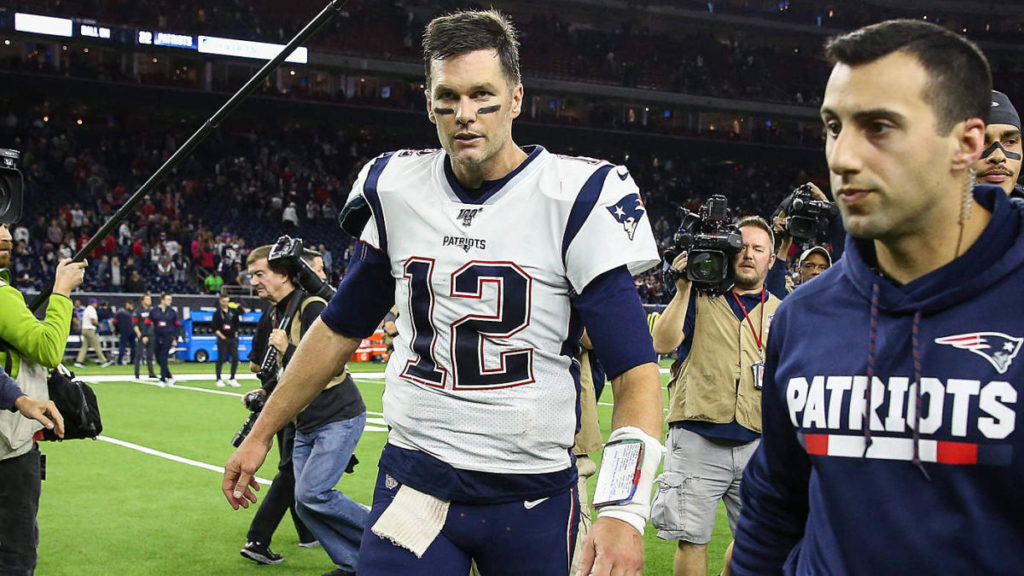
Tom Brady (QB – NE):
In Brady’s first eight games, he averaged 19.29 fantasy points per game, good for 10th best among quarterbacks in that period. However, in Brady’s second eight games, he was the QB25 in points per game among those who played five or more games during that time. He managed just 14.67 points per game, behind the likes of Kyle Allen and Mitch Trubisky. Brady looked worse down the stretch, and the Patriots seemed unable to run a cogent offense in the second half of the season.
Some might say that a lack of receiving weapons could have been to blame for Brady’s struggles, with Josh Gordon’s release and Julian Edelman’s injury troubles being the main problems that plagued the second half of Brady’s season. The Patriots also traded a second-round pick for Mohamed Sanu, who recorded just 207 total yards in eight games for the Patriots. Additionally, running back Sony Michel was utterly ineffective, averaging only 3.7 yards per carry in 2019. The lack of a competent ground game exposed the Patriots’ offense in the second half, allowing defenses to key in on Edelman and somewhat slow down the passing game.
Looking forward to 2020, there are significant rumblings that Brady will not play in a Patriots’ uniform. Brady was reportedly very unhappy with his lack of receiving weapons, especially the fact that the Patriots did nothing to replace Rob Gronkowski and failed to acquire and maintain a solid veteran wide receiver outside of Edelman. With Brady turning 43 in August, I think that age is finally catching up to him. I would avoid him in all 1QB redraft formats in 2020.
D.J. Chark (WR – JAX):
In Chark’s first eight games, he averaged 15.4 points in half PPR scoring, sixth among wide receivers during that period. However, during his final eight games, he averaged just 9.4 points per game, while missing a game due to injury struggles. That mark was outside the top 40 receivers during that timespan. In games 1-8, he received 61 targets, turning those into 39 receptions for 660 yards and six touchdowns. Interestingly, he averaged more targets over his final seven games, with 57 targets during that timespan. However, Chark only managed 34 receptions for a paltry 348 yards and just two receiving touchdowns on those targets.
The real question is: why did Chark’s production change so much from the first to the second half of the 2019 season? Three of those final seven games were started by Nick Foles, as opposed to Gardner Minshew. However, Chark’s best game of the last seven came in week 11, where he received 15 targets from Foles, converting those into eight catches for 104 yards and two touchdowns. To me, it doesn’t seem like the quarterback situation was responsible for Chark’s late-season slide. Additionally, as Chark’s target pace was very similar in both halves, his role in the offense mostly stayed the same.
The most likely explanation is that opposing defenses finally keyed in on Chark as the alpha receiver in Jacksonville’s offense. Considering Chark totaled just 174 yards in all of his 2018 rookie year, defenses in the first half of the season likely overlooked him. Once it was crystal clear that Chark was the focal point of the Jaguars’ passing game, defenses could no longer ignore him, and he was not able to overcome the added attention from opposing defense.
Given that information, Chark’s status as a fantasy asset in 2020 is very much in question. First, I think it is unquestioned that Chark is the top receiving weapon currently on the Jaguars. Even though Dede Westbrook and Chris Conley received 101 and 90 targets, respectively, neither player even came close to Chark’s production. However, I do believe that Chark is not a real alpha wide receiver in the league, and his inability to truly dominate as the number one receiver in an offense was exposed down the stretch.
While the free-agent wide receiver market is expected to be thin, with just A.J. Green likely available as a high-end starter, I do think the Jaguars will acquire a wide receiver in the first round of the 2020 NFL Draft. Many mock drafts seem to have the Jaguars selecting either Ceedee Lamb or Jerry Jeudy with their ninth overall selection. I think that would be a wise decision. Even though I’m not a devy or college analyst myself, both Lamb and Jeudy are extremely high-profile and hyped wide receiver prospects who could immediately challenge Chark for targets. On the other hand, perhaps another receiving weapon could open up better coverage for Chark, as he excelled under those conditions in the first half of the season. No matter what happens, Chark will be a risky pick in 2020 drafts.
Austin Hooper (TE – ATL):
In Hooper’s first eight games, he averaged 14.6 half PPR points and was the top tight end. He averaged a full point per game more than the next closest players in Hunter Henry and Darren Waller and almost three points per game more than Travis Kelce. However, Hooper collapsed in the second half, suffering an MCL injury and missing three games. Even in the five games Hooper played, he averaged just 7.4 points per game, just 14th among tight ends who played at least five games during this span.
The main question is: was Hooper recovering from his injury, or did defenses figure out a way to shut him down after his strong first half? The main argument in favor of an injury-related decline is that Hooper performed better in weeks 16 and 17 when he could have been fully healed from the injury that kept him out weeks 11-13. However, Hooper also could have benefited from an injury to receiver Calvin Ridley, who missed weeks 15-17, opening up more targets for Hooper.
Even though Hooper could have been recovering from injury, he was still far less effective than during his first eight games. In his four games after returning, he caught just 19 of 30 targets for 179 yards and no touchdowns. This compares to 52 receptions on 62 targets for 591 yards and five touchdowns during games 1-8. He averaged just 5.97 yards per target, as compared to 9.53 yards per target in the first eight games. Therefore, it is likely that the injury was not the sole explanation for Hooper’s decline in production.
The most interesting fact about Hooper going forward is that he is a pending unrestricted free agent going into 2020. Typically, most teams would make every effort possible to retain a talent like Hooper. However, the Falcons are already in significant salary cap trouble, having just $6.7 million in cap space going into 2020. Considering that Hooper will likely cost at least $10 million per season, there is a possibility that the Falcons will be forced to let Hooper walk in free agency.
It is unlikely that any situation will be better than Hooper’s spot with the Falcons, as he has a solid quarterback in Matt Ryan and is coming off back-to-back seasons with 70 or more receptions. If Hooper moves to a new team, I would consider him a high-risk in redraft leagues in 2020. Receiving options moving to new places often struggle in year one. On the flip side, if Hooper is retained on a big-money deal, I would consider Hooper a top option in redraft formats. A massive extension would demonstrate the Falcons’ commitment to Hooper. It would also suggest that his role throughout the first half of the season is what we can expect going forward.
Thanks for reading this article. You can find me on Twitter at @DFF_Justin. I’d love to interact with anyone in the community, so reach out anytime! I’ve been taking fantasy questions lately and trying to help out with all formats, so keep sending those questions my way.

