

Travis Etienne Injury Update
News broke late Monday night that Jacksonville Jaguars rookie running back Travis Etienne sustained a foot injury and was seen leaving the stadium in a walking boot. Adam Schefter later reported that Etienne suffered a midfoot sprain that would require further testing.
It wasn’t good news but we have seen players suffer midfoot sprains and return to play at a very high level. Most notably Calvin Ridley and Chris Carson last season only missing one game and four games respectively. However, we also saw Joe Mixon sustain a more severe injury which sidelined him from Week 6 on.
We needed to see the severity of the injury before we could properly assess Travis Etienne’s fate. Fantasy owners didn’t have to wait long as Tuesday afternoon, it was reported that Etienne had a grade 3 midfoot sprain and would be undergoing season-ending surgery. He was placed on the IR shortly after, confirming this report.
Midfoot Sprains
To better understand Etienne’s prognosis this year and into the future, we need to first better understand what a midfoot sprain is.
In the most basic definitions, a midfoot sprain is an injury to the bones and the ligaments that make up the arch of your foot. The most commonly injured ligament is the Lisfranc ligament (red line in the image below) which was what Etienne ended up injuring.
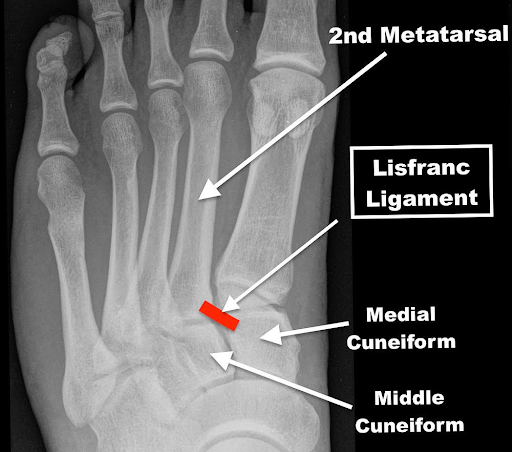
These ligaments and bones, although small individually, together create a very powerful area in your body that is responsible for absorbing a significant amount of force as with running, jumping, and landing. It’s why these injuries are so difficult to return from as many of the Joe Mixon owners felt last season.
Like all ligaments, the Lisfranc ligament can be injured in different grades and can have varying degrees of fractures or displacements. Displacements meaning whether or not the metatarsal was separated from the tarsus. The metatarsal being the long slender bones in the image above and the tarsus being the collection of smaller bones at the bottom of the image.
Grade 1: stretching/micro-tearing, non-displaced injury
Grade 2: Partially torn, minimally displaced
Grade 3: Complete tear, large displacement, managed surgically
Each grade also has an associated recovery time or return to play.
Grade 1: ~4 weeks (0-15 wks)
Grade 2: ~9.1 weeks (4-14 wks)
Grade 3: ~11.6+ weeks (However, this depends on the selected surgery. Some surgeries, return to play may be upwards of 36+ weeks)
We can safely assume that Etienne has a grade 3 Lisfranc tear with likely significant dislocation which is the worst possible outcome.
Redraft Outlook
Etienne will miss the 2021 season after being placed on the IR but it does make some of his teammates’ roles expand as a result of his absence.
James Robinson: Undrafted RB James Robinson has the most to gain following this injury. Robinson was on a high percentage of championship rosters last year due to his RB 7 finish in 14 games and a nearly free price tag. He doesn’t necessarily wow you with his tape but he does everything well and takes what’s blocked for him.
Robinson had 240 carries for 1,070 yards along with 49 receptions for 344 and 10 total touchdowns last season. He was amazing, but he also received 85%+ of the running back touches last season as he was basically the only running back on the roster.
This off-season, Urban Meyer drafted Travis Etienne in the first round and signed veteran Carlos Hyde whom he coached at Ohio St. demonstrating that Meyer at the very least didn’t believe in Robinson as a true workhorse running back. So I don’t see Carlos Hyde going away but I believe in the efficiency of James Robinson and see him controlling at least 60% of this backfield.
Right now, James Robinson is my RB 20 but I wouldn’t argue with anyone taking him over the likes of Josh Jacobs.
The second beneficiary of this injury is the second-year wide receiver Laviska Shenault Jr. Etienne figured to steal some of the underneath receiving work from Shenault but now I see him completely controlling this role on the team along with a rushing floor of 30-40 touches next season.
Right now, Shenault Jr. is my WR 42 with obviously high upside as the WR 1 in the Jaguars offense is currently up for grabs.
Dynasty/Long Term Outlook for Etienne
Right now, the research isn’t promising for the return of Travis Etienne to his previous form. One study looked at 47 professional football players and elite rugby players and concluded that athletes who returned following a Lisfranc surgery showed a significant decline in performance by 21% in the following season compared to their previous season before the injury.
The study then doubled down reporting that performance further decreased in NFL players who played offense compared to those who played defense.
A separate meta-analysis, which is at the top of the research pyramid as it looks at pools of research across many different studies, such as the study above, looked at the different surgical approaches to determine average return-to-play times and return rates to pre-injury level.
Return rate to pre-injury level:
ORIF or Open Reduction Internal Fixation Surgery – 72%
Percutaneous Reduction and Fixation – 98%
All Operative – 77%
Non-Operative: 90%
As we know Etienne is having surgery but we will never know which surgical procedure his surgeon elects, it is likely safe to assume a 77% chance to return to pre-injury level.
It was also reported that of the NFL players, only 83% ever returned to play. However, I don’t see this as the situation for Travis Etienne given his young age and significant draft capital.
Conclusion
Overall, Travis Etienne is going to be a risky selection next season even with his high draft capital as he has not had a chance to establish himself in the NFL and statistically may not return to his previous form in year two.
As we know, running backs return maximum value while on their first contracts. With Etienne missing 25% of his first contract due to his injury this year and possibly returning unstable fantasy value next season, I would be looking to sell in dynasty leagues for the right price.
Remember, this situation, although similar, is not the same as Joe Mixon’s past Lisfranc injury. His injury, from what we have been told, was addressed non-operatively and therefore has a much different outcome in the long term.
Right now, I’d be shopping Ettiene for a 1st+. However, I will admit that I also was lower on him than most during the draft process and was not a fan of his landing spot.
-Zach Pavlichek, PT, DPT
Feel free to follow me on Twitter @Zachpav42 for the latest injury reactions and analysis.
References
- Gregory Aidan James Robertson, Kok Kiong Ang, Nicola Maffulli, Gary Keenan, Alexander MacDonald Wood, Return to sport following Lisfranc injuries: A systematic review and meta-analysis, Foot and Ankle Surgery, Volume 25, Issue 5,2019, Pages 654-664, ISSN 1268-7731, https://doi.org/10.1016/j.fas.2018.07.008. (https://www.sciencedirect.com/science/article/pii/S1268773118301425)
- Chen P, Ng N, Snowden G, Mackenzie SP, Nicholson JA, Amin AK. Percutaneous reduction and fixation of low energy Lisfranc injuries results in better outcome compared to open reduction and internal fixation: Results from a matched case-control study with minimum 12 months follow up. Injury. 2021 Apr;52(4):1042-1047. doi: 10.1016/j.injury.2020.10.081. Epub 2020 Oct 18. PMID: 33268080.
- Singh SK, George A, Kadakia AR, Hsu WK. Performance-Based Outcomes Following Lisfranc Injury Among Professional American Football and Rugby Athletes. Orthopedics. 2018 Jul 1;41(4):e479-e482. doi: 10.3928/01477447-20180424-03. Epub 2018 Apr 30. PMID: 29708569.

