

This article is a massive departure from my usual writing. In this piece, I’m going back to basics by detailing personnel groupings in football. NFL teams are allowed to have five eligible receivers on any given play, combined with a quarterback and five ineligible linemen. However, there are no guidelines for who those receivers are. Teams are allowed to field any combination of players, as long as they designate five specific players as eligible before the snap.
Additionally, the offense must line exactly seven players on the line of scrimmage before the snap. Since the five linemen are virtually always there, this rule means that two of the five eligible receivers must be on the line of scrimmage, and three must be behind the line. Let’s start with the basic mechanics of personnel numbering.
Personnel Numbering Basics
NFL teams represent personnel groupings with a two-number phrase. For example, you might have heard “11 personnel” mentioned in some of my articles. The first number refers to the number of running backs on the field, while the second number refers to the number of tight ends. Then, since there are five eligible receivers, if you subtract the sum of both numbers from five, you get the number of wide receivers. For example, an 11 personnel group denotes a one RB, one TE, and three WR formation, which is the standard base offense in today’s NFL. For dynasty owners, 11 and 12 personnel are the two main formations, and I’ll break down each in detail.
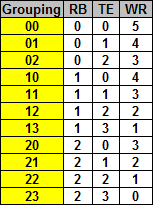
11 Base Personnel
As mentioned above, most NFL teams use three wide receivers as part of their base offense. While other formations can come up throughout a game in specific situations, the 11 formation is how most teams intend to run their offense most of the time. In an 11 formation, the three wide receivers play three different positions: the X, the Z or flanker position, and the Y or slot position.
The X receiver is usually the alpha receiver in an offense, lining up on the outside of the field. The X plays on the line of scrimmage and can thus face press coverage. These types of players are typically big-bodied wide receivers that can stand up to and beat physical coverage. Players like Julio Jones, A.J. Green, and Mike Evans are examples of X receivers. They dominate with their sheer physical size and can throw smaller cornerbacks aside, winning contested catches.
Z receivers are often the second receiver on the depth chart, but they sometimes can be the top player. Z receivers line up outside, off the line of scrimmage, giving them a free release. Depending on the team, the Z receiver can play a variety of roles and generally runs a varied route tree. Also, since the Z receiver plays off the line, they can go in motion, allowing them to move all over the formation before the snap. Tyreek Hill is the best modern Z receiver in the NFL, causing matchup nightmares for defenses with his pre-snap motions. Michael Gallup is a more pure Z receiver, playing across from Amari Cooper as the X receiver.
Finally, the Y or slot receiver plays inside the formation, off the line of scrimmage. They can play on the same side as either the X or Z receiver, but they usually play opposite the tight end in the base offense. This alignment gives the offense two receiving threats on each side. As the slot receiver plays inside the formation, they often see easier coverage matchups against a nickel cornerback or a linebacker. Therefore, slot receivers often run short, quick-breaking routes. Examples of pure slot receivers include Jamison Crowder and late-career Larry Fitzgerald.
There are a few distinct ways that dynasty owners can take advantage of this information. First, while I broke down the positions into X, Z, and Y, most NFL teams no longer limit their wide receivers to a single role. Many receivers can play all three roles well, especially top talents like Michael Thomas. The primary way to gain an advantage in dynasty is to examine the slot receiver because that’s where teams differ the most.
Some teams employ a slot specialist. These teams primarily play 11 personnel to highlight that player’s skills, as that particular player is often highly effective from the slot, but less so outside. In 2020, the Jets and Giants will likely employ such an approach. They have Jamison Crowder and Golden Tate on large contracts, both of whom only excel from the slot. Because of that, dynasty owners can count on high snap counts for their other receivers, due to the need to have three wide receivers on the field.
In other cases, the team has two clear starting wide receivers that can play the X or Z positions, but one of those players also excels from the slot. The Buccaneers’ 2019 offense was a great example of this type of offense, as Chris Godwin dominates both on the outside and from the slot. He played virtually all the snaps, but he would typically slide into the slot when they came out in 11 personnel.
In 2020, the Steelers should profile as this type of offense. Diontae Johnson and Juju Smith-Schuster are the team’s two top receivers and will play most of the snaps in all formations. However, Smith-Schuster is excellent in the slot, and he will move inside when they play 11 personnel. The Chargers with Keenan Allen are another example, as Allen plays well outside, but is even better from the slot. Many top dynasty receivers play well in the slot, allowing them to see softer coverage and dominate a variety of roles.
Last, some teams move all their receivers around the formation. They don’t have a particular receiver that is better in the slot, so they rotate who plays there. The Chiefs are a great example of this type of offense, as they played all their receivers a similar share of slot snaps. In these cases, it’s more important to look at the number of targets instead of the offensive alignment.
In 11 personnel, two more skill players complement the three receivers, a tight end, and a running back. The running back isn’t anything special, as most teams rotate their running backs relatively independently of their receivers. On teams that run 11 personnel, the tight end must play a dual role, as they are the only support to the lineman in the blocking game. Tight ends that can’t block struggle to get on the field in 11 personnel. Travis Kelce is the premier example of a tight end that’s excelled as a fantasy option in 11 personnel, as he can both block and play like a star receiver.
Going into 2020, I would look at Hayden Hurst as a potential breakout based on this principle. Hurst is an excellent blocker and should develop further as a receiving weapon. He will fit in perfectly in the Falcons’ 11 base personnel, and he shouldn’t have to come off the field for blocking purposes.
12 Base Personnel
From the numbering principle described above, 12 personnel consists of one running back, two tight ends, and two wide receivers. In today’s modern, pass-heavy NFL, teams had moved away from 12 personnel. However, recently, the formation is starting to make somewhat of a comeback. Unlike 11 personnel, teams generally have a reason to run 12 personnel since it’s not the norm. Most teams that run 12 personnel do so either because they have two every-down tight ends or because they’re a run-first offense.
The first group is far rarer, as there aren’t even 20 true every-down tight ends in the NFL. Therefore, teams that have two on a single roster are few and far between. In 2019, only the Eagles fell into this category, in my opinion. Tight ends Zach Ertz and Dallas Goedert represented the team’s two best healthy receiving weapons, forcing them to play 12 personnel to get their best players out there. I believe the Eagles will continue to play base 12 personnel in 2020, as Ertz remains a star, and Goedert continues to develop.
Outside of the Eagles, there are quite a few teams that plan to play 12 personnel in 2020, although most do so to improve their run game. Most teams that play a high percentage of 12 personnel have a clear starting tight end and either one or two backups. Depending on the team, that backup can be a receiver, blocker, or both.
Near the end of 2019, the Rams deployed 12 personnel, with Tyler Higbee as the star tight end and Gerald Everett and Johnny Mundt splitting snaps based on the situation. Everett played in receiving situations while Mundt was a blocker. The Ravens even started a blocking tight end, with blocker Nick Boyle playing as their primary tight end in terms of snap count. Mark Andrews came in on passing downs with Hayden Hurst playing on most rushing downs.
Generally, teams don’t throw enough to their tight ends to support two receiving options, even if both tight ends on the team have a history of fantasy success. That’s why I have no interest in players like David Njoku, O.J. Howard, or either Kyle Rudolph or Irv Smith Jr. Njoku and Howard are stuck behind Austin Hooper and Rob Gronkowski, respectively, while the Vikings’ tight ends are splitting receiving work. Even though these players might technically start and see a majority of snaps, they won’t find fantasy relevance.
Overall, 12 personnel has more of an impact on the rushing game than anything else. I have more confidence in rushing attacks on teams that play 12 personnel, which is why I’m so confident in the Browns’ and Vikings’ running backs for 2020. I also think 12 personnel could revitalize the Buccaneers and Rams’ rushing attacks, both of which struggled in 2019 under their old 11 personnel schemes.
Thanks for reading this article. You can find me on Twitter at @DFF_Karp. I love to interact with anyone in the community, so reach out at any time! I take fantasy questions and help with all formats, so keep sending those questions my way.

